To avoid these ads, REGISTER NOW!

Adding 240V and 120V Circuits at Meter Main Panel?

OP
H

highaltitude

Active member
Joined
Jul 22, 2013
Messages
30
You sure the 1-1/2" LB didn't say maybe #2/0 AWG?

Yeah, positive. AWG 2. Just double checked it. That's alright, I'm leaning more and more towards a lower capacity breaker feeding this sub-panel and going 6-3 instead of the big 2-2-2-4 AL. Therefore... no LB needed, except on the interior for the 6-3 cable.

Don't use 10/2 on 20a circuits. Its a waste and a PITA...

Ah, good point. I was thinking 10 was needed for 20a, but sure enough 12 is OK. I have a lot of leftover 12-2 Romex as well so that still works out nicely.

Now for hanging the panel, I want to go surface mounted simply for ease of install and access later. Garage isn't a show-piece anyways. The panel is 14" wide so I can only hit one stud at a time. My understanding is that I need to mount it up to a piece of plywood which then is mounted directly to the studs. I think I'll dive into that this afternoon and get started on some of the ground work here. I'll update with pics.
 
To avoid these ads, REGISTER NOW!
OP
H

highaltitude

Active member
Joined
Jul 22, 2013
Messages
30
Progress so far. Still waiting for the inspector to get back to me on his preferred method to get power into the garage from the existing panel.
 

Attachments

  • IMG_20170602_161631.jpg
    IMG_20170602_161631.jpg
    136.8 KB · Views: 65
OP
H

highaltitude

Active member
Joined
Jul 22, 2013
Messages
30
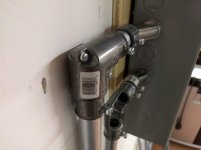
I spent some time considering conduit bender options. It just came down to cost, really. I needed a bender for likely more than a couple days due to my time constraints and slow progress. Rental prices were $12/day if I drove a ways away, per size. I couldn't find any to buy for less than about $75 for both 1/2" and 3/4". Craigslist wasnt really an option as I'm a not in the city so selection is extremely limited unless I want to spend $20 on gas to meet somewhere. The 90's look kinda neat, imo, and cost about $25 total, available at the local Home Depot and I don't have to worry about getting any bends just right in the conduit.

The offsets don't get the conduit flat against the wall, but that wasn't my plan. They just get it close. The vertical sections start about 1/2" off the drywall at the top and end flush with it at the bottom 90's. I could use a few different methods to fasten it down in those vertical sections if needed, but my hope was that they would be ok as is.

Sent from my Nexus 5X using Tapatalk
 

wyliesdiesels

Well-known member
Joined
Aug 14, 2012
Messages
20,021
Location
Modesto, CA
Yeah, positive. AWG 2. Just double checked it. That's alright, I'm leaning more and more towards a lower capacity breaker feeding this sub-panel and going 6-3 instead of the big 2-2-2-4 AL. Therefore... no LB needed, except on the interior for the 6-3 cable.


If you will be using 6-3 NM-b, it cant go outside so you will need to use 6-3 UF-b.

And it doesnt need to be in conduit.
 
Last edited:

EOC_Jason

Well-known member
Joined
Jun 25, 2012
Messages
11,388
Location
Bentonville, AR
You can buy just the head of a conduit bender cheaper (CL, eBay, etc..), then get a piece of black pipe to use for the arm. They can take a little practice getting the bend in the right place & angle, but once you get over that learning curve it goes quick.

Can you even pull cable thorough that tight of a 90?

I'm assuming the run going to the main panel will be coming out of the bottom?
 

LS6 Tommy

Well-known member
Joined
Dec 27, 2013
Messages
26,162
Location
Northern NJ
I spent some time considering conduit bender options. It just came down to cost, really. I needed a bender for likely more than a couple days due to my time constraints and slow progress. Rental prices were $12/day if I drove a ways away, per size. I couldn't find any to buy for less than about $75 for both 1/2" and 3/4".

A 1/2" & 3/4" dual hickey is about $30.00... :dunno:

Tommy
 
OP
H

highaltitude

Active member
Joined
Jul 22, 2013
Messages
30
Yeah, positive. AWG 2. Just double checked it. That's alright, I'm leaning more and more towards a lower capacity breaker feeding this sub-panel and going 6-3 instead of the big 2-2-2-4 AL. Therefore... no LB needed, except on the interior for the 6-3 cable.[/QUOTE]

If you will be using 6-3 NM-b, it cant go outside so you will need to use 6-3 UF-b.

And it doesnt need to be in conduit.

Hmm... So I guess I'm confused here. I plan on running the feeder cable through the exterior wall straight into the existing meter combo box. Is it considered "outside" if it never goes outside the box, except to go through the wall using one of the back knockouts of the panel?

Even then, it looks like UF-B needs some protection when mounted on walls. It would be going into my garage right at working height above my workbench with a bandsaw, grinder, drill press, etc...

You can buy just the head of a conduit bender cheaper (CL, eBay, etc..), then get a piece of black pipe to use for the arm. They can take a little practice getting the bend in the right place & angle, but once you get over that learning curve it goes quick.

Can you even pull cable thorough that tight of a 90?

I'm assuming the run going to the main panel will be coming out of the bottom?

Meh, I'm over the lack of conduit bends. The 90 elbows are made for pulling wire and worked well for the 10AWG in the 3/4". They do NOT work well with the Romex, so I'll be using thhn in most the 120V lines that have an elbow.

A 1/2" & 3/4" dual hickey is about $30.00... :dunno:

Tommy

Have a link for one for future reference? I was able to find a 3/4" EMT and a 1/2" rigid combo, but my understanding is that is not the same as 1/2" EMT.

Updated pic attached showing the clearence between the wall and elbows. The 3/4" elbow is touching the wall so that actually worked out perfect. The 1/2" elbow is a little off the wall, but not much. I don't expect that to be an issue.
 

Attachments

  • IMG_20170603_092628.jpg
    IMG_20170603_092628.jpg
    137.2 KB · Views: 32
OP
H

highaltitude

Active member
Joined
Jul 22, 2013
Messages
30
You left out a critical aspect to the cost analysis: you would then own a new TOOL.

;)

Haha, touche. That's a valid point. However... In about 10 years so far of working in my garages I've not once needed a conduit bender. I normally use the Wiremold metal raceway stuff and actually plan to do that in parts of this new wiring job. My use of EMT is pretty darn limited - until now, I suppose, haha.
 
OP
H

highaltitude

Active member
Joined
Jul 22, 2013
Messages
30
"The Romex"? Romex should never go inside EMT nor Condut.

Yeah, and now I certainly see why. I'm planning on running a circuit overhead, along the ceiling and back down the opposite wall. I thought Romex would be a good use in that application as the Romex would be "protected" by the conduit for the portions of the circuit below 8-10 feet or so. Above that on the walls and along the ceiling I was planning on just stapling it to the ceiling... unless that's no good. In which case I guess I'd just run THHN through conduit/EMT the whole way.
 

EOC_Jason

Well-known member
Joined
Jun 25, 2012
Messages
11,388
Location
Bentonville, AR
Hmm... So I guess I'm confused here. I plan on running the feeder cable through the exterior wall straight into the existing meter combo box. Is it considered "outside" if it never goes outside the box, except to go through the wall using one of the back knockouts of the panel?

No, that's fine and how it's usually done....
 

ard

Well-known member
Joined
Feb 16, 2015
Messages
4,391
Location
Sierra Foothills... California
Yeah, and now I certainly see why. I'm planning on running a circuit overhead, along the ceiling and back down the opposite wall. I thought Romex would be a good use in that application as the Romex would be "protected" by the conduit for the portions of the circuit below 8-10 feet or so. Above that on the walls and along the ceiling I was planning on just stapling it to the ceiling... unless that's no good. In which case I guess I'd just run THHN through conduit/EMT the whole way.

It's a code thing- no Romex in conduit, even if it fits. ;)

I don't understand this: " Above that on the walls and along the ceiling I was planning on just stapling it to the ceiling"

Romex needs to be IN the walls and IN the ceiling. Not 'on'.

EMT (or flex) the whole way if it will be exposed.
 
OP
H

highaltitude

Active member
Joined
Jul 22, 2013
Messages
30
No, that's fine and how it's usually done....

Ok, good deal. Now... Is there a "correct way" to protect 2-2-2-4 AL SER or 6-3 NM-B inside a garage without going through the walls? Ultimately this may just be up to my inspector, but of course your guys' opinions are just as, if not more, helpful. :)

It's a code thing- no Romex in conduit, even if it fits. ;)

I don't understand this: " Above that on the walls and along the ceiling I was planning on just stapling it to the ceiling"

Romex needs to be IN the walls and IN the ceiling. Not 'on'.

EMT (or flex) the whole way if it will be exposed.

So weird. I had no idea. I've done previous wiring jobs with Romex inside wiremold and never would have thought of any code violation. Guess I'm still not "in the know"!

I'll run that all in conduit (Wiremold, metal) and I'll be using THHN wires.

Thanks for the clarification all.

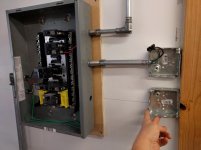
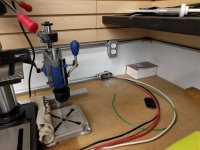
Now another question that I suspect may fall under some code issue: Can I put a 120V receptacle right next to another receptacle (240V)? See attached picture. I'd like to put them close to one another, but perhaps that violates a code somewhere. :dunno:

I'm also using a GFCI outlet on each 120V circuit as I understand that will satisfy code requirements for new outlets in a garage. I was pretty confident that was the right way to approach that, but who knows, haha.
 

Attachments

  • IMG_20170603_184524.jpg
    IMG_20170603_184524.jpg
    136.6 KB · Views: 21

LS6 Tommy

Well-known member
Joined
Dec 27, 2013
Messages
26,162
Location
Northern NJ
Have a link for one for future reference? I was able to find a 3/4" EMT and a 1/2" rigid combo, but my understanding is that is not the same as 1/2" EMT.

I'm sorry, you're correct. The hickey I was remembering is in fact for 1/2" & 3/4" rigid, 3/4" & 1" EMT. It took me a while to find a link. This is similar to the one I've used, but not the same exact thing. I also kind of used the wrong term. "Benders" are usually used for EMT and "Hickeys" are for rigid...

http://www.ebay.com/itm/Conduit-Hic...id-/262793321857?_trksid=p2141725.m3641.l6368

Tommy
 
Last edited:

EOC_Jason

Well-known member
Joined
Jun 25, 2012
Messages
11,388
Location
Bentonville, AR
Now another question that I suspect may fall under some code issue: Can I put a 120V receptacle right next to another receptacle (240V)? See attached picture. I'd like to put them close to one another, but perhaps that violates a code somewhere. :dunno:

I'm also using a GFCI outlet on each 120V circuit as I understand that will satisfy code requirements for new outlets in a garage. I was pretty confident that was the right way to approach that, but who knows, haha.

I found this bit online, apparently you can run NM in conduit when necessary (like in your case) to prevent damage...

National Electrical Code 2011
ARTICLE 334 Nonmetallic-Sheathed Cable: Types NM, NMC, and NMS
II. Installation

334.15 Exposed Work. In exposed work, except as provided in 300.11(A), cable shall be installed as specified in 334.15(A) through (C).

(B) Protection from Physical Damage. Cable shall be protected from physical damage where necessary by rigid metal conduit, intermediate metal conduit, electrical metallic tubing, Schedule 80 PVC conduit, Type RTRC marked with the suffix -XW, or other approved means. Where passing through a floor, the cable shall be enclosed in rigid metal conduit, intermediate metal conduit, electrical metallic tubing, Schedule 80 PVC conduit, Type RTRC marked with the suffix -XW, or other approved means extending at least 150 mm (6 in.) above the floor. [ROP 7-94] Type NMC cable installed in shallow chases or grooves in masonry, concrete, or adobe shall be protected in accordance with the requirements in 300.4(F) and covered with plaster, adobe, or similar finish.

EDIT - Well, there is more to it than that... Here's the whole thread with more code... Honestly, I would just ask your inspector or a licensed electrician what to do...

https://diy.stackexchange.com/questions/31149/can-romex-nm-b-be-run-through-conduit

Did you buy the wire already? Why not just get some THHN if you haven't? That would make the most sense to me...


120 next to a 240 like that should be fine. Just be conscience of what will go where... If it's going to be a big 240v plug you wouldn't want it draping over the little 120v ones, so I would put the 240v in the lower box.

Yes, your 120v circuits in the garage should have GFCI. You can either get breakers or receptacles that are the first one in the circuit.
 
Last edited:
To avoid these ads, REGISTER NOW!
OP
H

highaltitude

Active member
Joined
Jul 22, 2013
Messages
30
I found this bit online, apparently you can run NM in conduit when necessary (like in your case) to prevent damage...


EDIT - Well, there is more to it than that... Here's the whole thread with more code... Honestly, I would just ask your inspector or a licensed electrician what to do...

https://diy.stackexchange.com/questions/31149/can-romex-nm-b-be-run-through-conduit

Did you buy the wire already? Why not just get some THHN if you haven't? That would make the most sense to me...


120 next to a 240 like that should be fine. Just be conscience of what will go where... If it's going to be a big 240v plug you wouldn't want it draping over the little 120v ones, so I would put the 240v in the lower box.

Yes, your 120v circuits in the garage should have GFCI. You can either get breakers or receptacles that are the first one in the circuit.

Great detail. Thanks. I have pre-cut, non-returnable cable of 2-2-2-4 AL SER and 6-3 nmb. These were a part of my original, ill-informed plan. I think THHN is the cleaner way to go and should be a straightforward issue with the inspector. I originally steered to the nmb and ser because it seemed cleaner and safer, being that it's already got all the conductors and a clear ampacity rating. Hours of research later I realize that's not the case when you enter in the conduit/protection issues.

I will wait for inspectors call tomorrow and perhaps negotiate with home Depot to let me return the cable if I buy the 60 gal compressor I've been eyeing.

If I were to go with THHN wires for the service entry, is that typically in conduit within the wall as you transition from the exterior box to the internal surface mount emt?
 

Bert_

Well-known member
Joined
Dec 24, 2016
Messages
9,734
Location
NW Iowa
It's a code thing- no Romex in conduit, even if it fits. ;)

I don't understand this: " Above that on the walls and along the ceiling I was planning on just stapling it to the ceiling"

Romex needs to be IN the walls and IN the ceiling. Not 'on'.

EMT (or flex) the whole way if it will be exposed.

This is not what the code says.

Romex CAN be installed in conduit and this is often done if a small section of the wire needs to be protected. You do need to be concerned about cable fill

Romex CAN be run on the surface. The wording in the code just states it cannot be subject to damage. That is somewhat vague and different jurisdictions have varying interpretations, so it would be best to check what is acceptable in your area.
Most would agree it cannot be run unprotected at say 4' high on the walls since it could be easily damaged. But at 8' or 10' high on the ceiling it is pretty tough to argue that it is subject to damage, at least in a typical garage.
 

EOC_Jason

Well-known member
Joined
Jun 25, 2012
Messages
11,388
Location
Bentonville, AR
Yes the THHN would have to be completely in conduit.

Is your walls just sheetrock? Why not just cut a long strip where you will run the wire, drill the holes and run it through the studs, put some metal protector plates in so you don't try screwing into the stud where the wire will be, replace sheetrock (original pieces if you are careful / lucky), patch & paint?

Honestly, don't do anything else till you talk to the inspector... It's really up to him if you could run one of your existing cables you have in conduit. He's the final say in the matter... ;)

He might let you run the 2-2-2-4 in the conduit, and *worst* thing just want to de-rate it down to 75A. We are only talking about a 15' run, IIRC so I don't think it would be that big of a deal.... If you were trying to run like 50', that would be a different matter....
 
Last edited:
OP
H

highaltitude

Active member
Joined
Jul 22, 2013
Messages
30
This is not what the code says.

Romex CAN be installed in conduit and this is often done if a small section of the wire needs to be protected. You do need to be concerned about cable fill

Romex CAN be run on the surface. The wording in the code just states it cannot be subject to damage. That is somewhat vague and different jurisdictions have varying interpretations, so it would be best to check what is acceptable in your area.
Most would agree it cannot be run unprotected at say 4' high on the walls since it could be easily damaged. But at 8' or 10' high on the ceiling it is pretty tough to argue that it is subject to damage, at least in a typical garage.

Yup, I think I'll wait to talk to my inspector before I make my next (and i really hope my last) trip to Home Depot for this everlasting project.

Yes the THHN would have to be completely in conduit.

Is your walls just sheetrock? Why not just cut a long strip where you will run the wire, drill the holes and run it through the studs, put some metal protector plates in so you don't try screwing into the stud where the wire will be, replace sheetrock (original pieces if you are careful / lucky), patch & paint?

Honestly, don't do anything else till you talk to the inspector... It's really up to him if you could run one of your existing cables you have in conduit. He's the final say in the matter... ;)

He might let you run the 2-2-2-4 in the conduit, and *worst* thing just want to de-rate it down to 75A. We are only talking about a 15' run, IIRC so I don't think it would be that big of a deal.... If you were trying to run like 50', that would be a different matter....

Walls are painted sheetrock, but nothing I'd be bummed about cutting into. I'm honestly just after the easiest safe solution. I'm going for function here and not much more. I just want to power my tools/toys. :) If I can easily surface mount it, great. If I have to cut out a 15' strip(s) of drywall and run it in the wall, then so be it.

I'll try to get a hold of the inspector tomorrow and pause the project until he gives me some input. I'll let him weigh in on the Romex above 8' on the wall and the supply power from the main to the sub. Whatever he needs to see, I'll make happen and finish this all up this week, if possible.

I feel like I've done about 2 hours of online homework for every 5 minutes of actual work on this. It's getting frustrating, but the end is in sight.

Thanks again for the help.
 

ard

Well-known member
Joined
Feb 16, 2015
Messages
4,391
Location
Sierra Foothills... California
This is not what the code says.

Romex CAN be installed in conduit and this is often done if a small section of the wire needs to be protected. You do need to be concerned about cable fill

Romex CAN be run on the surface. The wording in the code just states it cannot be subject to damage. That is somewhat vague and different jurisdictions have varying interpretations, so it would be best to check what is acceptable in your area.
Most would agree it cannot be run unprotected at say 4' high on the walls since it could be easily damaged. But at 8' or 10' high on the ceiling it is pretty tough to argue that it is subject to damage, at least in a typical garage.

I know. Seemed easier to provide black and white guidance to this specific poster for this specific project.

So we can clarify for the OP:

What IS the allowable length of romex that can be run in conduit?

You are saying romex can be run on top of sheetrock, as long as the inspector determines this is not 'subject to damage'. (and the next home inspector, when you sell the home, will also not take issue) So it is always "up to the inspector', right?
 

wyliesdiesels

Well-known member
Joined
Aug 14, 2012
Messages
20,021
Location
Modesto, CA
Aww ****. Holy hell. My HTML quote code got screwed up and then everyone quoted my screwed up quote which compounded the problem....

ya'all might want to fix each of your comments, otherwise, its hard to read.

Hmm... So I guess I'm confused here. I plan on running the feeder cable through the exterior wall straight into the existing meter combo box. Is it considered "outside" if it never goes outside the box, except to go through the wall using one of the back knockouts of the panel?


You will be fine doing that.

Even then, it looks like UF-B needs some protection when mounted on walls. It would be going into my garage right at working height above my workbench with a bandsaw, grinder, drill press, etc...

Protection for "subject to damage" is very subjective and is very much dependent on the person who is interpreting the code and assessing the possibility of damage.

"The Romex"? Romex should never go inside EMT nor Condut.

NOT true.

It's a code thing- no Romex in conduit, even if it fits. ;)

I don't understand this: " Above that on the walls and along the ceiling I was planning on just stapling it to the ceiling"

Romex needs to be IN the walls and IN the ceiling. Not 'on'.

EMT (or flex) the whole way if it will be exposed.

There is NO CODE forbidding NM-b/Romex, in conduit. This is an old 'thumb-rule' that just wont go away.... :thumbup: :headshake:soapbox:

BTW you contradicted yourself here as u said no Romex in conduit in the first sentence then said "EMT the whole way if exposed."

Also, NM-b wiring CAN be surface mounted as long as its "not subject to damage"....

Ok, good deal. Now... Is there a "correct way" to protect 2-2-2-4 AL SER or 6-3 NM-B inside a garage without going through the walls? Ultimately this may just be up to my inspector, but of course your guys' opinions are just as, if not more, helpful. :)

Will the wire be mounted in a place that could be damaged by something?

So weird. I had no idea. I've done previous wiring jobs with Romex inside wiremold and never would have thought of any code violation. Guess I'm still not "in the know"!

Again, there is no code violation with putting NM-b in conduit indoors...

I'll run that all in conduit (Wiremold, metal) and I'll be using THHN wires.

Thanks for the clarification all.

Put the Romex in the conduit or wire mold if its easier. No code issue...

Now another question that I suspect may fall under some code issue: Can I put a 120V receptacle right next to another receptacle (240V)? See attached picture. I'd like to put them close to one another, but perhaps that violates a code somewhere. :dunno:

Yes u can. Go ahead.

I'm also using a GFCI outlet on each 120V circuit as I understand that will satisfy code requirements for new outlets in a garage. I was pretty confident that was the right way to approach that, but who knows, haha.

yup. all 120v outlets in garage need to be GFCI protected...
 
Last edited:

wyliesdiesels

Well-known member
Joined
Aug 14, 2012
Messages
20,021
Location
Modesto, CA
Great detail. Thanks. I have pre-cut, non-returnable cable of 2-2-2-4 AL SER and 6-3 nmb. These were a part of my original, ill-informed plan. I think THHN is the cleaner way to go and should be a straightforward issue with the inspector. I originally steered to the nmb and ser because it seemed cleaner and safer, being that it's already got all the conductors and a clear ampacity rating. Hours of research later I realize that's not the case when you enter in the conduit/protection issues.

I will wait for inspectors call tomorrow and perhaps negotiate with home Depot to let me return the cable if I buy the 60 gal compressor I've been eyeing.

If I were to go with THHN wires for the service entry, is that typically in conduit within the wall as you transition from the exterior box to the internal surface mount emt?

Use the NM-b and SER unless there is a clear and present danger of something damaging it. U were misinformed.

And individual conductors such as THHN/THWN need to be in conduit PERIOD.

Yes the THHN would have to be completely in conduit.

Is your walls just sheetrock? Why not just cut a long strip where you will run the wire, drill the holes and run it through the studs, put some metal protector plates in so you don't try screwing into the stud where the wire will be, replace sheetrock (original pieces if you are careful / lucky), patch & paint?

Honestly, don't do anything else till you talk to the inspector... It's really up to him if you could run one of your existing cables you have in conduit. He's the final say in the matter... ;)

He might let you run the 2-2-2-4 in the conduit, and *worst* thing just want to de-rate it down to 75A. We are only talking about a 15' run, IIRC so I don't think it would be that big of a deal.... If you were trying to run like 50', that would be a different matter....

No code requiring derating of SER cable ran in conduit.

SER de-rating comes into play if ran in insulation for more than 10' or 10% of its total length.

I know. Seemed easier to provide black and white guidance to this specific poster for this specific project.

So we can clarify for the OP:

What IS the allowable length of romex that can be run in conduit?

You are saying romex can be run on top of sheetrock, as long as the inspector determines this is not 'subject to damage'. (and the next home inspector, when you sell the home, will also not take issue) So it is always "up to the inspector', right?

There is no code limiting the length of NM wire in conduit.

Home inspectors have no authority and often misquote and misunderstand code.

The only inspector's interpretation that matters is the one who works for the local AHJ and is using NEC code and local WRITTEN amendments...
 

ard

Well-known member
Joined
Feb 16, 2015
Messages
4,391
Location
Sierra Foothills... California
Aww ****. Holy hell. My HTML quote code got screwed up and then everyone quoted my screwed up quote which compounded the problem....

Indeed

There is NO CODE forbidding NM-b/Romex, in conduit. This is an old 'thumb-rule' that just wont go away.... :thumbup: :headshake:soapbox:

Again, there is no code violation with putting NM-b in conduit indoors...

Put the Romex in the conduit or wire mold if its easier. No code issue...


.


I stand corrected.

Romex can be run for unlimited distances, inside EMT, inside wiremold, and 'raceway', no issues. (Provided that romex is appropriately rated, ie no restrictions in it's listing.)


I took the time to read up, elsewhere, and found more than a few persuasive discussions.

It is not only 'for protection' as Bert noted, but apparently can be used throughout an install, even where it is not needed for protection.

So thanks....


Home inspectors have no authority and often misquote and misunderstand code.

No argument there. But tell that to the buyer and the realtor, who backs out of the deal because the inspector disagrees..... you going to get the AHJ to come out and dispute an inspector who says 'romex on the garage ceiling should be protected"?? My point is that it is sometimes easier to do what is expected (ie no romex on the sheetrock 8,10 ft above grade in the garage...)

;)
 
OP
H

highaltitude

Active member
Joined
Jul 22, 2013
Messages
30
Wylie, Ard, thanks. That makes more sense with the Romex/conduit debate.

I finally got a voicemail from my inspector after playing phone tag all day. He simply said he'd defer to the manufacturer for their acceptable installation methods. Looking at Cerrowire's PDF on the NMB wire... they say it's up to the user to determine proper installation. So... I give up. I'm not sure the inspector has a clue. I live in a very small town and I think he's the sole inspector for everything building related in the town. Doesn't come across as a well versed electrician - though a nice guy. That being said, screw the NM-B altogether. I started wiring it today and it looks like hell and the staples don't stay in the wall. I won't be using for either the main power feed or the ceiling circuit I had planned.

I'll be going to Home Depot this evening to pick up #6 thhn wire with a #10 ground for the main power feed. I'll put it in 3/4 EMT the whole way with a 1" LB box with 3/4 reducers to make the transition on the interior wall. I'll likely HAVE to buy a conduit bender due to the weird 2x4 on my wall I need to snake around to get to the new sub panel. It'll also let me make a nice up angled section for the exterior box/interior wall transition.

The ceiling mounted circuit will all be 1/2" EMT clear through into the box on the opposite wall.

GFCI outlets on every 120 leg.

4 Post Lift will be on order tomorrow morning (Bend Pak HD-7W in Grey) with delivery late this week. Forklift rental underway for that delivery. Planning on buying the compressor from Home Depot if they let me exchange my pre-cut wire which I won't be using now. 60 Gallon, 3 HP or something. Plenty to get me going for now.

I'll also sell all my damn left over Romex on craigslist now that I'm not intimidated by THHN wiring, haha.

Sigh. Long project, holy cow. I've got this week off work before I start a new gig so I really want to get it all wrapped up this week.
 

Dr Stan

Well-known member
Joined
Nov 17, 2016
Messages
496
Location
Owensboro, KY
It's a code thing- no Romex in conduit, even if it fits. ;)

I don't understand this: " Above that on the walls and along the ceiling I was planning on just stapling it to the ceiling"

Romex needs to be IN the walls and IN the ceiling. Not 'on'.

EMT (or flex) the whole way if it will be exposed.

First off I'm not a licensed electrician, but wired both my garage addition & my shop. The garage required no changes and the shop just one after inspection.

A noteworthy point: The inspector told me in no uncertain terms he would not pass electrical work that included romex inside of conduit. Maybe that's a local thing, but as others have pointed out it could hold up a future sale.
 

wyliesdiesels

Well-known member
Joined
Aug 14, 2012
Messages
20,021
Location
Modesto, CA
First off I'm not a licensed electrician, but wired both my garage addition & my shop. The garage required no changes and the shop just one after inspection.

A noteworthy point: The inspector told me in no uncertain terms he would not pass electrical work that included romex inside of conduit. Maybe that's a local thing, but as others have pointed out it could hold up a future sale.

Ask him for a code reference. Ask him if its a local written amendment.
 
OP
H

highaltitude

Active member
Joined
Jul 22, 2013
Messages
30
Had my rough inspection today and passed in about 2 minutes. Buttoning up everything today for use later this week if all goes as planned.

Used the conduit bender to bend a 90 and an offset and back to get around a 2/4 mounted to the wall. Everything's looking good. The 6 AWG feed from the main panel was easy to push through the conduit with my soft bends. I'm sure going through a tight 90 would be more difficult, but it was a breeze for my conduit geometry.

Thanks for the help thus far!
 
OP
H

highaltitude

Active member
Joined
Jul 22, 2013
Messages
30
Pictures!

Did you get THHN or use the SER?

I went THHN all the way due to two things:

1. Ease of install. THHN is at least 5 times easier to move around in conduit. The 6-3 NM cable was INCREDIBLY difficult to bend, even in small sections. The 12-2 Romex I had was similar in 1/2" EMT. Just super, super hard to move through. Similar THHN I could move one handed it was so easy.

2. Code clarification. My inspector would have been fine with the NM in conduit, as far as I can tell. However, I didn't want to take any chances and spending some extra $$ to replace NM cable already on hand was worth the effort to save me possible wasted time. Add in potential inspection issues far down the road in selling the house and I just decided to skip the NM.

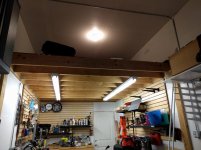
Here are some pics. It turned out great. Plugged it all in with no problems. Inspection should happen today and then I'm all done. Air compressor probably coming today and lift coming tomorrow!

The lift will fit with about 0.5" of excess clearance in the width so let's hope BendPak's QC is pretty tight... haha.
 

Attachments

  • IMG_20170607_203808.jpg
    IMG_20170607_203808.jpg
    134.7 KB · Views: 28
  • IMG_20170607_160414.jpg
    IMG_20170607_160414.jpg
    139.4 KB · Views: 24
  • IMG_20170607_203817.jpg
    IMG_20170607_203817.jpg
    133.9 KB · Views: 22
  • IMG_20170607_203832.jpg
    IMG_20170607_203832.jpg
    141.1 KB · Views: 25
OP
H

highaltitude

Active member
Joined
Jul 22, 2013
Messages
30
One more question!

So I got the lift installed. I needed to pull an audible and rotate the lift power post 180 degrees, putting it in the middle of the garage. Wiring must be done from the ceiling now.

What's the proper way to do that?

An outlet with a plug in cord hardwired to the lift dangling down is an option, but seems weird to have something like that plugged in that you can't easily unplug since the outlet is at 12.5 feet in the air.

Hardwiring seems a little iffy and I barely have enough wire to reach without a J-box or something so that's not ideal. I imagine it would require a long flex section or some means of securing the conduit to a structure I would fabricate.

What's the best approach here?
 

redmondjp

Well-known member
Joined
Nov 25, 2014
Messages
2,318
Location
Redmond, WA
There are multiple ways you could approach it. One would be a twistlock receptacle at the ceiling with a flexible cord. Another would be a junction box at the ceiling with a strain relief on a flexible cord drop down to the motor (hard-wired).

My approach would be a junction box on the ceiling, and then use flexible conduit, or type AC or MC cable (looks like flexible conduit but comes with the wires already inside) down from there to the pump motor.
 
To avoid these ads, REGISTER NOW!
Top Bottom