The pics below shows the main c/b panel inside my house. I'm wanting to add a 100 amp sub panel in my attached garage. Does anyone have a recommendation on the best way to rearrange the circuits in my main panel to open up two adjacent slots?

You are using an out of date browser. It may not display this or other websites correctly.
You should upgrade or use an alternative browser.
You should upgrade or use an alternative browser.
Adding a sub panel
- Thread starter osumet
- Start date
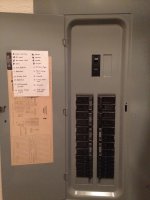
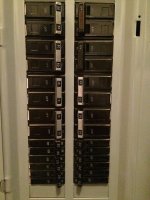
Have you opened it to see if there is buss under the bottom two knockouts?
If not it looks like some of those 2 pole breakers could be replaced with THQP's, Those are the slim breakers at the bottom, they are also available in 2 pole up to 50A. According to the label all but the top few spots will take the THQP's.
If you have lightly loaded circuits you could combine a couple. But that doesn't work that great in your case since the the single poles are already thqp's
If not it looks like some of those 2 pole breakers could be replaced with THQP's, Those are the slim breakers at the bottom, they are also available in 2 pole up to 50A. According to the label all but the top few spots will take the THQP's.
If you have lightly loaded circuits you could combine a couple. But that doesn't work that great in your case since the the single poles are already thqp's
Bad Habit
Well-known member
Are any of the circuits currently feeding anything in the garage? Those could be relocated to the sub-panel freeing up space
sberry
Banned
There are usually a couple in a full panel without much load that can be combined. I have seen a lot of circuits in houses that never had more than a radio or a clock on them. Some none, never been used.
Are any of the circuits currently feeding anything in the garage? Those could be relocated to the sub-panel freeing up space
Yes, There's a 30A 240V circuit for the water heater and a 20A 240V circuit for the well pump that are both in the garage. The main panel is in a bedroom closet on the opposite end of the house from the garage.
Bad Habit
Well-known member
There you go. If those 240v circuits are shifted over to the sub-panel, that will free up 4 breaker spaces. The 2p/100 breaker to feed the sub-panel only needs 2
ford33
Well-known member
Seems like you will have enough space to add your circuit for a sub panel. But why do you need 100 amps in the garage? Whole homes run on 100 amps!
The cost to install 100 amps is much higher than 50 or 60 amps and unless you have many machines running at one time the need for 100 amps is questionable.
Calculate the actual loads operating at one time in the home garage shop and go from there.
The cost to install 100 amps is much higher than 50 or 60 amps and unless you have many machines running at one time the need for 100 amps is questionable.
Calculate the actual loads operating at one time in the home garage shop and go from there.
75gmck25
Well-known member
Another reason to use lower amperage for the subpanel breaker is that 2-2-2-4 AL SER and MHF wire are readily available from both online and local suppliers, and they can handle 90 amps. To move up to 100 amps requires larger aluminum or copper cable, and that extra 10 amps will cost more if its a fairly long run.
Bruce
Bruce
D45
Well-known member
I have a 200AMP main panel for the house and a 100AMP (6 circuit) subpanel in my attached garage...…...fed by a 60 amp breaker in the main panel
sherlocktk
Well-known member
I did my garage similar used the 2-2-2-4 SER cable on a 60 amp breaker. Had to order the cable, and the rest I bought at home depot. This way I can move to a 90 amp breaker if I ever need it but even with the lights, air compressor, plasma cutter, and the AC on freeze, still have not tripped the 60.
The wire cost was pretty low difference between a 60 amp feeder vs 90 so I kept it oversize for essentially the same money.
The wire cost was pretty low difference between a 60 amp feeder vs 90 so I kept it oversize for essentially the same money.
sberry
Banned
I have done a couple dozen garages this way,,,,, never had a call about a trip, never and a couple were busy. The 90A wire makes it like its right there even at some distance and with motor starts as well as cheaper. It will deliver 50 or 60 at 200 ft without a problem.I did my garage similar used the 2-2-2-4 SER cable on a 60 amp breaker. Had to order the cable, and the rest I bought at home depot. This way I can move to a 90 amp breaker if I ever need it but even with the lights, air compressor, plasma cutter, and the AC on freeze, still have not tripped the 60.
The wire cost was pretty low difference between a 60 amp feeder vs 90 so I kept it oversize for essentially the same money.
Bretny
Well-known member
Yes, There's a 30A 240V circuit for the water heater and a 20A 240V circuit for the well pump that are both in the garage. The main panel is in a bedroom closet on the opposite end of the house from the garage.
By adding a sub pannel in the garage you would power the water heater and well off the sub pannel so you would actualy gain two spots in the main pannel.
I also have 100a to my detached garage. The man wants 100a let him have 100a. Years ago they were doing 60a mains...now look at them.
b-boy
Well-known member
I'm currently doing this.
I'm using 2-2-2-4 Cu THHN/THWN in conduit. My run is about 200ft. I have a 100A subpanel in the garage. I have an existing 60A breaker in my main panel that I'm using out to the garage. It's currently servicing an old barn that I'm going to tear down. I sized the wire so I can handle more that 60A if needed, but I'll keep it at 60A for now.
It wasn't cheap. The wire alone we close to $1200.
I'm using 2-2-2-4 Cu THHN/THWN in conduit. My run is about 200ft. I have a 100A subpanel in the garage. I have an existing 60A breaker in my main panel that I'm using out to the garage. It's currently servicing an old barn that I'm going to tear down. I sized the wire so I can handle more that 60A if needed, but I'll keep it at 60A for now.
It wasn't cheap. The wire alone we close to $1200.
Bretny
Well-known member
Why was your wire so much? I did a 120ft run of DB to serw cost about $400 for a 100a sub pannel.
b-boy
Well-known member
That's the cheapest I could find it. About $1.29 per foot for the 2 AWG, and $.90 per foot for the 4 AWG. I bought 230 ft each of red, black, white, and ground.
That's the cheapest I could find it. About $1.29 per foot for the 2 AWG, and $.90 per foot for the 4 AWG. I bought 230 ft each of red, black, white, and ground.
Why copper? 1/0 aluminum is about a third that.
I'm going to be moving the well pump or water heater or both to the sub panel. I'll also be running a air compressor that requires a 60A circuit, a table saw that requires a 30A circuit, a planer that requires 20A, etc. It's likely that I'll have 3 or 5 horsepower dust collector at some point. It's not unlikely to have many of these running at the same time.Seems like you will have enough space to add your circuit for a sub panel. But why do you need 100 amps in the garage? Whole homes run on 100 amps!
The cost to install 100 amps is much higher than 50 or 60 amps and unless you have many machines running at one time the need for 100 amps is questionable.
Calculate the actual loads operating at one time in the home garage shop and go from there.
I'll be making a 85 foot run in the attic using 2-2-2-4 Al SER and a 90A breaker for the main panel in the house. My sub panel will be a 100A, 24 slot, main breaker panel.Another reason to use lower amperage for the subpanel breaker is that 2-2-2-4 AL SER and MHF wire are readily available from both online and local suppliers, and they can handle 90 amps. To move up to 100 amps requires larger aluminum or copper cable, and that extra 10 amps will cost more if its a fairly long run.
Bruce
The attached picture shows a layout of the garage. I'm considering installing the sub panel in the closet where the water heater and well pump is. Does anyone see any problem with installing the sub panel in this location? I'm also going to be adding 14 light fixtures and a lot of 2 gang outlets along the wall.
Nathan
Attachments

I'm going to be moving the well pump or water heater or both to the sub panel. I'll also be running a air compressor that requires a 60A circuit, a table saw that requires a 30A circuit, a planer that requires 20A, etc. It's likely that I'll have 3 or 5 horsepower dust collector at some point. It's not unlikely to have many of these running at the same time.
I'll be making a 85 foot run in the attic using 2-2-2-4 Al SER and a 90A breaker for the main panel in the house. My sub panel will be a 100A, 24 slot, main breaker panel.
The attached picture shows a layout of the garage. I'm considering installing the sub panel in the closet where the water heater and well pump is. Does anyone see any problem with installing the sub panel in this location? I'm also going to be adding 14 light fixtures and a lot of 2 gang outlets along the wall.
Nathan
How much clearance between the WH & the panel? To me it looks a little tight, behind the entry door is a great location because it's not as likely to have **** piled behind it.
TRWham
Well-known member
You will need working space in front of the panel 36" deep (for 120V line to ground) by 30" wide extending from the floor to the ceiling. That 30" width includes the panel itself and need not be centered on the panel. Nothing can be stored in that working space. This is from 110.26.
Also, double check that compressor circuit ampacity. I doubt you need a 60A branch circuit unless it's bigger than 7.5 hp or running on 208V. It may call for a 60A breaker, but that does not necessarily mean you need 60A conductors. Motor circuits have different requirements (see Article 430 in the NEC).
Also, double check that compressor circuit ampacity. I doubt you need a 60A branch circuit unless it's bigger than 7.5 hp or running on 208V. It may call for a 60A breaker, but that does not necessarily mean you need 60A conductors. Motor circuits have different requirements (see Article 430 in the NEC).
Are you referring to the location as shown by the pink square in the attached picture? I do think that'd be a good location. I'm thinking about that location or the two locations shown in yellow in the attached picture.How much clearance between the WH & the panel? To me it looks a little tight, behind the entry door is a great location because it's not as likely to have **** piled behind it.
Looks like installing the panel in the closet will not be an option since the water heater encroaches on the 30"x36" space. Thanks for the heads up!You will need working space in front of the panel 36" deep (for 120V line to ground) by 30" wide extending from the floor to the ceiling. That 30" width includes the panel itself and need not be centered on the panel. Nothing can be stored in that working space. This is from 110.26.
Also, double check that compressor circuit ampacity. I doubt you need a 60A branch circuit unless it's bigger than 7.5 hp or running on 208V. It may call for a 60A breaker, but that does not necessarily mean you need 60A conductors. Motor circuits have different requirements (see Article 430 in the NEC).
Attachments

I've got another question. The main panel is on the other end of the house from the garage. I'm planning on running the 2-2-2-4 SER cable out of the top of the main panel, up the inside of the wall, through the top plate, into the attic, run about 75 ft across the attic and down to the sub panel in the garage. The attic has the blown insulation.
Question#1: Is it going to derate the circuit if I lay the cable on top of the insulation in the attic?
Question#2: I'm going to have to drill a 1" or 1-1/4" hole in the top plate to fish it down into the main panel. Is this too large of a hole to drill in the top plate?
Question#1: Is it going to derate the circuit if I lay the cable on top of the insulation in the attic?
Question#2: I'm going to have to drill a 1" or 1-1/4" hole in the top plate to fish it down into the main panel. Is this too large of a hole to drill in the top plate?
pattenp
Well-known member
As long as the SER is not buried within the insulation you are ok. The edge of the bored hole has to be at least 1.25" away from the nailing surface of the top plate, if not, you need to add a nail protection plate.
OK, I called the county permit office and was told that it was against code to use aluminum wire in a house, including in the attic. My house was built in '83 and has copper wire installed throughout. The main panel is in a closet in a bedroom and is on an outside wall. The county permit office also told me that If I made any changes to the electrical circuits or panel I would have to relocate the entire main panel out of the closet since it was against code to have a main panel in a closet. I live in Oklahoma. Is anyone familiar with oklahoma electric code and the use of aluminum wire? Also, do I really have to relocate the main panel if I want to add a new circuit?
OK, I called the county permit office and was told that it was against code to use aluminum wire in a house, including in the attic. My house was built in '83 and has copper wire installed throughout. The main panel is in a closet in a bedroom and is on an outside wall. The county permit office also told me that If I made any changes to the electrical circuits or panel I would have to relocate the entire main panel out of the closet since it was against code to have a main panel in a closet. I live in Oklahoma. Is anyone familiar with oklahoma electric code and the use of aluminum wire? Also, do I really have to relocate the main panel if I want to add a new circuit?
Ask them to cite the code. There is nothing in NEC that prohibits aluminum inside, possible they have an amendment though.
I don't see how they could require you to move the panel if all your doing is running a circuit or feeder. If you were to redo the service itself then yes it would need to comply with current code but that is not what you are doing.
AntonLargiader
Well-known member
It could be a matter of how you asked. Maybe the inspector thought that you were running aluminum branch circuit wiring rather than feeder wiring. And if your existing panel location never met code, then I can see it being failed on an inspection as it would not be grandfathered. Not enough info.
I'll call tomorrow and ask for the code paragraph. I don't see he could require that I redo the panel either. It just doesn't make sense. According to the following website (at bottom of list), Oklahoma has adopted the 2014 NEC and the amendments/modifications are out to the right side .https://www.ok.gov/oubcc/Codes_&_Rules/Adopted_Building_Codes/Ask them to cite the code. There is nothing in NEC that prohibits aluminum inside, possible they have an amendment though.
I don't see how they could require you to move the panel if all your doing is running a circuit or feeder. If you were to redo the service itself then yes it would need to comply with current code but that is not what you are doing.
It could be that he misunderstood but I was very specific and told him that i ran 2-2-2-4 aluminum ser from the main panel, into the attic, and down into the sub panel in the garage. I'm not exactly sure what you mean by branch circuit vs. feeder wiring? He said that my panel met the code when it was installed in '83. I just purchased the house about 3 months ago. An electrical inspection was performed and the only thing that the electrical inspector mentioned was that he recommended installing some gfci outlets.It could be a matter of how you asked. Maybe the inspector thought that you were running aluminum branch circuit wiring rather than feeder wiring. And if your existing panel location never met code, then I can see it being failed on an inspection as it would not be grandfathered. Not enough info.
Last edited: