To avoid these ads, REGISTER NOW!

Adding a TV antenna on house

Dragster Racer

Well-known member
Joined
Feb 9, 2008
Messages
1,891
Location
Morrison, IL
We are thinking of giving up Dish tv, and settling for broadcast for free. We live a good 50 miles from any of the tv stations locally. I was leaning toward a roof mounted deal, but I am a little clueless on this subject. How to you attach to the roof without causing damage? What about running wire? This is new to me.
 
To avoid these ads, REGISTER NOW!

astroracer

Well-known member
Joined
Jun 22, 2005
Messages
3,001
Location
Mid_Michigan
I used to install antenna's with my dad when I was a kid. You need to check signal strength and direction before you jump into this. I would suggest talking to a local TV/Radio shop and ask what needs to be done to get good reception.
I have never paid for cable or dish. Always watched the free local airwaves. My antenna is mounted on top of a 40' tower with 10 feet of pipe and a rotor. That puts the antenna 50' in the air and I get excellant reception on all of my local channels. Most of them are between 30 and 50 miles away.
My property is also "in a hole" as compared to most of the out-lying geography so I HAD to go high to get the antenna up into the airwaves.
You may not have to do that, depending on how your property sits.
Mark
 

LEVE

Well-known member
Joined
Jun 23, 2008
Messages
1,727
Location
On the Willapa
Have you looked into Free to Air TV I was considering this (and still may do it) but went with DISH in my move a few months ago. The wife was going through withdrawal of FOX news.
 

bczygan

Well-known member
Joined
Nov 4, 2009
Messages
22,002
Location
DETROIT! Arsenal of Scrappers
Get as much aluminum as you can, up as high as you can.

Install the highest quality Yagi with the most possible elements on top the highest tower you can afford, with a rotator and a powered amplifier at the antenna.

Use high quality coax and connectors to the house. Minimize connections and splitters.

That's the answer.
 

jkwilson

Well-known member
Joined
Dec 5, 2012
Messages
758
Location
SW Indiana
If possible, hang it in your attic. I'm 65 miles from a station and get good signals on a lot of channels with my antenna hung on the trusses in the attic over my garage. No weathering or worry about wind damage and no pole or tower.

If you go outside, put up a tower.
 
OP
D

Dragster Racer

Well-known member
Joined
Feb 9, 2008
Messages
1,891
Location
Morrison, IL
If possible, hang it in your attic. I'm 65 miles from a station and get good signals on a lot of channels with my antenna hung on the trusses in the attic over my garage. No weathering or worry about wind damage and no pole or tower.

If you go outside, put up a tower.

I don't think the attic will work in my case since I have a Decra roof (rock over steel). The tower may be better. I don't like the looks of a tower or any antenna for that matter, but Dish is costing me $800/year.
 

PWC Repair

Well-known member
Joined
Dec 27, 2012
Messages
3,170
Location
Arkansas
We are thinking of giving up Dish tv, and settling for broadcast for free. We live a good 50 miles from any of the tv stations locally. I was leaning toward a roof mounted deal, but I am a little clueless on this subject. How to you attach to the roof without causing damage? What about running wire? This is new to me.

I did just that over 8 years ago. I'm about 100 miles from any TV station. Everybody kept telling me I wouldn't pick up anything without a 50ft tower.....BS! I borrowed a field strength meter from a local TV repair shop that used to install antennas. Tune it to whatever station you know you should be picking up, then walk around with the handheld antenna until you get good signal. I have a "window" of signal on my roof about 6ft wide by 3ft tall. If you move out of this "window" the signal goes to almost nothing at all. Old school TV guy said don't waste money on anything that doesn't say ChannelMaster on it. So I bought an antenna, a tripod mount that lag bolts directly to the rooftop, Some coax cable, and a 4-way amplifier. I had to use one of those little barrel shaped adapters at the antenna, then ran the coax down into the house, then into the amplifier/splitter, and on to the rooms. I pick up about 15 channels, for free, for years now. We also watch some movies out of the Redbox now and then but we're not really TV people. I hope this helps.
 

2CRUZ

Well-known member
Joined
Jul 25, 2011
Messages
526
Location
Southern Illinois
Be very carefull when putting up an antena. Watch out for any power lines. I lost one of my very good friends when the antens fell over the house power line.
 

elav

Well-known member
Joined
Nov 12, 2008
Messages
122
This website can be a great resource for you- http://www.antennaweb.org/

Right on that front page you enter your Zip Code and can find out what stations are in the air near you and your likelyhood of grabbing them.

This is a great place to start! I used this site to identify to identify which stations are UHF (which most are), which are VHF, location and size of antennas required. I was able to point 1 antenna in between SF and Oakland and a 2nd antenna towards San Jose and use a combiner so there was no need to adjust the antenna positions. Works great!
 

dogdog

Well-known member
Joined
Nov 15, 2011
Messages
12,711
that website would let you get the approximate location of all the tv towers from your home location nice tool then from that point you can decide what antenna to buy. if you have smart phone, you can also use some app called "antenna pointer" or "TV antenna helper" cool tool uses phone build gps as compass to help you locate your towers. aside from that I used a el cheapo portable 7"LCD TV to help me check reception since I don't have field strength meter.
Cables get the RG8 Qaud shield not RG59 cables is nice. got them from homedepot think it is 500 ft for $50 or $70.
The lesser connections, splitters you put on your cable run the better. I am currently running the Clearstream C4, its nice, light and no wind to blow my antenna over. but might not be good enough for your areas.

What ever outdoor antenna you are installing, make sure you are properly grounding the mast and antenna ?
 

2ManyProjects

Well-known member
Joined
Jul 18, 2013
Messages
757
We are thinking of giving up Dish tv, and settling for broadcast for free. We live a good 50 miles from any of the tv stations locally. I was leaning toward a roof mounted deal, but I am a little clueless on this subject. How to you attach to the roof without causing damage?

There are a number of ways to attach an external radio/TV antenna to a rooftop, the most common being a chimney mount:

http://www.solidsignal.com/pview.as...4-chimney-mount-24-ft.-stainless-steel-(1224)
RON1218_medlrg.jpg


http://www.solidsignal.com/pview.as...-mount-for-use-with-antenna-rotator-(ron3324)
RON3324_zoom.jpg


...a vent-pipe clamp:

http://www.solidsignal.com/pview.asp?p=ron8200&d=ronard-8200-vent-pipe-mount-2-brackets-(8200)
RON8200_zoom.jpg


http://www.solidsignal.com/pview.asp?p=p-6&d=vmp-p-6-vent-pipe-mount-(p-6)
P-6_zoom.jpg


...and a tripod:

http://www.solidsignal.com/pview.asp?p=SKY6029&d=Solid-Signal-SKY6029-2ft-Tripod-(SKY6029)
SKY6029_zoom.jpg


http://www.solidsignal.com/pview.asp?p=cm9003&d=channel-master-cm9003-3-ft-tripod-mount-(cm-9003)
CM9003_ZOOM.gif


However, at 50+ miles out from the transmitters, you're going to need BOTH a fairly "ambitious" (read: large & heavy) antenna, AND as much mounting height as you can get. The reason for the former should be fairly obvious: Larger antennas tend to have more "gain" (i.e., produce a stronger signal on the downlead for any given amount of RF field strength in the air itself). The latter is because TV and (at least FM) radio signals are "line of sight" propositions; and you need to have enough antenna height (on BOTH ends) to overcome any intervening obstacles like hills, trees, other houses, and especially curvature of the Earth.

Big heavy antennas on top of tall masts are NOT something to be taken casually. They can and do produce some very serious loads, especially in any sort of wind. Hence, "wimpy" mounts (such as most of the above) need not apply. If you are even semi-serious about this, you probably ought to consider installing a real tower. In my "suburban" location about 25 miles from (most of) the transmitting antennas, I used four (nominally 10-foot; really closer to 9-1/2) sections of Rohn 25G series http://www.rohnnet.com/bracketed, with a house bracket up near the top of one gable end, and a 10-foot mast atop that so that I could mount separate UHF and VHF antennas while still maintaining adequate vertical separation between them. That was probably a bit on the "overkill" side for my particular location; but I'd rather err on the side of "too much" than "not enough".

Also, one other thing which is VERY important: Ever since the transition to digital over-the-air television, the STABILITY of the signal has become MUCH more important, vis-a-vis simple raw signal strength. Even with my fairly "robust" tower system and antennas which produce plenty of raw signal, I still sometimes get pixellation and/or no usable signal, due to the antenna being blown around ever so slightly and thus screwing up the timing/phase relationships of the various signal components (upon which the ATSC broadcast format is extremely dependent). So if/when in doubt, use a somewhat SMALLER antenna if you must, but DO mount it absolutely as solidly as you can.

And finally, one other post-DTV issue: The channel numbers you see displayed on your TV screen, or even used by the TV stations themselves as part of their "brand", no longer necessarily have any correlation to the actual "channel" being used to transmit the signal. In fact, most OTA TV signals are now in the UHF band, despite having "virtual" channel numbers in the 2-13 range. Hence, it is important to know the ACTUAL channels you are attempting to receive, when selecting and installing an antenna.


What about running wire?

The "downlead" (which is the cable connecting the antenna to the TV or radio receiver) is perhaps the ONLY place where something approximating a "free lunch" can be had. The less loss that cable imposes, the better; and once those losses are incurred, there is simply no good way to get them back without bringing on other potential problems. Hence, spend what it takes to use the best low-loss and well-shielded cable you can get. I used quad-shield RG-11/U for my main downleads (separate lines for VHF and UHF, with no intervening splices or connections), which are then combined in the basement to feed RG-6/U through to the various locations around the house where the signals are needed.

You do NOT want to use active amplification if it is at all avoidable; but if you must, the best approach is a high-quality low-noise PRE-amplifier, mounted up at the antenna(s), as opposed to a "distribution amp" or similar located further down the signal path. This is because the former can boost the signal while it is still relatively "pure", before noise & interference has had a chance to creep into the downlead; whereas the latter will simply amplify any noise which was picked up between the antenna and the amplifier. But like I said, your BEST bet is no amplification at all.

This is new to me.

That's OK. There's no magic to any of this; and the basic principles have not changed in more than 75 years (despite all manner of hype to the contrary). Take your time; figure it out; and be willing to spend what it takes to do it RIGHT the first time.

Here is a web site which can give you a primer on the basics:

http://www.tvtower.com/hdtv_antenna_and_reception.html


I used to install antenna's with my dad when I was a kid. You need to check signal strength and direction before you jump into this. I would suggest talking to a local TV/Radio shop and ask what needs to be done to get good reception.

That's all well and good, if he can FIND a good "local TV/Radio shop". Sadly, they have been a fast-dying breed for awhile now.


Have you looked into Free to Air TV I was considering this (and still may do it) but went with DISH in my move a few months ago.

That's a pretty useless substitute for what most folks think of as "real TV". The only programming you/he are likely to get that way is the real "oddball" stuff which virtually no one wants to watch. See the list under "North America" at the link you posted.

The wife was going through withdrawal of FOX news.

Oh, Dear.

I think I'd better leave that one alone. :rolleyes2


This website can be a great resource for you- http://www.antennaweb.org/

Right on that front page you enter your Zip Code and can find out what stations are in the air near you and your likelyhood of grabbing them.

That can be a very useful tool, especially for determining the ACTUAL broadcast channels available in any given location , and their relative bearings. But don't take all the "color coding" and similar marketing-driven nonsense too seriously.


Get as much aluminum as you can, up as high as you can.

Install the highest quality Yagi with the most possible elements on top the highest tower you can afford, with a rotator and a powered amplifier at the antenna.

Arguably an oversimplification; but mostly on-point EXCEPT for the rotator, which should be avoided if at all possible. If most/all of the stations "Dragster Racer" wants to receive line in the same general direction relative to his home, a rotator is simply unnecessary. And he should hope that is is unnecessary, because having/using a rotator becomes very problematic in this day an age of multiple TVs, time-shifting via DVRs, etc.; in effect it limits you to dedicating the entire antenna system to a single TV. In many/most cases, it would be better to install separate antennas, each (permanently) aimed in the directions needed to pick up all the desired signals, then combine their outputs before distributing the signal out to the various points of use.

Use high quality coax and connectors to the house. Minimize connections and splitters.

Or at least use whatever splitters are required intelligently. "Daisy-chaining" multiple splitters one after the other to create additional drops in an ad hoc fashion is usually a VERY bad idea. Figure out how many total "drops" you're going to need to feed your various TVs, DVD recorders, PVRs, etc., then use ONE splitter capable of supporting that many outputs, and "home run" your distribution cables from those various devices back to that one centrally located splitter. If you have a LOT of such drops, a high-quality distribution amplifier may be required in place of the splitter; but even so, it's PROBABLY better to pre-amplify the signal at the antenna, and use a passive splitter.


[The BBS software is nattering at me that the message is too long. So I'm breaking it here. Continued in next message...]


2ManyProjects

Well-known member
Joined
Jul 18, 2013
Messages
757
[...Continued from previous message.]

If possible, hang it in your attic. I'm 65 miles from a station and get good signals on a lot of channels with my antenna hung on the trusses in the attic over my garage. No weathering or worry about wind damage and no pole or tower.

Depending on its composition, the roofing itself can act as an RF shield. Even the nails used to fasten the shingles tend to act as a weak Faraday Cage. Because of this, attic-mounted antennas sacrifice a LOT of performance, vs. even the same exact antenna mounted on a short (say, 5-ft.) mast on the rooftop, and are generally only feasible in "near-suburban" areas where very high field strengths are the norm. How you're getting anything usable at 65 miles out from the transmitters is a mystery to me. Are you perhaps in the "flatlands", with little or no "civilization" (with its inherent dose of "RF pollution") in the immediate area?


I don't think the attic will work in my case since I have a Decra roof (rock over steel).

Then an attic-mounted antenna would be an absolute non-starter.

The tower may be better. I don't like the looks of a tower or any antenna for that matter, but Dish is costing me $800/year.

Personally, I like the look of a well-done tower much better than a typical rooftop antenna. Even when installed directly adjacent to the building (such as in my case), the tower seems to visually separate itself from the house itself, particularly its roofline (aided no doubt by the fact that the antennas themselves are a good 20+ feet above the ridge line, and thus somewhat out of the "field of view"). By comparison, when I had an antenna mounted to my chimney via a 10-foot mast, it stuck out like a sore thumb every time I came around the corner.


I did just that over 8 years ago. I'm about 100 miles from any TV station. Everybody kept telling me I wouldn't pick up anything without a 50ft tower.....BS! I borrowed a field strength meter from a local TV repair shop that used to install antennas. Tune it to whatever station you know you should be picking up, then walk around with the handheld antenna until you get good signal. I have a "window" of signal on my roof about 6ft wide by 3ft tall.

You're obviously getting terrain-induced "skipping" and maybe multipath interference; and you really rather "lucked out" to find that one small spot where things happened to fall into place "just so". Most folks simply cannot count on that. A field strength meter WILL be useful when it comes time to aim the antennas, however.


Cables get the RG8 Qaud shield not RG59 cables is nice. got them from homedepot think it is 500 ft for $50 or $70.

No, NOT RG-8. That's a 50-Ohm cable used for certain types of communications radio (Amateur/"Ham" radio, and Marine VHF, for example); and it will NOT work correctly for home TV/FM use. You/he need a good-quality 75-Ohm cable, such as RG-6/U or RG-11/U.

 
OP
D

Dragster Racer

Well-known member
Joined
Feb 9, 2008
Messages
1,891
Location
Morrison, IL
Wow! The right guy certainly showed up here! I am closer to on city that has more of the channels that I would want, and I think with my distance from them, a single direction could do fine with no turning needed. How do you tie a tower to the house....or do you? The house is only a few years old and I kind of hate to protrude if I can avoid it. The house itself is about25' tall, plus a few feet to get it over the house. The travel through the basement about 30'. So estimate 55' anyhow for cable.
 

bczygan

Well-known member
Joined
Nov 4, 2009
Messages
22,002
Location
DETROIT! Arsenal of Scrappers
2ManyProjects,
Would you please stop reminding me how little I know!!!

Your posts are a treatise. Wow!

Can't think of anything to add.

Are you a Ham?

Are you an electrical/electronics engineer?

And what's your location?

Please keep contributing like this. We appreciate the effort. You are a wealth of valid knowledge.

Another advantage of a tower is better anchoring. I like one that has the appropriate foundation, attachment to the house where available, or proper guying. Much better than a chimney mount in my book.

I also like to keep coax runs short by making the main run go to a centrally located distribution point on the main or second floor, rather than way down to the basement.
 

2ManyProjects

Well-known member
Joined
Jul 18, 2013
Messages
757
Wow! The right guy certainly showed up here! I am closer to on city that has more of the channels that I would want, and I think with my distance from them, a single direction could do fine with no turning needed.

Good. That simplifies things significantly.

How do you tie a tower to the house....or do you?

Any tower of more than minimal (maybe 20 feet) height absolutely MUST be supported. In my case, I used a hinged base:

http://www.dxengineering.com/parts/roh-sbh25g
roh-sbh25g_sn_xl.jpg


set in about three feet of concrete (with corrosion inhibitor added to the mix) over about one foot of #2 stone (for drainage). Then I added a "House Bracket":

http://www.dxengineering.com/parts/roh-hb25ag
roh-hb25ag_oh_xl.jpg


mounted as high as I could get it on the house's gable end.

Between the two, the tower is solidly fixed in place.

The house is only a few years old and I kind of hate to protrude if I can avoid it. The house itself is about25' tall, plus a few feet to get it over the house.

Not sure what you mean by "protrude" in this context. In any event, if you're going to go to the bother & expense of a tower, you might as well make it tall enough to really do you some good. You'll want your antenna(s) located AT LEAST 10-15 feet above the roof, on general principles.

The travel through the basement about 30'. So estimate 55' anyhow for cable.

More. If your house is 25 feet tall, and you go up another 15 feet to the antenna, that's 40 feet to get to ground level (where you will presumably enter the structure). Then another ~30 feet horizontally (you said); and add another 5-10 feet to account for drip loops, radiused bends, minor "zig-zags" in the cable routing to get it where you want it, and general "fudge factor" -- we're up to about 75-80 feet, total. DO use good low-loss cable.


2ManyProjects,
Would you please stop reminding me how little I know!!!

Your posts are a treatise. Wow!

Can't think of anything to add.

Thanks for the kind words.

Are you a Ham?

Nope. Former audio nut.

Are you an electrical/electronics engineer?

Not officially. Dropped out of the BSEE program to pursue a career in microcomputers, which were "hitting big" at the time.

And what's your location?

East Coast, mostly around the Philadelphia area.

Another advantage of a tower is better anchoring. I like one that has the appropriate foundation, attachment to the house where available, or proper guying. Much better than a chimney mount in my book.

I like mine, save for the minor instability induced by the 10-foot mast atop the tower. If I had it to do over again, I'd use a single combo VHF/UHF antenna, and a shorter mast.

I also like to keep coax runs short by making the main run go to a centrally located distribution point on the main or second floor, rather than way down to the basement.

That kind'a depends on the house, and where in it you can get good access to run all the drops. In my case, the basement was THE way to go, as the attic is nearly inaccessible and utter Hell to maneuver in even if you can get there (early '60s ranch house with a 3/12 roof -- yuck!).

 
OP
D

Dragster Racer

Well-known member
Joined
Feb 9, 2008
Messages
1,891
Location
Morrison, IL
My roof is pitched on the end that I would put the tower. I would have to do a little different bracket in my case. Any disadvantage to pouring a pad and mounting the tower on top.....with a support high up also of course.
 

Highbeam

Well-known member
Joined
Feb 15, 2011
Messages
2,292
Location
Mt Rainier foothills, WA
The wife would not allow our OTA antenna on the roof much less up on a tower, we've still got to live here.

I use a db4e antenna that I just recently bought to replace the nearly identical home made version in my attic. I'm only about 35 miles from the towers with a decent spread of 40 degrees or so between towers. Excellent reception and no ugly outdoor hardware.

If the towers you are trying to talk to are behind your house then you can always mount the antenna to the wall so it is below the eave and out of sight plus protected from weather. Modern antennas, especially UHF ones, are almost flat and about the size of a window. The days of those huge yagi beam antennas are almost over unless you require VHF.
 

volleyball

Well-known member
Joined
Aug 29, 2011
Messages
4,127
Location
NY, not NYC
You don't want a chimney mount, unless you are a mason and don't mind working on your own.
There is no replacement for size. An amp at the antenna helps a lot though. You get as big as you need.
I have a setup very similar to 2 many and I still didn't get good enough reception. Like real estate, location, location, location. I didn't have it.
 

bczygan

Well-known member
Joined
Nov 4, 2009
Messages
22,002
Location
DETROIT! Arsenal of Scrappers
My roof is pitched on the end that I would put the tower. I would have to do a little different bracket in my case. Any disadvantage to pouring a pad and mounting the tower on top.....with a support high up also of course.

When you say pad, I assume you mean foundation. This tower needs to be on a 3' diameter by 4' deep foundation. You do have a choice between a base section embedded in the foundation or a base plate anchored to it. Then, depending on height, it needs support with brackets to a structure and/or guying.

Google Rohn 25G:

http://www.rohnnet.com/rohn-25g-tower
 
To avoid these ads, REGISTER NOW!

bczygan

Well-known member
Joined
Nov 4, 2009
Messages
22,002
Location
DETROIT! Arsenal of Scrappers
The wife would not allow our OTA antenna on the roof much less up on a tower, we've still got to live here.

I use a db4e antenna that I just recently bought to replace the nearly identical home made version in my attic. I'm only about 35 miles from the towers with a decent spread of 40 degrees or so between towers. Excellent reception and no ugly outdoor hardware.

If the towers you are trying to talk to are behind your house then you can always mount the antenna to the wall so it is below the eave and out of sight plus protected from weather. Modern antennas, especially UHF ones, are almost flat and about the size of a window. The days of those huge yagi beam antennas are almost over unless you require VHF.

Mmmmmmmm.......Yes AND No.

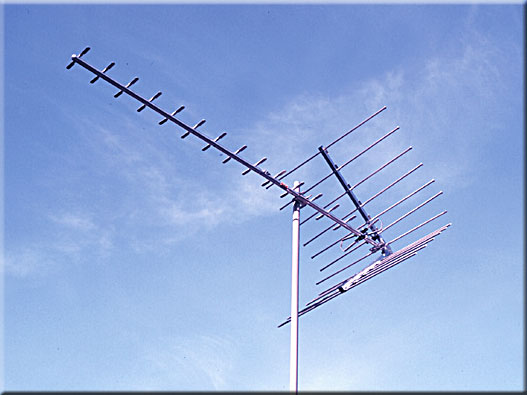
The purpose of multi-element Yagi designs is to increase gain in a particular direction and pull in signals from weak distant stations. This is something that can be needed for VHF OR UHF. Thus the need for this UHF Yagi.

W75-1050%20HD9095P.jpg


And combination VHF/UHF antennas are produced with large numbers of elements to pull in both kinds of signals if you are in a fringe area.

W75-1046%20HD7698P.jpg
 
Last edited:

jkwilson

Well-known member
Joined
Dec 5, 2012
Messages
758
Location
SW Indiana
The days of those huge yagi beam antennas are almost over unless you require VHF.

Yagi antennas are the way to go if you want good coverage on a specific channel. They have much better gain than the plate UHF antennas, and can be built to work at a specific frequency which can help when you are looking at stations a long way off with stronger stations near the same frequency closer to you. I used to have that problem with channel 3 in Champaign, Il and channel 3 in Louisville. I'm almost on a line between them, so when pointing at one, the other was on the backside of an antenna.

The general coverage yagis with multiple reflectors are really only good at a couple of points in the band and are pretty badly compromised outside those spots.

I watch a channel that is almost 100 miles from me using a simple yagi made from PVC pipe and brazing rod tuned to that specific channel.
 

jkwilson

Well-known member
Joined
Dec 5, 2012
Messages
758
Location
SW Indiana
Or at least use whatever splitters are required intelligently. "Daisy-chaining" multiple splitters one after the other to create additional drops in an ad hoc fashion is usually a VERY bad idea. Figure out how many total "drops" you're going to need to feed your various TVs, DVD recorders, PVRs, etc., then use ONE splitter capable of supporting that many outputs, and "home run" your distribution cables from those various devices back to that one centrally located splitter.

While this is very valid, many times multi-output splitters are actually daisy-chained inside. A lot of them have as much as 11dB loss in some or all of the outputs because they are splitting the outputs of a 2-way splitter once or twice to generate the other outputs. You can get by with that close to a station, but when you get away from the transmitter it can be a problem. I prefer a distribution amp that splits internally if I need more than 2 runs.

I actually used to use splitters as cheap attenuators for testing when installing antennas in town. One station was so strong in a particular neighborhood that the front end of the receiver lost sensitivity and you struggled to get other stations that were 30 miles away because of it. I'd put splitters in to see if that was the problem, then order an attenuator to reproduce that loss if it was needed.

Another key thing which even some technical people don't account for is unused outputs. A splitter with an unterminated output may behave in an unexpected way. Say you have a 4-way splitter connected to 3 devices with the fourth output open. The signal from the antenna may be divided unequally between the 3 used outputs because of the unterminated output. Unused outputs should have 75 Ohm terminations attached for best performance of the system.
 

ddawg16

Well-known member
Joined
Jul 11, 2008
Messages
21,005
Location
S. California
This is my antenna....60+ channels of HD along with another 20 something analog....perfect reception.

I have a cable for internet....so if I want to watch something that is not OTA...download it for later viewing.


2ManyProjects

Well-known member
Joined
Jul 18, 2013
Messages
757
My roof is pitched on the end that I would put the tower. I would have to do a little different bracket in my case.

Just be aware that the higher you can get that house bracket, the better; and if you really CAN'T get it up reasonably high, that limits the maximum height of your tower. It's been too long for me to recall the specific details; but as a VERY general rule of thumb, the tower should not exceed about twice the height of the house bracket. Rohn publishes all the pertinent specs for this sort of thing; Google them as needed before making any decisions.

Any disadvantage to pouring a pad and mounting the tower on top.....with a support high up also of course.

They do make a "plate type" base; but by my lights, its not as secure or desirable as one which is sunk into ~3-ft. of solid concrete. Once the hole is dug and the base is set, it LOOKS like a "pad" anyway; so no real downside to doing it right.


The wife would not allow our OTA antenna on the roof much less up on a tower, we've still got to live here.

I'll leave your "domestic bliss" issues to you. :rolleyes2 But at least in MY household, infrastructure/technological matters are "my department"; and the overarching philosophy is, "form follows function."

I use a db4e antenna that I just recently bought to replace the nearly identical home made version in my attic. I'm only about 35 miles from the towers with a decent spread of 40 degrees or so between towers. Excellent reception and no ugly outdoor hardware.

You are apparently "lucked out" in that all of your desired stations are in the UHF band. That's is far from always the case. Around here, three of the local stations (including two major networks) actually do use VHF. And I am NOT complaining about that; nor should anyone else in the same situation. VHF has inherently better propagation than UHF, and is more reliable in general.

If the towers you are trying to talk to are behind your house then you can always mount the antenna to the wall so it is below the eave and out of sight plus protected from weather.

That would put the receiving antenna awfully low, in the overall scheme of things. Maybe OK if you are in a "Near Suburban" environment with very strong signals coming from not all that far away; but it would be far from ideal for most folks.

Modern antennas, especially UHF ones, are almost flat and about the size of a window. The days of those huge yagi beam antennas are almost over unless you require VHF.

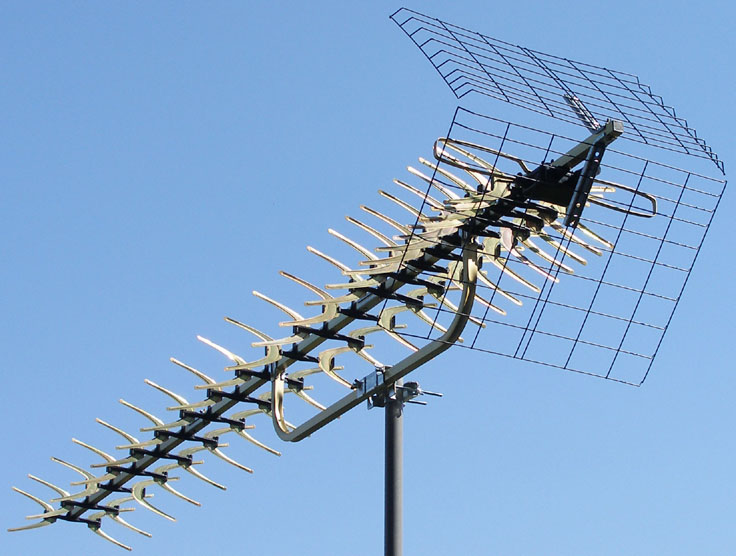
Not necessarily true. Yes, SOME types of UHF antennas are broad and flat, such as that Antennas Direct DB-4E you mentioned (or the Channel Master 4228 upon which its design is based). But others, such as the Channel Master CM4248:

http://www.hdtvprimer.com/antennas/cm4248.html
4248.jpg


and AntennasDirect XG91:

http://www.antennasdirect.com/store/91XG-Ultra-Long-Range-DTV-Antenna.html
http://www.hdtvprimer.com/antennas/XG91.html
XG91.jpg


DO use horizontal beams of substantial proportions. And too, "Bow-Tie / Grid" designs such as the CM4228 and DB-4E tend to have a LOT of surface area in the vertical plane, which means their wind loads are higher. And of course, as noted above, many folks DO need VHF coverage.

BTW... Here is another good source of info for folks just "getting up to speed" on this stuff: http://www.hdtvprimer.com/ and especially http://www.hdtvprimer.com/ISSUES/erecting_antenna.html. The comparative data at http://www.hdtvprimer.com/antennas/comparing.html is especially useful.


terek

New member
Joined
Feb 10, 2019
Messages
1
Location
Austin
Love the advice and experiences posted on this thread!

Just want to add that in order to know which antenna you can purchase in the first place, go to the TV Fool website to see:

- where the towers around you are located - for instance, if many of them are clustered relatively close together (and they're say, less than 40-60 degrees apart in relation to your location), then you can go with a Yagi/log periodic/unidirectional antenna; if however they're relatively wide apart (but up to 180 degrees apart), you may consider getting multidirectional antenna (example of this would be ClearStream 4)
- the signal strength of your location. TV Fool uses color codes to indicate whether an indoor, attic, or outdoor antenna (mounted on your roof like on those chimney clamps mentioned in a previous post) would be appropriate

My personal opinion, but I think TVFool has better data than Antennaweb.

Also, try to avoid attic installations if you can. They typically lose 40-50% of signal. But if you must (e.g., the wife tells you to, your neighbors are frowning), then by all means go for it. Results may be ok.

If you find an outdoor antenna is appropriate for your needs, I'd read up first on the topic in various guides before attempting it myself, or hire a contractor to do it.
 
Last edited:

MattT

Well-known member
Joined
Feb 20, 2010
Messages
3,201
My personal opinion, but I think TVFool has better data than Antennaweb.

After taking a look at both I agree:thumbup: Antennaweb didn't even show stations we were picking up with the antenna 4 feet off the ground.
6 Year old thread.....revived.....

It's worth a bump. Now people can save over a grand a year ditching cable/satelite instead of the several hundred when this thread was started:lol_hitti
 

Crazyjake8493

Well-known member
Joined
Sep 26, 2014
Messages
3,949
Location
Upstate NY
For anyone curious, I've had one of these $40 units in my attic just inside the gable vent for over a year now, and we get 15-20 channels with no static or drop-outs. We're about 40-45 miles from most towers with a few a bit farther and the antenna is rated for 65 miles. We get all the local channels I watch and a few others.
 

frank001

Well-known member
Joined
Mar 1, 2015
Messages
665
Location
Southern California
This website can be a great resource for you- http://www.antennaweb.org/

Right on that front page you enter your Zip Code and can find out what stations are in the air near you and your likelyhood of grabbing them.

This is what I got from the website after entering my Zipcode:

Up to 0 channels from 0 over-the-air stations may be received at this location.
 To enter a different address, click here.
 This address is not be affected by the FCC Repack.
No Stations were predicted for this address
Due to factors such as terrain and distance to broadcasting towers, signal strength calculations have predicted no television stations may be reliably received at this location.

Guess I'm SOL.
 

yrly

Well-known member
Joined
Jul 23, 2006
Messages
691
I see someone posted the XG91. Just a heads up this thing works great for distance reception but it is not durable. I’m on my 3rd free in 5 years under their lifetime warranty. I don’t live in the highest wind area either.
 

jdepiero

Well-known member
Joined
Feb 9, 2014
Messages
195
Location
NE, Ohio
There are a lot of sites to reference for TV reception in your area and also a lot of reviews on antenna's. We do not watch a lot of tv, so for the house I bought an antenna from best buy for about $100.00 and mounted it on the roof. we get 65 channels including all of the local channels which is what i am mostly interested in. Put the same antenna in my detached garage attic which is 300 ft from the house. I get 60 channels. I wanted to watch TV down in my basement game room while on the tread mill. I didn't want to split the one from the main TV, so I bought a $40 antenna and just stuck it up in the floor joists against the rim joist. I get 27 channels.
I guess what i am saying is to give it a try.Gamble a few $$,buy an antenna and play around with antenna locations. You may be surprised.
 

Luckaso

Member
Joined
Apr 24, 2019
Messages
9
Location
Chicago
Hello. Honestly, I don’t have a clue how to install the antenna - my eldest son did all the work for me - our home specialist in everything that is somehow connected with the technology, if he can - he will write here. As for the choice of the antenna, I have already become, in a sense, an expert, and this was helped by the review from https://technogeekknows.com/reviews/best-attic-antenna (quite good, in my opinion) and purely business, without too much stuff).
 

Yarz

Well-known member
Joined
Sep 11, 2013
Messages
121
Location
Tarentum PA
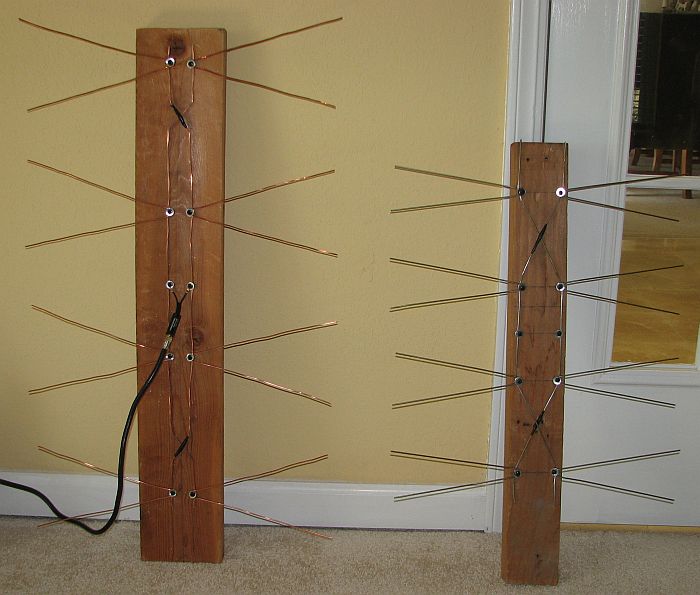
For the DIY type that is interested in OTA TV, but doesn't want to buy anything just yet, there are some very simple antennas that you can build, basically for free. Then you can test them in different areas, angles, and heights to see what is available in your area.

Here are 2 examples of some simple ones:

1. The coat hanger antenna is a common one, and mine looked very similar to below:
2564748.attach


2. Then I built a simple version of the Gray-Hoverman, similar to below, with speaker wire.
2327364072_0a5b0b4b5d_o.jpg


I've since built a more advanced version of the GH, and intend to put it up on a pole/tower.
 

theoldwizard1

Well-known member
Joined
Feb 22, 2011
Messages
43,106
Location
SE MI
For the DIY type that is interested in OTA TV, but doesn't want to buy anything just yet, there are some very simple antennas that you can build, basically for free. Then you can test them in different areas, angles, and heights to see what is available in your area.
That is a VERY GOOD design ! The length of those wires is VERY important !!

I have the "commercial" version

51lNmuZ1OYL.jpg
 

Copymutt

Well-known member
Joined
Sep 3, 2016
Messages
3,383
Location
Colorado
https://www.fcc.gov/media/engineering/dtvmaps

https://www.antennasdirect.com/transmitter-locator.html

Both sites will indicate broadcast o.t.a. In your area. The farther the distance, the larger your antenea needs to be.
I installed a 13’ Archer at the gable end of the roof. Run the mast down 4’ or so below the roof peak and pocket it into a set of 2x6s fastened to the facia, thus a triangle, drilled with a hole saw. Extend above the roof at least 8’. Trees and structures in line of sight are your enemy. Ground it!!.
We seldom watch these stations as everything and anything can be streamed if you have good internet.
 

b-boy

Well-known member
Joined
Oct 2, 2013
Messages
2,155
Location
Buffalo NY
It sounds like this antennae could get pretty expensive.

Do you have fast internet? There's a lot of good streaming content available for free. There's also a lot available for minimal $$. A Fire Stick or Roku gives you a lot of online options. Many local stations have streaming that allows you to watch the news and some programming online as well.
 

bob_mp

Well-known member
Joined
Jan 7, 2011
Messages
65
Location
Bay Area, CA
Get as much aluminum as you can, up as high as you can.

Install the highest quality Yagi with the most possible elements on top the highest tower you can afford, with a rotator and a powered amplifier at the antenna.

Use high quality coax and connectors to the house. Minimize connections and splitters.

That's the answer.

^ This.

You want to a large antenna to collect signal power. Putting it higher increases the amount of signal you collect and reduces the level and frequncy selectivity of the mulipath. A low noise amplifier with a gain at least 15 dB greater than the loss of the cable means that the noise figure of of your TV isn't going to materially affect the overall noise figure of your LNA + cable + TV.

BUT...

Mounting an antenna to a brick chimney is a really bad idea in my opinion. A masonry chimney is not durable with respect to intermittent tensile forces, which is what wind loading of the antenna creates. The wind loading force times the height of the antenna divided by the width of the chimney predicts the upward force on one side of the chimney. The opposite side is in compression by the same amount.

A typical Yagi antenna has an effective wind area of 5.5 square feet (Wineguard HD8200U), which is small compared to the area of the chimney. A 70 mph wind imparts a force of about 12 lbs per square foot. Ignoring the mast, the wind load of the antenna is coincidentally about 70 lbs.

If you put this antenna on top of a 10 foot mast, you give this force leverage. and create an torque of 700 ft lbs that varies back and forth. This is what causes problems.
 

AE2

Well-known member
Joined
Nov 28, 2012
Messages
305
Location
Atchison KS
I do a little antenna work from time to time and parents have a motorhome so we are always adjusting and rescanning. Winegard has an app for your phone that will use your location and your camera to show you where to point the antenna. Works well enough.

http://www.winegard.com/apps

antenna-apps.jpg
 
To avoid these ads, REGISTER NOW!
Top Bottom