To avoid these ads, REGISTER NOW!

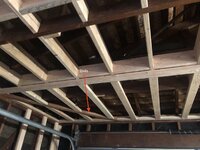
Adding additional framing for the attic storage in the garage, does this look safe?

naithara1989

New member
Joined
Jan 3, 2022
Messages
3
Hi All,

I’m adding attic storage to the garage and currently working with a contractor. He mentioned that the ceiling joists (2x6, 20 feet long) are 48 inches apart and sagging. So he reinforced the ceiling joists by adding multiple 2x6 that attaches to the roof rafter. Instead of adding additional ceiling joists, he added 2x6 lateral support to the joists for supporting both drywall and plywood on top. I'm planning to store our holiday decorations, empty suitcases and 4-6 boxes 50 lbs each. Thoughts on this framing structure? (the house is in california)
 

Attachments

  • Image from iOS.jpg
    Image from iOS.jpg
    273.3 KB · Views: 336
Last edited:
To avoid these ads, REGISTER NOW!
OP
N

naithara1989

New member
Joined
Jan 3, 2022
Messages
3
I’m adding attic storage to the garage and currently working with a contractor. He mentioned that the ceiling joists (2x6 20ft wide) are 48 inches apart and sagging. So he reinforced the ceiling joists by adding multiple 2x6 reinforcements that attaches to the roof rafter. Instead of adding additional ceiling joists, he added 2x6 (16 inches apart) laterally to the joists. I'm planning to add 3 plywood sheets as shown in the image along with drywall. In terms of load, I'm planning to store light weight load (couple of empty suitcases and 2-3 boxes 50lbs each max). He's planning on adding the ceiling soon and finishing the work. I'll probably not have the full visibility into how the joists are handling the load.

From my research online and talking to some friends, here's a list of options I compiled (ranking from more work to less work) -
a) remove newly added framing, add additional 2x6s 24 inches apart and redo the framing? I have water heater and HVAC on the other which makes it harder to add 2x6s there.
b) sister existing ceiling joists with additional joists, one of my friends did this instead of adding 2x6s 24 inches apart
c) run couple of continuous beams under the ceiling joists without removing the newly added framing. the distance between the other two walls is 24 feet
d) leave the framing as is for now and be wary of storing heavy load

Any help here is appreciated!
 

Attachments

  • Image from iOS.jpg
    Image from iOS.jpg
    299 KB · Views: 313

laser3kw

Well-known member
Joined
Nov 17, 2012
Messages
7,276
Location
northen IL
If the ceiling joist were on 48" and sagging, what is shown is doing little to fix that problem. In my opinion, they / he should have put in 1 if not 2 more joist between the existing joist and the addition supports tied back to the rafters.
 

wssix99

Well-known member
Joined
Mar 2, 2011
Messages
5,161
Location
Chicago, IL
OK. After taking a second look at the pictures, I think I see what is going on.

This is really bad. I would stop and re-group with a competent professional before you do anything more. As mentioned above, you have a structural problem and an engineer can give you the solution for your area and local building codes.

Some of the things your contractor has done will not address your problem directly and other things they did can bring your roof down.

- The lateral bracing installed is probably overkill. The lateral bracing will help increace the load carrying capacity of the ceiling joists, but they probably won't do much for the sagging and bending. (Unless they were all bent and curved laterally before the contractor started. Otherwise, they may have gotten things flatter.)

- The vertical pieces tying the joits to the rafters puts point loads on the rafters, which they were not designed for. This reduces the wind, snow, etc. load bearing capacity of the roof, which will deminish when you store more weight on the joists.

What you likely need are additional joists are more joists sistered to your original ones. You probably need some lateral bracing and the vertical ties will most likely need to go. An engineer can work all this out very easily for you.
 

Bretny

Well-known member
Joined
Jul 31, 2017
Messages
3,918
Location
Dutchess county NY
Adding blocking like he did didnt do anything to help the sagging ceiling joists. But them being 2x6x20' also isnt helping. They could be sagging just from there own weight along in a length like that...then you go and add storage up there, that's not going to help.

Putting 2x6x20' every 16in would be bare minimum with only light storage.
 

billconner

Well-known member
Joined
Jul 20, 2021
Messages
6,970
Location
Thousand Islands NYS
I agree with wssix99. The original 20' 2x6 ceiling joists seem under designed for the original job of preventing the walls from spreading.
Unless I'm missing something, the lateral 2x6s between them seem totally wrong and wssix66's point about the vertical 2x6s is right on unless the rafters were oversized (doubtful) or reinforced.

Adding truss joists between the 2x6s would have been my direction, but not possible now with the lateral 2x6s.
 

kmacht

Well-known member
Joined
Apr 12, 2010
Messages
2,769
Location
Connecticut
Are the kids 2x6x20s unsupported in the middle? That’s an awful long span for a 2x6 that is going to support any weight for storage. Their original purpose as cross ties is just to be used as tensioners to keep the outside walls from spreading out. They were not designed to hold any vertical loads. Tying them to the roof joists is not the right way to do this type of project. You need a beam running under the 2x6 to take the load vertical for attic storage or you need a different roof truss design. If it were me I would have the contractor stop work immediately as it doesn’t seem like he has a clue if this was his solution.
 

racecougar

Well-known member
Joined
Jan 26, 2021
Messages
5,106
Location
Missouri
Agreed with all above. All the contractor has done here is create an attic floor that is now hung from the rafters, placing point loads on the rafters that they were not designed for. Was this not discussed before the contractor began work?
 
To avoid these ads, REGISTER NOW!

firebirdparts

Well-known member
Joined
Jun 8, 2016
Messages
10,630
Location
Kingsport, TN
I think the reinforcement is good, but running all the framing the other way is bad. Joists running the traditional direction would have been better. In fact they would have been a lot better.

I am choosing to believe, without seeing them, that the rafters are primarily designed based on bending and he connected near the peak; when you put them in additional compression by this load, they won't mind that at all. What does mind it, and you should be careful about this, is the connection to the few joists you had and the connection to the wall. Every pound you put on the vertical support will put several pounds on your connections out there, and the connections to the wall especially are not easy to make strong. The geometry is not very good for that. But joist-to-rafter connections are flat with lots of area to connect.
 
Last edited:

firebirdparts

Well-known member
Joined
Jun 8, 2016
Messages
10,630
Location
Kingsport, TN
I agree with wssix99. The original 20' 2x6 ceiling joists seem under designed for the original job of preventing the walls from spreading.
FWIW a 2 by 6 in tension is incredibly strong. You could pull a locomotive with one if you could connect to it. And normally you've got one every 16 inches. They sag at that length, but in tension they're actually overkill. Typical ranch house trusses, even at your typical 30 foot span and 4/12, don't even need to use them.

Putting them every 4 feet was not very good.
 
Last edited:

Half-fast eddie

Well-known member
Joined
Jul 10, 2021
Messages
1,479
Location
Virginia
So he reinforced the ceiling joists by adding multiple 2x6 that attaches to the roof rafter.
You need to find a competent contractor. By adding connectors between the ceiling joists and the roof rafters, you are going to collapse both the joists and the rafters when you overload the storage space.
 

billconner

Well-known member
Joined
Jul 20, 2021
Messages
6,970
Location
Thousand Islands NYS
FWIW a 2 by 6 in tension is incredibly strong. You could pull a locomotive with one if you could connect to it. And normally you've got one every 16 inches. They sag at that length, but in tension they're actually overkill. Typical ranch house trusses, even at your typical 30 foot span and 4/12, don't even need to use them.

Putting them every 4 feet was not very good.
I say under designed because the building code requires sof #2 2x10s - 16 o.c. for the 20' span (actually 19-10 is max). That's for a attic with storage.

I don't know what trusses have to do with this garage.
 

FMB4

Well-known member
Joined
Jan 19, 2017
Messages
2,926
Yep, I see what you have as being very poorly designed from the start. I might have missed it; but is garage attached to living quarters? If so, that likely wasn't to code.
 

Bert_

Well-known member
Joined
Dec 24, 2016
Messages
9,734
Location
NW Iowa
Why are the extra joists run that way? They really need to span the width of the building. This is a big enough problem that you really need to start over.

You can hang a load from the rafters but it absolutely has to be done from the peak. Look at how a truss is designed and it becomes pretty obvious. All the load goes to the peak.
 
OP
N

naithara1989

New member
Joined
Jan 3, 2022
Messages
3
The original 20' 2x6 ceiling joists seem under designed for the original job of preventing the walls from spreading.
Not sure if its the right name but there are two 2x6 joists that go from the center of the two walls (holding the ceiling joists) to the roof ridge beam. Also two 2x4s (shown in the picture) that connects the the walls (holdings the ceiling joists) to the garage door. Not sure if they are added to provide additional support to hold the walls together?
 

Attachments

  • IMG_9978.jpeg
    IMG_9978.jpeg
    313.6 KB · Views: 179

billconner

Well-known member
Joined
Jul 20, 2021
Messages
6,970
Location
Thousand Islands NYS
naithara1989 - not a simple issue and really needs to be looked at. I agree with others that whomever suggested adding the lateral 2x6s doesn't understand structural loads and code. Finding a safe and practical solution will be a challenge for someone and, unless you're in NY north country, won't be me.
 

3onthetree

Well-known member
Joined
Nov 14, 2018
Messages
191
I think everyone got the bits and pieces right. So restating some of what was said and adding a little more:

The 2x6x20's are your rafter ties keeping your walls from pushing out. In the old days they were placed every 4'. They can be as little as 2x4 for their purpose, but were usually bumped up to 2x6 over long distances to prevent sagging from its own weight, not to allow storage. If you think they will just hold some Xmas stuff and junk, undersized wood and nails are very accomodating. Heck, I have rims, body panels, iron heads and **** on trusses and I even know better. But it's a risk you take with storage creep over time.

The old diagonal 2x4 tying in the corner top plates of your garage was just temporary to keep the walls square until the roof went on. The 2x6 up to the ridge you speak of but doesn't show in the pics, those were probably also temporary to hold up the ridge board until all the rafters were in place (looks like a hip roof). Neither of these are needed now, but keep the 2x6 braces as your ridge and hip rafters are probably not sized as beams.
____________________________

If you want to solidify this existing roof and provide real attic storage:
- Remove all the ceiling-level framing. The new lateral bracing between these rafter ties has done nothing but added more dead weight to what the 2x6x20's already has to contend with. Running a bunch of purlins up to the rafters might keep them from sagging, but it actually reduces your existing roof rafter capabilities.
- Install 2x10x20'@12"o.c. ceiling joists (existing rafters look 24"o.c.)
- Install 2x4 kickers from each rafter on the perpendicular 24' long hip roof, down to the 2x10 ceiling joists.

If you want to add real attic storage by keeping the old 2x6x20's:
- Remove all the new lateral bracing, everything except the old 2x6x20'@48"o.c.
- Add new 2x6x20's in between to make the spacing 24"o.c.
- Add a perpendicular 24' long steel W-flange beam under the midpoint of the 2x6x20's. It has to be under because with the hip roof over the garage door it would clip a flush beam if resting on the top plate. Then it has to be steel because you only have about 8" above the garage door header. Then you need to verfiy the existing garage door header can take the weight, and provide a post on the opposite side in the house wall and then verify that foundation is adequate too. Then offset your garage door opener. See where I'm going?
 
To avoid these ads, REGISTER NOW!
Top Bottom