To avoid these ads, REGISTER NOW!

Adding Grease to Sealed Ball Joint by Adding a Zerk

YoshiMoshi3

Well-known member
Joined
Nov 2, 2022
Messages
502
I drilled a hole into an outer tie rod. Tapped it for a zerk fitting, installed the fitting and added grease. I've seen a couple of people on YouTube do this. I was surprise how much it took. I was able to install it in the car. The new ball joint was nice and tight. But when torquing it down to spec the boot blew passed the spring clamp and grease came out from the base of the boot. I probably added to much grease. I tried to remove the part, take off the clamp and get the boot and clamp back in place. Even with the clamp back in it's proper place, grease still came out of the boot, I probably overstretch the clamp. The ball joint now spun very easily, making it very difficult to reassemble because the ball joint and nut spun together.

This got me thinking about a few things:
  1. When adding zerk to ball joints via a zerk fitting, you can over-grease very easily and there are no provision for grease to be expelled from the joint. Where does the grease go in a sealed ball joint? Seems like I should add grease every oil change, because it could result in over-greasing. So I should just check to see if the boot is nice and firm. If it's firm do not add grease. It seems like once I have added grease to the joint, I won't need to add grease ever again, or only once every several years? This is opposed to greaseable ball joints from the factory, that you should grease every oil change.
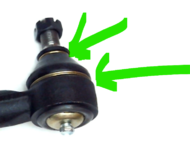
  2. Is there a specialty tool to remove or help install the spring clamps for ball joint boots, without overstretching? These clamps.1714355422997.png
 
To avoid these ads, REGISTER NOW!

Jswain

Well-known member
Joined
Apr 26, 2013
Messages
2,465
Location
Calgary, AB
Typically you watch the boot when you grease and stop as soon as the boot starts to move, only a couple shots if you're doing it every oil change.

Tie rods aren't as picky because a lot of the times the boot just sits there without being somewhat sealed.

I've always just worked those springs off like a coil, using a pick to wrap it down the boot, I'm sure there is a better way though.
 

Wamsutta

Well-known member
Joined
Jan 8, 2014
Messages
10,888
Location
Amarillo, Texas
Shoot grease into the boot after the ball joint is assembled to the steering knuckle. When the boot starts to puff up, stop.

Some ball joint boots have a relief cut out at the top of the boot by the ball joint stud. Those you can grease as much as you want.
 

Ultradog MN

Well-known member
Joined
Jan 20, 2024
Messages
798
Location
Twin Cities
How much is a new ball joint?
I haven't replaced a ball joint on a vehicle in Many years but have done it on several old tractors. Those are pretty cheap.
 

Pasha

Well-known member
Joined
Jan 28, 2014
Messages
99
How much is a new ball joint?
I haven't replaced a ball joint on a vehicle in Many years but have done it on several old tractors. Those are pretty cheap.
For a passenger car, probably a little over $100. For the ball joint (installing it yourself) and new alignment.
 

dchawk81

Well-known member
Joined
Jul 31, 2014
Messages
14,419
That's only good enough to make it road worthy to get to the shop for a proper alignment.
If it's the same length, you didn't change anything and the alignment guy won't have anything move. So you're just wasting time and money.
 

2ndGearRubber

Well-known member
Joined
Mar 24, 2014
Messages
14,185
Location
Pittsburgh
If it's the same length, you didn't change anything and the alignment guy won't have anything move. So you're just wasting time and money.

Typically the joint centerline AND the overall length, aren't going to be zero tolerance perfect.


Typically a greasable ball joint connection has a path in the (usually plastic) wear sleeve it rides on. If you do not drill fully through this sleeve, any grease added will just bypass the friction surfaces and exit via the boot. I've seen people try to do this previously and damage the wear sleeeve/surface, leading to a very loose ball joint or tie rod quite quickly.

I use a pocket screwdriver and "walk" off those boot clips. If the joint is now loose you likely broke the internal wear sleeve either by drilling or hydraulically fractured it with the grease.
 
To avoid these ads, REGISTER NOW!

rust in the eye

Well-known member
Joined
Oct 2, 2017
Messages
2,816
Location
Chicagoland
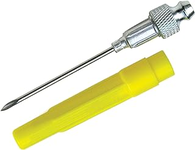
If you insist on adding grease to a sealed ball joint, tie rod etc. you can do so via a needle. Excess will be expelled through the hole you've made.
Given a properly manufactured and installed ball joint alignment shouldn't be needed. If a car has been re-aligned while having worn parts then a new part may now throw things off.
I never do any alignment unless a car is symptomatic, uneven tire wear or poor driving/steering characteristics. Drives good, tires wearing good then I leave it the F alone.
1714392005339.png
 

AA/FC

Well-known member
Joined
Dec 9, 2010
Messages
2,080
I did this to my brand new Ram 5500 work truck back in 2017. The truck had just over 36K miles and the ball joint started squeaking terribly when I would turn the steering wheel. The joint wasn't bad (yet) it was just dry and squeaky. I drilled the top ball joint, installed a zerk, and put in as much grease as I could..... which wasn't much. There isn't a channel for grease to flow into the joint like there would be in a joint that was intended to be greased. After 1 or 2 pumps it was like trying to pump grease into a "dead end". However, it was just enough to stop the joints from squeaking until the end of that truck's like (traded in for a new one 120K)

As for pumping grease into the rubber boot with the "needle" attachment..... I've heard of others trying that but unfortunately, the boot area of the joint isn't where the grease is needed. You need grease in the actual joint itself.... The boot area of the joint is basically the "reservoir". You could fill the boot jam packed with grease but the actual joint could still be bone dry.
 

cannuck

Well-known member
Joined
Nov 30, 2021
Messages
4,660
Location
Rural SK
I usually pay less than $15 for a tie rod end, or $40 for an entire tie rod with 2 ends. Just not worth buggering around with to lube. IMHO on steering anything I want as little slop as I can get. Also replacing entire tie rod with clean, new threads make alignment a lot easier.
 

shanker

Well-known member
Joined
Jun 27, 2005
Messages
1,259
Location
Portland, TX
I recently replaced every suspension wear item (ball joints and control arm bushings) under the front of my 2000 F150 and purchased exclusively the TTX line of ball joints based on a friend that own's a shop recommendation. I noticed on the ball joint boots that there is a tiny pin hole with a flapper in it that allows for excess grease to be pushed out. I don't understand why this isn't standard for every serviceable ball joint.
 

bwringer

Well-known member
Joined
Jan 1, 2013
Messages
10,322
Location
Indianapolis
I'd replace the thing rather than try and figure out where to put a zerk so it might actually do some good.
 
OP
Y

YoshiMoshi3

Well-known member
Joined
Nov 2, 2022
Messages
502
Typically the joint centerline AND the overall length, aren't going to be zero tolerance perfect.


Typically a greasable ball joint connection has a path in the (usually plastic) wear sleeve it rides on. If you do not drill fully through this sleeve, any grease added will just bypass the friction surfaces and exit via the boot. I've seen people try to do this previously and damage the wear sleeeve/surface, leading to a very loose ball joint or tie rod quite quickly.

I use a pocket screwdriver and "walk" off those boot clips. If the joint is now loose you likely broke the internal wear sleeve either by drilling or hydraulically fractured it with the grease.
Trying to understand this. Are you talking about the white plastic bearing that sits in-between the ball joint and the ball joint housing? But yea I drilled through this bearing, and then pumped in grease.

I'm surprised there is not a specialty tool to pull off those spring clips off the ball joints.

For the ball joint boots with the flapper, to bad I can't just buy the boots.
 

2ndGearRubber

Well-known member
Joined
Mar 24, 2014
Messages
14,185
Location
Pittsburgh
Trying to understand this. Are you talking about the white plastic bearing that sits in-between the ball joint and the ball joint housing? But yea I drilled through this bearing, and then pumped in grease.

I'm surprised there is not a specialty tool to pull off those spring clips off the ball joints.

For the ball joint boots with the flapper, to bad I can't just buy the boots.

Yes, the plastic load-bearing surface. If you drilled through that and the joint is now loose, it was likely damaged by drilling.


Most people don't bother trying to service ball joints/tie rods on passenger vehicles. Thus parts for such work aren't easily available. Some ball joint applications basically require you to remove the boot to press the joint in. So that's my experiences with messing with boots.


EDIT: Thinking about it more - the plastic load bearing surface should remain static in the joint, and the ball pivot above it. It is possible drilling or greasing dislodged the mounting position of the plastic, allowing both the ball and the plastic to move in response to inputs.
 

Steve_P

Well-known member
Joined
Sep 15, 2010
Messages
5,188
Typically the joint centerline AND the overall length, aren't going to be zero tolerance perfect.


Typically a greasable ball joint connection has a path in the (usually plastic) wear sleeve it rides on. If you do not drill fully through this sleeve, any grease added will just bypass the friction surfaces and exit via the boot. I've seen people try to do this previously and damage the wear sleeeve/surface, leading to a very loose ball joint or tie rod quite quickly.

I use a pocket screwdriver and "walk" off those boot clips. If the joint is now loose you likely broke the internal wear sleeve either by drilling or hydraulically fractured it with the grease.


Sooo... this is what I do. I pry back the clip and squirt some grease in with a needle tip on the hose.

I know it's not the same as a fitting, but it's something.
 
To avoid these ads, REGISTER NOW!
Top Bottom