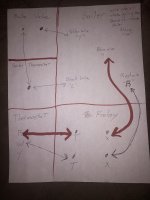
I posted the other day but things have changed. We live in a 2 story house with hot water base board heat. We have a well-Maclean boiler and then there are two relays controlling the valves for upstairs/downstairs. There are separate thermostats on both floors. They both have old analog Honeywell thermostats. They only had 2 wires going to them. My wife wanted a “smart thermostat”. I realized the current wire setup wasn’t going to work so I ran a new 18/5 wire. My diagram shows the old wire setup for the first floor from start to finish. Can anyone help me with where I would tap into for a “c” wire the 3 wires would get hooked up to the new thermostat?

You are using an out of date browser. It may not display this or other websites correctly.
You should upgrade or use an alternative browser.
You should upgrade or use an alternative browser.
Adding Smart thermostat/C wire
- Thread starter alex2929
- Start date
Terry D
Well-known member
Im not getting your diagram. Are the valves 120 volt. Did you run the the 18-5 from the thermostat to the boiler. Where ever the 24 volt transformer is, that is where you would hook up the common. You already have your R at the thermostat, by hooking up the C (common) you now will have both sides of your 24 volt up there. Your 24 volt relay will also have a common, which ever is easier to run.
Climatecreator
Well-known member
What control is on the boiler? Or zone panel?
You just need the end switch of the isolation relay(s) going to TT on the boiler primary control. Or for multi zone to a zone panel. Some boilers don't have a common. You'd need a 24v transformer added on to power the smart stat and treat it like it's a transformer in an AC air handler etc
Everything else should be powered from the transformer. Including any common you would run.
The idea is to isolate the boiler from the second transformer you're adding.
CC
You just need the end switch of the isolation relay(s) going to TT on the boiler primary control. Or for multi zone to a zone panel. Some boilers don't have a common. You'd need a 24v transformer added on to power the smart stat and treat it like it's a transformer in an AC air handler etc
Everything else should be powered from the transformer. Including any common you would run.
The idea is to isolate the boiler from the second transformer you're adding.
CC
ovilla
Well-known member
If you can’t figure out where/how to tap into your 24v transformer, then just buy one of these.
24Volt Doorbell Transformer, C - Wire Adapter Thermostat, Compatible with Nest,Honeywell,and Ecobee Smart WiFi Thermostat, Nest Hello Ring Video Doorbell https://www.amazon.com/dp/B07RXL53K5/?tag=atomicindus08-20
24Volt Doorbell Transformer, C - Wire Adapter Thermostat, Compatible with Nest,Honeywell,and Ecobee Smart WiFi Thermostat, Nest Hello Ring Video Doorbell https://www.amazon.com/dp/B07RXL53K5/?tag=atomicindus08-20
I think that diagram might have problem.... T and T on a relay usually are 120V/240 high voltage stuff on the other side... and "usually" if you shorted out T and T it turns on the burner/boiler... and does not needed to apply a voltage to it. as oppose to what your diagram suggests. ... not a 24V thing.from my none pro experience... I suspect magic smoke comes out maybe at best case, or kaboom at worse.
C is easy to find... C means common or aka the other leg in the transformer output that is designated as return/negative sort of... ( not earth)... go look at your 24V transformer. trace which one of the wire is the R connected to... The Other wire is C. If you measure the AC voltage between R and C, it should read 24VAC as well...
in general that is how I usually finds them... except in Hydronic valves... its a bit different but almost the same procedure modified to fit.
Problem with "Smart" thermostat is that it draws a lot more current than standard dumb thermostat, some system can't can handle the extra load..especially the one that have a lot of zones... and power hungry valves.. so you might needed a separate transformer and isolation relay....
echobee website have a great support article on isolation relays.. I have used it to add a transformer for my friends 5 zone hydronic heating... YMMV of cause, If it was me, I would figure out what you have first before diving into things... especially what's bought up on post #2, #3..... you mention baseboard, circulating hot water..... older systems uses line voltage. especially things that mention T1 T2 or T T...
*** this is the article .. I got my friend the HVAC duty transformer 40VA and a RIBU1C relay ... in reality you can choose any relay that is 24VAC but I just choose the one made for HVAC stuff so I don't deal with you buy me cheapie component.
https://support.ecobee.com/hc/en-us...ermostat-installation-with-an-isolation-relay
C is easy to find... C means common or aka the other leg in the transformer output that is designated as return/negative sort of... ( not earth)... go look at your 24V transformer. trace which one of the wire is the R connected to... The Other wire is C. If you measure the AC voltage between R and C, it should read 24VAC as well...
in general that is how I usually finds them... except in Hydronic valves... its a bit different but almost the same procedure modified to fit.
Problem with "Smart" thermostat is that it draws a lot more current than standard dumb thermostat, some system can't can handle the extra load..especially the one that have a lot of zones... and power hungry valves.. so you might needed a separate transformer and isolation relay....
echobee website have a great support article on isolation relays.. I have used it to add a transformer for my friends 5 zone hydronic heating... YMMV of cause, If it was me, I would figure out what you have first before diving into things... especially what's bought up on post #2, #3..... you mention baseboard, circulating hot water..... older systems uses line voltage. especially things that mention T1 T2 or T T...
*** this is the article .. I got my friend the HVAC duty transformer 40VA and a RIBU1C relay ... in reality you can choose any relay that is 24VAC but I just choose the one made for HVAC stuff so I don't deal with you buy me cheapie component.
https://support.ecobee.com/hc/en-us...ermostat-installation-with-an-isolation-relay
Last edited: