To avoid these ads, REGISTER NOW!

Adding subpanel (125A) adjacent to 200A main service

Dave88LX

Well-known member
Joined
Nov 25, 2006
Messages
664
Location
York, PA
Man. The more I am reading, the more confused I am getting. I'm hoping to sort out my confusion so I can proceed. I don't want to ask stupid questions, but I don't want to keep reading in circles any longer either :bounce:. I am comfortable doing the installation work and wiring. I just want to make sure I am using the right stuff.

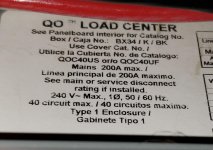
My 200A main panel is pretty close to full (see pics below). I still have yet to add:
  • Generator Interlock (2 slots)
  • Air Compressor (2 slots)
  • Garage Subpanel (2 slots)
  • Shed Subpanel (1 or 2 slots)
  • Basement Wiring (currently unfinished -- multiple slots)

The first thing I want to do is move the two top right breakers to the bottom for a generator feed interlock. I will need to extend the hots. From my understanding, it's allowable to splice an extension onto a wire. Is there any thing "nicer" than a twist-on wire nut?

I don't see any reason not to run a 125A subpanel (max current load center breaker size) next to the main panel. I can't predict every thing I'm going to have through the future, but, it's not much extra cost to just do a 125A from the start.

Does this breaker follow the "80% rule" in which case I'd want to limit the subpanel load capacity to 100A?

(Have to forgive the thumbnails -- might have to click them. I tried uploading pics as an album and inserting as BB code, but they come out blurry.)

If I am limited to 100A, then, following the 75° column, I would use 3AWG Copper or 1AWG Aluminum. If I should be sizing to 125A, then it would be 1AWG Copper (1-1-1-3 SER) or 1/0 Aluminum (1/0-1/0-1/0-2 SER).

Is SER the best option? Or conduit with THHN?

It's only going to be a couple foot run, so cost will be negligible anyways, even in the Copper vs. Aluminum debate. I see people arguing for both sides, but I don't have a horse in the race. Aluminum is cheaper, but for such a small length, it doesn't matter. I'd want whatever is easier to work with (bend and move around) I guess.
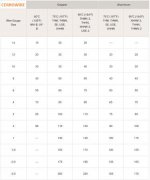
Ampacity Wire Chart.jpg


20200410_010731.jpg


20200421_182652.jpg


20200426_004222.jpg
 
To avoid these ads, REGISTER NOW!
OP
D

Dave88LX

Well-known member
Joined
Nov 25, 2006
Messages
664
Location
York, PA
Current load center is QO as stated above, so I figure run another SquareD QO panel so I only have to buy one type of breaker.


This breaker:
https://www.homedepot.com/p/Square-D-QO-125-Amp-2-Pole-Circuit-Breaker-QO2125CP/100114369


Any objections to this panel?

QO 125 Amp 24-Space 24-Circuit Indoor Main Lug Qwik-Grip Plug-On Neutral Load Center with Cover Ground Bar - Value Pack

Includes:
(3) QO120 QO 20 Amp single-pole circuit breakers
(2) QO230 QO 30 Amp double-pole circuit breakers
(1) factory-included flush cover

https://www.homedepot.com/p/Square-...ound-Bar-Value-Pack-QO124L125PQGCVP/301280487
 

Terry D

Well-known member
Joined
Mar 25, 2015
Messages
2,202
Location
St. Louis, MO.
I would think a 100 amp sub panel would be fine. But if your main panel is rated for a 125 amp breaker, you could do this to. Which ever way, the panel you mentioned would work. I don't know what you mean by the 80% rule. I would just use a piece of EMT of PVC to connect the two panels if they are a couple of feet apart

100 amp feed- (3) #1 XHHW alum. and (1) #6 XHHW alum EGC - 1 1/4 conduit

125 amp feed (3) 1/0 XHHW alum and (1) #4 XHHW alum EGC - 1 1/2 conduit

You will probably have to buy a lug kit to connect to the neutral buss for that larger wire

https://www.homedepot.com/p/Square-...Auxiliary-Neutral-Lug-Kit-LK100ANCP/100115933

https://www.homedepot.com/p/Square-D-70-Amp-Load-Center-Auxiliary-Neutral-Lug-Kit-LK70ANCP/203122137
 
Last edited:
OP
D

Dave88LX

Well-known member
Joined
Nov 25, 2006
Messages
664
Location
York, PA
Thank you for the info/feedback so far. Yeah 100A might be enough, but I don't know what the future will bring, and can't see any good reason not to just set up a 125A.

I will check out XHHW as well. What is your preference for it over THHN? I'll do my own Googling too. I did see this:

Flexibility:
"Surprisingly, even though XHHW has a thicker and more protective jacket, it is also more flexible than THHN wire. This is due to the XLPE insulation of the XHHW allowing the cable to bend and flex more easily than the PVC insulation of the THHN – making XHHW much easier to work with during the installation process."


The 80% rule I see mentioned -- basically if you have a 20A breaker, you don't want to be running more than 16A through it (IIRC).

I'll check the knockouts on the side and see what size they go up to.

Current breaker panel is mounted to what looks like a pair of 2x4s that have been attached to the concrete wall. I assume it's acceptable to do the same here, but open to better ways.

I have that that sheet insulation on the walls currently, I'd have to cut a little section out (no biggie).
 
Last edited:
OP
D

Dave88LX

Well-known member
Joined
Nov 25, 2006
Messages
664
Location
York, PA
Last edited:

Terry D

Well-known member
Joined
Mar 25, 2015
Messages
2,202
Location
St. Louis, MO.
You will not have to concerned about the 80% deration. That is for continuous loads. A continuous load is something that is going to one constant for 3 or more hrs. Lighting loads are considered continuous. So you individual branch circuit breakers is where you would have to fiqure that in with your case.

XHHW is cheaper and bends easy

Sent from my SM-G960U using The Garage Journal mobile app
 

Terry D

Well-known member
Joined
Mar 25, 2015
Messages
2,202
Location
St. Louis, MO.
To avoid these ads, REGISTER NOW!
OP
D

Dave88LX

Well-known member
Joined
Nov 25, 2006
Messages
664
Location
York, PA
Makes sense on the XHHW and sizing. XHHW not showing up at local big box; might have to find a local electric supply house or order online.

Thanks for the heads-up on this. If I'm following, the 1/0 Al conductor will enter this lug, which will utilize 2 spots on the neutral bar? I did some more digging on this.

The lug says it's a 70A lug though...You can see my confusion.

(Brainstorming in the thread)
This might be the one I need...LK125AN
https://www.se.com/us/en/product/LK125AN/lug-kit/

Although this FAQ indicates I might not need one.
https://www.se.com/us/en/faqs/index?page=content&id=FA101026&actp=search&viewlocale=en_US

What is the wire range for the main lugs of a 125 ampere convertible Main Lug QO load center?
The main lugs accept (1) #6 - 2/0 AWG aluminum or copper conductors and should be torqued to 50 inch-pounds. The main neutral lugs will accept (1) #4 - 2/0 AWG aluminum or copper conductors and should also be torqued to 50 inch-pounds.
 
Last edited:

Terry D

Well-known member
Joined
Mar 25, 2015
Messages
2,202
Location
St. Louis, MO.
Makes sense on the XHHW and sizing. XHHW not showing up at local big box; might have to find a local electric supply house or order online.


Thanks for the heads-up on this. If I'm following, the 1/0 Al conductor will enter this lug, which will utilize 2 spots on the neutral bar? I did some more digging on this.

The lug says it's a 70A lug though...You can see my confusion.

(Brainstorming in the thread)
This might be the one I need...LK125AN
https://www.se.com/us/en/product/LK125AN/lug-kit/

Although this FAQ indicates I might not need one.
https://www.se.com/us/en/faqs/index?page=content&id=FA101026&actp=search&viewlocale=en_US

What is the wire range for the main lugs of a 125 ampere convertible Main Lug QO load center?
The main lugs accept (1) #6 - 2/0 AWG aluminum or copper conductors and should be torqued to 50 inch-pounds. The main neutral lugs will accept (1) #4 - 2/0 AWG aluminum or copper conductors and should also be torqued to 50 inch-pounds.

I noticed also with the 70 amp rating, I actullaly never knew they had a rating, been using these for years. Main thing is that it is rated for the size of wire that you are using, plus, if it will give you peace of mind, you will never have 70 amps on that neutral. You would have to have all your load on one leg. The neutral carries back the difference (the unbalanced load) between the two hots. Basically if you have 30 amps on one hot and 40 amps on the other, you will have 10 amps on the neutral. And you are right, they fit under 2 terminals of a neutral or ground buss. I call them crows feet, don't know what they are called across the country. I like these better because they come off the side of the buss, not straight up or down. The other kind might work better for you.

You can use set screw or compression fittings on the conduit, although compression are a little more in price and not required since it not outside. Also, on the ends of the fittings, inside of each panel, screw on a 1 1/2 threaded plastic bushing, these are required by code with the larger wire, I believe its #4 and up.

https://www.homedepot.com/p/Halex-1-1-2-in-Plastic-Insulating-Bushing-97525/100201688

There are no clamps when you use conduit, like if you were using a SER cable. The conductors just lay in the conduit and in the panels.
 

mike93lx

ALLIANCE MEMBER
Joined
Dec 9, 2013
Messages
38,398
Location
Richmond, VA
I didn't see it mentioned, but while you are limited to a 125a breaker in the main panel, you can use a larger sub panel. I would get something with a ton of spaces, probably would be labeled as a 200a panel
 
OP
D

Dave88LX

Well-known member
Joined
Nov 25, 2006
Messages
664
Location
York, PA
TerryD -- Thanks for the explanation of the neutral -- wasn't exactly sure how it worked there on the sub. Makes sense.

I'll only need 2 fittings, so the cost difference is negligible between 'em, no biggie there. I was going to use EMT though. What is the 1-1/2" threaded plastic bushing used for?

Mike -- Good point. I'll look into that option as well. It would be nice to have that kind of flexibility.
 
OP
D

Dave88LX

Well-known member
Joined
Nov 25, 2006
Messages
664
Location
York, PA
I had a pice of 1AWG copper THHN. Christ that is stiff stuff. Can't imagine even thicker.

Looks like I'll need to upgrade my wire cutters as well. I have bolt cutters, if those are acceptable, unless there's something better to use.
 

Terry D

Well-known member
Joined
Mar 25, 2015
Messages
2,202
Location
St. Louis, MO.
TerryD -- Thanks for the explanation of the neutral -- wasn't exactly sure how it worked there on the sub. Makes sense.

I'll only need 2 fittings, so the cost difference is negligible between 'em, no biggie there. I was going to use EMT though. What is the 1-1/2" threaded plastic bushing used for?

Mike -- Good point. I'll look into that option as well. It would be nice to have that kind of flexibility.

The plastic bushing just gives extra protection to the wire getting nicked , cut or abrasions from contacting the end of the fitting. I know it seems redundant, but it is required
 
OP
D

Dave88LX

Well-known member
Joined
Nov 25, 2006
Messages
664
Location
York, PA
Hacksaw, jeez... got one though.

Ok I'll add that bushing. Just wanted to make sure you knew I was doing EMT.
 

mike93lx

ALLIANCE MEMBER
Joined
Dec 9, 2013
Messages
38,398
Location
Richmond, VA
Hacksaw, jeez... got one though.

Ok I'll add that bushing. Just wanted to make sure you knew I was doing EMT.

It's plenty common for the big stuff. But if you want an excuse to buy bigger cutters, don't let me get in your way :thumbup:

The bushing protects the wire from the fitting, not the conduit. You would use it with any metal fitting
 
To avoid these ads, REGISTER NOW!
Top Bottom