To avoid these ads, REGISTER NOW!

Adding wiring to a welding table

Iron Beaver

Well-known member
Joined
May 3, 2020
Messages
684
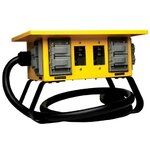
I got the bright idea of adding wiring to my welding table, in conduit inside of pipe for protection and well away from the top to stay cool. Then I thought... What happens if I use a device with HF start such a a TIG or plasma unit? Seems like stray current could theoretically feed electrical noise through the ground into all other devices in the house, right? I'm about ready to drop the idea unless anyone comes up with a convincing argument that it will be fine.

Bring on your arguments. Bonus points if you cite relevant parts of the NEC.
 
To avoid these ads, REGISTER NOW!

Walkers

Well-known member
Joined
May 17, 2021
Messages
3,912
Location
Cave Creek Az
I work at my table every day. I have plenty of wall outlets at 40” height, and have cord hangers at the most used outlets. I know having outlets on the table sounds handy, but it just isn’t. The cord is never long enough, so you will still need extension cords, which are being fed by an extension cord. My table is also on wheels, so you would also have the cord in the way when moving the table.
If you insist on doing it, just tack a metal box to the table. You will either have noise issues from HF or you won’t. If you do just unplug the cord feeding the table while doing that operation.
 
OP
I

Iron Beaver

Well-known member
Joined
May 3, 2020
Messages
684
My situation is a little different because I work outside. Right now powering anything means running an extension cord through an obstacle course and exposing it to trampling, tripping, sharp objects, and other hazards. It would be a big help if I could put one L14-50R on the wall, and then have the welding table wired with a 6-50R to run the welder or plasma cutter and a couple 5-20Rs for the angle grinder and mag drill. Then I'd run a 50 amp rated cord from the welding table setup to plug into the L14-50R on the wall. So unplugging would solve any HF noise issues, but not in a productive way :LOL:
 
OP
I

Iron Beaver

Well-known member
Joined
May 3, 2020
Messages
684
Not sure I get why that is safer? Not trying to disagree, just want to learn :)
 

Walkers

Well-known member
Joined
May 17, 2021
Messages
3,912
Location
Cave Creek Az
Being outside adds a level of difficulty. Honestly the safest method would be to put in a pedestal, or use a spider similar to what is used on construction sites.
 

matt_i

Well-known member
Joined
Mar 14, 2008
Messages
10,737
Location
SE Michigan
If you download this pdf for a Miller Syncrowave tig welder, on page 69 and 70 there's a diagram for bonding all metal objects to an earth ground to dissipate HF electrical noise. I suspect the same issues apply as it uses a HF arc-start.

My free opinion is the short, low-resistance path to ground is the one "chosen" by the HF energy rather than the longer one back thru the panel, etc.

I don't have that setup in my shop, just remembered it. I have never had an issue with any electronics in my house which is the source for the main panel.


pattenp

Well-known member
Joined
Jun 4, 2008
Messages
10,175
Location
Virginia - USA
Not sure I get why that is safer? Not trying to disagree, just want to learn :)
If you're thinking of splitting a 240V 50A cord at the welding table to a 50A outlet and a couple of 120V 20A outlets the 20A outlets need 20A overcurrent protection. It's not safe to have the 20A outlets on a 50A circuit. Would you put a 50A plug on your angle grinder and plug it into a 50A outlet?
 
OP
I

Iron Beaver

Well-known member
Joined
May 3, 2020
Messages
684
I thought it was code compliant to have the breaker rated higher than the outlet as long as there was more than one outlet in the circuit?

I also thought there were inline breakers (similar idea to the ones in an outlet strip) that could be used if necessary without needing a full blown subpanel


I'd rather keep my plugs as standard as possible and using 50 amp outlets would kinda hinder that.
 
OP
I

Iron Beaver

Well-known member
Joined
May 3, 2020
Messages
684
Also I see no code compliance issue plugging an angle grinder into a 50 amp outlet. Is there an issue that I'm missing?
 
To avoid these ads, REGISTER NOW!

Gunfixr

Well-known member
Joined
Feb 9, 2021
Messages
677
Location
behind the house
So, i've been reading this as replies get added, maybe i'm missing something. I'm sure someone here knows more about electric than I, but, if your work area is outside, and running any extension cords is a pita, aren't you talking about basically running an extension cord to the weld table? Not sure i'd want other electrical items or circuits connected to a weld table.
So, why don't you run one extension cord out to the area? I currently cannot wire my garage, so, in the meantime, i've set up an extension cord. I've mounted a 30amp rv hookup box with outlet at the back of the house. A cord, made using sjoow 10ga wire, with a 30 amp rv plug on one end, and a weather resistant 4 gang box on the other, containing a standard 15a outlet, and a 20a outlet. Now, I cannot fully load both outlets at once, but it will run my little welder and plasma cutter. If you don't need that, you could use two 15a outlets.
That gives you weather resistant power anywhere you drag that cord, with 4 plug ins, and 30a total.
Just a thought......
 

pattenp

Well-known member
Joined
Jun 4, 2008
Messages
10,175
Location
Virginia - USA
Also I see no code compliance issue plugging an angle grinder into a 50 amp outlet. Is there an issue that I'm missing?
There is no NEC rules governing what you plug into an outlet but the are manufacturer and UL listings and common sense.
Another thought is the 20A outlets should be gfci protected.
 

TRWham

Well-known member
Joined
Aug 11, 2017
Messages
1,962
Location
East Cobb County, Georgia
I would be careful attaching anything that is bonded to the system ground to a welding table. I don't remember all the details anymore, but there was a case posted here where an extension cord reel was mounted on a welding table and provided a separate ground path resulting in some of the welding current sneaking directly back to the panel rather than to the welder. The EGC in the cord was getting hot and they did not know why.
 

Bert_

Well-known member
Joined
Dec 24, 2016
Messages
9,761
Location
NW Iowa
The 15/20 amp stuff would need over current protection. Can't feed a 15 or 20 outlet with more than a 20A circuit. Doesn't matter how many outlets, can't feed with anything larger than 20A
 
OP
I

Iron Beaver

Well-known member
Joined
May 3, 2020
Messages
684
I would be careful attaching anything that is bonded to the system ground to a welding table. I don't remember all the details anymore, but there was a case posted here where an extension cord reel was mounted on a welding table and provided a separate ground path resulting in some of the welding current sneaking directly back to the panel rather than to the welder. The EGC in the cord was getting hot and they did not know why.
Something like this is exactly what I was afraid of. I think I'm dropping the idea of mounting outlets to the table
 
OP
I

Iron Beaver

Well-known member
Joined
May 3, 2020
Messages
684
There is no NEC rules governing what you plug into an outlet but the are manufacturer and UL listings and common sense.
Another thought is the 20A outlets should be gfci protected.
Right, those are assumed.
 

acer66

Well-known member
Joined
Dec 4, 2010
Messages
4,418
Location
Western North Carolina
I would be careful attaching anything that is bonded to the system ground to a welding table. I don't remember all the details anymore, but there was a case posted here where an extension cord reel was mounted on a welding table and provided a separate ground path resulting in some of the welding current sneaking directly back to the panel rather than to the welder. The EGC in the cord was getting hot and they did not know why.
My metal fabrication days are decades away so things might have changed but we were never allowed to power a welder with wire left on a reel because of the danger of overheating the wire on the reel.
 
Last edited:

mcbane

Well-known member
Joined
Jul 23, 2017
Messages
794
Location
California
If you download this pdf for a Miller Syncrowave tig welder, on page 69 and 70 there's a diagram for bonding all metal objects to an earth ground to dissipate HF electrical noise. I suspect the same issues apply as it uses a HF arc-start.

My free opinion is the short, low-resistance path to ground is the one "chosen" by the HF energy rather than the longer one back thru the panel, etc.

I don't have that setup in my shop, just remembered it. I have never had an issue with any electronics in my house which is the source for the main panel.

I remember ignoring that part of the instructions. And I had huge problems with a synchro 250 setting off my Elk security system, killing land line voice calls, and locking up my internet router.

My machine is from 1998. I wonder if newer TIG machines cause less interference
 
To avoid these ads, REGISTER NOW!
Top Bottom