To avoid these ads, REGISTER NOW!

"Advanced framing"...anyone done it?

mike93lx

ALLIANCE MEMBER
Joined
Dec 9, 2013
Messages
37,455
Location
Richmond, VA
thinking about the next "big" project, which is a 16x16 pool house. I know, basically the same as your 80x120 ag building, so don't get too jealous.

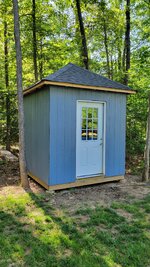
I like using builds like this to try out new stuff, with the hopes of putting it all together in a future home. The last one was a shall shed with a pyramid hip roof.

I'm planning two courses of 6" wide block on top of an existing pad. With that size block, 2x6 for the walls feels somewhat natural, but 16OC 2x6 framing is wildly overkill for the application, so that brings me to 24OC or advanced framing. It would also tend to mean a single top plate, but I'm also hoping to eliminate the need for rafter ties, so I'm contemplating doubling up to stiffen the top of the wall.

This won't be inspected, but I am not using that as a way to cut corners. I want this to be at a level that would pass for residential construction. with that said, I'm not looking for anyone to provide engineering specs or a materials list...just a discussion on the topic.
 
To avoid these ads, REGISTER NOW!

Zeke

Well-known member
Joined
Aug 13, 2009
Messages
17,176
Location
Long Beach CA, the sewer by the sea.
Initially when that was popularized some years ago, it was called optimum value engineering (OVE). Now advanced framing means the same. Roof members line up with studs. Windows, doors and interior wall always have one side lined up with one of the 24" O.C. studs.

This can be limiting for design purposes but no doubt a lot of lumber is wasted when the planning is weak.

The best bang for the buck is trusses placed on the studs so you can save your double top plate. In CA that might be a moot point because a lot of our sill plates are 3 x lumber and with the double top plate gives enough for the nailing schedule.

Trusses give you a roof and a ceiling all in one. It doesn't get much cheaper. The ultimate OVE house is gonna be a gable roof, no hips, valleys, etc. Probably a long single story ranch style, no bump outs. You could put a smaller gable structure at one end just to gain some design feature. That could be a standard attached garage with the utilities.

Also, plumbing can be optimized whereas you don't have bathrooms at the far ends.
 

rockettauto

Well-known member
Joined
May 12, 2023
Messages
745
Nope but now I'm curious.... I have pretty limited knowledge and I know you said no inspection but essentially youre still building to code.

How does the double top plate get you out of rafter ties , or at least collar ties?

Forgive my ignorance but Im thinking from a code perspective and can't think of where it would matter really.

I get the idea of it keeping the roof from trying to bow the walls so much in the center but youd still need compression bracing in the form of collar ties right?

I can't really help you but it sounds like you could help me here.
 
OP
M

mike93lx

ALLIANCE MEMBER
Joined
Dec 9, 2013
Messages
37,455
Location
Richmond, VA
Initially when that was popularized some years ago, it was called optimum value engineering (OVE). Now advanced framing means the same. Roof members line up with studs. Windows, doors and interior wall always have one side lined up with one of the 24" O.C. studs.

This can be limiting for design purposes but no doubt a lot of lumber is wasted when the planning is weak.

The best bang for the buck is trusses placed on the studs so you can save your double top plate. In CA that might be a moot point because a lot of our sill plates are 3 x lumber and with the double top plate gives enough for the nailing schedule.

Trusses give you a roof and a ceiling all in one. It doesn't get much cheaper. The ultimate OVE house is gonna be a gable roof, no hips, valleys, etc. Probably a long single story ranch style, no bump outs. You could put a smaller gable structure at one end just to gain some design feature. That could be a standard attached garage with the utilities.

Also, plumbing can be optimized whereas you don't have bathrooms at the far ends.
Nope but now I'm curious.... I have pretty limited knowledge and I know you said no inspection but essentially youre still building to code.

How does the double top plate get you out of rafter ties , or at least collar ties?

Forgive my ignorance but Im thinking from a code perspective and can't think of where it would matter really.

I get the idea of it keeping the roof from trying to bow the walls so much in the center but youd still need compression bracing in the form of collar ties right?

I can't really help you but it sounds like you could help me here.
I'm planning another pyramid hip roof and would like to keep things open. If that doesnvt work, I'd like to try steel cables to stop spreading. Collar ties can pretty easily be replaced with specific hardware, but also, in the case of this style roof, I think it's all locked together so tightly at the peak that it won't really matter anyway.

The pyramid was a challenge and I'd like to make another pass at it and see how much better I can do. The first one went OK and it looks great from the exterior, but I can improve.

The idea on thickening the top plates was to resist bowing, but that is recognizing it is just a 16' wall. It certainly wouldn't be enough on a "real" structure.
 

rockettauto

Well-known member
Joined
May 12, 2023
Messages
745
I'm planning another pyramid hip roof and would like to keep things open. If that doesnvt work, I'd like to try steel cables to stop spreading. Collar ties can pretty easily be replaced with specific hardware, but also, in the case of this style roof, I think it's all locked together so tightly at the peak that it won't really matter anyway.

The pyramid was a challenge and I'd like to make another pass at it and see how much better I can do. The first one went OK and it looks great from the exterior, but I can improve.

The idea on thickening the top plates was to resist bowing, but that is recognizing it is just a 16' wall. It certainly wouldn't be enough on a "real" structure.
Oh cool! Did you, or do you plan to make your own steel corner pieces for the pyramid rafters? I have a 12x12 I'm sort of playing with that idea on.


The end goal is to make the inside look like it's decked with 2x and stained.
 
Last edited:

larry4406

Well-known member
Joined
Jan 27, 2006
Messages
19,108
Location
Northern Virginia
The brain trust bean counters at my company went to 24" OC perimeter walls for our homes when we first upsized to 2x6 from 2x4 for better R-value insulation. This was 10 years ago or so.

With 16" oc, you have 4 studs supporting 4' wide sheathing (2 edges and 2 in the field) and with 24" oc, you have 3 (2 edges and 1 in the field).

The wall sheathing waves at you with 24" oc and it telegraphs thru the siding. You don't see it till the siding goes on.

After many repairs which negated the cost savings and more, the brain trusts reverted to 16" oc and the problems went away.
 

billconner

Well-known member
Joined
Jul 20, 2021
Messages
6,948
Location
Thousand Islands NYS
I built a hip roofed 16 x 16 addition using OVE, and thought it was fine. I did use 23/32 sheathing and avoided Larry's issue.

For walls longer than you can find a single top plate, I might pause.

Where I live now 2x4 with fibreglass and 2" of continuous foam on exterior is accepted, 2x6 with just fibreglass is not, so makes it easy.

And for the nuts like me that use rough sawn 1by for sheathing, you can't use let in bracing for lateral bracing with studs more than 16" on center.

I'm planning another build and am thinking 2x4 16 oc with let in bracing, horizontal board sheathing, and 2".
 
OP
M

mike93lx

ALLIANCE MEMBER
Joined
Dec 9, 2013
Messages
37,455
Location
Richmond, VA
Oh cool! Did you, or do you plan to make your own steel corner pieces for the pyramid rafters? I have a 12x12 I'm sort of playing with that idea on.


The end goal is to make the inside look like it's decked with 2x and stained.
No, just made one of the commons 1.5" longer (with a little step down to replicate the alignment of a ridge) then the rest were identical. The intersection is a bit ugly, but it's solid

For the next one, I was contemplating making a octagonal center piece out of a wood block
20230616_184352.jpg
20230528_191819.jpg
 
OP
M

mike93lx

ALLIANCE MEMBER
Joined
Dec 9, 2013
Messages
37,455
Location
Richmond, VA
The brain trust bean counters at my company went to 24" OC perimeter walls for our homes when we first upsized to 2x6 from 2x4 for better R-value insulation. This was 10 years ago or so.

With 16" oc, you have 4 studs supporting 4' wide sheathing (2 edges and 2 in the field) and with 24" oc, you have 3 (2 edges and 1 in the field).

The wall sheathing waves at you with 24" oc and it telegraphs thru the siding. You don't see it till the siding goes on.

After many repairs which negated the cost savings and more, the brain trusts reverted to 16" oc and the problems went away.
Do you remember what type and thickness sheathing was being used?
 
OP
M

mike93lx

ALLIANCE MEMBER
Joined
Dec 9, 2013
Messages
37,455
Location
Richmond, VA
I built a hip roofed 16 x 16 addition using OVE, and thought it was fine. I did use 23/32 sheathing and avoided Larry's issue.

For walls longer than you can find a single top plate, I might pause.

Where I live now 2x4 with fibreglass and 2" of continuous foam on exterior is accepted, 2x6 with just fibreglass is not, so makes it easy.

And for the nuts like me that use rough sawn 1by for sheathing, you can't use let in bracing for lateral bracing with studs more than 16" on center.

I'm planning another build and am thinking 2x4 16 oc with let in bracing, horizontal board sheathing, and 2".
In this case, I don't plan to insulate, although I wouldn't be surprised if my wife ends up wanting it to be a space for her to do yoga.

There will be just a single 6' French door and no windows. Super simple

If I planned to do insulation, I'd absolutely do exterior
 

strutaeng

Well-known member
Joined
Dec 12, 2011
Messages
2,261
Location
Dallas, TX

Some information you may find useful. You need to register, but registration and PDF downloads are free.
 

larry4406

Well-known member
Joined
Jan 27, 2006
Messages
19,108
Location
Northern Virginia
Do you remember what type and thickness sheathing was being used?
1/2" nominal OSB sheathing (its marketed as 7/16").

@billconner said he used 3/4" nominal sheathing (marketed as 23/32").

So you can delete studs and plates for advanced framing yet upsize your sheathing to solve the problem advanced framing created. Not sure where the actual pay off is. Our bean counters determined it was best to stay 16" oc and keep the 1/2" nominal sheathing; granted this is for homes 4,500-11,000 SF.
 
OP
M

mike93lx

ALLIANCE MEMBER
Joined
Dec 9, 2013
Messages
37,455
Location
Richmond, VA
1/2" nominal OSB sheathing (its marketed as 7/16").

@billconner said he used 3/4" nominal sheathing (marketed as 23/32").

So you can delete studs and plates for advanced framing yet upsize your sheathing to solve the problem advanced framing created. Not sure where the actual pay off is. Our bean counters determined it was best to stay 16" oc and keep the 1/2" nominal sheathing; granted this is for homes 4,500-11,000 SF.
Sheathing aside, my math shows 2x6 24oc at basically a wash to 2x4 16oc, so I won't be saving any money
 

gtae07

Well-known member
Joined
Mar 6, 2015
Messages
2,964
Location
Fayetteville, GA
I used 2x6s at 24OC for my shop. There was a tiny cost savings vs 2x4 at 16, but I was able to put thicker insulation in the walls and there was less nailing to do. Down hwre we have to build to hurricane wind codes and I used the WFCM 120mph prescriptive supplement. Made it simple.
 
OP
M

mike93lx

ALLIANCE MEMBER
Joined
Dec 9, 2013
Messages
37,455
Location
Richmond, VA
1/2" nominal OSB sheathing (its marketed as 7/16").

@billconner said he used 3/4" nominal sheathing (marketed as 23/32").

So you can delete studs and plates for advanced framing yet upsize your sheathing to solve the problem advanced framing created. Not sure where the actual pay off is. Our bean counters determined it was best to stay 16" oc and keep the 1/2" nominal sheathing; granted this is for homes 4,500-11,000 SF.
I'd really rather not jump up to 23/32 for sheathing. It's so damn heavy and doesn't allow use of the coated stuff, like forcefield, weather logic or ZIP

Decisions decisions.
 
To avoid these ads, REGISTER NOW!

Voi

Well-known member
Joined
Oct 10, 2010
Messages
5,140
Location
Western South Dakota
I have done this but only for small sheds with single slope roofs. Much easier than a hip roof like you'll be using so I'm reluctant to recommend it.

Believe I've only done this with T1-11 & didn't have wavy walls but I could see how this could be a problem.

LSL studs might help but I'm guessing there won't be any savings. Haven't used them in seven years so it's possible the price gap has gotten better. Also possible it has gotten worse.

With only one door & the possibility of exterior insulation, I'd look into framing that door from the start as an "outie". No experience but am considering this for an upcoming build myself.

Just not a fan of the inset door & window look on EIFS houses.
 

acer66

Well-known member
Joined
Dec 4, 2010
Messages
4,418
Location
Western North Carolina
I do everything new with 2x6” 24o/c and try to minimize wood members as much as possible.
But in OP’s case I would go with 2x4” unless you can use the depths of the 2x6” for something.

Part of my house started out as a 1901 farmhouse which was completely made out of 2x4” 24” o/c except for the floor joists.

Still standing strong and I like the noise the house makes when the winds are strong.

I have not noticed wavy conditions like larry mentioned.

I normally use green 7/16” zip horizontal with 2x’s horizontal between the studs where the zip sheeting meets as nailers.

2x6” are mainly used for insulation reasons and in my current remodeling I used rockwool r23 in the walls to keep future costs down.

While we are at it shout out for rockwool.
I had the insulation stored for 1&1/2 years in a shed with a mice problem.
While there was critter activity between the plastic wrappers of the bales they never webt into the insulation itself.
 
OP
M

mike93lx

ALLIANCE MEMBER
Joined
Dec 9, 2013
Messages
37,455
Location
Richmond, VA
I have done this but only for small sheds with single slope roofs. Much easier than a hip roof like you'll be using so I'm reluctant to recommend it.

Believe I've only done this with T1-11 & didn't have wavy walls but I could see how this could be a problem.

LSL studs might help but I'm guessing there won't be any savings. Haven't used them in seven years so it's possible the price gap has gotten better. Also possible it has gotten worse.

With only one door & the possibility of exterior insulation, I'd look into framing that door from the start as an "outie". No experience but am considering this for an upcoming build myself.

Just not a fan of the inset door & window look on EIFS houses.
Why does the roof style matter for wall construction?

I'd love to build an lsl framed house with over the top exterior insulation, but not for this project.

The plan for the door will be inswing. It just works better for the layout and usage, IMO. Or are you talking about inswing but not mounted flush on the interior? How would that work?
 
Last edited:

Voi

Well-known member
Joined
Oct 10, 2010
Messages
5,140
Location
Western South Dakota
Why does the roof style matter for wall construction?

I'd love to build an lsl framed house with over the top exterior insulation, but not for this project.

The plan for the door will be inswing. It just works better for the layout and usage, IMO

With a hip roof I'm guessing it might be easier to have a double top plate & 16" centers so the rafters do not need to rest directly over a stud, which would be required with a single top plate.

Possibly might also work better with bird mouths, depending on how deep they needed to be cut,

Pure speculation on my part. I have never framed a hip roof.
 
OP
M

mike93lx

ALLIANCE MEMBER
Joined
Dec 9, 2013
Messages
37,455
Location
Richmond, VA
With a hip roof I'm guessing it might be easier to have a double top plate & 16" centers so the rafters do not need to rest directly over a stud, which would be required with a single top plate.

Possibly might also work better with bird mouths, depending on how deep they needed to be cut,

Pure speculation on my part. I have never framed a hip roof.
The jack rafters sit on the wall the same way as a typical gable roof. The hips are the only ones that have a different birds mouth to deal with. The hips also get up sized, so the birdsmouth depth is ok

It would just be a matter of making sure a stud lands in the middle of the wall assembly. With a 16' wall, that will be easy
 
  • Like
Reactions: Voi
OP
M

mike93lx

ALLIANCE MEMBER
Joined
Dec 9, 2013
Messages
37,455
Location
Richmond, VA
I do everything new with 2x6” 24o/c and try to minimize wood members as much as possible.
But in OP’s case I would go with 2x4” unless you can use the depths of the 2x6” for something.

Part of my house started out as a 1901 farmhouse which was completely made out of 2x4” 24” o/c except for the floor joists.

Still standing strong and I like the noise the house makes when the winds are strong.

I have not noticed wavy conditions like larry mentioned.

I normally use green 7/16” zip horizontal with 2x’s horizontal between the studs where the zip sheeting meets as nailers.

2x6” are mainly used for insulation reasons and in my current remodeling I used rockwool r23 in the walls to keep future costs down.

While we are at it shout out for rockwool.
I had the insulation stored for 1&1/2 years in a shed with a mice problem.
While there was critter activity between the plastic wrappers of the bales they never webt into the insulation itself.
I have no need for the wall depth. Even if I insulate, r13 would be plenty.

I am absolutely sure that this building would last more than long enough with 2x4 24oc, too, and buildings like your house are a great example.

There is no meaningful snow load, no second story, hurricanes really aren't much of an issue and it's in a pretty protected spot.

So build it like a real house or take it a little easier and build it like a shed...
 

Viper98912

Well-known member
Joined
Oct 20, 2012
Messages
1,124
Location
GA
I know someone who has 2x4 24" OC framing for their entire house, and I find it terrible. Every time you close a door, the entire wall shakes. The amount of noise that travels through is much more. The wall has a way to "resonate" more. And the drywall frankly just feels weak when you push on it. And forget about trying to mount anything that needs two studs, as many things do not have a 24" bracket width, nor will it be in the right location where you need it anyway. I'm definitely not a fan.

(Sticking on 2x4's at the moment) On a 16 ft wall, you're talking about a difference of using what, 13 vs. 9 studs? Now that 2x4's are back to the $3 range than the obnoxious $8 range, you're looking at a cost savings of about what, $15 after tax per wall by going 16 OC instead of 24 OC? And you'd have a much better setup, especially when your wife asks you to start hanging stuff that needs to be on a stud.

Now going with 2x6's will definitely be a stronger build, but at a cost of more than double the price of a 2x4, you'll actually spend more money on the 2x6 24 OC setup but it may not "feel" as strong if you finish it on the inside (which if your wife uses it as a studio, I assume she will want some nicely finished drywall, insulation, and some stuff hanging on the wall).

I'd go with 2x4 16 OC, but that's just my opinion.
 

billconner

Well-known member
Joined
Jul 20, 2021
Messages
6,948
Location
Thousand Islands NYS
To get back to original post, I don't think a double 2x6 top plate 16' long will resist the rafter thrust without rafter ties. I'm not able to calculate that. A single 2x8 or 2x10 might.

I agree with the 2x6 on 24" centers as a way to make sense of the 6" blocks - just use a little thicker sheathing and 5/8" gwb if sheet rocking inside.
 
OP
M

mike93lx

ALLIANCE MEMBER
Joined
Dec 9, 2013
Messages
37,455
Location
Richmond, VA
To get back to original post, I don't think a double 2x6 top plate 16' long will resist the rafter thrust without rafter ties. I'm not able to calculate that. A single 2x8 or 2x10 might.

I agree with the 2x6 on 24" centers as a way to make sense of the 6" blocks - just use a little thicker sheathing and 5/8" gwb if sheet rocking inside.
Thanks Bill. What do you think about a single 2x6 top plate with a steel cable at the center of each wall?
 

billconner

Well-known member
Joined
Jul 20, 2021
Messages
6,948
Location
Thousand Islands NYS
It should work. I'd hold there was a little outward bow before cranking turnbuckle. I'm not sure both walks will be plumb or if one will pass plumb.

It would probably prevent collapse even if it didn't keep walls plumb and parallel.
 

Hank11

Well-known member
Joined
Aug 19, 2019
Messages
1,146
Location
Tennessee
If you go minimalist on materials and then have to do much extra work to make up for it, I think you should reconsider any "advanced framing".

Other than the challenge of learning something different you're not helping yourself.
 
OP
M

mike93lx

ALLIANCE MEMBER
Joined
Dec 9, 2013
Messages
37,455
Location
Richmond, VA
If you go minimalist on materials and then have to do much extra work to make up for it, I think you should reconsider any "advanced framing".

Other than the challenge of learning something different you're not helping yourself.
Refer to post 1
 

Voi

Well-known member
Joined
Oct 10, 2010
Messages
5,140
Location
Western South Dakota
I have no need for the wall depth.

I have seen pictures of the interior of a house with only exterior insulation & with no drywall on the interior. Blocking was installed randomly to create little cubbies everywhere. That's the one way I could see the extra depth being useful. It was a neat look & possibly useful for your pool/yoga house.

I want to build a garage/bunkhouse behind our cabin & am considering doing this. But I need to price woodpecker resistant EIFS first.
 

Hank11

Well-known member
Joined
Aug 19, 2019
Messages
1,146
Location
Tennessee
Refer to post 1
Sure, I read your original post.

What I'm saying is all you will get is education, not necessarily a better building or a cheaper building. Advanced framing is about cheaper but still code compliant buildings.
 

wopchop

Member
Joined
Aug 18, 2020
Messages
8
Location
Oakville, Ontario
Sure, I read your original post.

What I'm saying is all you will get is education, not necessarily a better building or a cheaper building. Advanced framing is about cheaper but still code compliant buildings.
Advanced framing is about maximizing energy efficiency, not just minimizing cost. By minimizing wood members, you are creating a structure that will perform better from an energy perspective. It will have more cavity space for insulation, less thermal transfer, etc.
 
OP
M

mike93lx

ALLIANCE MEMBER
Joined
Dec 9, 2013
Messages
37,455
Location
Richmond, VA
Advanced framing is about maximizing energy efficiency, not just minimizing cost. By minimizing wood members, you are creating a structure that will perform better from an energy perspective. It will have more cavity space for insulation, less thermal transfer, etc.
Beat me to it.

Thermal bridging really knocks down the efficiency of a wall assembly.
 
OP
M

mike93lx

ALLIANCE MEMBER
Joined
Dec 9, 2013
Messages
37,455
Location
Richmond, VA
I have seen pictures of the interior of a house with only exterior insulation & with no drywall on the interior. Blocking was installed randomly to create little cubbies everywhere. That's the one way I could see the extra depth being useful. It was a neat look & possibly useful for your pool/yoga house.

I want to build a garage/bunkhouse behind our cabin & am considering doing this. But I need to price woodpecker resistant EIFS first.
Matt Risinger featured a passive house a couple years ago that was like that. Open interior walls and in Maine, to boot.

I am sure I could find **** to pack in there, but it's not something I need, by any stretch.
 

acer66

Well-known member
Joined
Dec 4, 2010
Messages
4,418
Location
Western North Carolina
Matt Risinger featured a passive house a couple years ago that was like that. Open interior walls and in Maine, to boot.

I saw that too and to me that looked like a bunch of cavities made to collect dust to clean and it looked also way too busy Imho.

Not sure if I want that look even in a shop but I guess you could make doors for it.
 
OP
M

mike93lx

ALLIANCE MEMBER
Joined
Dec 9, 2013
Messages
37,455
Location
Richmond, VA
I saw that too and to me that looked like a bunch of cavities made to collect dust to clean and it looked also way too busy Imho.

Not sure if I want that look even in a shop but I guess you could make doors for it.
I don't think I would be down for the look either, but it's a damn impressive build
 
To avoid these ads, REGISTER NOW!
Top Bottom