To avoid these ads, REGISTER NOW!

Advice for a 40x40 build

magallanas

Member
Joined
Aug 5, 2024
Messages
18
Location
Lower Catskills NY
Hello everyone, we are building a new house with a detached garage that will be located about 200 or so feet from one another, will be in the Catskill mountains in NY. The primary use of the garage will be a wood shop, but I would also like a section where I can hoist up cars/motorcycles and work on a tractor now and again. Budget now is around 80-90k

At first I thought I wanted hydronic slab heating, but now I am thinking maybe a minisplit (that I will have to build a filter box for d/t the sawdust) for heating and cooling, and de-humidification

Does anyone here have suggestions for:

- type of build...stick, post and beam, or ... timber frame?
- insulated garage doors
- things to consider with the foundation, i.e. insulation, drain (it will be on a fairly flat area that gradually slopes away, not too concerned with drainage)
- considerations for wall height/storage upstairs (will not be converting to living space later, but would be nice to have conditioned space for wood. other tools, etc.)

I'd would really like to hear your thoughts, what you considered (are considering also), thinks that worked or you would have definitely done differently... many thanks in advance!
 
To avoid these ads, REGISTER NOW!

Quik5oh

Well-known member
Joined
Jul 31, 2009
Messages
47
Location
North-Central, CT
Subscribing... I'm building a 32x40 garage/shop in CT for car storage and servicing and looked at various framing options - stick, post and beam and timber frame. Stick made the most sense for me because of the way I want to construct the building, insulate and finish the interior - 2x6 walls with traditional insulation batting covered by drywall and paint and/or some FRP in a section where I'll wash the cars.

Just some thoughts below... I'm sure others with far more knowledge than I will chime in, however, not much input in the build thread that I started so far...

Quick note on my build and what I've taken into consideration with my planning... If I had more room on my one acre lot, I'd go bigger, but my town has lot consumption requirements, I'm in a residential neighborhood and don't want a building that looks "commercial" in my backyard, it needs to be as tasteful and as appealing as possible, while functionally meeting my needs. Considering resale of my home with a large out-building - a future owner could use my building for vehicle/camper/boat/toy storage and operate a home based business on the second floor if they wanted (no bathroom though).

  • Garage floor:
    • If your city/town allows a floor drain system, I would absolutely install one, can wash cars inside in the winter if that's your thing. The open the garage door and squeegee the water out method is super annoying and time consuming and may freeze the bottom of the door in the winter (even with heat in your shop), not to mention any salt will get into your garage door and start to rust it. Been there done that.
    • I'm not an expert, but I'm working with an experienced concrete contractor - at a minimum I'd consider vapor barrier, polystyrene insulation, rebar, mesh and/or fiber along with zip strips for control joints (or saw cuts)
  • 12' garage ceiling height for me due to vehicle lift height requirements. You may want to consider second owner appeal/use with the size of building you are doing and go with a taller ceiling like mine or even higher (I have height requirements in my town). No reason to have a low ceiling in a big out-building.
  • I'm going with 10x10 garage doors to fit the size of the building and well, it's a big building, might as well make it easy to get things in and out.
    • I have a 24' enclosed car hauler that will need to fit into the garage for service, cleaning, etc., and it's over 8.5' wide
    • If I wasn't in a residential neighborhood, I'd go bigger with the doors, but trying not to make it look like a commercial building, especially since it's in my backyard on an acre lot.
  • My 2nd floor will have a large Dormer and I-Dormers utilized to increase space with approx. 7'6" finished ceiling height - I wouldn't go any lower than a 7'6" ceiling height on the 2nd floor
  • Think about staircase placement, inside/outside... In New England, inside is best IMO, but placement may or may not be something that needs to be strategic. You can see where I've decided to place my interior staircase via the link above.
Hope this helps.
 

cretedog

ALLIANCE MEMBER
Joined
Mar 27, 2012
Messages
232
Location
North Dakota USA
Hello everyone, we are building a new house with a detached garage that will be located about 200 or so feet from one another, will be in the Catskill mountains in NY. The primary use of the garage will be a wood shop, but I would also like a section where I can hoist up cars/motorcycles and work on a tractor now and again. Budget now is around 80-90k

At first I thought I wanted hydronic slab heating, but now I am thinking maybe a minisplit (that I will have to build a filter box for d/t the sawdust) for heating and cooling, and de-humidification

Does anyone here have suggestions for:

- type of build...stick, post and beam, or ... timber frame?
- insulated garage doors
- things to consider with the foundation, i.e. insulation, drain (it will be on a fairly flat area that gradually slopes away, not too concerned with drainage)
- considerations for wall height/storage upstairs (will not be converting to living space later, but would be nice to have conditioned space for wood. other tools, etc.)

I'd would really like to hear your thoughts, what you considered (are considering also), thinks that worked or you would have definitely done differently... many thanks in advance!

If it's to be more of a shop than a garage- some random thoughts after doing it twice--


Spend plenty of time on shop/ machine layout, to scale on paper or computer. Then spend more time on same. Then revisit.

Build it high enough to get proper drainage away from the structure.

Stick framing unless you have a preference for something special .

Styro under the floor and tubing in at a minimum so hydronic can be installed or added later. Insulate the perimeter of your slab or foundation.

Floor thickness/ tubing locations planned for a lift if you're considering one. Same with ceiling height.

Upstairs storage is not all it's cracked up to be unless you really need it. If so, consider a proper stairs and a powered lift or hoist.

Scissor trusses can give you added ceiling height if you don't need the upstairs storage.

Consider beefed up trusses/ doubling or tripling designed for a point load where you might want to install a hoisting point, hoisting beam, chain fall, etc.

HD drain or pit in the floor with a vehicle sized section of floor sloped to it.

Windows high up or skylights to give lots of natural light and preserve wall space.

Don't skimp on electrical service size or number of panel spaces.

Conduit between house and garage including spare with pull string. CAT 6 x ? between house and garage for internet, tv, alarm, cameras, etc.

Exterior wall recepts for convenience, lights, cameras, welder, pressure washer, mini-split, air, etc.

Things you might put in/ under the floor-

Electrical conduits/ floor boxes for machines out away from walls and to get to other needed locations.

Air lines or pvc fish pipes for same from compressor location to locations that will need air.

Shop sink water supply and drain, condensate drain for mini split.

Underfloor dust collection if it will be a serious woodshop.


Enjoy your planning and build!
 
Last edited:

chinboys

Well-known member
Joined
Jun 20, 2011
Messages
434
I have in-floor tubing and radiators on my hydronic heating system.
I have mini-split heat pump units for cooling and heating.

I prefer using hydronic to heat and maintain my home.
It is slow to heat up and slower to lose its heat capacity due to the mass of the concrete and heavy metal radiators.
It is perfect if one is inside to enjoy the "gentle" heat.

Heat pump heating is much like forced hot air heating.
It may get the air temps up to your satisfaction but as soon as it does, it will feel cooler due to the convection flow (use a ceiling to circulate). And in my area, heating by natural gas is cheaper than electricity.
I think it is great if you don't spend too much time in the building.
It will also take a long time for all of the masses of your building, vehicles, and equipment to absorb the heat the air is holding.

Many will choose a heat pump as it is one system used for cooling and heating. This makes good sense if your electric rates are low or you can't get natural or propane gas.

The key to any heating or cooling method is having minimum air exchanges and putting in the right amounts of insulation.

I would get a Manual J calculation done to size your choice of heating and cooling.
And I would get a blower door test to see how well your building prevents the cold or heat\humidity from migrating in.
 

Tbender78

Well-known member
Joined
Feb 23, 2013
Messages
122
Location
Boston area
I would build closer if you can. 200’ feet doesn’t seem that far but after your 5th trip out to the shop mid project because you keep forgetting something gets old.
 

mike93lx

ALLIANCE MEMBER
Joined
Dec 9, 2013
Messages
37,572
Location
Richmond, VA
Are you building yourself? If not, my first advice is to increase that budget, a lot. 90k isn't getting a finished 1600 sq ft shop and probably won't even get you a shell
 

Notgrownup

Well-known member
Joined
May 5, 2014
Messages
5,906
Location
Snow Hill NC
Radiant heat would be nice up north. The mini split will be great to keep your humidity down for your wood. I have a 24x24 (wish it was 40) and a 18000btu and it keeps my exotic lumber at the correct humidity . I don’t need much heat hear but you would and enjoy the warm floor in the winters. I have a very simple dust deputy set up and vacuum my mini split occasionally.
Me I would stick build but if you want a lift later on you might consider split level ceiling height. Lower over your wood shop to have storage over the ceiling and lower ceiling costs less to heat & cool..???
 
Last edited:

manwithtools

ALLIANCE MEMBER
Joined
Aug 24, 2015
Messages
13,878
Location
Lebanon, TN
Are you building yourself? If not, my first advice is to increase that budget, a lot. 90k isn't getting a finished 1600 sq ft shop and probably won't even get you a shell
That is a certainty, I'm getting bids right now for a 32 x 48 x 12. They range from $75k for a pole structure to $159k for a conventionally framed one with Hardi siding to somewhat match the house. That's no insulation, no electrical, no plumbing, no interior finish and in the case of the Hardi sided one, no exterior paint. I could easily see a $200k total in the conventionally framed shop :eek:
 

mike93lx

ALLIANCE MEMBER
Joined
Dec 9, 2013
Messages
37,572
Location
Richmond, VA
That is a certainty, I'm getting bids right now for a 32 x 48 x 12. They range from $75k for a pole structure to $159k for a conventionally framed one with Hardi siding to somewhat match the house. That's no insulation, no electrical, no plumbing, no interior finish and in the case of the Hardi sided one, no exterior paint. I could easily see a $200k total in the conventionally framed shop :eek:
Go higher.

If you are at 159k for the sided shell, you are going to need a lot more than 40k to finish the interior

My folks are doing a renovation and even with me doing 100% of the demo, the master bath alone is 40k plus fixtures.
 

manwithtools

ALLIANCE MEMBER
Joined
Aug 24, 2015
Messages
13,878
Location
Lebanon, TN
Go higher.

If you are at 159k for the sided shell, you are going to need a lot more than 40k to finish the interior

My folks are doing a renovation and even with me doing 100% of the demo, the master bath alone is 40k plus fixtures.
Nope, I'm doing all of the inside work other than closed cell foam insulation. I can do it for a bit less than $40k based on my estimates.
 
To avoid these ads, REGISTER NOW!

Mezz2006

Well-known member
Joined
Feb 28, 2012
Messages
271
Location
Clintonville, WI
Are you building yourself? If not, my first advice is to increase that budget, a lot. 90k isn't getting a finished 1600 sq ft shop and probably won't even get you a shell
Absolutely This! I will be at just shy of 100k on my shell (44x56x16) (excavating, concrete with radiant tubing, stick built structure, windows and doors, and labor to put it up). Labor for my shell is running about $15k total. I will be doing all the interior work myself, but I'm sure that will still be another 20k or more.
 
OP
M

magallanas

Member
Joined
Aug 5, 2024
Messages
18
Location
Lower Catskills NY
Absolutely This! I will be at just shy of 100k on my shell (44x56x16) (excavating, concrete with radiant tubing, stick built structure, windows and doors, and labor to put it up). Labor for my shell is running about $15k total. I will be doing all the interior work myself, but I'm sure that will still be another 20k or more.
Understood! Thanks for the budget info here guys. I just don't know what prices are these days. I will be doing the majority of interior work myself as we have some maple that we cut down and will be used as siding or interior paneling.
 

dcg9381

Well-known member
Joined
Jun 20, 2018
Messages
11,766
Location
Austin, TX
- type of build...stick, post and beam, or ... timber frame?
Timber frame on that budget? I mean, that's art work. The "funny" thing about timber frames is that they shift and can make quite a bit of noise... Beautiful if done right though!

You need to look at two things:
1) What's common in the labor market there (more labor for construction type = more competitive bids
2) Current cost of the building material as a commodity, it shifts.

I prefer "red iron" for it's ability to span and because there is a LOT of local labor that does that type of construction.


- insulated garage doors
Regional.. Stay the hell away from roll-up doors. Consult your local garage door suppliers. Insulated panel doors, especially at 12' to 14' heights ain't cheap these days.

- things to consider with the foundation, i.e. insulation, drain (it will be on a fairly flat area that gradually slopes away, not too concerned with drainage)
Drain seems to be a thing if you do cash washes indoors.

- considerations for wall height/storage upstairs (will not be converting to living space later, but would be nice to have conditioned space for wood. other tools, etc.)
IMHO, you can get two levels out of a 16' eve building, but "just barely" if you build with steel. For me, if I'm doing 2 stores, 18' height minimum. With steel there is a nominal price difference. With wood, it may be more substantial. If you're doing trusses, even scissor truss, it's going to your available space.

A tall building with "low" garage doors is unhelpful... At least for what I use these buildings for.

Heating - I use mini-splits until temps go below zero and then switch to propane (unvented) because I was too cheap to do a vented system.

Heating is partly determined by insulation.
 
Last edited:

CraigStu

Well-known member
Joined
May 22, 2014
Messages
4,034
Location
Blacksburg, Va
One thing that sticks out to me is you considering a floor drain. I'd consider a long time on that. Check local codes. Often, if it is a garage or repair shop, you get into requirements for for oil traps etc. Since distance to the house is so, far that would require a lot of pipe to connect a toilet drain into the house system. So a drain can quickly become a lot more than some pvc stubbed into the floor. You might be better off always talking about a wood shop and 6 months later install a lift. Also explain garage type doors as being so you can back a trailer full of raw wood in and pull a trailer w/ a finished project out.
 

mnglocker

Member
Joined
Jul 28, 2024
Messages
8
Plan on a 3/4 bathroom. Keep the dirt in the shop, plus as a matter of safety, if you have a coolant explosion or a battery leak.

Hydronic is the CHIT. That being said, plan ahead where you'll want to install hoist, and other anchored objects, and map out the layout of the lines. I'd look at an infrared hotdog as a backup/quick recovery heater, and consider large ceiling fans to keep stratification of the air from happening, not to mention preventing dust from settling.

At least a 12' ceiling height to clear a hoist, personally, I'd got for 18-20' so I can walk on top of my 5th wheel.
Don't skimp on electric service.

Floor drains. You'll be in heavy snow country, all that melt **** needs to drop someplace.
 

Stuart in MN

Well-known member
Joined
Sep 8, 2005
Messages
23,120
Location
Minneapolis
Radiant floor heat is great, but note that it's not the sort of thing you shut off when you're not in there and then turn on again - once it's up to temperature it's very stable but it takes a while to get there, so you pretty much have to run it continuously all winter.

40 feet wide will require some good size roof trusses - would making it narrower and longer (so you have the same square footage) be an option? It may reduce construction costs but that's just a guess.
 

manwithtools

ALLIANCE MEMBER
Joined
Aug 24, 2015
Messages
13,878
Location
Lebanon, TN
40 feet wide will require some good size roof trusses - would making it narrower and longer (so you have the same square footage) be an option? It may reduce construction costs but that's just a guess.
I think for most builders anything over 30' on trusses means bringing in a crane so savings might not be substantial. It's a questions worth asking though. I'm aiming at 32 x 48, slightly less total floor space but effectively larger bays, 40' = 4 -10' bays, 48' = 4 - 12' bays.
 
OP
M

magallanas

Member
Joined
Aug 5, 2024
Messages
18
Location
Lower Catskills NY

Radiant floor heat is great, but note that it's not the sort of thing you shut off when you're not in there and then turn on again - once it's up to temperature it's very stable but it takes a while to get there, so you pretty much have to run it continuously all winter.

40 feet wide will require some good size roof trusses - would making it narrower and longer (so you have the same square footage) be an option? It may reduce construction costs but that's just a guess.
I am very open to having different dimensions to having a easier building to build. Do you have any examples of this or where I could see what others have done?
 

Mezz2006

Well-known member
Joined
Feb 28, 2012
Messages
271
Location
Clintonville, WI
I think for most builders anything over 30' on trusses means bringing in a crane so savings might not be substantial. It's a questions worth asking though. I'm aiming at 32 x 48, slightly less total floor space but effectively larger bays, 40' = 4 -10' bays, 48' = 4 - 12' bays.
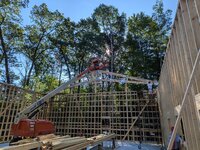
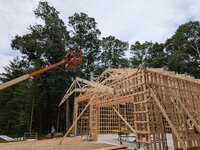
My 44' (48' with overhang) trusses weighed ~450lbs each. We set them using a 40' Boom lift. If we hadn't walled the front of the building, we would have set them with a telehandler (Lull). A crane in my area would have added a few thousand dollars to the build. I rented the boom lift for $450 for the day with delivery and pickup. This allowed us to go at our own pace and not have to temporary brace everything.
 

Attachments

  • Truss 1.jpg
    Truss 1.jpg
    973.6 KB · Views: 25
  • Truss last.jpg
    Truss last.jpg
    793.8 KB · Views: 25
To avoid these ads, REGISTER NOW!
Top Bottom