To avoid these ads, REGISTER NOW!

Advice on concrete floor condition

timgr

Well-known member
Joined
Dec 19, 2006
Messages
544
Location
Medford, MA USA
Part of my garage floor looks like this:
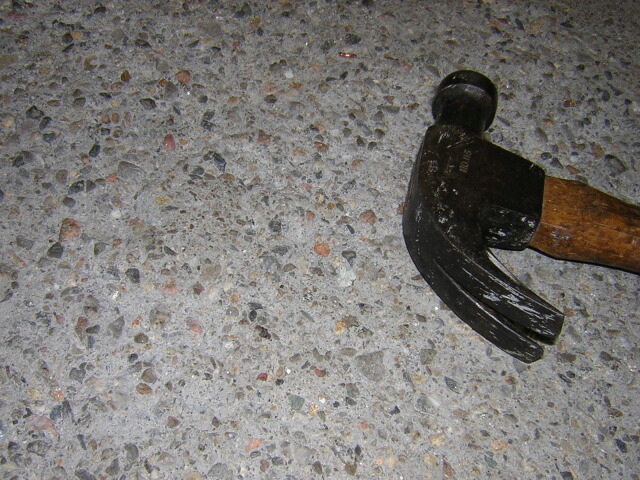
concretesurface.jpg


The rough patches clearly match up with where the PO's car was parked and dripped. Rest of the floor looks norbal.

A couple of 'experts' have told me this is because of the road salt, but I suspect it's more likely from the unsealed concrete soaking up water and freeze-popping. What say ye? The floor is otherwise solid - a few hairline cracks, and the rough areas seem solid once the loose material on top is vacuumed off.

I'm going to coat the floor with either epoxy or VCT, eventually. What would be a good product to level these rough areas?
 
To avoid these ads, REGISTER NOW!

Hammerdown

Well-known member
Joined
Oct 28, 2005
Messages
596
Location
The Motor City
Spalling like that is typically caused by winter de-icing agents (salt, and all the chloride mixes). It really is not the actual salt, but the exothermic reaction when salt meets ice. This chemical reaction releases a great deal of heat (compartively for the mass of the *salt*) which causes a temperature change from freezing to above freezing very rapidly, which the concrete is unable to withstand. Imagine pouring hot water on your windshield in the winter to clean it- it cracks it.
 
To avoid these ads, REGISTER NOW!

Hammerdown

Well-known member
Joined
Oct 28, 2005
Messages
596
Location
The Motor City
This would be an epoxy coating method- apply epoxy first (primer) coat.
Patch the large pits and cracks with suitable compound. (two part epoxy patch)
Apply 100% solids re-surfacing epoxy.
Apply 2nd coat. Finish coat.

The 100% solid re-surfacer is typically applied in a 12-16 mil thickness and is squeegeed out over the area. This would help fill minor imperfections and create a more uniform appearance. When done in conjuction with a good repair material, this should be a very effective way to smooth out the floor.

Sherwin Williams and UCoat It I know offer 100% solids, and I think even MuscleGloss does as well. Do a search for 100% solids epoxy coatings or check the above mentioned websites.
Just my $.02
 

dxdexter

Well-known member
Joined
Aug 1, 2006
Messages
1,923
Your problem more than likely stems from the use of non-air entrained concrete placed at a high water/cement ratio. Basically concretes exposed to deicing chemicals and freeze-thaw should have an air entraining agent added to the mix in order to create and air void structure within the paste potion of the concrete. This allows for the expansion of water as it freezes within the concrete and the deicing chemicals produce osmotic pressures within the pore structure.

Here is an excerpt from the Cement Association of Canada:

"Osmotic pressures develop from differential concentrations of alkali solutions in the paste. As ice develops, it creates an adjacent high-alkali solution. The high-alkali solution, through the mechanism of osmosis, draws water from lower alkali solutions in the pores. This osmotic transfer of water continues until equilibrium in the fluids’ alkali concentration is achieved. Osmotic pressure is considered a minor factor, if present at all, in aggregate frost action, whereas it may be dominant in certain pastes. Osmotic pressures, as described above, are considered to be a major factor in “salt scaling.”


The salt can also crystallize. As the salt crystals grow they expand within the paste. Air voids allow for this expansion to take place without affecting the concrete.

You can try the suggested epoxy coating, but this is more than likely a band-aid approach which will buy you some more years of service, but should moisture penetrate the coatings the concrete will continue to degrade. If you keep the cars off the slab in the winter and keep the garage heated then this would go a long way to preserving the slab. Unfortunately the proper fix would be to replace the slab.
 
To avoid these ads, REGISTER NOW!
Top Bottom