To avoid these ads, REGISTER NOW!

Advice on improving pole barn stability in high wind

ericj205

Active member
Joined
Sep 19, 2023
Messages
27
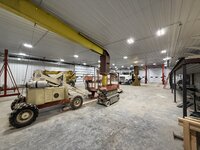
This is my 60'x40' pole barn with 14' eave height and sliding barn doors on each end. 6x6 poles spaced 12' apart. 4" concrete slab with 12"x12" footer. 6x6 are cross-drilled and have rebar running through them in the footer trench. 2x6 girts. R-Panel walls. I want to improve the chances of surviving high winds from tropical storms.

1. I was going to screw an additional "bookshelf" to the existing girts at the 4' and 8' heights and tie that into the 6x6 poles using 2x6 blocking (blue arrow is pointing at one I test fit).
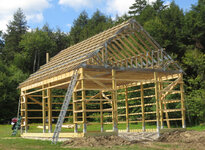
2. I was thinking of adding a 2x6 diagonally to the fixed wall on either side of the door opening (second pic with blue lines).
3. I was also going to add an X-brace in the center section of the side walls. For the X-brace I was going to use 1/4" steel cable attached to the 6x6 poles via large lag screws instead of 2x6's since the proposed "bookshelves" will somewhat be in the way. Thoughts? Any better ideas?
 

Attachments

  • IMG_6969.jpeg
    IMG_6969.jpeg
    304.1 KB · Views: 66
  • IMG_6970.jpeg
    IMG_6970.jpeg
    123 KB · Views: 69
To avoid these ads, REGISTER NOW!

zkdiesel

Well-known member
Joined
Oct 6, 2013
Messages
8,315
Location
chicagoland cornfields
You can add poles in between to make 6’ on center
2 of my buildings have them on 4’ on center for added strength.

Then knee braces to trusses
Steel lining kit on inside also adds strength like drywall on a house
IMG_7131.jpegIMG_5345.jpegIMG_1121.jpeg
 

tarmy

Well-known member
Joined
May 28, 2014
Messages
4,672
Location
Nor Cal
Welp, out here in earthquake country shear is your friend. Adding plywood sheathing to those walls with appropriate Simpson or similar fasteners and various tie downs, clips for the roof attachment point etc. that thing won’t rack or go anywhere.
 

Natty Bumppo

Well-known member
Joined
Dec 8, 2019
Messages
368
Location
Savoy, MA
I added 4x6 braces to all of the corners of my pole barn. As the others have mentioned, sheathing also works to brace a building.

I'll add this too...I am pretty sure adding knee braces to trusses is NOT recommended unless the trusses were designed to handle that load. It's been discussed here before if I recall but I don't remember the specifics. Tread carefully with that one.

IMG_3484.jpg
 

CraigStu

Well-known member
Joined
May 22, 2014
Messages
4,027
Location
Blacksburg, Va
IMHO #1 is not worth the effort. It adds a tiny bit of strength right at a hinge point but would get in the way of things like inside sheathing and the diagonals you have mentioned. #2 and #3 would help. An additional thought would be inside sheathing. You could put it just on the ends of the walls. That would be similar to exterior sheathing where the corners get good plywood and the rest of the wall gets something less expensive but also less strong.
 

theoldwizard1

Well-known member
Joined
Feb 22, 2011
Messages
43,138
Location
SE MI
Run a steel cable from the top of each corner top to the bottom of the adjacent post. Put a turnbuckle in the middle. If the turnbuckle ends are just "folded" eyes, put a weld on the spot where the "wire" comes together. Do this in both directions at corners.

At 60x40, I would add a couple more on each side, alternating the direction.

Do NOT use screw eyes at the anchor points. Use "lifting eyes"/forged eye bolts and big washers through the posts.
 
To avoid these ads, REGISTER NOW!
OP
E

ericj205

Active member
Joined
Sep 19, 2023
Messages
27
IMHO #1 is not worth the effort. It adds a tiny bit of strength right at a hinge point but would get in the way of things like inside sheathing and the diagonals you have mentioned. #2 and #3 would help. An additional thought would be inside sheathing. You could put it just on the ends of the walls. That would be similar to exterior sheathing where the corners get good plywood and the rest of the wall gets something less expensive but also less strong.
I should have been more specific about this #1. I thought I remember hearing one of the failure modes in a building is the pressure differential and pulsating in a storm. Since the girts are external screwed to the 6x6s I was concerned about internal pressure pushing “outward” on the wall sections and blowing it out. I thought the bookshelf would help help make each 12’ wide section more rigid (it flexes when you push on it) and reduce the chance of a wall sections blowing out because you’re not just “pulling” on the original girt screws, now you’re also trying to “shear” a bookshelf screw. I could be way off base here but that was my initial thought.
 

Bert_

Well-known member
Joined
Dec 24, 2016
Messages
9,717
Location
NW Iowa
Make sure the door is always closed if there is high winds in the forecast.

If the purlins and girts have several screws/nails into each joint, the next weakest point is probably the poles. 12' is a long ways apart.
 

Fav Onefour

Well-known member
Joined
Jul 14, 2022
Messages
705
Location
MN cold and hot
@ericj205 , you are on the right path with your assessment about pulsating. I've been inside trying and have seen it happening. The walls start to move by heaving in and out.
These big pole buildings have a sorta fatal flaw. The walls are long, high, and essentially big sheets through the middle. The bigger the sheet, the more prone to heaving. When the buildings give up, the walls come off in large sections.
One of our machine sheds has 20' walls and 64X240 footprint. Sidewall soffits are 2' with open mesh venting. Gable ends do not have venting. It has one large full height 32' wide split slider across one end. The other walls are uncut except for a small man door.
The wall that starts heaving first is the tall end wall opposite the slider opening. The end wall has the same post dimensions and spacing as the sidewalls but longer posts that go through to the top of the gable end. It was built too tall without additional framing and supports. Watching the end wall is interesting. It billows in and out through the center area. The top stays firmly in place, eventually the posts start to shift in the ground.
Shorter wall height and length do help. We have two other adjacent pole sheds with shorter walls that have been solid through the same wind events.
We found a couple items that have helped on the bigger walls. We added diagonal bracing on sidewalls at each rafter that attach about 4' down from top sill. The end wall was tricky. We ran diagonal bracing to a frame structure built into the last three rafters. Those braces are attached to the wall about 10' down from ceiling height.
The most helpful change was super simple. Close the damn door when it's windy. We had started doing that part before adding bracing. With the door closed, the heaving was much better. It still moved some in the big winds which led us to add all the bracing. In the big picture, the steel was probably already wearing around fasteners. We were playing with a loose structure compared to new and tight.

I'm not sure how far you would need to go on bracing to make it through hurricane winds. The winds that started creating havoc on our taller walls were roughly 40-50 mph over the course of days. I know that our doors would not hold in hurricane winds. Once those flop over the top, the shed would be gone quickly.
 

nadogail

Well-known member
Joined
Jan 23, 2009
Messages
31,942
Location
Coronado, CA
I am not familiar with Pole Barns, but from reading posts about them I have come to the conclusion that they seem to be “Tin Tents”.
IMHO, there seems to be very little stability in any kind of tent. Before I would invest in a Tin Tent, I would seriously consider erecting a “tilt up”. The slab floor and cast in place reenforced concrete walls are going to resist almost all weather events.
 

rsanter

Well-known member
Joined
Dec 22, 2007
Messages
18,506
Location
visalia ca
If you put shipping containers on the sides of the shop then you lessen the wind forces hitting the walls of the shop.

if you put tie wires (like electrical poles) from the poles to the ground outside of the barn then you will have added resistive forces under wind load.

you can create earthen berms on the sides of the shop that will direct wind over the structure and then lessen the wind loads on the building

if you run chains from the ground, up the wall, through the roof structure, down the other wall to the ground and anchor those chains you will resist the lift forces from taking off your roof.
 

CraigStu

Well-known member
Joined
May 22, 2014
Messages
4,027
Location
Blacksburg, Va
I should have been more specific about this #1. I thought I remember hearing one of the failure modes in a building is the pressure differential and pulsating in a storm. Since the girts are external screwed to the 6x6s I was concerned about internal pressure pushing “outward” on the wall sections and blowing it out. I thought the bookshelf would help help make each 12’ wide section more rigid (it flexes when you push on it) and reduce the chance of a wall sections blowing out because you’re not just “pulling” on the original girt screws, now you’re also trying to “shear” a bookshelf screw. I could be way off base here but that was my initial thought.
That makes sense to me now that I understand the goal.
 
To avoid these ads, REGISTER NOW!
Top Bottom