To avoid these ads, REGISTER NOW!

Advice req: Sistering 4x10x18' unsupported header

MikeDeuce

Member
Joined
Jan 2, 2009
Messages
16
Hey folks,

Apologies for breaking this out of my last thread, but I think (+hope) this is enough of a departure to see if I can solicit some additional advice.

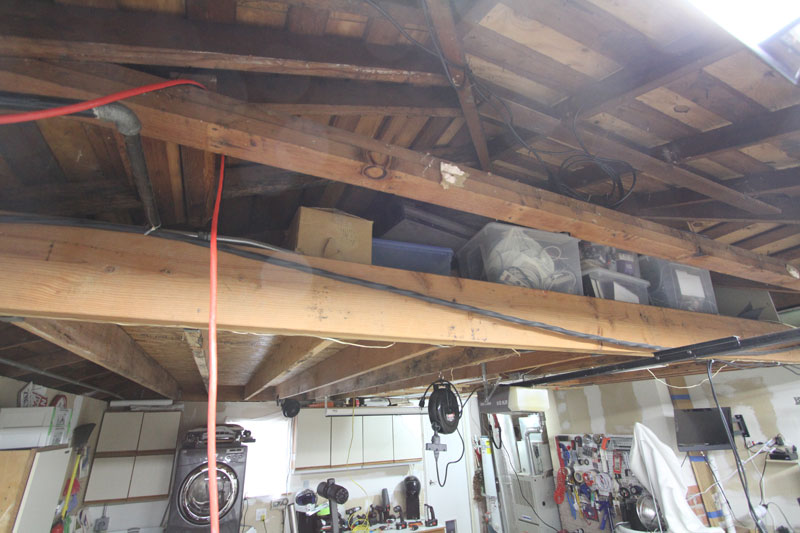
I have a long header with an open span supporting a storage loft:
2.jpg


Supported on opposite ends by 4x4s (note one end has an angle cut out of it for the roof, the other end is square):
4.jpg


I plan to drywall the ceiling/bottom of the loft, hang a ton of lights, and continue to store a bunch of stuff on top. A concern was raised about the wide, unsupported span, and I'm leaning towards agreeing with the concern (considering I hang out underneath it a lot, and park a car there the rest of the time).

My question is are:

1) what would be sufficient/slightly overkill without being over-overkill? Should I sister in an additional 4x10? Is a 3x10 sufficient?

2) How best to sister the two pieces of lumber? Construction adhesive and carriage bolts? What size hardware? Any pattern to the fasteners?

Thank you very much!
Mike
 
Last edited:
To avoid these ads, REGISTER NOW!

Chrome Lugnut

New member
Joined
Mar 30, 2011
Messages
1
Location
Raleigh
Hey folks,

Apologies for breaking this out of my last thread, but I think (+hope) this is enough of a departure to see if I can solicit some additional advice.
I have a long header with an open span supporting a storage loft:
Supported on opposite ends by 4x4s (note one end has an angle cut out of it for the roof, the other end is square):
I plan to drywall the ceiling/bottom of the loft, hang a ton of lights, and continue to store a bunch of stuff on top. A concern was raised about the wide, unsupported span, and I'm leaning towards agreeing with the concern (considering I hang out underneath it a lot, and park a car there the rest of the time).

My question is are:

1) what would be sufficient/slightly overkill without being over-overkill? Should I sister in an additional 4x10? Is a 3x10 sufficient?

2) How best to sister the two pieces of lumber? Construction adhesive and carriage bolts? What size hardware? Any pattern to the fasteners?

Thank you very much!
Mike

I have a 20' beam in my pole building shop. I use 3 2'x10''20 and glued and screwed 1/2' ply wood to both sides of the center 2x10x20 and the glued and screwed the outside 2x10x20 to it. I also have diagonal braces on the sides because i have hung a chain fall off of it to pull and engine.
It's held up for about 20 years no problem
Hope this helps.
Les
 
OP
M

MikeDeuce

Member
Joined
Jan 2, 2009
Messages
16
Thanks Les! So your beam is beefier than mine and you are likely supporting less weight than I (assuming they aren't ginormous motors you're pulling ;) ).
 

timewarp

Well-known member
Joined
Feb 24, 2008
Messages
272
Location
Silverdale, WA
I would use a taller beam, let it stick up above the floor above. Even just building a wall across the existing beam and sheeting it with osb or plywood, you could put 2 layers of sheeting offset by 4' so none of the seams lined up. That would really strengthen that beam. There are many ways to make that beam stronger as long as you are willing to have a wall from that beam up, that way you don't loose headroom underneath.
 

ducati

Well-known member
Joined
Oct 15, 2010
Messages
97
I would take two metal straps say like 3/16"x3"xX length (what ever the measurement from the top of your hip to the bottom of your beam) drill 9/16" holes at each end and bolt one side to the actual hip and straight down to the center of the beam. Do this on both hips, with using flat stock, you will be able to twist the metal so it mounts flat to both surfaces. Then bolt the metal strap to the beam and hip with 1/2" bolts. Since the hip has opposing force from two different angles it will take a quite a bit of load off your beam. This will keep your space below post free and probably give you more support then sistering in another beam. If you sister in another beam your weak point will then be the angle you have to cut on the end of the beam to miss your roof line.
 
OP
M

MikeDeuce

Member
Joined
Jan 2, 2009
Messages
16
There are many ways to make that beam stronger as long as you are willing to have a wall from that beam up, that way you don't loose headroom underneath.

This is very interesting -- I was already planning to wall in that area later on when I start drywalling. I hadn't thought that part through at all yet, so I never considered the additional strength I'd get if I built the wall atop the existing beam... also, I imagine I'd have to tie that into the roof structure at the same time, not that I would want to get any strength from it, but there'd probably be some structural gain all around from tying all the various members together like that.

Paranoid question: With regards to the 4x4s supporting the beam, it's my understanding they can take massive loads (4000lbs/ea + according to most folks) in the vertical orientation, as long as they are not permitted to bend. Any thoughts on that? I feel like I'm putting a lot of weight up there, even though it's nowhere near the purported limit.

Thanks!
 
Last edited:
OP
M

MikeDeuce

Member
Joined
Jan 2, 2009
Messages
16
...bolt one side to the actual hip and straight down to the center of the beam. Do this on both hips, with using flat stock

Thanks duc, can you elaborate (or at least define, pardon my ignorance) what the hip is? I'm having trouble picturing the overall design you're describing.
 

ddawg16

Well-known member
Joined
Jul 11, 2008
Messages
21,005
Location
S. California
Ducati is basically showing a variation of a truss.

I agree with the idea....but I think you can improve on it by also glueing and nailing some 1/2" OSB to the end of that joist. There was another thread about making some floor joists stiffer....after advice for here, he ripped some 7" wide strips of OSB, glued and nailed them to his floor joists. Was extreemly pleased with the results....doing just one of them made a significant difference.

So, if you do the hip and OSB, I think you will have plenty of margin.
 

Crawdad20

New member
Joined
Feb 1, 2011
Messages
2
A stout piece of angle iron lagged to the side and bottom of that header may do the trick, make sure you have plenty of bearing on the ends, might be worth adding additional jack studs on each end. Hard to tell from pics what type of building that is. Hippped roof? Not much in the way of ceiling joists which prevent walls from spreading from roof loads? If thats the case I'd be careful attaching anything else to the roof structure without consulting somebody who can come out and look at the structure in person.
 
OP
M

MikeDeuce

Member
Joined
Jan 2, 2009
Messages
16
Make Sense?
Ah, yessir, thanks!

Crawdad's comments do raise some concerns, though, as it is a hipped roof.

I consistently find myself being paralyzed with paranoia as to how to proceed after these threads :)

I'm trying to reach out to an acquaintance who worked on the software side of a structural engineering firm in a past life, to see if he knows anyone that does residential gigs.

Thanks again for all the thoughts... at least I'm sufficiently convinced that what I have now is inadequate and not entirely safe.

Mike
 

bczygan

Well-known member
Joined
Nov 4, 2009
Messages
22,002
Location
DETROIT! Arsenal of Scrappers
None of these answers is of any use, except as anecdotal evidence of what the posters did in their situation. If you want to know what loads you can place on that beam with particular safety margins, you need to measure the spans and calculate the loads and look at the species of lumber or capabilities of other materials. Tell me exactly what you have existing and what load capability you want and I'll check some charts and tell you where you are at.

A couple of points though. Looks like your garage door hangs from it. Also, as one poster said, you can strengthen the beam by going up and turning it into a girder truss or a deeper beam by sistering. But until you decide what the weight of what you store is going to be, and do calcs. you just don't know.
If you really want to know, tell us what the beam span is, what the beam is composed of, the joist span, what the loads are going to be, how the header on the other end is supported, the decking material and the species of the beam and header material.

Bill
 
Last edited:
OP
M

MikeDeuce

Member
Joined
Jan 2, 2009
Messages
16
Thanks for your offer, I'll gladly accept!

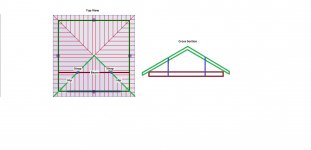
Whipped this up with all the requested dimensions (click for full version):


Wood species is all doug fir.

The far end 4x10 is bolted into the side of the wall, into every stud, 16 o.c. for the entire span of the header.

Current load (1550lbs.):
- Garage doors, when open (can't find exact specs... 16x7 steel+insulated, most say around 250lbs).
- 1000lbs. (est.) in storage, evenly distributed
- 300lbs. of 1/2" OSB (52lbs/sheet)

Ideal load (2165lbs. minimum, ideally with a nice big safety margin):
- 1550lbs. (all the above weight)
- 415lbs. drywall (based on 2.2lbs/sq ft of 5/8" drywall – not counting the weight loss in holes cut for recessed lighting)
- 200lbs. lighting (10x 20lbs troffer lights)

Let me know if you need additional information/accuracy on anything.

Thanks!
Mike
 
Last edited:
To avoid these ads, REGISTER NOW!

bczygan

Well-known member
Joined
Nov 4, 2009
Messages
22,002
Location
DETROIT! Arsenal of Scrappers
One more thing. What is the span of the joists?

Bill

Thanks for your offer, I'll gladly accept!

Whipped this up with all the requested dimensions (click for full version):


Wood species is all doug fir.

The far end 4x10 is bolted into the side of the wall, into every stud, 16 o.c. for the entire span of the header.

Current load (1550lbs.):
- Garage doors, when open (can't find exact specs... 16x7 steel+insulated, most say around 250lbs).
- 1000lbs. (est.) in storage, evenly distributed
- 300lbs. of 1/2" OSB (52lbs/sheet)

Ideal load (2165lbs. minimum, ideally with a nice big safety margin):
- 1550lbs. (all the above weight)
- 415lbs. drywall (based on 2.2lbs/sq ft of 5/8" drywall – not counting the weight loss in holes cut for recessed lighting)
- 200lbs. lighting (10x 20lbs troffer lights)

Let me know if you need additional information/accuracy on anything.

Thanks!
Mike
 
Last edited:

bczygan

Well-known member
Joined
Nov 4, 2009
Messages
22,002
Location
DETROIT! Arsenal of Scrappers
Here you go:

Span 18-4
Area 14-6x18-4=266SF

Present LL=1000#/266SF=4#/SF

Future Dead Load:
Joists 37x11=407#
Beams 60x4=240
DW 450#
OSB 300#
Lights 200#
Garage Door 250#
Total 1847#

1847/266=7#/SF

LL+DL=11#/SF
Beam contributing area=133SFx11#/SF=1463# Total Load/18.33=80#/LF

2-2x10's Doug Fir #2 is an adequate beam for this application


If you want to store more weight just change the LL amount and recalculate
For example, if you wanted to use a 20#/SF LL to store 5320# Total:

Live Load 20#/SF
Dead Load 7#/SF

Beam Contributing area=133SFx27#/SF=3591# Total Load/18.33=196#/LF

2-2x16's Doug Fir #2 is an adequate beam for this application

Note that I added the weight of the joists and beam to the dead load.
http://www.brownlumberservice.com/PDF/lumberweight.pdf
Welcome to the world of people who know how much weight is held up over their heads everyday by the rules of physics and good or bad designers! A lot of people never think of it.

Here is a calculator you can use:

http://courses.cit.cornell.edu/arch264/calculators/example8.1/index.html
 
Last edited:
OP
M

MikeDeuce

Member
Joined
Jan 2, 2009
Messages
16
Amazing... I don't think I would've ever figured out how to calculate the load specific to the beam.

Does the angle cut out of the left-side of my 4x10 to fit under the roof have any bearing on any of your calculations? Or is that not compromising the strength of the beam as much as I would imagine?

Thank you for your time/generosity!
 

bczygan

Well-known member
Joined
Nov 4, 2009
Messages
22,002
Location
DETROIT! Arsenal of Scrappers
The main thing is NOT to miss anything, like including the weight of the existing structure in the deal load. Also figuring the area contributing load to the member in question is important. You always need to look for unusual conditions like the garage door load. The stairs are a load but it is countered by the fact that no storage occurs there. Your weight is also a load to consider if the design was close to being overloaded, but there are safety factors built into the calculations. This is designed for a deflection of 1/360 of span. Good stiffness to avoid cracking for drywall. If you had a very heavy load, you could turn the beam into a truss to add capability or shore it up and replace it with a deeper beam that extends further up than the present one, or you could sister on some material (also extending up if needed) either wood or metal to get the strength needed.

Thanks for letting me use your situation as an example. When people offer suggestions like those above, even though they are well intended, your particular conditions may vary in some small,but very important way. Those suggestions may work fine, or not. The only way to tell for sure is to check all the existing conditions and do the calcs. The answer will have specific conditions about material strength and species and size and fastening and support. BTW, the angle cut doesn't markedly affect it. If you are going to do these calculations yourself there are calculators like the one I gave a link to, but be sure you understand the other factors involved like what the loads are and contributing areas and loads required by code. Also remember these loads have to be carried down to earth. That means checking the requirements for the posts supporting the beams and even sometimes the foundation under them.
One last thing. I did not check the joists, but there are plenty of joist charts out there.

Bill
 
Last edited:

Zeke

Well-known member
Joined
Aug 13, 2009
Messages
17,176
Location
Long Beach CA, the sewer by the sea.
This is why engineers give builders a headache. He's absolutely right but it's a storage deck in a garage for chrissakes. An old garage that most likely has one problem he didn't factor, weakened wall studs due to water and/or insect damage. Or loose fitting framing members, cracks and all that stuff.

Why not get into diagonal bracing and rotational shear? Do we know what seismic zone this building is in? Some hold downs may be in order.

I think I'll just build my over-sized shelf in the garage with some common sense and be done with it.

bczygan, you are totally correct in everything you say.
So am I.
 

bczygan

Well-known member
Joined
Nov 4, 2009
Messages
22,002
Location
DETROIT! Arsenal of Scrappers
Engineering is just a tool to measure things. If you don't need to know with great certainty, you don't need to apply the tool. But the OP wanted to know if he and his car were in danger. It's a tool to predict the answer. I use it more to predict if a structure will do what I want using the materials I want to use, usually as a method to save money by not over building. Experienced builders get a feel for when a certain joist size is spanned too far giving a springy floor, or when an engineered member is better than dimensional lumber for cost and performance, or when steel is the answer.
 

Zeke

Well-known member
Joined
Aug 13, 2009
Messages
17,176
Location
Long Beach CA, the sewer by the sea.
I need to emphasize that I respect you and engineering. However, around here, engineers typically "over engineer" everything. If I could find a civil engineer that would do exactly as you state, that would be wonderful.

I'm a retired contractor and have had my share of experiences with ingineering. Most are total clowns. I've had numerous situations that became un-buildable as per plans and had to pay said engineer to fix the problem he created.

Another problem with over thinking a "shelf" is that for each alternate solution, the engineer charges for the calcs on any sheet. So, people often ask the engineer to provide the one solution he likes and eliminate the other possibilities.

Now, this is exactly why I'm posting because bczygan has stated that, "None of these answers is of any use, except as anecdotal evidence of what the posters did in their situation."

None? I respectfully disagree. While some posts here look to be inefficient, others look OK. It's the variety that one gets on an Internet forum that one may not get at the engineer's office.

And that's specifically why I said engineers give builders a headache.

Please don't take offense. I do respect :bowdown: a professional, just be open about solutions.
 

bczygan

Well-known member
Joined
Nov 4, 2009
Messages
22,002
Location
DETROIT! Arsenal of Scrappers
Milt,
Let me change what I said a little bit. The suggested modifications ARE useful, in that they explore alternatives for adding capability for additional load support in the beam. And the OP did ask for suggestions for "what would be sufficient/slightly overkill without being over-overkill?", after adding DW and lights. All the calcs do is to find out what's what. They show that the existing beam IS adequate for the existing conditions WITH the addition of DW and lights. The suggested additions will add strength. If you wanted to know how much, calcs would tell you. I would actually like to see contractors have more engineering knowledge and capability. And also engineers need more practical building experience. The cost of checking alternatives shouldn't hinder exploring them, but of course, it does. I, as a contractor, like having the tools to check the alternate solutions, run the different calcs, do the costing on each and choose the one that meets my particular needs and desires. I think a builder should have all the tools to do that in his toolbelt.
 

Zeke

Well-known member
Joined
Aug 13, 2009
Messages
17,176
Location
Long Beach CA, the sewer by the sea.
Then you, sir, are the exception. I don't have the skills to do calcs. I'm old school and have had to rely on "anecdotal experience" when doing structural work in the distant past. When I started, we barely had glue lams, much less LVL beams. Span tables from the building dept were in the tool belt, not a scientific calculator. ;) Solutions were based on previous solutions. When the CA earthquake codes came out, all that old school stuff went out the window. Building depts now won't even look at plans that don't have the engineering sheets stamped and attached. Many times the engineer goes off the architects drawings w/o analyzing what's there.

We saw some strange stuff and still do. Also understand that any hardware, structural material, and packaged goods used in CA construction have to be certified. Most local jurisdictions recognize Los Angeles City Dept of Engineering Certification and those that have an ICBO (now ICC) number.

So, unless it has been tested, certified, spec'd and calc'd, we don't use it.

And that's a PITA. You just touched a nerve, that's all. ;)
 
Last edited:

bczygan

Well-known member
Joined
Nov 4, 2009
Messages
22,002
Location
DETROIT! Arsenal of Scrappers
Milt,
Wow..................I forgot you live in CA. ..........................................I live in Detroit...........................and I would NEVER live there..............what does THAT say??? :D

Bill
 
To avoid these ads, REGISTER NOW!
Top Bottom