To avoid these ads, REGISTER NOW!

Advise on Transfer Switch

Gigfy

Well-known member
Joined
Jan 30, 2011
Messages
82
As I posted in another thread, I'm installing a subpanel next to the main panel. I've now decided I want to install a transfer switch in between the main and subpanel for a standby generator. I'll put the critical circuits in the 100 amp subpanel. The main panel, transfer switch, and sub will all be inside.

I'm looking for a 100 amp transfer switch, but there are a million of them out there. Any recommendations on one?

I don't exactly know what I want, but I know what I don't want. I don't want an interlock plate. I also don't want the kind of transfer switch that has breakers which only switch the load lines, but leave the neutral connected to the power grid (To my way of thinking, this is no different than an interlock plate.)

I used to own a business that had a 400 amp transfer switch, which switched the the load lines as well as the neutral. I'd like that kind of switch in 100 amp size.

Lastly, is there an NEC regulation regarding the case grounding of a transfer switch? In other words, is it wired just like a subpanel - lead to lead; neutral to neutral, ground to ground - or does a transfer switch have to have it's own ground rod in addition to grounding it to the main panel?

Thanks.
 
To avoid these ads, REGISTER NOW!
OP
G

Gigfy

Well-known member
Joined
Jan 30, 2011
Messages
82
Thanks Berserker,

I got to looking on the internet remember that they called those switches 3 pole double throw (It's been a long time since I've done any serious wiring like this, and I've forgotten the lingo).

Anyway, I found one on Ebay. It supposedly is "brand new", that is never been installed, but from looking at the style, it looks like it's about 50 years old. I don't know any reason why it won't work. The components look just like my old 400 amp transfer panel, only smaller.

The fella advertised it as a safety switch, but I looked at the pictures, and the diagram closely and it's a transfer switch.

http://cgi.ebay.com/ws/eBayISAPI.dl...ZE%3D&viewitem=&sspagename=ADME:X:AAQ:US:1123
 

MoFoJoe

Member
Joined
Jan 25, 2011
Messages
9
Location
Greensburg, PA.
Last edited:

Norcal

Well-known member
Joined
Mar 16, 2008
Messages
13,753
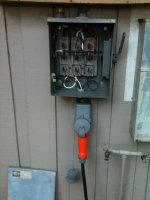
Here is a picture of a 100A double throw switch.Connector is a 60A 125/250V Pin & sleeve device.
 

Attachments

  • IMG_0002.jpg
    IMG_0002.jpg
    73.2 KB · Views: 79
To avoid these ads, REGISTER NOW!
OP
G

Gigfy

Well-known member
Joined
Jan 30, 2011
Messages
82
Mikester,

I sure don't want to hold myself out as an expert, since I have no formal training. But in my situation, I'm pretty sure I want to size the transfer switch as large, or larger than the box it's feeding into (in this case my subpanel). My subpanel will be fused at 100 amps, so if I got a transfer box that was only rated at, say, 60 amps, then theoretically I could burn the transfer box up before the breaker ever "blew".

In real life that probably wouldn't happen though. When I had the 400 amp panel, I recall asking a lineman friend (who got me started wiring) why the panel was so huge. He said the large size helped keep the contacts from arcing under heavy load, and that if you always shut the load down before you pulled the switch, the switch could be manufactured a lot smaller. Still I wouldn't feel good about risking a smaller transfer switch than the overload protection.

Joe,

You're right, most people would go with the interlock or a double pole double throw. After I started looking on the internet, I found hardly any 3 pole double throw switches. Apparently only people in Canada are required to switch the neutral. In the USA, all that's required is to switch the load lines (at least for residential).

Still, I like the idea of completely disconnecting from the power grid while running a generator, and I wonder if eventually the U.S. will follow Canada's lead and require the neutral be switched on all transfer switches. However, if I couldn't have found a reasonably priced 3PDT transfer switch, I would probably have ended up using the interlock as you suggest.
 
OP
G

Gigfy

Well-known member
Joined
Jan 30, 2011
Messages
82
Mikester, In re-reading my post, it wasn't all that clear what I was trying to say. You probably understand, but there may be others who may be confused by what I'm saying, so let me re-state my proposed setup.

Out of the 200 amp main panel will come two feeder lines off a 100 amp breaker. These will go into the 100 amp transfer switch (along with the neutral and equipment ground). After running the leads and neutral through the switch, they will go into the subpanel (along with the equipment ground) with 100 amp overload protection (I had to take back the first subpanel I bought because it didn't have overload protection, and you need it with a transfer switch.)

So according to this setup both the transfer switch and subpanel are designed for 100 amps and will have overload protection at that current. If either the subpanel or the transfer switch were rated at less than 100 amps, theoretically they could burn up before the overload protection kicked in.
 

Norcal

Well-known member
Joined
Mar 16, 2008
Messages
13,753
If the neutral is bonded to the frame of the genny, it is required to switch the neutral because you cannot bond the neutral in 2 places & w/o switching the neut. you will be bonded twice.
 

nehog

Well-known member
Joined
Jan 2, 2010
Messages
7,935
Location
Jaffrey, NH
As others say, don't get us started on switching neutral! Norcal's basically right, but there are some complex rules on when to switch and when to not switch the neutral. And some major safety rules too...

Many generators don't use bonded neutral, but do have a ground wire that must be connected. Some generators that do bond the neutral have a removable strap to unbond it. And of course, local codes always apply.

My preference is a separate ground for the generator, and the generator be unbonded to the neutral. Connect the ground first, before starting the generator, or connecting it. Then connect the power connector. Finally start the generator.
 
OP
G

Gigfy

Well-known member
Joined
Jan 30, 2011
Messages
82
I decided to resurrect this post because I've been doing some reading on this subject (here, Mike Holt's forum, etc.) and would like to pose a scenario. This scenario applies to feeding a subpanel with a generator by use of a 3 pole transfer switch (used to switch the neutral). I've never come across where this scenario discussed in the archives of this forum, Mike Holt's forum, or anywhere else on the Internet.

As noted above, I had decided on a 3 phase switch so the neutral could be switched. I thought with the neutral switched there is no possibility for energizing any electrical lines outside the main panel.

However that was a error, and I do believe there is a scenario which could energize lines outside the service entrance, even with a switched neutral. As I mentioned, I've read a good amount of info. on this, a lot of it from electricians, but not seen it discussed. This question is probably tailored toward those with a significant electrical understanding. I'd appreciate your thoughts.

First, (according to Mike Holt) all standby single phase generators are supposed to have an unbonded neutral if they are connected to a double pole transfer switch. Since a double pole switch is the most common transfer switch in the U.S., there are probably a lot of generators out there that have a floating neutral. My own generator came with a floating neutral.

However, if the neutral is switched at the transfer switch, the neutral on generator must be bonded (again according to Mike Holt). Now for the scenario. Again this scenario is for a 3 pole transfer switch used to switch the neutral as well as the line leads, ahead of a subpanel:

Assume the neutral bonding wire on the generator vibrates loose (there is a good degree of vibration on a standby generator, so this could happen) or the machine was made on a Friday afternoon and the bonding strap didn't get attached, or the electrician who installed the generator didn't check to make sure the neutral was bonded on the machine, or the homeowner hooking up the machine didn't know to bond the neutral, etc.

There is a power outage. The generator is fired up and the lever pulled on the transfer switch. Now assume a ground fault somewhere on one of the branch circuits in the subpanel. Tracing it out in my head the current goes from one of the "hots" to the equipment ground at the outlet. It follows back up to the subpanel and heads out toward the generator on the ground wire. Only the equipment ground on the generator is NOT bonded to the neutral. So, the ground fault energizes the whole EGS of the house. The electricity follows the path back to the main panel through the EGS. Since the ground and neutral are bonded in the main panel, the voltage jumps over to the neutral, out the service entrance, and up the pole to the transformer. All the while the generator is not detecting this problem. Am I seeing this correctly?

I understand in 2011 new portable generators are required to have GFCI protection, but there are millions of generators out there without it.
 
To avoid these ads, REGISTER NOW!
Top Bottom