To avoid these ads, REGISTER NOW!

After Cooler?

mayday0017

Well-known member
Joined
Oct 20, 2010
Messages
1,715
Location
Houston Texas
Who has an after cooler on your compressor? Show me your setup, share your thoughts....:rocker:

Here are a couple I found...

CompressorAftercooler1.jpg

B&M model 70266 (11″ x 8″ x 1½”) tranmission/engine oil cooler, an EBM Pabst model W2E250-HL06-01 230V AC fan (1160 cfm in open air) wired in parallell with the motor so when the motor runs, the fan runs and a Wilkerson model X01-04-M00 automatic drain. This fellow measured his compressor outlet temperature at 310F going into the aftercooler and 96F coming out. That’s a big drop! He says there are visible droplets of water in the plastic drain going to the Wilkerson. Note how he organized his plumbing to take the moisture down low and the air rising above.
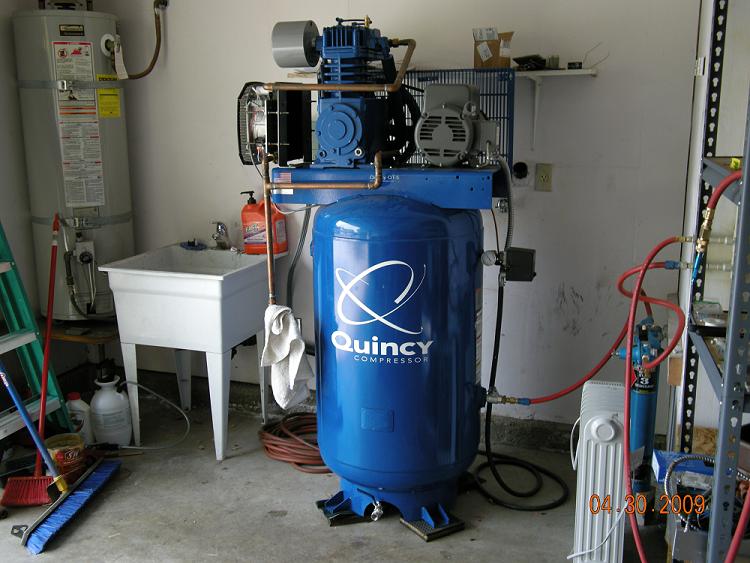


compaftercooled.jpg

Another compressor with a B&M transmission cooler and a 230V fan.


GuardedAftercooler.jpg

Very professional looking guard on this aftercooler. The automatic drain is from below again…
 
To avoid these ads, REGISTER NOW!

buening

Well-known member
Joined
Dec 17, 2007
Messages
1,338
Location
Decatur, IL
There is some ingenuity in those installations. I'd be curious as to the pressure drop in those B&M trans coolers. That Quincy is likely using 3/4" inlet and outlet copper pipes, but all B&M coolers I've found have 1/2" NPT fittings and the tubes/plates themselves are likely even smaller within the cooler. Seems like it could be a bottleneck in the system IMO, but who knows it may have a very small pressure drop.
 
OP
M

mayday0017

Well-known member
Joined
Oct 20, 2010
Messages
1,715
Location
Houston Texas
There is some ingenuity in those installations. I'd be curious as to the pressure drop in those B&M trans coolers. That Quincy is likely using 3/4" inlet and outlet copper pipes, but all B&M coolers I've found have 1/2" NPT fittings and the tubes/plates themselves are likely even smaller within the cooler. Seems like it could be a bottleneck in the system IMO, but who knows it may have a very small pressure drop.


Good point, made me go do a little research, found a manufactured aftercooler with 1/2 NPT claiming 80cfm.... See link below

http://www.gosuburban.com/pdf_documents/Astrocooler_Compressor_Aftercooler.pdf
 

buening

Well-known member
Joined
Dec 17, 2007
Messages
1,338
Location
Decatur, IL
Interesting. Looks like it may have a fan or some type of cooler on the bottom. Seems pretty compact too.

I personally like the coolers mounted to the fan guard in front of the fan, similar to your last picture, as you can use the fan from the compressor pump to draw air across the cooler instead of having an electric fan that may end up being a noise maker. The manufacturer of my compressor makes an aftercooler, but I can't swallow the $400 pricetag they want for it! Similar to the B&M coolers but with larger input/output fittings. See below, bottom of page 6.

http://belairecompressors.com/Belaire_Brochure.pdf
 
OP
M

mayday0017

Well-known member
Joined
Oct 20, 2010
Messages
1,715
Location
Houston Texas
Well if the one I posted previously can even do 1/2 of the CFM it states then it will be more then enough for our compressors, which means the B&M would be as well.... Tempted to buy a B&M and mount it like Belaire has theirs mounted. Figure I can blow a fan I have across it and compair with and with out the fan. Maybe drain the tank let it run till up to pressure. Then drain tank again collecting the water. Wait 15-30 min, blow a fan across it run till up to pressure again, drain & compair. If it is very close I won't even bother with a fan. Sounds like a good project for me in the up coming months....
 

buening

Well-known member
Joined
Dec 17, 2007
Messages
1,338
Location
Decatur, IL
I say you have a good plan with the B&M. You may wanna add a drop like they did with the Quincy and put a ballvalve on the end. The length and diameter will determine how much water it'll hold, in case you aren't a frequent drainer LOL. Putting the drop at the aftercooler will minimize the amount of water sitting in the bottom of the tank, which causes the tank to rust and is the main killer of air compressor tanks.
 
OP
M

mayday0017

Well-known member
Joined
Oct 20, 2010
Messages
1,715
Location
Houston Texas
Thinking I will finally get around to installing the automatic tank drainer I bought 2 years ago for my old compressor and put it on this new one, if I do that I prob won't bother with a drop line unless you think it will make a difference?
 

pipsters

Well-known member
Joined
Sep 1, 2010
Messages
4,899
Location
USA
There is some ingenuity in those installations. I'd be curious as to the pressure drop in those B&M trans coolers. That Quincy is likely using 3/4" inlet and outlet copper pipes, but all B&M coolers I've found have 1/2" NPT fittings and the tubes/plates themselves are likely even smaller within the cooler. Seems like it could be a bottleneck in the system IMO, but who knows it may have a very small pressure drop.

It's something to think about but keep in mind you might only be flowing 20 CFM at that stage at most coming out of the compressor. Plus whatever pressure drop you have would most likely be offset by filling the tank with cooler air, therefore less pressure drop after it cools in the tank.

http://www.engineeringtoolbox.com/pressure-drop-compressed-air-pipes-d_852.html

3/8" pipe, 10 feet of length (inside cooler, rough estimate)

20 CFM @ 175 psi
Pressure drop 1.19 psi

15 CFM @ 150 psi
Pressure drop of 0.81 psi

6 CFM @ 150 psi
Pressure drop of 0.15 psi (that's for me, adding a cooler to my 120v compressor)

Seems like it's a non-issue
 

buening

Well-known member
Joined
Dec 17, 2007
Messages
1,338
Location
Decatur, IL
Good thought pipster. I guess it is before the tank so it'd only affect the pumps cfm to fill rather than the cfm out of the tank. I'm no hydraulics guy though, but yeah those values are pretty small in the grand scheme of things!
 

Morrisman

Well-known member
Joined
Nov 7, 2006
Messages
424
Location
Angeles City, Philippines
Great ideas! I work on air compressors for a living and cooling and condensate removal is huge part of the installations complexity. That fan in the top installation you showed will cool the air, the motor and the compressor. A win-win situation.

My two small compressors, at home, have but a finned copper tube for cooling. I might see about fitting a cooler like this to the larger of the two, as we now live in the tropics and 90f temps in my shop are not uncommon during the day.

The ones at work have five huge water-air inter-coolers. Just about all the plumbing you can see is for cooling and draining the air:

This little baby produces 1500cfm at 2000psi.

db606c0f.jpg
 
Last edited:

pipsters

Well-known member
Joined
Sep 1, 2010
Messages
4,899
Location
USA
Thinking I will finally get around to installing the automatic tank drainer I bought 2 years ago for my old compressor and put it on this new one, if I do that I prob won't bother with a drop line unless you think it will make a difference?

Where it will make a difference is when using the air. Typically the air will cool in the tank and you'll have (relatively) water free lines. However if you are using a grinder or something that makes the compressor run close to 100% the air will cool in the lines putting water in your tools. This pre-cools the air, and if you can get it down enough using a filter will also take out the moisture even before it reaches your tank. Longevity for the tank and the tools because no water.

Right now I'm looking at that B&M and using a radiator fan to blow across it, because radiator fans are much cheaper and move much more air than other fans I have found. Only problem is they are 12v, but I found a cheap 120v to 12v 5 amp power supply designed for LEDs.
 
OP
M

mayday0017

Well-known member
Joined
Oct 20, 2010
Messages
1,715
Location
Houston Texas
I wonder if having water come out of your unloader valve right there with your electrical connections and running down the tank like that is a good idea... just seems messy to me and like a potential short waiting to happen.... Maybe there is a hose connected to the other side of it I don't see?
 

pipsters

Well-known member
Joined
Sep 1, 2010
Messages
4,899
Location
USA
This is cooling the air before it enters the tank which results in much dryer air. Better for blasting, painting, and tool life...

It only results in drier air if you filter it out. Filters don't work when the water is in a vapor state (ie humid). If must be condensed. That is what the aftercooler is supposed to do - cool the air to below its dewpoint thereby condensing out the water, then you filter it out, then bring it to your tank. Almost no moisture at all would be in the tank or the lines at that point.
 

stonesfan68

Well-known member
Joined
Apr 19, 2012
Messages
2,758
Location
Houston, TX
How much does the B&M cooler cost?

The link that I am attaching describes a heat exchanger that mounts on the back of the belt guard and uses the compressor pulley to pull cooling air across the tubes. It runs around $240.

belt guard aftercooler
 

pipsters

Well-known member
Joined
Sep 1, 2010
Messages
4,899
Location
USA
How much does the B&M cooler cost?

The link that I am attaching describes a heat exchanger that mounts on the back of the belt guard and uses the compressor pulley to pull cooling air across the tubes. It runs around $240.

belt guard aftercooler

The universal coolers cost various amounts ranging from $55 to $100 or so depending on size.

I'm curious what size pipe that product has in the internal side. It uses large NPT connections but appears to have smaller pipe inside the cooler. Looks like it uses a bunch of straight 3/8" size pipe connecting the in/out tubes. Not sure how most trans coolers work, do they loop or do they just flow straight across?
 
Last edited:

buening

Well-known member
Joined
Dec 17, 2007
Messages
1,338
Location
Decatur, IL
The particular B&M cooler above uses stacked plate design rather than the tube and fin. Below is the stacked plate design cutaway

0710or_05_z+b_m_chill_out_tech+cooler_main.jpg
 

pipsters

Well-known member
Joined
Sep 1, 2010
Messages
4,899
Location
USA
So what is a stacked plate design? How does the liquid/air flow? I'm confused. That cutaway doesn't show much. How does it compare to the tube/fin design? What would flow better? And cool better?
 
To avoid these ads, REGISTER NOW!
OP
M

mayday0017

Well-known member
Joined
Oct 20, 2010
Messages
1,715
Location
Houston Texas
Tube/Fin will not flow as well due to all the bends and turns and forcing the air down a path, Stacked plate is like an open chamber and the air can take path of least resistance and has much less pressure drop but does not cool quite as well but when used as a transmission cooler most people prefer stacked plate as it is more durable as well and just use a bigger one then they would use with tube/fin.

This is from an HVAC Condenser but same principle... Notice how it is divided into 4 sections vs 1 single path...
condenser1.jpg
 
Last edited:

buening

Well-known member
Joined
Dec 17, 2007
Messages
1,338
Location
Decatur, IL
Essentially (from what I recall) it has wavy plates the full width and height and the air/fluid passes by these plates, which extract the heat from them. Below is another diagram. A stacked plate typically has more contact surface area and is more efficient. Its also, from what I recall, more vibration resistant and more durable for offroad conditions. Stacked plate coolers are typically smaller in dimensions (except thickness), perfect for cramped areas. Don't confuse plate and fin with stacked plate though ;)

PG03-L2.gif


More info: http://www.etrailer.com/faq-about-engine-transmission-coolers.aspx

Also, don't try threading an NPT fitting onto an AN fitting on the trans coolers. I'm sure there are adapters available that you will need.
 
Last edited:

Morrisman

Well-known member
Joined
Nov 7, 2006
Messages
424
Location
Angeles City, Philippines
I doubt whether the cooler is going to produce much restriction when you are moving a mere 10cfm or so.

You can empty your air tank in minutes, with the compressor running, by cracking open the drain valve, and that has far more restriction that the cooler ever will.
 
OP
M

mayday0017

Well-known member
Joined
Oct 20, 2010
Messages
1,715
Location
Houston Texas
On side topic, am I not understanding this correctly? I thought the PUMP put out the CFM so if you have a 20CFM compressor that is out of the PUMP and has nothing to do with the tank, the tank is storage only... The CFM is how fast the tank will fill which dictates how big of a tool you could run with out running out of air... That means it would not be a mere 10cfm but more depending on the size of your compresor....

If I'm wrong someone please school me on this because I have seen this statement afew times lately and want to make sure how things work. Thanks in advance!
 

Morrisman

Well-known member
Joined
Nov 7, 2006
Messages
424
Location
Angeles City, Philippines
On side topic, am I not understanding this correctly? I thought the PUMP put out the CFM so if you have a 20CFM compressor that is out of the PUMP and has nothing to do with the tank, the tank is storage only... The CFM is how fast the tank will fill which dictates how big of a tool you could run with out running out of air... That means it would not be a mere 10cfm but more depending on the size of your compresor....

If I'm wrong someone please school me on this because I have seen this statement afew times lately and want to make sure how things work. Thanks in advance!

The CFM is how many cubic feet of air the compressor ***** in per minute, theoretically.

In real life a 10cfm compressor actually gets though about 7cfm, due to general inefficiency.

Even after it is compressed it is still referred to as the same rate of flow.
 

Danglerb

Well-known member
Joined
Sep 6, 2007
Messages
9,736
Location
SoCal
I wonder how small the aftercooler could be and still be useful?

The bigger it is, in internal volume the more air you dump in each on/off compressor cycle, and the more costly the unit is.

With a heat exchanger size = flow x efficiency, where efficiency is how close to ambient the output air temperature gets, closer is better. Not very close though is way cheaper.
 
OP
M

mayday0017

Well-known member
Joined
Oct 20, 2010
Messages
1,715
Location
Houston Texas
The CFM is how many cubic feet of air the compressor ***** in per minute, theoretically.

In real life a 10cfm compressor actually gets though about 7cfm, due to general inefficiency.

Even after it is compressed it is still referred to as the same rate of flow.


Thanks for the reply, still doesn't answer my question really.... I understand what CFM is, but people are saying you will never get even 10cfm coming out of a compressor and well I believe there is about 19cfm roughly coming out of mine.... If there wasn't then I wouldn't have the CFM rating that I have on my compressor because a tank does nothing for CFM rating....

Either way I plan on buying an oil cooler and making this aftercooler setup in a month or 2 and i will report back with some study findings....
 

LumpyMusic

Well-known member
Joined
May 2, 2012
Messages
492
Location
Phoenix Arizona USA
Air flow over the cooling element(s) is surely critical. Some vehicles use power steering fluid coolers that are nothing more than a loop of steel tubing about 24" total, under the bumper that may (or may not) have some air flow directed onto it from veh movement.


Lumpy

You were the "OPERATION" game voice?
Yes. Take out wrenched ankle.

www.LumpyMusic.com
 

pipsters

Well-known member
Joined
Sep 1, 2010
Messages
4,899
Location
USA
I wonder how small the aftercooler could be and still be useful?

The bigger it is, in internal volume the more air you dump in each on/off compressor cycle, and the more costly the unit is.

With a heat exchanger size = flow x efficiency, where efficiency is how close to ambient the output air temperature gets, closer is better. Not very close though is way cheaper.

Great question and I've wondered the same thing. In lieu of having a bigger cooler, you could use a bigger fan I suppose.

Looks like the *best* an aftercooler will do is about 70% reduction. While that is significant for me, for those painting it's not that much. To go any further you need a refrigerated dryer. You could probably rig one up with an old cheap ($50) fridge/freezer combo with more ****** coolers or coils of copper in them on the cheap.
 

pipsters

Well-known member
Joined
Sep 1, 2010
Messages
4,899
Location
USA
Thanks for the reply, still doesn't answer my question really.... I understand what CFM is, but people are saying you will never get even 10cfm coming out of a compressor and well I believe there is about 19cfm roughly coming out of mine.... If there wasn't then I wouldn't have the CFM rating that I have on my compressor because a tank does nothing for CFM rating....

Either way I plan on buying an oil cooler and making this aftercooler setup in a month or 2 and i will report back with some study findings....

He was just pulling a number out of the air.

He also made a good point in that the drain hole on most compressors is fairly small and with it open they won't build any pressure and will lose all of their charge even with the pump operating. He was comparing the drain hole (small opening) to the relatively larger restriction of a ****** cooler and saying it was a moot point.
 

buening

Well-known member
Joined
Dec 17, 2007
Messages
1,338
Location
Decatur, IL
The CFM at the tool depends on the restrictions between the tool and the tank, which is directly related to pressure drop (with a guage at the tool you'll notice it may read 40psi but when you operate the tool it'll drop to 35psi....thats pressure drop). Larger pipes with minimal bends will reduce the pressure drop and maximize the CFM. CFM is also dependent on your pressure in the tank, the higher the pressure the more CFM that will go through the pipes. You can EASILY get over your pumps rated CFM with an unobstructed end (like the drain). The issue is, most tools and blow nozzles are the end restrictors and will allow only so much CFM exit. With a sandblaster, different guns with certain size tips have a rated CFM. Choose one that is under your rated CFM and you won't run out of air.

A handy link: http://engineersedge.com/pipe_flow_capacity.htm
 

Morrisman

Well-known member
Joined
Nov 7, 2006
Messages
424
Location
Angeles City, Philippines
Thanks for the reply, still doesn't answer my question really.... I understand what CFM is, but people are saying you will never get even 10cfm coming out of a compressor and well I believe there is about 19cfm roughly coming out of mine.... If there wasn't then I wouldn't have the CFM rating that I have on my compressor because a tank does nothing for CFM rating....

Either way I plan on buying an oil cooler and making this aftercooler setup in a month or 2 and i will report back with some study findings....

I was just using 10 cfm as an example. :D

If your compressor is rated at 20cfm then that is the swept volume of the piston in one minute, how much it theoretically pumps.

As mentioned, in reality it does not work at 100% efficiency, nothing does. So your 20cfm compressor will be pumping out maybe 15-18cfm.

But, that is the volume of the uncompressed air we are talking about, not the physical volume that is coming out. SCFM: Standard Cubic Feet per Minute.

Just to complicate the issue, the air that comes out of your compressor is NOT at any pressure, until you restrict the flow, into a tank.

If your compressor is rated at 20cfm, and tank is 20 cubic feet volume, and if the pressure switch is set to trip off at 10 bar = ten atmospheres = 145 psi, then it will, theoretically, take exactly ten minutes to fill your tank.

If my math is correct. :D
 

Morrisman

Well-known member
Joined
Nov 7, 2006
Messages
424
Location
Angeles City, Philippines
(with a guage at the tool you'll notice it may read 40psi but when you operate the tool it'll drop to 35psi....thats pressure drop).

My HVLP spray gun has a small gauge I plugged into it so I can read the pressure whilst the system is actually operating. And as expected it does drop 5psi when spraying, but climbs up again as soon as I stop.

I have a regulator in the system, after the main tank, before the hose to the gun, so I can set the output with the spray gun operating.

A shorter hose, or larger diameter hose, will improve this, if you are using, say, a large impact driver and want max power to pull lug nuts.
 

Morrisman

Well-known member
Joined
Nov 7, 2006
Messages
424
Location
Angeles City, Philippines
I wonder how small the aftercooler could be and still be useful?

The bigger it is, in internal volume the more air you dump in each on/off compressor cycle, and the more costly the unit is.

With a heat exchanger size = flow x efficiency, where efficiency is how close to ambient the output air temperature gets, closer is better. Not very close though is way cheaper.

You could plumb it in after the unloader switch? Put a check valve in the line, rather than use the one built into the tank. A fair bit more work, and probably not worth the effort for the difference it will make overall.

There are easier way to cool the air...... :D

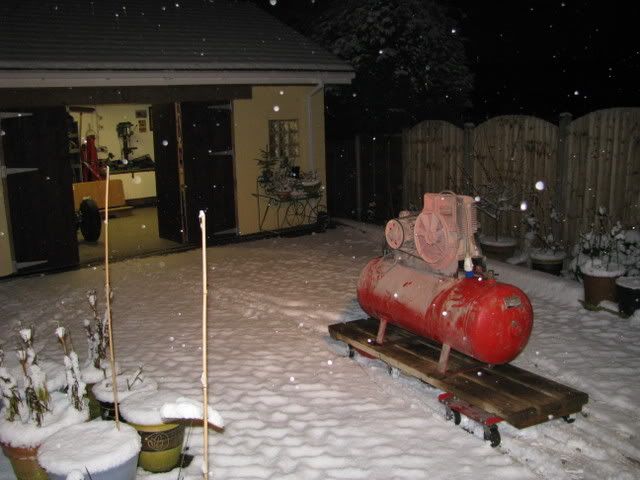
IMG_1318.jpg


I was actually just moving it into its new home. :thumbup:
 

Outlawmws

Well-known member
Joined
Aug 9, 2011
Messages
39,177
Location
The Badlands
Another ghetto source for a cooler could be either of the units in a car's AC system. You will want to look at form factors and flow design so you don't restrict it too much.

Interesting side note: I recently "drained" my 80 gallon after YEARS of neglect. I got less than a cup of water, so I guess I'm in a less humid environment than many...

That said I've been thinking about either putting a cooler on mine or getting a more compact unit and doing so, as an 80 gallon Horizontal tank had always been a hassle...
 

Morrisman

Well-known member
Joined
Nov 7, 2006
Messages
424
Location
Angeles City, Philippines
Most tank drains are at the lowest point, for obvious reasons, so leaving it cracked open just enough to whisper air out continually will remove any water before it rusts your tank out.

The red one in the piccie above was half full of ice when I got it, just frozen condensate where it had been used by a buddy for years with nary a draining. It had to thaw out before I could empty it. No wonder it was so heavy when I moved it around.
 

aka Larry

Well-known member
Joined
May 2, 2012
Messages
8,029
Location
Eastern, NC
Most tank drains are at the lowest point, for obvious reasons, so leaving it cracked open just enough to whisper air out continually will remove any water before it rusts your tank out.

That hissing sound (a.k.a. a leaky fitting) would drive me nuts! If I have a fitting that leaks, I'll replace it right away.

As far as water in the tank, I purge mine after EVERY use, so it won't be a problem for me. Granted, I only use mine once a week though.
 

IONH

Well-known member
Joined
Feb 12, 2010
Messages
2,043
Location
Central Massachusetts
Interesting side note: I recently "drained" my 80 gallon after YEARS of neglect. I got less than a cup of water, so I guess I'm in a less humid environment than many...

Drained my 60 gallon tank for the first time after about 3 years of occasional use and got a good couple of cups out.

Since then, I installed a right angle NPT fitting with a ball valve sticking out right by a leg so I can open it from time to time. I mean to do it every time I finish for the day but rarely remember.
 

pipsters

Well-known member
Joined
Sep 1, 2010
Messages
4,899
Location
USA
Most tank drains are at the lowest point, for obvious reasons, so leaving it cracked open just enough to whisper air out continually will remove any water before it rusts your tank out.

The red one in the piccie above was half full of ice when I got it, just frozen condensate where it had been used by a buddy for years with nary a draining. It had to thaw out before I could empty it. No wonder it was so heavy when I moved it around.

That still won't remove the vapor'd moisture from the lines though. Only if you fill your tank, let it sit, then use the air would it have an effect.

I ran into an issue for the first time when I was using my 3" cut off, water was just pouring out the tool air outlet hole, and that was on my 120v compressor.
 

buening

Well-known member
Joined
Dec 17, 2007
Messages
1,338
Location
Decatur, IL
....thus the reason metal piping around the garage is a good idea, as it allows the air to cool even further before it gets to the tool. Condensate in the piping gets directed to the drops with ball valves.
 
To avoid these ads, REGISTER NOW!
Top Bottom