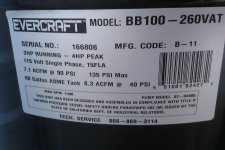
I don't know where you stand now on this but here goes.
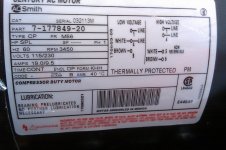
I'm going from the MOTOR nameplate, not the other tag, since the motor is the motor mfgr. Your motor needs 19 amps at 120V so a 20 A circuit will not cut it. If because of pulley ratios, the motor does only draw at full rated load, the 15A so much the better.
I think it started and ran the first time because the tank was empty and the motor was not started against any kind of load. Your machine should have a relieving valve that dumps air pressure in the line between the pump and the checkvalve at the tank upon shutdown. There should also be a check valve to stop pressure bleedback. However after that first pump up even with those two item working properly now the motor is pumping against a serious load almost immediately , the tank pressure, and it needs the full current.
The motor will only draw the full load current when it is working hard which would have been the case as the machine came up to pressure the first time but the build up would have been much slower so the breaker held for enough time. The second time pumpup would have pulled close to full current right from the start. and thus the breaker would be in overload fast and the reaction time less. The breaker may also have been still warm if the restart was soon enough.
Note a typical household circuit breaker has a time curve. They work on heat buildup. There are published specs that will show this. Small, short time overloads can often allow the breaker to not trip. They will still fast trip on short circuits. I think that's why your machine worked the first time. The overload time was of short enough duration that the breaker held . However, the next time the full current was needed immediately and the time to trip was exceeded.
To boot motors will draw several times the rated current at startup, typical is 4X but I've seen higher which makes your problem worse.
FOR MOTOR STARTING the code in your area should allow a bigger breaker, up to 1.75X the motor FLA and wire size for breakers, if I remember correctly, which should allow that motor to start. I'm assuming you used 12 ga wire, although better would have been 10ga. As said above if the motor does really work on 15A in that useage then a 30A may do ok. For the 19A rating I don't think you will find a 35A breaker so the code will sometime allow the next size up [a 40A] IF the motor will not start reliably on the calculated correct breaker. So try the 30A first adn if there is still trouble then go to the 40A.
If you can convert that circuit to 230V the rated motor current will drop to 9.5A. You will need a 2 pole breaker or a double breaker and the panel room to change it which may entail juggling some other breakers to get the side by side room to do it. A 20A 2 pole should start that motor handily. Also motors generally work better on the higher voltage.
DO NOT JUST INSTALL 2 SINGLE POLE BREAKERS__DANGEROUS. without the proper ties as an overload or short may only trip one leaving the other live to wake someone up or injure them.
If you are the least bit uncomfortable with this then get someone in that really knows, an electrician, and show and explain what you need/want.
Note that on a short circuit the allowed size up of the breaker for starting will still trip and fast. That's why the size up is allowed because the startup motor current is short term, usually a few seconds, and the time curve will still trip it if the motor doesn't start, but just takes a bit longer.
Good luck,
I hope this isn't too fuzzy