To avoid these ads, REGISTER NOW!

Air Compressor Bushing

Augster

Member
Joined
Nov 14, 2019
Messages
9
Location
Home
I've got a 15-year old work-horse Snap-On 5HP 60Gal (13.5SCFM@140PSI) air compressor for which I'm building a whole new garage workshop airline distribution system. I want to run 3/4" pipe in a loop around my 3-car garage but the OEM bushing on the tank is cut for 1/2" NPT.

Would it really matter if I have a reducing adapter to go from 1/2 to 3/4 then run 3/4" pipe? Or should I switch the bushing to 3/4" FNPT? I'm afraid after all these years trying to wrench off the huge bushing would just simply chip paint and round off the hexes. Perhaps drilling and tapping it out to 3/4"? Or would the new threads be a weak point?

Am currently remodeling my home and the compressor will be pushing my hopper texture gun. But after the dust has settled, it will mostly be running automotive air tools, and an occasional die grinder and spray painting. Sand blasting is probably the highest volume application, but I rarely do that nowadays.
 
Last edited:
To avoid these ads, REGISTER NOW!

The Cobbler

Super Moderator
Staff member
Joined
Oct 24, 2013
Messages
25,824
Location
Niagara Region, Ontario, Canada
in my opinion you're wasting $$ by going top 3/4" .
1/2" will be fine. I textured a ton of ceilings & repair areas with a 3/8" hose. One time I had a ton of repairs in an apartment complex . I had the compressor in a corner and had at least 200' of hose running off the gun.
 

GeoBruin

Well-known member
Joined
May 5, 2018
Messages
3,733
If you're truly doing a loop, I agree 1/2" is plenty for the system but if you really want 3/4", don't worry about 1 reducer at the tank. It's long runs of restriction like small lines and hoses that really reduce flow. Small, discrete restrictions like fittings don't have nearly the same affect on the system overall unless you have a ton of them.

I'm speaking as someone who obsessed over the same kind of thing to the point of purchasing multiple flow meters while screwing with my air system and testing multiple configurations until I realized what really mattered and what didn't. Good luck.
 
OP
A

Augster

Member
Joined
Nov 14, 2019
Messages
9
Location
Home
in my opinion you're wasting $$ by going top 3/4" .
1/2" will be fine. I textured a ton of ceilings & repair areas with a 3/8" hose. One time I had a ton of repairs in an apartment complex . I had the compressor in a corner and had at least 200' of hose running off the gun.

I was going off numerous charts from different sources showing recommended air supply pipe sizes based on CFM and length of runs, which mine will be around 130-170 feet (of which 120-150 is a loop; and let’s not forget the 3/8” hose that will plug in to get to the final project destination, which will add another 100-200‘) and the recommended pipe size is 3/4”. In addition, RapidAir Fastpipe, which is what I’ll be using, minimum pipe size offered is 3/4”; I was comparing the prices and Fastpipe seems to be the cheapest and easiest to install.
 
Last edited:
OP
A

Augster

Member
Joined
Nov 14, 2019
Messages
9
Location
Home
If you're truly doing a loop, I agree 1/2" is plenty for the system but if you really want 3/4", don't worry about 1 reducer at the tank. It's long runs of restriction like small lines and hoses that really reduce flow. Small, discrete restrictions like fittings don't have nearly the same affect on the system overall unless you have a ton of them.

I was thinking one small but very brief squeeze through that reducer wouldn’t really be significant enough to warrant all the extra effort to fix It to 3/4”. So yea, I’m no longer going to sweat it and just plug in a reducer.
 

Wiz02

Well-known member
Joined
Jul 13, 2007
Messages
2,399
Location
Southeastern PA
Always interesting to get real world perspective on these questions as I am designing the air line configuration for my garage and I too am concerned about restrictions in flow.

My compressor is rated 11.9 scfm @ 90 psi and it has a 3/4" pipe outlet. I plugged those numbers into a calculator to get 11.9 scfm with a 3/4" pipe diameter, and then changed the pipe diameter to 1/2". The flow went down to 5.3 scfm, so you lose more than half of the potential flow. However, I don't know if that actually matters in the real world or not, sounds like no for many applications.

I figure that it will only matter for something that is an air hog like a sand blaster, but I am running 3/4 until I get to the actual coupler because overkill is a GJ thing.

Calculator link if you want to play with numbers.


welder4956

Well-known member
Joined
Apr 8, 2010
Messages
3,059
Location
Birmingham, AL USA
I've got a 15-year old work-horse Snap-On 5HP 60Gal (13.5SCFM@140PSI) air compressor for which I'm building a whole new garage workshop airline distribution system. I want to run 3/4" pipe in a loop around my 3-car garage but the OEM bushing on the tank is cut for 1/2" NPT.

Would it really matter if I have a reducing adapter to go from 1/2 to 3/4 then run 3/4" pipe? Or should I switch the bushing to 3/4" FNPT? I'm afraid after all these years trying to wrench off the huge bushing would just simply chip paint and round off the hexes. Perhaps drilling and tapping it out to 3/4"? Or would the new threads be a weak point?

Am currently remodeling my home and the compressor will be pushing my hopper texture gun. But after the dust has settled, it will mostly be running automotive air tools, and an occasional die grinder and spray painting. Sand blasting is probably the highest volume application, but I rarely do that nowadays.
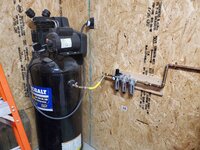
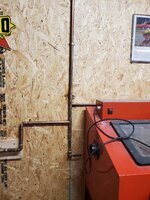
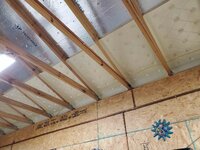
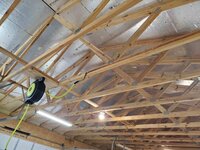
I have pretty much the same arrangement in a 3 car garage, except I ran a 3/4" header across the back wall only and 1/2" drops from the header with a drain valve at the bottom of each drop. The connection at the compressor is 1/2" then increases to 3/4" just before the regulator. My initial plan was a 3/4" loop all the way around the garage, but I wanted to get part of it finished and working then finish the loop later. Just having the header and drops across the back wall has worked so well that there is not really a need to go the rest of the way around. I run have run air grinders, air saw, air sander and impact gun on it so far and no issues with air supply. I don't think you will have any problem at all with the 1/2" connection at the compressor and 3/4" for the rest of the line.

20211016_124133.jpg

20211016_124138.jpg

20211016_124145.jpg

20211016_124210.jpg

20211016_124216.jpg

20211016_124237.jpg

20211016_124252.jpg

20220102_160734.jpg

20220102_160735.jpg
 
OP
A

Augster

Member
Joined
Nov 14, 2019
Messages
9
Location
Home
I have pretty much the same arrangement in a 3 car garage, except I ran a 3/4" header across the back wall only and 1/2" drops from the header with a drain valve at the bottom of each drop. The connection at the compressor is 1/2" then increases to 3/4" just before the regulator. My initial plan was a 3/4" loop all the way around the garage, but I wanted to get part of it finished and working then finish the loop later. Just having the header and drops across the back wall has worked so well that there is not really a need to go the rest of the way around. I run have run air grinders, air saw, air sander and impact gun on it so far and no issues with air supply. I don't think you will have any problem at all with the 1/2" connection at the compressor and 3/4" for the rest of the line.

Fantastic layout! I priced out 3/4" copper and here in my neck of the woods, it's $2.41/foot, where as Fastpipe is $2.06/foot. Of course, the fittings for Fastpipe are WAY more expensive than copper fittings. But the ease of both installation AND modification (loosen, remove, modify, tighten; versus desolder, remove, modify, resolder) won me over to Fastpipe.

And like you, I may not go full loop on intial install; just enough to hit half the garage with drops and an overhead reel like yours. Then play by ear.
 
To avoid these ads, REGISTER NOW!
OP
A

Augster

Member
Joined
Nov 14, 2019
Messages
9
Location
Home
Always interesting to get real world perspective on these questions as I am designing the air line configuration for my garage and I too am concerned about restrictions in flow.

My compressor is rated 11.9 scfm @ 90 psi and it has a 3/4" pipe outlet. I plugged those numbers into a calculator to get 11.9 scfm with a 3/4" pipe diameter, and then changed the pipe diameter to 1/2". The flow went down to 5.3 scfm, so you lose more than half of the potential flow. However, I don't know if that actually matters in the real world or not, sounds like no for many applications.

I figure that it will only matter for something that is an air hog like a sand blaster, but I am running 3/4 until I get to the actual coupler because overkill is a GJ thing.

I figure that if I'm going to spend the money and if 3/4" is already the consensus recommended size from various air flow charts for what I have now, there's no point cheaping out now and going 1/2" because when someday I replace my current compressor, I don't want my air distribution to be the limiting factor in selecting it's replacement. I.e. I can splurge to a much higher rated SCFM machine if I wanted knowing my delivery system can handle it.
 

GeoBruin

Well-known member
Joined
May 5, 2018
Messages
3,733
I figure that if I'm going to spend the money and if 3/4" is already the consensus recommended size from various air flow charts for what I have now, there's no point cheaping out now and going 1/2" because when someday I replace my current compressor, I don't want my air distribution to be the limiting factor in selecting it's replacement. I.e. I can splurge to a much higher rated SCFM machine if I wanted knowing my delivery system can handle it.
I didn't realize you were going with aluminum pipe but yes, it's only available in minimum 3/4". It will serve you well.

Just to be clear, the size of your compressor has little to do with the distribution needs. Even if you double or triple your compressor's output, the cfm numbers are still well below what even a 1/2" distribution system can flow. What we're talking about when we're talking about the systems ability to flow is the flow from the tank that is already under pressure, not the flow from the compressor pump to the tank, which is how the compressor cfm is specified. While the latter is usually 10-20 cfm for a home shop compressor, the former is likely over 100 cfm for a well designed system.

Edit: I just shot this video. This air has flowed from the compressor tank through a series of fittings, valves, and short lengths of hose, bulkhead fittings and about about 10' of 1/2" iron pipe just to get to my shop from the shed the compressor sits in. It has then flowed through a water separator, dessicant filter, and a regulator (all 1/2" ports) then through approx. 30' of 3/4" "maxline" piping including a half-dozen fittings, then through another 3' length of rubber hose, a 3/4" Motor Guard filter, another short length of rubber hose, then through a 50' 3/8" hose reel with a Stedlin QD coupler to the gauge apparatus which has a brass harbor freight QD plug on it.

The regulator is set at 90 psi (surely lower at the end of the hose) and I'm still free flowing 100 cfm.
 
Last edited:

Citation

Well-known member
Joined
Jan 20, 2016
Messages
3,212
Location
Indy
I would suggest looking into PEX as a cheaper alternative for home use. 1/2" ID tubing seems like plenty for this system. I suspect most of the 3/4" suggestions assume multiple users sharing the system. The OP won't have that. The same is generally true of the loop suggestion. A loop makes sense with multiple users as it helps ensures a heavy user near the compressor doesn't draw down the pressure for users further down the line. If you have a linear setup then a heavy user at the first drop could cause a big pressure drop for all down stream users. If you are the only user on the system that isn't an issue.

I helped a friend setup his auto shop air system in a 10k sqft building. We did just 1/2" PEX in a branched system. It works fine even for his blast cabinet. It works because there is rarely more than one person using air at a time. I can understand wanting to do the "right" system but sometimes it's like buying a low profile Snap-on wrench set to replace the stamped sheet metal wrench that came with your new Ikea chair.
 

Walkers

Well-known member
Joined
May 17, 2021
Messages
3,912
Location
Cave Creek Az
The small outlet on the tank won't matter a bit. The air flow will recover entirely. After years working with orifice meters I used to be able to calculate the flow given the pressure, but I think it has been too long now.
 
OP
A

Augster

Member
Joined
Nov 14, 2019
Messages
9
Location
Home
I would suggest looking into PEX as a cheaper alternative for home use. 1/2" ID tubing seems like plenty for this system.

I do have 1/2" tools for PEX from my whole home remodel I did on my previous home in which l relocated both the washer lines in the laundry room as well as the kitchen sink. Though I'm not so thrilled in having to work hard to keep the flexible tubing straight along long runs (which tends to curve from being sold tightly coiled) with more supports spaced closer together.
 

Citation

Well-known member
Joined
Jan 20, 2016
Messages
3,212
Location
Indy
I do have 1/2" tools for PEX from my whole home remodel I did on my previous home in which l relocated both the washer lines in the laundry room as well as the kitchen sink. Though I'm not so thrilled in having to work hard to keep the flexible tubing straight along long runs (which tends to curve from being sold tightly coiled) with more supports spaced closer together.
A few members have made tools to straighten the pex before installing it. I agree that the wavy look isn't a nice as straight tubes.
 
To avoid these ads, REGISTER NOW!
Top Bottom