To avoid these ads, REGISTER NOW!

Air Compressor / Generator

alex123

Well-known member
Joined
Jan 16, 2019
Messages
177
Location
USA
Hello Everyone,

I'm in the market to get a decent sized compressor to run air tools. Due to the nature of my living circumstances (moving multiple times, current landlord not okay with me rewiring to 220v, etc...), I am unable to get a 220V outlet setup at my house. Is it at all possible (and realistic) to run a 80 gallon 220v air compressor off a generator? I was considering this generator, and this compressor. Though, the compressor is rated at 230v and the generator is rated for 220v... Not sure if that matters? If there's anything else I should know, please feel free to share. Many thanks!
 
To avoid these ads, REGISTER NOW!

matt_i

Well-known member
Joined
Mar 14, 2008
Messages
10,722
Location
SE Michigan
I'd say you have a good shot.

The FLA is somewhere around 25A running, I'd guess 50A across the lines when starting (double the FLA)

The surge capacity of 12,500W = 240vac * 52A.

So allegedly the numbers work in your favor but you're right on the ragged edge.

Drop that back to a 5hp and I think you'd have smooth sailing.

Imo you'd be better off with electric tools....this combo is going to make a large amount of noise and that compressor is not at all portable....they list product weight at 623# which probably includes some crating, etc. But that's not a trivial thing to move around....
 

American Locomotive

Well-known member
Joined
Jan 8, 2017
Messages
10,929
Location
Rhode Island
I sincerely doubt that generator will start that compressor reliably. Maybe when the tank is empty, but I doubt it will do it once it has some air in that tank. Motor starting current is a lot more than double the running current. Typically it's 4-8x. So I'd expect start-up current on a 7.5HP motor to be close to 80-100A.

Just skip the middle man, and for less money you can just get a gas powered compressor.

https://www.northerntool.com/shop/tools/product_200596488_200596488

https://www.northerntool.com/shop/tools/product_350443_350443

When you're ready to settle down, you can either sell the unit, or strip the gas motor off and convert it to electric.
 

mike93lx

ALLIANCE MEMBER
Joined
Dec 9, 2013
Messages
37,362
Location
Richmond, VA
There is no such thing as 220v in the US anymore. Anyone labeling voltage at 220v or 230v is living in the past. It is all 240v.

What do you need so much air for? I would seriously consider battery or corded tools way before using a very loud generator to run a very loud compressor

I think that generator has almost no chance of starting a 7.5hp motor. You'll get serious voltage sags and may damage something
 

TonyJ

Well-known member
Joined
Sep 10, 2019
Messages
384
Location
West Virginia
ad339269757fd9fe05f7ce85e6731ea2.jpgf490fce9c384a30d2899b61291d9c587.jpg

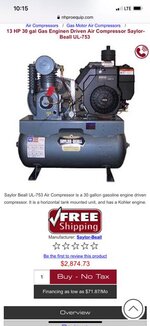
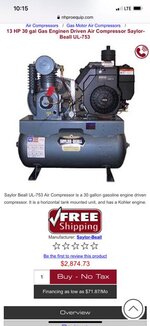
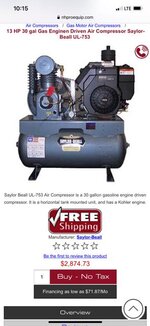
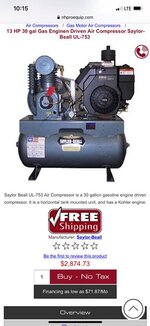
Or one like this that will likely out live you and will give plenty of air, easier to move around, and can be truck or trailer mounted for remote usage. And another plus is it’ll outlast the dewalt and all at the same time still saving a few hundred bucks between purchase prices


Tony
 

Attachments

  • ad339269757fd9fe05f7ce85e6731ea2.jpg
    ad339269757fd9fe05f7ce85e6731ea2.jpg
    31.8 KB · Views: 0
  • f490fce9c384a30d2899b61291d9c587.jpg
    f490fce9c384a30d2899b61291d9c587.jpg
    31.6 KB · Views: 0

nadogail

Well-known member
Joined
Jan 23, 2009
Messages
31,904
Location
Coronado, CA
My Harbor Freight 13 horse engine spinning a 10 KW (advertised) Harbor Freight Alternator starts my 20 gallon Devilbis compressor and will run my Hobart Stickmate burning 1/8" 7018 @ 100 Amps. This is a home brewed gen set, not a factory production model. I can also run a 12" table saw.

I don't try to do everything at once.
 

mike93lx

ALLIANCE MEMBER
Joined
Dec 9, 2013
Messages
37,362
Location
Richmond, VA
My Harbor Freight 13 horse engine spinning a 10 KW (advertised) Harbor Freight Alternator starts my 20 gallon Devilbis compressor and will run my Hobart Stickmate burning 1/8" 7018 @ 100 Amps. This is a home brewed gen set, not a factory production model. I can also run a 12" table saw.

I don't try to do everything at once.

None of those are anywhere near a 7.5hp motor
 
OP
A

alex123

Well-known member
Joined
Jan 16, 2019
Messages
177
Location
USA
I'd say you have a good shot.

The FLA is somewhere around 25A running, I'd guess 50A across the lines when starting (double the FLA)

The surge capacity of 12,500W = 240vac * 52A.

So allegedly the numbers work in your favor but you're right on the ragged edge.

Drop that back to a 5hp and I think you'd have smooth sailing.

Imo you'd be better off with electric tools....this combo is going to make a large amount of noise and that compressor is not at all portable....they list product weight at 623# which probably includes some crating, etc. But that's not a trivial thing to move around....

Matt, - Thank you for your reply. I do have some Milwaukee Fuel 18V tools, and absolutely love them! I just wanted to get a compressor for more versatility. I've also been told that gas compressors may be an option, so to cut out the middle-man with a generator. I'm still new to the air compressor world so forgive me if my next question seems a little silly. Almost all gas compressors I see are 30 gallons or less, whereas the electric one I was considering is 80 gallons. Is this possibly because the the gas powered ones have a high CFM rating? If so, what is the relationship (and effect on tool run time/power) between my CFM and tank size? Also, is it safe to have a gas powered unit in a garage (fumes)? I am totally open to gas powered if its safe and yield the same performance, but I'm not really familiar with them and don't know if I'd be losing performance? Many thanks!
 
OP
A

alex123

Well-known member
Joined
Jan 16, 2019
Messages
177
Location
USA
I sincerely doubt that generator will start that compressor reliably. Maybe when the tank is empty, but I doubt it will do it once it has some air in that tank. Motor starting current is a lot more than double the running current. Typically it's 4-8x. So I'd expect start-up current on a 7.5HP motor to be close to 80-100A.

Just skip the middle man, and for less money you can just get a gas powered compressor.

https://www.northerntool.com/shop/tools/product_200596488_200596488

https://www.northerntool.com/shop/tools/product_350443_350443

When you're ready to settle down, you can either sell the unit, or strip the gas motor off and convert it to electric.

Thank you for your reply @American Locomotive. I am open to this idea. I am new to air compressors. What would I be losing by going down to a 30 gallon tank (instead of 80 gallon). Is it the higher CFM that makes up for the smaller tank size? Will I be able to run essentially any tool on the 30 gal. gas compressor, or will my options be limited to those that don't require much air consumption?
 
OP
A

alex123

Well-known member
Joined
Jan 16, 2019
Messages
177
Location
USA
ad339269757fd9fe05f7ce85e6731ea2.jpgf490fce9c384a30d2899b61291d9c587.jpg

Or one like this that will likely out live you and will give plenty of air, easier to move around, and can be truck or trailer mounted for remote usage. And another plus is it’ll outlast the dewalt and all at the same time still saving a few hundred bucks between purchase prices


Tony

Tony, thank you for your reply. I am new to air compressors. What would I be losing by going down to a 30 gallon tank (instead of 80 gallon). Is it the higher CFM that makes up for the smaller tank size? Will I be able to run essentially any tool on the 30 gal. gas compressor, or will my options be limited to those that don't require much air consumption?
 

Attachments

  • ad339269757fd9fe05f7ce85e6731ea2.jpg
    ad339269757fd9fe05f7ce85e6731ea2.jpg
    29 KB · Views: 0
  • f490fce9c384a30d2899b61291d9c587.jpg
    f490fce9c384a30d2899b61291d9c587.jpg
    28.3 KB · Views: 0

mike93lx

ALLIANCE MEMBER
Joined
Dec 9, 2013
Messages
37,362
Location
Richmond, VA
Tanks in gas comps are smaller because they are meant to be portable or mounted on a truck. No one needs a 80 gal tank in a portable setting. If you need that much air, you are using a towable compressor.
 
OP
A

alex123

Well-known member
Joined
Jan 16, 2019
Messages
177
Location
USA
Tanks in gas comps are smaller because they are meant to be portable or mounted on a truck. No one needs a 80 gal tank in a portable setting. If you need that much air, you are using a towable compressor.

Mike93lx, thank you for your reply. I guess what I'm trying to get at is will the 30 gal. gas compressor be able to yield the same performance as an 80 gal. electric? For example, a disc sander requires 20cfm and is considered high air consumption. A 80 gal. can keep up with it, but can the 30 gal. gas provide the air needed to run such a tool? I'm just trying to see what my best option is given my current situation. Many thanks!
 

mike93lx

ALLIANCE MEMBER
Joined
Dec 9, 2013
Messages
37,362
Location
Richmond, VA
Mike93lx, thank you for your reply. I guess what I'm trying to get at is will the 30 gal. gas compressor be able to yield the same performance as an 80 gal. electric? For example, a disc sander requires 20cfm and is considered high air consumption. A 80 gal. can keep up with it, but can the 30 gal. gas provide the air needed to run such a tool? I'm just trying to see what my best option is given my current situation. Many thanks!

You need to look at the specs.

You really don't want to run a corded sander? Running a 13+hp engine to spin a small sander seems quite silly to me
 
OP
A

alex123

Well-known member
Joined
Jan 16, 2019
Messages
177
Location
USA
You need to look at the specs.

You really don't want to run a corded sander? Running a 13+hp engine to spin a small sander seems quite silly to me

I can run a corded sander... That's just one tool of many that I plan to run. I just don't want to spend $2500 on a gas compressor and then find out half the pneumatic tools won't run on it.
 

mike93lx

ALLIANCE MEMBER
Joined
Dec 9, 2013
Messages
37,362
Location
Richmond, VA
I can run a corded sander... That's just one tool of many that I plan to run. I just don't want to spend $2500 on a gas compressor and then find out half the pneumatic tools won't run on it.

I get it. You are looking at spending at least 2 grand to get this setup and it won't be great at that. Gas compressors are designed for jobsite. Standing near a 13hp engine running all day sounds like it would ****.

What tools do you need that aren't available cordless or corded?
 

TonyJ

Well-known member
Joined
Sep 10, 2019
Messages
384
Location
West Virginia
You can run just about any tool on a gas powered one. The difference your looking at is 30vs 80 gal. The compressor you listed the 7.5hp is going to be killer in amps to run with a generator and likely will kill a generator of the size you spec’ed in short order. Also your original idea included the use of a gas generator. That of course will put out fumes so it’ll have to set outside while running. The gas powered compressors how they keep up with the larger 80gal models is the gas motor doesn’t shut off when the tank is full it just slows down its rpm and the pump unloads until the tank is low on air and it kicks back in and fills it back up. The cycling of the 7.5hp is whats killing your idea and you would be better served with a gas powers model and set it outside ( fumes ) just like how you was going to have to do with the generator.


Tony
 

American Locomotive

Well-known member
Joined
Jan 8, 2017
Messages
10,929
Location
Rhode Island
Pretty much all of the gas-powered compressors linked here will be capable of running just about any air tool you could throw at them. You need to look at the "CFM" rating. The gas compressors linked have 20+ CFM on tap.

Electric compressors typically have large air tanks to reduce cycling (how often the motor turns on/off). But gas compressors just run the engine continuously and "unload" the compressor pump when they hit the desired pressure, so they can get by with much smaller tanks.

If you have many air tools, want to be able to use air in your shop, and your nomadic lifestyle will be continuing for the near future without the guarantee of 240v - I'd say go ahead and buy one of the listed gas compressors.
 
OP
A

alex123

Well-known member
Joined
Jan 16, 2019
Messages
177
Location
USA
You can run just about any tool on a gas powered one. The difference your looking at is 30vs 80 gal. The compressor you listed the 7.5hp is going to be killer in amps to run with a generator and likely will kill a generator of the size you spec’ed in short order. Also your original idea included the use of a gas generator. That of course will put out fumes so it’ll have to set outside while running. The gas powered compressors how they keep up with the larger 80gal models is the gas motor doesn’t shut off when the tank is full it just slows down its rpm and the pump unloads until the tank is low on air and it kicks back in and fills it back up. The cycling of the 7.5hp is whats killing your idea and you would be better served with a gas powers model and set it outside ( fumes ) just like how you was going to have to do with the generator.


Tony

TonyJ, Thank you for clarifying.
 
To avoid these ads, REGISTER NOW!
OP
A

alex123

Well-known member
Joined
Jan 16, 2019
Messages
177
Location
USA
Pretty much all of the gas-powered compressors linked here will be capable of running just about any air tool you could throw at them. You need to look at the "CFM" rating. The gas compressors linked have 20+ CFM on tap.

Electric compressors typically have large air tanks to reduce cycling (how often the motor turns on/off). But gas compressors just run the engine continuously and "unload" the compressor pump when they hit the desired pressure, so they can get by with much smaller tanks.

If you have many air tools, want to be able to use air in your shop, and your nomadic lifestyle will be continuing for the near future without the guarantee of 240v - I'd say go ahead and buy one of the listed gas compressors.

American Locomotive, Thank you for your reply. How do I determine what my CFM requirement will be? Yes, the 30 gallon gas compressors are 20+ CFM. But the 8 gallon gas compressors (for example) are only 12 CFM. Will that suffice? I don't really want to be limited by my compressor. I don't mind spending more, if it'll give me more capability of using a wider range of tools though.
Also, is 20+ CFM the number I should be looking for as my "minimum" CFM to be able to run all my pneumatic tools?
 

Lucid Moments

Well-known member
Joined
Aug 9, 2015
Messages
1,775
Location
Gainesville, Ga
Electric compressors typically have large air tanks to reduce cycling (how often the motor turns on/off). But gas compressors just run the engine continuously and "unload" the compressor pump when they hit the desired pressure, so they can get by with much smaller tanks.

This is a key issue in the difference between a gas powered compressor vs. an electric one. The big downside is you are going to have a gas motor going the whole time you are using an air tool. So it will be loud.
 

Lucid Moments

Well-known member
Joined
Aug 9, 2015
Messages
1,775
Location
Gainesville, Ga
American Locomotive, Thank you for your reply. How do I determine what my CFM requirement will be? Yes, the 30 gallon gas compressors are 20+ CFM. But the 8 gallon gas compressors (for example) are only 12 CFM. Will that suffice? I don't really want to be limited by my compressor. I don't mind spending more, if it'll give me more capability of using a wider range of tools though.
Also, is 20+ CFM the number I should be looking for as my "minimum" CFM to be able to run all my pneumatic tools?

Figuring out real air tool consumption is a PITA because it varies from tool to tool and user to user. But here are a few questions that can get you started in the right direction.

1. How many tools will be using air at one time? If it is only one that makes the calculations pretty easy. If multiple tools will be used at the same time then add their consumption together.

2. How do you use the tools? Are they intermittent or continuous. Blasting is a notorious air hot partly because it gets used constantly over a fairly long time. And impact wrench you give the bolt a few ugga duggas and then pause. You mentioned a sander which I suspect will be one of your bigger air hogs so dig into that. The manufacturer generally advertises an air consumption based on average use. That is a place to start. Sometimes you can dig and find a peak or maximum usage figure but manufacturers sometimes don't like to give that information out.

Here is a chart giving estimates of tools and air usage. It is a place to start anyway.
 

TonyJ

Well-known member
Joined
Sep 10, 2019
Messages
384
Location
West Virginia
The 8 gal ones won’t have enough storage or cfm to get you and keep you going. Those are more for roofing jobs when using things like nailers and stuff or maybe pumping up a tire 2 miles out in the woods lol. Just for an insight for instance. The 30 gal ones are usually always the choice for service trucks around here like the trucks that goes out to the mines to work on a remote job. Those guys mainly use impact tools and impact tools can use allot of air but those 30 gal compressors get the job done. Also something else that can be done is you can always set the 30gal one up outside and get you a 60 or 80gal used tank and set the tank inside your shop and just plumb they two together and the 20cfm pump won’t have no issues keeping both tanks up and going


Tony
 

American Locomotive

Well-known member
Joined
Jan 8, 2017
Messages
10,929
Location
Rhode Island
American Locomotive, Thank you for your reply. How do I determine what my CFM requirement will be? Yes, the 30 gallon gas compressors are 20+ CFM. But the 8 gallon gas compressors (for example) are only 12 CFM. Will that suffice? I don't really want to be limited by my compressor. I don't mind spending more, if it'll give me more capability of using a wider range of tools though.
Also, is 20+ CFM the number I should be looking for as my "minimum" CFM to be able to run all my pneumatic tools?
12 CFM is pretty marginal for heavier use tools. Generally speaking 18+ CFM will provide adequate air for just about any homeowner-grade air tool. Spray guns, sanders, or even sand-blasting cabinets.

It's nice to have some air storage, because there are some tools that might take giant gulps of air - but only for a few seconds. The small 8 gallon tank might run out of air really quick, but the larger tank will be able to buffer things better.

I don't think you'd find much practical difference in terms of operation between a 30 gallon 20 CFM engine drive compressor and an 80 gallon 20 CFM electric compressor.
 
OP
A

alex123

Well-known member
Joined
Jan 16, 2019
Messages
177
Location
USA
This is a key issue in the difference between a gas powered compressor vs. an electric one. The big downside is you are going to have a gas motor going the whole time you are using an air tool. So it will be loud.

I absolutely agree. Unfortunately, because of my living situation, 220v electric will not be an option.
 
OP
A

alex123

Well-known member
Joined
Jan 16, 2019
Messages
177
Location
USA
Figuring out real air tool consumption is a PITA because it varies from tool to tool and user to user. But here are a few questions that can get you started in the right direction.

1. How many tools will be using air at one time? If it is only one that makes the calculations pretty easy. If multiple tools will be used at the same time then add their consumption together.

2. How do you use the tools? Are they intermittent or continuous. Blasting is a notorious air hot partly because it gets used constantly over a fairly long time. And impact wrench you give the bolt a few ugga duggas and then pause. You mentioned a sander which I suspect will be one of your bigger air hogs so dig into that. The manufacturer generally advertises an air consumption based on average use. That is a place to start. Sometimes you can dig and find a peak or maximum usage figure but manufacturers sometimes don't like to give that information out.

Here is a chart giving estimates of tools and air usage. It is a place to start anyway.


Hello and thank you for your reply. Also, thank you for sharing the CFM chart - very handy! :)

With respect to your questions, it will be just myself using the tools, so no multi-users drawing CFM at the same time. As for which tools, I will definitely need to use 1" impact wrench cut off tool, air saw, air hammer, and hopefully some painting. Do you think at 20CFM 30 gallon can keep up with this? I am not in the heavy industry so typical tools used by a mechanic and/or body shop is what I'd run.. Will a 30 gallon 20CFM gas compressor suffice for these types of tools?
 
OP
A

alex123

Well-known member
Joined
Jan 16, 2019
Messages
177
Location
USA
The 8 gal ones won’t have enough storage or cfm to get you and keep you going. Those are more for roofing jobs when using things like nailers and stuff or maybe pumping up a tire 2 miles out in the woods lol. Just for an insight for instance. The 30 gal ones are usually always the choice for service trucks around here like the trucks that goes out to the mines to work on a remote job. Those guys mainly use impact tools and impact tools can use allot of air but those 30 gal compressors get the job done. Also something else that can be done is you can always set the 30gal one up outside and get you a 60 or 80gal used tank and set the tank inside your shop and just plumb they two together and the 20cfm pump won’t have no issues keeping both tanks up and going


Tony

I absolutely LOVE your idea of linking up the 30 gallon gas compressor to a larger (60 gallon, or 80 gallon) down the road. Do they even sell tanks that big as stand alone? Will that not be too much strain on the engine?
I plan on using most automotive tools and body shop tools with my compressor, so will a 20cfm 30 gallon gas compressor suffice? Also, what are the limitations of the 30 gallon gas compressor? In other words, what will I for sure not be able to do?
 
OP
A

alex123

Well-known member
Joined
Jan 16, 2019
Messages
177
Location
USA
12 CFM is pretty marginal for heavier use tools. Generally speaking 18+ CFM will provide adequate air for just about any homeowner-grade air tool. Spray guns, sanders, or even sand-blasting cabinets.

It's nice to have some air storage, because there are some tools that might take giant gulps of air - but only for a few seconds. The small 8 gallon tank might run out of air really quick, but the larger tank will be able to buffer things better.

I don't think you'd find much practical difference in terms of operation between a 30 gallon 20 CFM engine drive compressor and an 80 gallon 20 CFM electric compressor.


Thank you for your reply. I'm glad you told me about the 18+ cfm because Harbor Freight has a 30 gallon truck mount compressor and it produces 18 cfm at 90 psi.... but to be honest, I don't trust their ratings. I feel like something like a IR or DeWalt with 20 CFM should be able to run most automotive, and body shop tools (painting)?
 
OP
A

alex123

Well-known member
Joined
Jan 16, 2019
Messages
177
Location
USA
Expensive way to get air for shop work.
Do the wire work so neat o one realizes you done it, plug in.

You are correct in that it is expensive... but given how often I move, I think gas compressors may be my only option. Even if I did wire up my current unit to 220v without the landlords permission, I'll be back to square one as soon as I move. I don't want to be the guy that moves in and gives every landlord a free wiring upgrade to 220v. LOL
 

redmondjp

Well-known member
Joined
Nov 25, 2014
Messages
2,318
Location
Redmond, WA
You are correct in that it is expensive... but given how often I move, I think gas compressors may be my only option. Even if I did wire up my current unit to 220v without the landlords permission, I'll be back to square one as soon as I move. I don't want to be the guy that moves in and gives every landlord a free wiring upgrade to 220v. LOL

You can run a real 5HP air compressor off of a 30A dryer outlet or a 50A electric stove outlet. Virtually every dwelling has one or both of those circuits already in it. My 60 gallon air compressor in my garage has been running on the dryer outlet since 1998 just fine (temporarily, heh heh).

You can easily make an adapter buy buying a dryer or electric stove cord, and then installing a 240V receptacle for the compressor plug on the end of it. And if you are in a place where the electrical panel is on an unfinished wall, it's easy to punch in a spare circuit and the circuit breaker will run you about $25 at the local box store. Then just put a receptacle near the panel, and use a 12-gauge extension cord (that you take when you move), if needed, to the compressor.

Just some ideas . . . there is always another way to skin the cat, so to speak.

The gas-powered compressors (I have one) are really loud and I try to only run mine when necessary.
 
OP
A

alex123

Well-known member
Joined
Jan 16, 2019
Messages
177
Location
USA
You can run a real 5HP air compressor off of a 30A dryer outlet or a 50A electric stove outlet. Virtually every dwelling has one or both of those circuits already in it. My 60 gallon air compressor in my garage has been running on the dryer outlet since 1998 just fine (temporarily, heh heh).

You can easily make an adapter buy buying a dryer or electric stove cord, and then installing a 240V receptacle for the compressor plug on the end of it. And if you are in a place where the electrical panel is on an unfinished wall, it's easy to punch in a spare circuit and the circuit breaker will run you about $25 at the local box store. Then just put a receptacle near the panel, and use a 12-gauge extension cord (that you take when you move), if needed, to the compressor.

Just some ideas . . . there is always another way to skin the cat, so to speak.

The gas-powered compressors (I have one) are really loud and I try to only run mine when necessary.

Thank you for the ideas! My last unit had the laundry room right next to the garage and it would have worked wonderfully. Current unit has a bit of a different setup and the wiring would have to be very long. Even if that worked, I want a more permanent solution so I know the air tools can be run whenever I want them to be available. Still love the suggestions though. Thanks again!
 

TonyJ

Well-known member
Joined
Sep 10, 2019
Messages
384
Location
West Virginia
I absolutely LOVE your idea of linking up the 30 gallon gas compressor to a larger (60 gallon, or 80 gallon) down the road. Do they even sell tanks that big as stand alone? Will that not be too much strain on the engine?

I plan on using most automotive tools and body shop tools with my compressor, so will a 20cfm 30 gallon gas compressor suffice? Also, what are the limitations of the 30 gallon gas compressor? In other words, what will I for sure not be able to do?


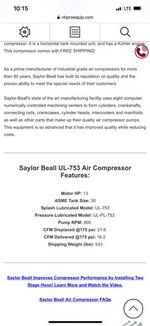
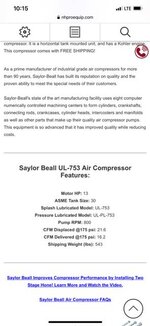
The pump that is on the gas one that I posted earlier in the thread is a Saylor Beall 705 pump. That same pump is sold in many different configurations as in gas engine 30 gal, electric horizontal 60gal & 80gal and also vertical 60 & 80gal. So no it won’t have any problems with a two tank configuration. It will just run a little longer filling the tanks but also you will have more air storage between each pump cycle. Saylor Beall and Quincy pumps are well known as being top of the line compressors and most of the time they out live the people that buy them when treated right with maintenance. This one is 30 gal because of portability and that’s why most gas driven ones are 30gal and not larger.


Tony
 
OP
A

alex123

Well-known member
Joined
Jan 16, 2019
Messages
177
Location
USA
The pump that is on the gas one that I posted earlier in the thread is a Saylor Beall 705 pump. That same pump is sold in many different configurations as in gas engine 30 gal, electric horizontal 60gal & 80gal and also vertical 60 & 80gal. So no it won’t have any problems with a two tank configuration. It will just run a little longer filling the tanks but also you will have more air storage between each pump cycle. Saylor Beall and Quincy pumps are well known as being top of the line compressors and most of the time they out live the people that buy them when treated right with maintenance. This one is 30 gal because of portability and that’s why most gas driven ones are 30gal and not larger.


Tony

Many thanks Tony! I noticed the compressor you listed mentions the cfm @ 175psi. Most stationary compressors mention cfm @ 90psi. Am I missing something?
 

American Locomotive

Well-known member
Joined
Jan 8, 2017
Messages
10,929
Location
Rhode Island
Many thanks Tony! I noticed the compressor you listed mentions the cfm @ 175psi. Most stationary compressors mention cfm @ 90psi. Am I missing something?
Generally single-stage "consumer" or "prosumer" electric compressors are rated at 90 PSI, while commercial/industrial units are often rated at 175 PSI. The idea is that you will regulate your air pressure to 90-120 PSI, while the compressor kicks on and off between ~140-175 PSI. That way you can get constant air pressure while the compressor does its thing.

Very large industrial screw compressors are typically only rated at 90 PSI, but that's because they can deliver the exact amount of air needed at all times, and don't turn on/off.

The IR gas powered compressor I linked earlier is rated for 24 SCFM @ 175 PSI as well.
 
OP
A

alex123

Well-known member
Joined
Jan 16, 2019
Messages
177
Location
USA
Generally single-stage "consumer" or "prosumer" electric compressors are rated at 90 PSI, while commercial/industrial units are often rated at 175 PSI. The idea is that you will regulate your air pressure to 90-120 PSI, while the compressor kicks on and off between ~140-175 PSI. That way you can get constant air pressure while the compressor does its thing.

Very large industrial screw compressors are typically only rated at 90 PSI, but that's because they can deliver the exact amount of air needed at all times, and don't turn on/off.

The IR gas powered compressor I linked earlier is rated for 24 SCFM @ 175 PSI as well.

Ah! That makes sense! Yes, I noticed that on the IR compressor you linked earlier. I was comparing that to the Northern Tool one. The NT one has a Honda engine, and the IR one has a Kohler engine. While most of the IR reviews are good, there were some reviews saying the Kohler engines aren't that great. Kinda on the fence now tbh.
 

larry_g

Well-known member
Joined
Apr 28, 2007
Messages
16,864
Location
oregon
Forget tank size for a moment. The compressor head and the prime mover determine the amount of work you can do with any compressor. For electric compressors you can figure a 3.5 to 4 cfm@90 as a rule of thumb. Gas engines are rated a bit different on HP so it takes a larger rated gas engine to deliver. So if you have a compressor head matched to the prime mover then you can get the most efficient energy conversion electricity or fuel to air pressure and flow.

Tank size, the tank is just a place to store the energy converted by the compressor. So if you have a large tank and a small usage tool online the compressor will run infrequently to recharge the tank & run the tool as long as the compressor head will deliver more air than the tool is using. On the other hand if your using an air hog tool that consumes air faster than the compressor can deliver then you will deplete the tank of air and you stop working till the tank refills. In this scenario the tank is just a large diameter pipe in the system once the compressor starts. So you run a bit and wait a bit. The tank size will determine the run/wait times but at the end of the day you can only do as much work as the compressor head can do, tank size is irrelevant in this case.

So when I hear someone refer to getting a compressor based on tank size I know they do not understand. When they talk in terms on scfm then I hope at least they have a clue. You can put the same motor/compressor head on any size tank and they will all deliver the same amount of work. Now if your work is intermittent then the larger tank will cover for an undersized compressor head.

lg
no neat sig line
 
To avoid these ads, REGISTER NOW!
Top Bottom