To avoid these ads, REGISTER NOW!

Air Compressor gets new Pressure Switch + Soft Start + Cooling Fan

gahrajmahal

Well-known member
Joined
Dec 12, 2008
Messages
2,527
Location
Cincinnati, Ohio
P1060491.JPG

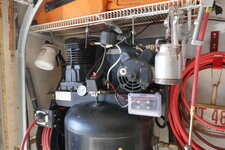
Sorry, no "Before" photos! This is my 25+ year old Black Max Sanborn compressor purchased at Sam's Club. It has been a reliable workhorse for me. It received a Harbor Freight hose reel about five years ago and other than a few Mobile 1 synthetic oil changes I have done nothing to it. This year was like many others and I worked it hard running DA sanders, air nailers, air grinders, air drill with nylon wire brush, impact wrenches, tire inflator, blow gun, and multiple body working tools this year along with a new Iwata HTE (high transfer efficiency) Air Gunsta spray gun along with my old stand by Binks and Devillbis guns.

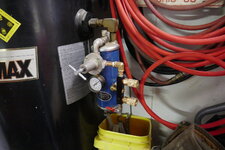
It was the middle of summer when I repaired and repainted my daily driver 2020 Corolla where I made some of the initial compressor upgrades. I added the cooling fan, a take off from our old furnace. I added a drip leg with multiple quick disconnects so I could use a dedicated dessicant drier plus regulator for spraying auto paints. I could then use a new hose for spraying.

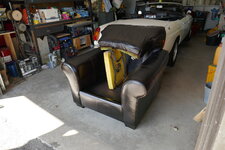
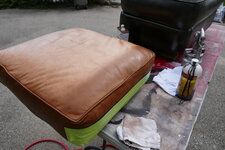
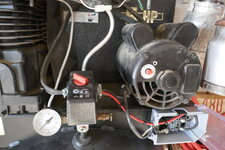
It was the fall when I was dyeing our leather club chair and ottoman when the pressure switch contacts welded themselves closed and caused a run on. I could only shut it off by quickly pulling the fuses at the power box. It was then I started to shop for a new pressure switch. After a lot of research and prices from $15 to $hundreds I came across a U.S. company called Condor. Using the motor tag information and compressor information I called the factory to get a recommendation. This will be your best bet for getting the right replacement. I needed 95 psi start, 125 psi stop, (4) port 1/4" NPT 240 volt 30 amps. Model MDR 11 Pressure Relief Valve. Cost? A modest $45 + shipping.

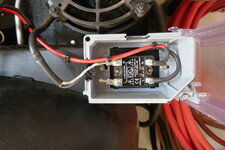
I've always disliked the way the compressor jerks violently to life and wanted to see if I could also add a soft start to the system to allow it to ramp up to speed. This is what I installed from Newark. $75 + shipping.

I found a great see through outlet cover at Menards to cover the Soft Start. I can open the cover and adjust the speed of the soft start. I would say I have it at about 1-2 seconds before full power. Initially it was about 5 seconds, but the motor was really groaning .

Now if I could just figure a way to quiet down the intake and running noise I would really love it even more!
P1060492.JPGP1060493.JPG
 
To avoid these ads, REGISTER NOW!

seber

Well-known member
Joined
May 31, 2016
Messages
4,195
Location
Deep East Tx.
A lot of noise comes from the inlet air. Automotive filter will do a lot for that. I once saw a crankcase with lead plate glued to it. The system was pretty quiet but I don't know how much the lead actually helped. I would think more of the mechanical noise would come through the cylinders and cooling fins. One thing that absolutely helps is a sound barrier. Ceiling tile board in front of the unit. Sound absorber behind will also help. More ceiling tile.
 
OP
G

gahrajmahal

Well-known member
Joined
Dec 12, 2008
Messages
2,527
Location
Cincinnati, Ohio
A lot of noise comes from the inlet air. Automotive filter will do a lot for that. I once saw a crankcase with lead plate glued to it. The system was pretty quiet but I don't know how much the lead actually helped. I would think more of the mechanical noise would come through the cylinders and cooling fins. One thing that absolutely helps is a sound barrier. Ceiling tile board in front of the unit. Sound absorber behind will also help. More ceiling tile.
I have been reading the GJ and considering my options. My intake is a rectangular opening with a mesh filter (scotch bright) and no fasteners in sight. I would have to JB weld something to it, or other jerry rigged setup. I think the belt guard is rattling again, plus other noise transmitted from the tank and floor mounts. As you can see, space is at a premium and I lazily hang stuff from the wire shelf above that holds my chainsaw and other "stuff".
 

NFH2740

Well-known member
Joined
Apr 16, 2012
Messages
476
Location
NE Indiana
Is the blue housing the primary desiccant canister?

What is your typical relative humidity and how often must the desiccant be changed?
 
Last edited:
OP
G

gahrajmahal

Well-known member
Joined
Dec 12, 2008
Messages
2,527
Location
Cincinnati, Ohio
Hi NFH2740, it’s a Harbor Freight Filter regulator. It never captured much in the way of water from the compressor. I kept it as the regulator works ok and I didn’t have any fittings to work with my other regulator. I should probably replace it though.

Here in a Cincinnati summer we often have 100% humidity. Despite draining my tank frequently, water in the airline is a problem. The new desiccant filter, another harbor freight item, kept my spot repair on the Corolla dry. I don’t worry about the water in my regular tools, just keep em lubricated.
 

finn

Well-known member
Joined
Mar 27, 2005
Messages
16,219
Location
The UP, God's country
Come up with a Helmholtz resonator for the air box.

The old 7.3 NA in the ford pickups in the mid to late 80s and early nineties had a pretty effective one. It was referred to as a Pope’s Hat. Basically an inverted dome on the air cleaner lid. Customers used to routinely rip them off because the engine sounded more powerful when the intake was unsilenced, even though the helmholtz resonator had zero effect on airflow or power. It just broke up the reversion pressure waves from the intake valves closing.

Customers aren’t always very smart, I guess.
 
To avoid these ads, REGISTER NOW!

theoldwizard1

Well-known member
Joined
Feb 22, 2011
Messages
43,132
Location
SE MI
@gahrajmahal Looking at the same soft start. But question.....why did you install it after the switch, rather than before?
That "switch" is also the pressure shut off/start switch. You want the soft starter "inline" every time the motor is going to start.

The point of a "true" soft starter is to limit the amount of current going the start capacitor. That is, the start capacitor is charged slowly. It still get to a full charge, it just take a second or 2 longer.
 

67King

Well-known member
Joined
Nov 14, 2014
Messages
577
Location
Friendsville, TN (Knoxville area)
That "switch" is also the pressure shut off/start switch. You want the soft starter "inline" every time the motor is going to start.

The point of a "true" soft starter is to limit the amount of current going the start capacitor. That is, the start capacitor is charged slowly. It still get to a full charge, it just take a second or 2 longer.

Yeah, I know. I have an external switch on mine between the breaker and the auto switch since the compressor is outside.

Wondering if the capacitor needs to be hot the whole time to recharge, rather than switched. In my case (new house, setting up shop - running solar so want to go easy on inverter), the cleanest place will be junction box where wiring goes through the wall. Which would mean it is hot when running a lot, but not when I turn it on the first time.
 
OP
G

gahrajmahal

Well-known member
Joined
Dec 12, 2008
Messages
2,527
Location
Cincinnati, Ohio
That "switch" is also the pressure shut off/start switch. You want the soft starter "inline" every time the motor is going to start.

The point of a "true" soft starter is to limit the amount of current going the start capacitor. That is, the start capacitor is charged slowly. It still get to a full charge, it just take a second or 2 longer.

What “the old wizard” said. It just was wired between the pressure switch “off/on” circuit and the motor. I’m not quite sure how the capacitor gets charged and uncharged during the whole operation but the old wizard’s explanation makes sense to me.
 

mm08822

Well-known member
Joined
Jan 13, 2012
Messages
5,895
Location
NJ
Probably only holding a charge from recent re-starts for the next run cycle.

So the first start of the day is simply "across the line" as if the soft start wasn't present b/c cap has no charge still stored.
 

67King

Well-known member
Joined
Nov 14, 2014
Messages
577
Location
Friendsville, TN (Knoxville area)
What “the old wizard” said. It just was wired between the pressure switch “off/on” circuit and the motor. I’m not quite sure how the capacitor gets charged and uncharged during the whole operation but the old wizard’s explanation makes sense to me.

Okay, thanks, and now that I am re-reading it.......

The point of a "true" soft starter is to limit the amount of current going the start capacitor. That is, the start capacitor is charged slowly. It still get to a full charge, it just take a second or 2 longer.

I think I get it. I had seen something that was wired differently whereby the capacitor discharged before the power came to kick on the motor, then had to be recharged. This is actually the opposite, where the soft starter acts like a damper or surge tank or something. That would mean it would need to be wired after the switch (auto/pressure controlled) to do anything.
 

senlow

Well-known member
Joined
Apr 26, 2008
Messages
2,230
Location
Wheat Ridge, Colorado
I'll suggest a few things that will help reduce noise:

Mechanically isolate the compressor. Eliminate rigid connections between the compressor and the building.
  • Use isolation feet under the compressor. Hockey pucks are popular, but don't do the best job because they are too stiff.
  • Use a flexible cord rather than rigid conduit to connect the electrical.
  • Use a hose between the compressor and your air distribution system (if you have a distribution system).
Finn suggested a Helmholtz resonator. That will reduce intake noise. You will have to use some imagination to connect it. Since you didn't post pics of the cylinder head, I'll have to guess a bit. I'm thinking that you may be able to fabricate a cover plate for the intake and install it with brackets that are fastened by the head bolts. Drill a hole in the cover plate and install a pipe bulkhead fitting. Then you can attach the resonator to that.

I see that the compressor is in a corner. The walls reflect the noise and the corner acts as a horn. Put some absorptive material on the walls behind the compressor. A sound barrier in front will also help.
 
OP
G

gahrajmahal

Well-known member
Joined
Dec 12, 2008
Messages
2,527
Location
Cincinnati, Ohio
To reduce noise I have the compressor on three pressure treated 4 x 4 blocks. The steel feet have a rolled edge that is wrapped in a length of thick heater hose and they are set on the blocks. The blocks are more for room for the drain valve on the bottom. I have always thought the bulk of the noise originated from the open intake holes in the head of the compressor, but the air going into the compressor must make some noise
 
To avoid these ads, REGISTER NOW!
Top Bottom