To avoid these ads, REGISTER NOW!

Air Compressor Gets Sluggish and Crawls to a Halt

HandyFS

Well-known member
Joined
Apr 22, 2024
Messages
46
Location
Northeast USA
This air compressor gets sluggish and stops building pressure around 50 psi. If I let pressure out it will start again and chug along until it can’t spin anymore. While it is running in the early stages as it grows from 0 psi, you can hear in the video how in the motor it sounds like some type of clutch is clicking to activate but doesn't seem to completely engage, however, it is building pressure until it reaches about 50psi. Once it reaches 50psi, it crawls to a halt and stops spinning, but the motor is still under power and hums.

It is not turning off with the pressure switch as the motor is still under power and trying to spin, instead this is as if the motor is seizing or weak.
It was originally patched directly into a circuit (120V? 20amp?) before I got it. I hooked it up to a 120V 20 amp circuit with a short cord directly into a 20amp outlet that has nothing else on it.

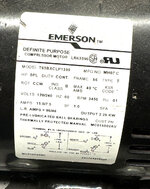
Attached is a video of it running so you can hear, and a photo of the label on the motor. Seems like it can be either 120V or 240V. The way it was wired it has just 1 black, 1 white, and 1 green wire, so I'm assuming it was in a 120V setup.

Is this capacitor related? Power related? Motor related? Any tips appreciated.
 

Attachments

  • IMG_9920.jpg
    IMG_9920.jpg
    1.1 MB · Views: 59
To avoid these ads, REGISTER NOW!

mm08822

Well-known member
Joined
Jan 13, 2012
Messages
6,030
Location
NJ
Upon starting the motor, look in through the air vents and see if the centrifugal switch is functioning/bound up.

Pull the belt and check motor operation. Free to spin, hard to spin? Any bearing noise?

Pull covers on motor caps. Inspect caps and wiring connections for damage. Read caps with VOM. Record cap info for future reference.
 
OP
H

HandyFS

Well-known member
Joined
Apr 22, 2024
Messages
46
Location
Northeast USA
Upon starting the motor, look in through the air vents and see if the centrifugal switch is functioning/bound up.

Pull the belt and check motor operation. Free to spin, hard to spin? Any bearing noise?

Pull covers on motor caps. Inspect caps and wiring connections for damage. Read caps with VOM. Record cap info for future reference.

Thanks for the quick and helpful tips. So far I did the following:
-I pulled the belt shield off to expose the motor and compressor pulleys. All seems to turn fine, nothing bound up, no noises
-I popped off the motor covers to look at the capacitors, I don't have a ton of experience here but they both looked normal, nothing bulging.

Capacitors:
For the capacitors, to test these with a volt meter, am I looking up the numbers on the label and then checking their resistance? I've done this in the past, but its been so long I completely forget the procedure. They are not bulged though so no visible issue or instant failure seen.

Centrifugal Clutch:
On the centrifugal clutch, when it makes that noise I could see some type of clutch inside trying to engage and then it seems to stop trying to engage/click, but it keeps running along. It does seem to sometimes just run even though that inner noise clicks a few times. It seems like it does great until about 30psi where you can notice its starting to weaken, by 50 psi it completely halts. If I turn the switch off and on, sometimes it will make a revolution and stop and hum, other times it just hums. In the video, that clicking noise you can hear is inside the motor, assuming it is the centrifugal clutch trying to engage.

Could this be some type of amp/power issue if that centrifugal clutch can engage due to a power draw? Its getting a full 120V on a 20amp circuit. From the label it seems to show 120/240V and 15 amp, so I think this current power setup is ok, but I could be wrong. Or does this sound more like a clutch/internal motor issue? Are there some type of contact points or leads inside that I could access and clean up? Guessing there are some type of points inside, so I may as well discharge the caps, and pop the motor cover off and monkey around a bit with the centrifugal clutch.

I never used this compressor myself. I got it from someone who had it in use and they were getting rid of equipment so it was no longer needed anymore. Chance it already had issues, or it could have been fine I'm not so sure.
 
Last edited:
OP
H

HandyFS

Well-known member
Joined
Apr 22, 2024
Messages
46
Location
Northeast USA
Has it ever ran properly?

There's a good chance that the motor is connected for 240 and supplied with 120.
I'm not so sure how it ran before. I was told it ran fine in its old setup. It doesn't have a plug, only a metal electric box with the White/Black/Ground wire inside. If that's the case, there is a good chance its struggling since it needs that extra power.

Is there an easy way to tell if it was originally wired for 240V vs. 120V just by looking at the existing wiring? Or is there a switch/jumper of some sort inside the motor that I can open up and look at to confirm? Now that I look, the electric motor has a diagram of sorts so I'll plan to open that up and get a photo so I can share to see if you all can help confirm if its wired for 120V or 240V.
 
Last edited:

johnre

Well-known member
Joined
Dec 1, 2016
Messages
1,056
Location
Portland, OR
Is there an easy way to tell if it was originally wired for 240V vs. 120V just by looking at the existing wiring? Or is there a switch/jumper of some sort inside the motor that I can open up and look at to confirm?
Your 120 V / 240 V hookup diagram is already shown in your first post. Open the black cover where the power cord enters and see which way it's hooked up.

Admittedly, that diagram leaves a lot to be desired - I presume that "Low line" refers to 120 V and "High line" refers to 240 V; others can confirm perhaps?

And there may be a better diagram on the inside of that cover; they often put one there as the one on the outside can be damaged or painted over.
 
Last edited:

Citation

Well-known member
Joined
Jan 20, 2016
Messages
3,223
Location
Indy
That looks like a Westward horizontal 20 gallon compressor (not a bad unit). I agree with others to check the motor voltage wiring. That cap could be bad. You would need ot measure those with the capacitor setting on a multimeter. However, if you don't know if the thing was setup for 120 or 240 I would definitely check that.
 

wyliesdiesels

Well-known member
Joined
Aug 14, 2012
Messages
20,066
Location
Modesto, CA
Your 120 V / 240 V hookup diagram is already shown in your first post. Open the black cover where the power cord enters and see which way it's hooked up.

Admittedly, that diagram leaves a lot to be desired - I presume that "Low line" refers to 120 V and "High line" refers to 240 V; others can confirm perhaps?

And there may be a better diagram on the inside of that cover; they often put one there as the one on the outside can be damaged or painted over.
correct
 

wyliesdiesels

Well-known member
Joined
Aug 14, 2012
Messages
20,066
Location
Modesto, CA
looks like 2 caps. 1 start cap 1 run cap

switching is engaging disengaging because motor is slowing down speeding up.

could be voltage issue or bad run cap....

check motor lead wiring first inside cover....
 
OP
H

HandyFS

Well-known member
Joined
Apr 22, 2024
Messages
46
Location
Northeast USA
That looks like a Westward horizontal 20 gallon compressor (not a bad unit). I agree with others to check the motor voltage wiring. That cap could be bad. You would need ot measure those with the capacitor setting on a multimeter. However, if you don't know if the thing was setup for 120 or 240 I would definitely check that.
Good eye, it is a Westward 12 gallon. I am going to go ahead and test the capacitors, and snap some photos of the wiring once I get over there later or tomorrow and I'll report back.
looks like 2 caps. 1 start cap 1 run cap

switching is engaging disengaging because motor is slowing down speeding up.

could be voltage issue or bad run cap....

check motor lead wiring first inside cover....
Yes, 2 capacitors, 1 under each of the covers. Good info all around. I'll get some more photos once I get over there and share.

I am pretty rusty at using a multimeter, but typically it comes back to me pretty quickly once I turn the dial and start probing.
 

walta

Well-known member
Joined
Jan 13, 2017
Messages
2,313
Location
Dutzow Missouri
Do you own or can you barrow a clamp on Amp meter?

Does the motor run smoothly when the belt is removed?

Does the pulley on the motor appear to be original?

Walta
 

grounded-b

Well-known member
Joined
Oct 23, 2012
Messages
285
Location
Milwaukee, WI
The white and brown wire connections determine if it is wired for 120V or 240V. White on term #4 and Brown wire on term #2 for 120V White on term #2 and Brown wire not connected and taped up (insulated) for 240V. The black and white LINE wires go to terminals 1 & 4 for either 120V or 240V operation
 
OP
H

HandyFS

Well-known member
Joined
Apr 22, 2024
Messages
46
Location
Northeast USA
Do you own or can you barrow a clamp on Amp meter?

Does the motor run smoothly when the belt is removed?

Does the pulley on the motor appear to be original?

Walta
I don't own an amp clamp, but I've been meaning to buy one. Looking on Amazon I got overwhelmed and never got one last time. I want to make sure I buy it right so I can do AC/DC and just about anything I may run into.

Motor is smooth other than the up and down RPM's and as it comes to a crawl/halt after it builds pressure. Things appear original, and looking up Westward there isn't a ton of into, but it looks like the Emerson motor may have been standard on it.
KISS

Check the wiring first....
Great reminder, thank you!

The white and brown wire connections determine if it is wired for 120V or 240V. White on term #4 and Brown wire on term #2 for 120V White on term #2 and Brown wire not connected and taped up (insulated) for 240V. The black and white LINE wires go to terminals 1 & 4 for either 120V or 240V operation
Great specific guidance, I appreciate this. I never got back over there yesterday but I will be this weekend so I'll get some photos and have more info to share soon.
 

walta

Well-known member
Joined
Jan 13, 2017
Messages
2,313
Location
Dutzow Missouri
I don't own an amp clamp, but I've been meaning to buy one. Looking on Amazon I got overwhelmed and never got one last time. I want to make sure I buy it right so I can do AC/DC and just about anything I may run into.
Adding the DC as a requirement 6X the cost and I have to wonder is you will use the ability enough to justify the expense.

My guess is there is a harbor freight nearby with a $15 meter in stock.

I have been considering getting a DC clamp but I cant justify it in my mind.

Walta
 
To avoid these ads, REGISTER NOW!
OP
H

HandyFS

Well-known member
Joined
Apr 22, 2024
Messages
46
Location
Northeast USA
Adding the DC as a requirement 6X the cost and I have to wonder is you will use the ability enough to justify the expense.

My guess is there is a harbor freight nearby with a $15 meter in stock.

I have been considering getting a DC clamp but I cant justify it in my mind.

Walta
This is exactly the dilemma I have. I almost grabbed the HF meter more than once, then said to hold out to look through Amazon listings for something better. Then analysis paralysis sets in and I don't get anything. There are some on Amazon that seem to do both AC/DC in the $30-$50 range that rank well, looking quickly this one came up with great reviews:

I was trying to lay out a list of real world places I would use it and decide what I need, then time gets away from me. If anyone has one of these average meters that they recommend in the $40-$50 range, please do share.
 
OP
H

HandyFS

Well-known member
Joined
Apr 22, 2024
Messages
46
Location
Northeast USA
The white and brown wire connections determine if it is wired for 120V or 240V. White on term #4 and Brown wire on term #2 for 120V White on term #2 and Brown wire not connected and taped up (insulated) for 240V. The black and white LINE wires go to terminals 1 & 4 for either 120V or 240V operation
So here it is. It looks like the black wire and white wire from the outlet plug are connected (Black on the left, White on the right), but the brown wire is just in a holder not hooked up to anything. So does this mean its 240V after all?

Can this motor happily run on 120V if the wiring is adjusted? I don't have a 240V hookup readily available so 120V would naturally be easier if possible for now.

Any tips on how to achieve that would be appreciated.
 

Attachments

  • compressor-1.jpg
    compressor-1.jpg
    289.4 KB · Views: 23
OP
H

HandyFS

Well-known member
Joined
Apr 22, 2024
Messages
46
Location
Northeast USA
If you connect it for 120, it'll run on 120.

Since the current will be pretty high, it'll need a 20 amp circuit and any extension cords smaller than #12 and longer than 50' will cause trouble.
Is that wiring set up for 120V? I'm not well versed on the wiring schematics so I'm uncertain based on the earlier post by @grounded-b if something needs to change what posts the wires are hooked to, or if that brown wise needs to be connected also.

I had this hooked to a 20-amp 120V circuit that has nothing other than this 1 outlet on it on a very short cord.

Clean the air filter and replace the oil??
I certainly could try that, but I pulled the dip stick and the oil looked ok color wise, and level wise.
 

cosmokenney

Well-known member
Joined
Oct 18, 2017
Messages
275
Location
Loyalton, CA
I certainly could try that, but I pulled the dip stick and the oil looked ok color wise, and level wise.
I had a problem with my Quincy not wanting to run this winter. I drained the oil and it looked pretty much new until I got to the bottom and leaned the compressor forward to get the left overs out. Then a bunch of gray oil came out from the bottom. After putting in some less thick synthetic oil, she runs like a champ. Look for my thread here.
 

grounded-b

Well-known member
Joined
Oct 23, 2012
Messages
285
Location
Milwaukee, WI
Is that wiring set up for 120V? I'm not well versed on the wiring schematics so I'm uncertain based on the earlier post by @grounded-b if something needs to change what posts the wires are hooked to, or if that brown wise needs to be connected also.

I had this hooked to a 20-amp 120V circuit that has nothing other than this 1 outlet on it on a very short cord.
No, it it currently wired for 240V. That is why it has no torque and slows down.

Remove the white wire from terminal #2, and place it on terminal #4. ( there are two white wires, be sure not to move the one from the line cord ). Move the brown wire to terminal #2.

Do not move the black and white white wires coming from the line cord.
 
OP
H

HandyFS

Well-known member
Joined
Apr 22, 2024
Messages
46
Location
Northeast USA
No, it it currently wired for 240V. That is why it has no torque and slows down.

Remove the white wire from terminal #2, and place it on terminal #4. ( there are two white wires, be sure not to move the one from the line cord ). Move the brown wire to terminal #2.

Do not move the black and white white wires coming from the line cord.
Thanks @grounded-b! I'm going to head over late night and try to follow your instruction and see if I find success. I will keep you all posted!
What is the benefit of running on 240V vs. 120V? Quicker recovery, and faster function? I assume that's the case, but just curious.
In my case, I may move this compressor around depending the job it will be doing, so 120V makes more sense in most use-cases. But if it eventually finds a set home/work shop location, I could wire in 240V if its worth the work to run it.
 

micromind

Well-known member
Joined
Sep 24, 2023
Messages
3,085
Location
Fernley, Nevada, about 30 miles east of Reno.
Every single phase motor will run better on 240 than 120.

In theory, it won't matter but in real life it does.

Not only can you use smaller wire/cords but they can be longer plus the motor will run cooler at 240.

On something like a table saw or other tool that can be overloaded, at 240 the motor will have substantially more breakdown torque. This is the maximum power right before a sudden drop in RPM.
 
OP
H

HandyFS

Well-known member
Joined
Apr 22, 2024
Messages
46
Location
Northeast USA
Every single phase motor will run better on 240 than 120.

In theory, it won't matter but in real life it does.

Not only can you use smaller wire/cords but they can be longer plus the motor will run cooler at 240.

On something like a table saw or other tool that can be overloaded, at 240 the motor will have substantially more breakdown torque. This is the maximum power right before a sudden drop in RPM.
Makes good sense. Eventually I may run it 240V in my garage or basement. For now, I have to juggle it around a bit so 120V will be great to get the job done.
 
OP
H

HandyFS

Well-known member
Joined
Apr 22, 2024
Messages
46
Location
Northeast USA
If you have a 120 outlet that is the only one on the circuit, converting it to 240 is easy. Just make sure nothing else is on the same circuit.
Can you share some of the general concept? Is the breaker swapped out for a 2-pole breaker? Assuming it would need to be a 12/3 line, and not a 12-2? I do plenty of electrical I'm comfortable with, but leave the more complex stuff to my electrician typically unless its pretty cut and dry/easy, or I am extra motivated. The last 240V I/we ran was 10 gauge and 8 gauge for a stove and dryer.
 

micromind

Well-known member
Joined
Sep 24, 2023
Messages
3,085
Location
Fernley, Nevada, about 30 miles east of Reno.
Can you share some of the general concept? Is the breaker swapped out for a 2-pole breaker? Assuming it would need to be a 12/3 line, and not a 12-2? I do plenty of electrical I'm comfortable with, but leave the more complex stuff to my electrician typically unless its pretty cut and dry/easy, or I am extra motivated. The last 240V I/we ran was 10 gauge and 8 gauge for a stove and dryer.

12/2 is fine.

You'll need to take the panel cover off, disconnect the black wire from the breaker and the white from the neutral bus.

This can get tricky unless there are 2 unoccupied spaces next to each other in the panel. If so, remove the single pole breaker and install a 2 pole one of the same amperage, often 20. Stay with the same brand if possible.

If there are not 2 empty spaces next to each other, a pic of the panel will help a lot. About a dozen of us can lead you through it.

Put the black wire in one of the new breaker terminals, white goes in the other. If either or both wires are too short, the can be spliced with wire nuts inside the panel. Despite what the know-it-alls say, this is perfectly code compliant, safe and it's done on a fairly regular basis.

Leave the breaker off for now.

Replace the outlet with a 250 volt one. Black is one terminal, white is another and the bare ground goes to the ground terminal.

Turn on the breaker, test if you want and you're done.
 
OP
H

HandyFS

Well-known member
Joined
Apr 22, 2024
Messages
46
Location
Northeast USA
12/2 is fine.

You'll need to take the panel cover off, disconnect the black wire from the breaker and the white from the neutral bus.

This can get tricky unless there are 2 unoccupied spaces next to each other in the panel. If so, remove the single pole breaker and install a 2 pole one of the same amperage, often 20. Stay with the same brand if possible.

If there are not 2 empty spaces next to each other, a pic of the panel will help a lot. About a dozen of us can lead you through it.

Put the black wire in one of the new breaker terminals, white goes in the other. If either or both wires are too short, the can be spliced with wire nuts inside the panel. Despite what the know-it-alls say, this is perfectly code compliant, safe and it's done on a fairly regular basis.

Leave the breaker off for now.

Replace the outlet with a 250 volt one. Black is one terminal, white is another and the bare ground goes to the ground terminal.

Turn on the breaker, test if you want and you're done.
Great info, thanks for sharing! Seems easy enough, this is a good start to the research for if/when the time comes. I'm going to hold off for now but once I'm ready and figure out where that 240V is going I'll consider reworking a 20-amp single circuit, or, running a new line all together. Thanks again for the explanation.
 

Wiz02

Well-known member
Joined
Jul 13, 2007
Messages
2,399
Location
Southeastern PA
@HandyFS , I believe in lending fellow GJers a helping hand, but your questions on basic electricity really frightened me.

I will take the opposite side of @micromind suggestion and strongly suggest that you hire a professional electrician instead of attempting to run a 240vac line or perhaps even more dangerous - converting an existing 120vac line to 240vac.


Getting help diagnosing a miswired motor for your current supply voltage is one thing, running a new circuit is something else. At the very least, read up on fundamental of residential wiring.

"A man has to know his limitations".

To quote Clint Eastwood or Camille Paglia.
 
OP
H

HandyFS

Well-known member
Joined
Apr 22, 2024
Messages
46
Location
Northeast USA
@HandyFS , I believe in lending fellow GJers a helping hand, but your questions on basic electricity really frightened me.

I will take the opposite side of @micromind suggestion and strongly suggest that you hire a professional electrician instead of attempting to run a 240vac line or perhaps even more dangerous - converting an existing 120vac line to 240vac.


Getting help diagnosing a miswired motor for your current supply voltage is one thing, running a new circuit is something else. At the very least, read up on fundamental of residential wiring.

"A man has to know his limitations".

To quote Clint Eastwood or Camille Paglia.
Totally respect this comment, and I agree that most times one must know their limitations. What's impossible to one, is possible to another, every man must know his own comfort level.

I've done it all, and I normally will research something to all end before I even think about touching electrical that is beyond the usual stuff. As I said earlier, I normally leave the more complex stuff to my electrician so when he is over I give him a laundry list of things to knock out that I would rather not do myself, this is probably one of them. Running a few new circuits in the box is no big deal for me when I'm in research mode and brush up on all the code and research online. I'm trying to get this on 120V as I mentioned earlier since this compressor doesn't have a set home just yet, so its 120V for now, but 240V is probably in its future.
 

Citation

Well-known member
Joined
Jan 20, 2016
Messages
3,223
Location
Indy
I wouldn't change that compressor over to 240V. So long as you have reasonable wiring (ie 20A breaker, not 100+ ft from the panel, not using a 15A light circuit installed in the 1930s (just a hypothetical) then that compressor should have no issues running on a 120V outlet.
 
OP
H

HandyFS

Well-known member
Joined
Apr 22, 2024
Messages
46
Location
Northeast USA
I wouldn't change that compressor over to 240V. So long as you have reasonable wiring (ie 20A breaker, not 100+ ft from the panel, not using a 15A light circuit installed in the 1930s (just a hypothetical) then that compressor should have no issues running on a 120V outlet.
Great point. 120V it is.

No, it it currently wired for 240V. That is why it has no torque and slows down.

Remove the white wire from terminal #2, and place it on terminal #4. ( there are two white wires, be sure not to move the one from the line cord ). Move the brown wire to terminal #2.

Do not move the black and white white wires coming from the line cord.
A quick update. This did the trick, thanks again to everyone, and @grounded-b for the ultimate fix. The motor was setup to run on 240V and I had it on 120V. I swapped the wiring as suggested and it runs right up to 125psi strong and steady now without even flinching. The motor engaging before that would sort of stop and start before now instantly engages and it doesn't let up the entire time.

Motor feels extremely cool and runs great. The top of the compressor head and the copper line get pretty hot, and the top of the air tank feels warm too. I know compressors generate a lot of heat as they compress air so I'm assuming that is normal.

What oil do you all recommend? Oil looks fine, but while I'm tuning this thing up I figure I may as well just do it. Regular old Campbell Hausfeld Oi? Synthetic? I don't plan to use this compressor much, but I may push its limits and do a small spray job. I've done a similar job with my 6 gallon pancake. I know its not ideal, but that's how it goes sometimes. So I figure new oil couldn't hurt.

While I'm at it, I figure I may as well get some type of simple air/water separator on it. Think this will do the trick? Not looking to break the bank since this is my 3rd or so compressor and won't be used all that much. I normally wouldn't run anything at all, but figure for $20 its worth adding if this is ideal to help filter out some water/oil from the air. Thoughts on this?

Link:
Hromee 1/4 Inch Air Compressor Filter Regulator Combo, Water Oil Separator with Pressure Gauge, Manual Drain, Ball Valve and Bracket AW2000-02

Thanks everyone!
 
Last edited:
To avoid these ads, REGISTER NOW!
Top Bottom