Need advice on installing hardlines inside my garage. My compressor will be install on one side of the garage. I'll be running a hardline inside the wall and ceiling to the other side of the garage where my work area will be. Originally, I was thinking 3/4" pex as it's a 50ft run just to where I'm going to install a hose reel that has 25 feet of 3/8" hose. How much CFM am I going to lose if i go 1/2"? Not really worried about cost savings. Just that 1/2" will be so much easier to run straight without having to install elbows around tight bends in the wall and ceiling. The 3/4 is much more rigid and is going to require extra work. Thanks as always.


You are using an out of date browser. It may not display this or other websites correctly.
You should upgrade or use an alternative browser.
You should upgrade or use an alternative browser.
Air compressor harline CFM loss advice please
- Thread starter monster1
- Start date
BillK
Well-known member
What exactly are you planning on using air for ??
nadogail
Well-known member
My best guess is “It Depends”. What is the capacity of your compressor and the size of your load?

BillK
Well-known member
My entire 30 x 60 shop here at my business is 1/2" copper and is not an issue. The only thing i have that is a big consumer is the glass bead booth and it is only 5 ft from the compressor and it works fine. I do have a 2 stage that runs at about 150 lbs so that probably helps.
pcmeiners
Well-known member
Fill in your parameters, hit calculate, basically using 1/2 gives approx. 4 times the friction loss vs 3/4", which is not much, your big losses will be fittings..... then a again why not use 1", ....

Zeke
Well-known member
I think too many fittings may cause a loss in flow. But remember the difference in volume from 1/2" ID to 3/4 is 100%, or double.
Using PEX, keep in mind the fittings are a choke point. I would go with 3/4" just for that reason, at least for the min runs. Drops can be 1/2".
1/2" is already less than the called diameter and the inside of a 1/2" PEX fitting is about 3/8".
50 feet of 1/2" PEX will out flow the 50 foot, 3/8" air hose reel. I doubt you will notice a difference between 1/2" and 3/4" PEX at the end of your 50 foot hose reel. I still would be tempted to go 3/4"
1/2" is already less than the called diameter and the inside of a 1/2" PEX fitting is about 3/8".
50 feet of 1/2" PEX will out flow the 50 foot, 3/8" air hose reel. I doubt you will notice a difference between 1/2" and 3/4" PEX at the end of your 50 foot hose reel. I still would be tempted to go 3/4"
You can also plumb a storage tank inline to use as a capacitor / flow smoother of sorts if all your tools usage at the far end is "bursty" tools like an impact.
You want a just large enough tank that when you stop the trigger for a few seconds it keeps pulling air to keep the pressure up for longer when you hit the trigger again. But not large enough to mess with your compressors duty cycle time.
I am planning to do that by reusing a 7 gallon tank from an old 120v compressor where the pump went bad, the tank is good and the compressor wasn't nice enough to be worth fixing up.
I don't know how much difference it will make in practice but in theory it makes sense.
You want a just large enough tank that when you stop the trigger for a few seconds it keeps pulling air to keep the pressure up for longer when you hit the trigger again. But not large enough to mess with your compressors duty cycle time.
I am planning to do that by reusing a 7 gallon tank from an old 120v compressor where the pump went bad, the tank is good and the compressor wasn't nice enough to be worth fixing up.
I don't know how much difference it will make in practice but in theory it makes sense.
duneslider
Well-known member
I would say just do the 3/4 now and be done with it but the 1/2" will likely be just fine for your intended use.
I'm not there yet in my new shop, but this is what I was looking at for air line.
As for your compressor choice, I purchased a similar 60 gallon Husky years ago as it was all I could afford at the time. It runs impacts and such just fine since they don't require much air to begin with, but if you ever think you may want to run sanders, grinders or do any blasting in the future, you may want to look at something different. We can all talk ourselves in to the "it's not big enough" mindset around here so take my comments with a grain of salt.
As for your compressor choice, I purchased a similar 60 gallon Husky years ago as it was all I could afford at the time. It runs impacts and such just fine since they don't require much air to begin with, but if you ever think you may want to run sanders, grinders or do any blasting in the future, you may want to look at something different. We can all talk ourselves in to the "it's not big enough" mindset around here so take my comments with a grain of salt.
1/2” pex should be plenty for this job. A nice thing with pex is you might be able to do the whole run with zero online joints. If you use the expanding pex then even the joints have a 1/2” ID. I think you will be fine.
BTW, if that impact is really the biggest to you want to use then that compressor is probably over kill. You might consider a smaller compressor and/or a battery impact wrench. But I'd you want to add zip wheels, sanders etc in the further didn't down size.
BTW, if that impact is really the biggest to you want to use then that compressor is probably over kill. You might consider a smaller compressor and/or a battery impact wrench. But I'd you want to add zip wheels, sanders etc in the further didn't down size.
PWC Repair
Well-known member
I debated just exactly this when I bought my Rapidair Maxline kit, which is 1/2" I.D. My compressor is on one side, drop at a workbench, branch out to my hose reel, drop at the other side of the shop. From compressor, up....over....around to other side of shop, and down.....65-70ft total run. The I have a regulator setup and drain valve. No problems at running running any kind of air tools.
FYI.....I shopped around and priced fittings and related line, etc. YOU CAN'T beat the price of a Maxline kit that comes with everything.
FYI.....I shopped around and priced fittings and related line, etc. YOU CAN'T beat the price of a Maxline kit that comes with everything.
I did this for (air) motorized equipment that had to have the ability to move if power outage or compressor failure. It was a near point-of-use 500 gallon storage tank with condensate drainage and check valve on the inlet. W/o the check valve, the tank would have just backfed the distribution piping.You can also plumb a storage tank inline to use as a capacitor / flow smoother of sorts if all your tools usage at the far end is "bursty" tools like an impact.
You want a just large enough tank that when you stop the trigger for a few seconds it keeps pulling air to keep the pressure up for longer when you hit the trigger again. But not large enough to mess with your compressors duty cycle time.
I am planning to do that by reusing a 7 gallon tank from an old 120v compressor where the pump went bad, the tank is good and the compressor wasn't nice enough to be worth fixing up.
I don't know how much difference it will make in practice but in theory it makes sense.
rayra
Well-known member
unless you are running a paint sprayer or an air-powered sander or die grinder for long periods, that machine will do fine. Certainly won't impact an impact.
Too, before you get too wrapped up in piping diameters, just look at the I.D. of the extension hoses and QD couplers. The latter are rarely bigger than 1/4".
Zeke's correct about more turns = less flow, but that's more important with water than it is with compressed air. But I'd still avoid using 90deg turns if you can. There's a lot written about the hydrodynamics at play in lawn irrigation sectors of the internet.
And whatever you do, don't dare use 1900psi burst rated PVC for your supply lines on a compressor equipped with a 125psi pressure relief valve. Everybody knows that's a terrible incredibly dangerous idea. Just ask them, they'll tell you. Heck, you don't even have to ask them, they will tell you and tell you.
Too, before you get too wrapped up in piping diameters, just look at the I.D. of the extension hoses and QD couplers. The latter are rarely bigger than 1/4".
Zeke's correct about more turns = less flow, but that's more important with water than it is with compressed air. But I'd still avoid using 90deg turns if you can. There's a lot written about the hydrodynamics at play in lawn irrigation sectors of the internet.
And whatever you do, don't dare use 1900psi burst rated PVC for your supply lines on a compressor equipped with a 125psi pressure relief valve. Everybody knows that's a terrible incredibly dangerous idea. Just ask them, they'll tell you. Heck, you don't even have to ask them, they will tell you and tell you.
Leaflessshadetree
Well-known member
Have you considered using bend supports on the 3/4: PEX. The bend radius may be smaller than you expect and could avoid the fittings.
csp
Well-known member
Pex A is much more flexible than the Pex B you typically find in the big box stores. You can use the fittings meant for Pex B on Pex A, but not the other way around.
My local HD actually has Pex A in 20' lengths.
My local HD actually has Pex A in 20' lengths.
haveissues
Well-known member
Throwing it out here you might want to consider running it up high on the wall instead of in the ceiling. It makes adding a drop somewhere take a few minutes with pex. Also as someone else said expansion pex fittings have a much larger ID. I ran a 3/4 ring around my shop and when I need air in a new location I just wack in a 3/4 to 1/2 Tee and run 1/2 down the wall.
strutaeng
Well-known member
I would say compare the pressure drop for the long run 1/2" vs 3/4" at 90 psi and 12 CFM and see how that compares to your pump's CFM rating (about 12 CFM.) Both will handle way more than 10 CFM @ 90 psi.
 www.gates.com
You can go with the 3/4" line, but you will not see any difference because your pump will never deliver the capacity of the air line.
Air Flow Pressure Calculator
This Air Flow Pressure Calculator can help you answer basic air flow problems using Gates hoses with air compressors.
www.gates.com
You can go with the 3/4" line, but you will not see any difference because your pump will never deliver the capacity of the air line.
I debated on this a long time before I finally went with copper 1/2"
I can run pretty much anything with my Quincy QT54 that I've thrown at it... paint gun, blast gun, air tools, etc.
I was going to go with Pex, but saw some people having issues with blowouts and I was worried about sweating the copper. But once I did a couple pipes... it's super easy. Not to mention the copper looks awesome
I can run pretty much anything with my Quincy QT54 that I've thrown at it... paint gun, blast gun, air tools, etc.
I was going to go with Pex, but saw some people having issues with blowouts and I was worried about sweating the copper. But once I did a couple pipes... it's super easy. Not to mention the copper looks awesome
You size the line for the tool you will be using, not the compressor. For instance, You can run a 1" impact off a 60 gallon compressor that puts out 1/3rd the CFM required to operate the tool. You just will not do it continuously.You can go with the 3/4" line, but you will not see any difference because your pump will never deliver the capacity of the air line.
On the other hand if I have a 10 HP compressor do I put in 1" air lines every where? Or just where I will be using high air use tools?
Mike65
Well-known member
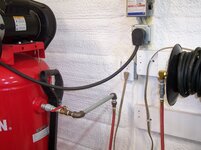
I have the same air compressor & it works fine for powering all my air tools. My compressor is in the back corner of my garage/shop & I usually work just outside the roll up door in the driveway & if I am removing a high torque nut or bolt with my impact gun the tank needs to be full to remove it. My compressor has a short length of hard line the hose to the hose reel, & the hose reel has 30" of hose on it.
racecougar
Well-known member
I did a little test years ago to see if there was any noticeable difference with common air tools when upsizing the air hose and/or switching from the typical industrial-type couplers to the Milton V-style high flow couplers. Figured it's relevant discussion here.
"Before" video: Hose is 50' long 3/8" rubber. Pressure is regulated at the compressor outlet to 90 psi. All tools are running the typical industrial style couplers.
"After" video: Hose has been upgraded to 50' long 1/2" rubber. Pressure remains regulated at the compressor outlet to 90 psi. The first two tools have the 1/4" Milton V-style high flow couplers; the last two still have the old industrial style couplers (which happen to work with the Milton V-style coupler on the hose). These videos could use editing to place each tool back-to-back, but you can hear a huge improvement on the tools that received both the larger air hose and the Milton V-style coupler. You can also hear some improvement on the tools that only received the larger air hose.
I went with 3/4" RapidAir Maxline and Milton V-style high flow couplers throughout the shop after this. I do still have a couple of 3/8" hoses that could stand to be upgraded, but the two main hoses are 1/2".
"Before" video: Hose is 50' long 3/8" rubber. Pressure is regulated at the compressor outlet to 90 psi. All tools are running the typical industrial style couplers.
"After" video: Hose has been upgraded to 50' long 1/2" rubber. Pressure remains regulated at the compressor outlet to 90 psi. The first two tools have the 1/4" Milton V-style high flow couplers; the last two still have the old industrial style couplers (which happen to work with the Milton V-style coupler on the hose). These videos could use editing to place each tool back-to-back, but you can hear a huge improvement on the tools that received both the larger air hose and the Milton V-style coupler. You can also hear some improvement on the tools that only received the larger air hose.
I went with 3/4" RapidAir Maxline and Milton V-style high flow couplers throughout the shop after this. I do still have a couple of 3/8" hoses that could stand to be upgraded, but the two main hoses are 1/2".
It would be interesting to know which changes had the biggest impact. Was it the couplers or the hose or both? One way to check would be use the 3/8" hose with no couplers, just hard connected.I did a little test years ago to see if there was any noticeable difference with common air tools when upsizing the air hose and/or switching from the typical industrial-type couplers to the Milton V-style high flow couplers. Figured it's relevant discussion here.
"Before" video: Hose is 50' long 3/8" rubber. Pressure is regulated at the compressor outlet to 90 psi. All tools are running the typical industrial style couplers.
"After" video: Hose has been upgraded to 50' long 1/2" rubber. Pressure remains regulated at the compressor outlet to 90 psi. The first two tools have the 1/4" Milton V-style high flow couplers; the last two still have the old industrial style couplers (which happen to work with the Milton V-style coupler on the hose). These videos could use editing to place each tool back-to-back, but you can hear a huge improvement on the tools that received both the larger air hose and the Milton V-style coupler. You can also hear some improvement on the tools that only received the larger air hose.
I went with 3/4" RapidAir Maxline and Milton V-style high flow couplers throughout the shop after this. I do still have a couple of 3/8" hoses that could stand to be upgraded, but the two main hoses are 1/2".
racecougar
Well-known member
They both have an effect. As mentioned above, I still have a couple of 3/8" hoses, but have switched everything to the V-style couplers. The couplers definitely made an improvement, but combined with the larger 1/2" hose, it becomes a very noticeable change.It would be interesting to know which changes had the biggest impact. Was it the couplers or the hose or both? One way to check would be use the 3/8" hose with no couplers, just hard connected.
Note that PEX (like several other 'plastic' piping products) is NOT rated for use with compressed gases (including air).
PEX also has (like several other plastic piping products) temperature-pressure limitations that could be exceeded near an air compressor.
It is also subject to UV degradation and must be protected from UV (sunlight, welding, some lighting and all some common sources of UV that things in a garage might be exposed to).
3/4" PEX has an ID of 0.681". Copper pipe 3/4" has an ID of 0.811" in Type M and 0.785" in Type L and 0.745" in Type K.
PEX fittings reduce the ID even further, but copper pipe fittings do not (the fitting goes OVER the copper pipe).
Any fitting reduces the flow rate through that fitting just because of the geometry change.
Rapidair has a flow rate calculator for their air line products. https://www.rapidairproducts.com/technical-faq/flow-rate-calculator
PEX also has (like several other plastic piping products) temperature-pressure limitations that could be exceeded near an air compressor.
It is also subject to UV degradation and must be protected from UV (sunlight, welding, some lighting and all some common sources of UV that things in a garage might be exposed to).
3/4" PEX has an ID of 0.681". Copper pipe 3/4" has an ID of 0.811" in Type M and 0.785" in Type L and 0.745" in Type K.
PEX fittings reduce the ID even further, but copper pipe fittings do not (the fitting goes OVER the copper pipe).
Any fitting reduces the flow rate through that fitting just because of the geometry change.
Rapidair has a flow rate calculator for their air line products. https://www.rapidairproducts.com/technical-faq/flow-rate-calculator
Agreed. I priced out the 3/4 max line kits verses 3/4 pex. I needed 185ft and 6 points of connection and 2 control valves. Pex and associateed fittings were actually $37 more expensive than two 100' maxline kits. Plus the maxline is rated for more pressure than pex and is approved for air use. To me it's a no brainier.I debated just exactly this when I bought my Rapidair Maxline kit, which is 1/2" I.D. My compressor is on one side, drop at a workbench, branch out to my hose reel, drop at the other side of the shop. From compressor, up....over....around to other side of shop, and down.....65-70ft total run. The I have a regulator setup and drain valve. No problems at running running any kind of air tools.
FYI.....I shopped around and priced fittings and related line, etc. YOU CAN'T beat the price of a Maxline kit that comes with everything.
pcmeiners
Well-known member
As to pressure loss small ID pipe causes the most loss, rough interior such as galvanized/black pipe causes turbulence, thus loss. The number of fittings and the type of fitting has a great affect, use large low loss check valves as check valves have high friction loss, full flow valves, sweeps versus elbows, use over sized filters. Present day manufacturers do not adhere to proper pipe/fitting design, but to profit margin, most manufactures downsize flow path or improperly design parts Eg. dead ended 90 degree elbows which have no radius but make abrupt right angles turns, thus the fluid/gas smashes against the elbow interior, then turns, causing turbulence/pressure loss.,
csp
Well-known member
Both of these statements depend on what type of PEX you're using.3/4" PEX has an ID of 0.681". Copper pipe 3/4" has an ID of 0.811" in Type M and 0.785" in Type L and 0.745" in Type K.
PEX fittings reduce the ID even further, but copper pipe fittings do not (the fitting goes OVER the copper pipe).