To avoid these ads, REGISTER NOW!

Air Compressor Issue

Joined
Jan 13, 2023
Messages
6
I’d appreciate anyone’s help. My father in law recently passed away and he had a bunch of tools from his garage. I decided to keep them and learn how to do more DIY things.

One of those tools is this Central Pneumatic 21 gal. Air compressor. It just won’t start up and I tried dosing as much searching to see if I could come across the same issue. I have no idea what’s going on and I’d appreciate any help figuring it out.

This is what the compressor does.
 
To avoid these ads, REGISTER NOW!

The Cobbler

Super Moderator
Staff member
Joined
Oct 24, 2013
Messages
25,823
Location
Niagara Region, Ontario, Canada
3 quick first thoughts.
either the head is not unloading ( drain the tank completely & try again)
or the start capacitor is bad
or the pump is seized

I would take off the pressure line from the pump head to the tank and see if it runs then
remove the plastic cowl & see if the pump & motor turn easily or is tight.
look for the capacitor and see if it's bulged or leaking.
there's more but this is some first basic test steps
 
OP
N
Joined
Jan 13, 2023
Messages
6
3 quick first thoughts.
either the head is not unloading ( drain the tank completely & try again)
or the start capacitor is bad
or the pump is seized

I would take off the pressure line from the pump head to the tank and see if it runs then
remove the plastic cowl & see if the pump & motor turn easily or is tight.
look for the capacitor and see if it's bulged or leaking.
there's more but this is some first basic test steps

Thanks for the quick reply. I emptied the tank and disconnected the hose. Now this is what it’s doing.


Zeke

Well-known member
Joined
Aug 13, 2009
Messages
17,176
Location
Long Beach CA, the sewer by the sea.
I had a similar compressor that wouldn't get going when cold and on a 15 amp 24 ga. wire circuit. The only way was to open the valve and run it free for a minute to build up some heat. In SoCal for awhile some tracts were using 14 ga. on receptacle circuits. I knew if I was in one of those tracts first thing in the morning.

Don't strain it like that much or it will die.
 

tipsy

Well-known member
Joined
Jul 16, 2014
Messages
337
Location
Speedwell, Tennessee
Big sticker on it that says STOP Oil required. Find the oil fill and check it. It's possibly that ********* stick I see on the left end. Sounds like it's dry or possibly seized. Go to Harbor Freight website and find similar model and read the manual. Good luck!
 

Norcal

Well-known member
Joined
Mar 16, 2008
Messages
13,752
I had a similar compressor that wouldn't get going when cold and on a 15 amp 24 ga. wire circuit. The only way was to open the valve and run it free for a minute to build up some heat. In SoCal for awhile some tracts were using 14 ga. on receptacle circuits. I knew if I was in one of those tracts first thing in the morning.

Don't strain it like that much or it will die.
14 AWG is all that is required for the LR & bedroom circuits, and tract homes are built as cheap as they can get away with.
 

mikedodge

Well-known member
Joined
Jun 27, 2017
Messages
2,756
If it's not cold like someone else said it sounds like it's pressurizing the head. Could be it's seizing up but then it ustally wouldn't have made a difference when you made those changes to it.
 
OP
N
Joined
Jan 13, 2023
Messages
6
I would pull off the plastics and see how easily it spins by hand, and look at the start capacitor next
there is oil in it?
Thank you everyone for the help. Here’s the update.
Also, I’m in San Diego and the room is probably around 65-70 degrees.


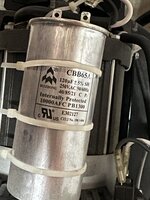
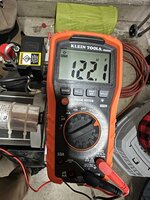
It doesn’t spin freely by hand and there’s a little bit of resistance when I spin it. I also looked online snd learned how to check the capacitor with a multi meter. It looked like that’s not the issue but I’ve posted those pictures too.

I don’t know how to check if there’s oil in it though.
 

Attachments

  • B1E3DBFA-764F-4B6A-80A4-BD75BB1F6A7A.jpeg
    B1E3DBFA-764F-4B6A-80A4-BD75BB1F6A7A.jpeg
    494 KB · Views: 21
  • 1611A804-E16A-4745-929C-742AAB10169F.jpeg
    1611A804-E16A-4745-929C-742AAB10169F.jpeg
    717.3 KB · Views: 11

The Cobbler

Super Moderator
Staff member
Joined
Oct 24, 2013
Messages
25,823
Location
Niagara Region, Ontario, Canada
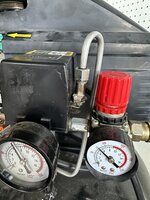
it looks like it has a cold start unloader valve on it ( the tee thing coming off the head)
I'm not sure if that was from the factory or not. they aid in getting the compressor going full speed before they hit compressed air ( hope it makes sense) they don;t usually plug but your could be
I would next remove the pipe from the head to the tank & see what results you get
 
To avoid these ads, REGISTER NOW!

tipsy

Well-known member
Joined
Jul 16, 2014
Messages
337
Location
Speedwell, Tennessee
Check the oil by removing the dipstick. It's that black thing standing up from the head at the opposite end of the fan. Most likely unscrews and will have a dipstick on it to verify oil. One of the Central Pneumatic owners manuals also mentioned there is a sight glass right below that dipstick too. If you can find the model number on this somewhere, the Central Pneumatic website has all their manuals available there for free.
 

david3921

Well-known member
Joined
Apr 22, 2014
Messages
428
Location
Wyoming, Michigan
Harbor Freight no longer sells this compressor, well, at least here. It's the 21 gallon one. Look below the black (fill) tube on the left in your videos. There is a site glass there at the bottom of the pump case to check the oil level. Look on YouTube for videos on your compressor. I used the search term 'Harbor Freight 21 gallon compressor'. There are quite a few videos about the compressor so it's pretty likely that one will pertain to your issue.
 

Citation

Well-known member
Joined
Jan 20, 2016
Messages
3,212
Location
Indy
It's hard to judge by the messages if this is spinning as it should (ie not excess drag)

It's possible the centrifugal starter switch is bad (I assume this motor has one).

I guess the question now is are you dealing with a pump problem that is stopping the motor or a motor problem. It's still possible it has excessive drag. Pulling the head might tell you if the piston/cylinder is in good shape. With the head off the motor should spin rather freely since it won't be working against any pressure.
 

Nodakdad

Member
Joined
Jan 27, 2020
Messages
17
Location
North Dakota
Assuming it has oil and not damaged i would say the brass unloader valve in the head. When you try to start it, push down the little brass "pin" on the top of the unloaded valve see if intakes off then. My was sticky, and also mine would have issues using an extension cord plug direct into the outlet.
 

Citation

Well-known member
Joined
Jan 20, 2016
Messages
3,212
Location
Indy
The unloader wouldn't matter if the tank was empty. I think that is down in the second video.
 
OP
N
Joined
Jan 13, 2023
Messages
6
Assuming it has oil and not damaged i would say the brass unloader valve in the head. When you try to start it, push down the little brass "pin" on the top of the unloaded valve see if intakes off then. My was sticky, and also mine would have issues using an extension cord plug direct into the outlet.

Thank you again to everyone for their input and suggestions. I have got it working but it requires a strange step. This has gotten quite interesting to say the least.
Update Video:

To recap:
-After reviewing the manual, whatever is going on is tripping the Automatic shutoff system. I've attached that page with the information on it at the bottom. Both possible causes that it mentions don't apply here.
-The compressor does have oil to the fill level
-I tried starting the compressor with and without the air filter, no difference.
-I'm not using an extension cable.

The way I've gotten it working is by opening one of two things. Either I unscrew the brass unloader valve at the top (it's called the start valve on the manual listed as #2) and it starts right up as you can see in the update video, or I leave that part attached and instead unscrew the unloader tube that (#60 on the manual).

[Interesting side note, one of the first things I did was try to start the compressor with the unloader tube unscrewed and it didn't start then. The video is above in this thread. It did seem like it was making progress but it couldn't start still. It now starts up with the unloader tube disconnected.]

I've attached the images of the two parts I'm referring to here:
IMG_5935.JPG <--- Start Valve IMG_5934.JPG <--- Unloader Tube

Either way, I have to essentially screw them back on while compressed air is being pumped through whichever part is unscrewed. It seems like I have to do this EVERY time I try to get the compressor started. Regardless of if its got pressure in the tank or not.


Again, I have no idea how compressors work, but it seems to me like the compressor can't get started when there is some kind of resistance or in this case in the form of air pressure. I could be completely wrong but I'm curious what others with experience think.

I feel like I'm so close, any help would be super appreciated.


Attached are the pages referenced from the manual:
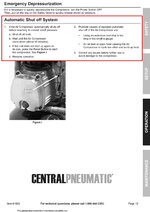
Manual-13.jpgManual-18.jpgManual-19 copy.jpg
 

PoorUB

Well-known member
Joined
Mar 29, 2021
Messages
11,622
Location
Fargo, ND
Is the unloader valve on the pressure switch releasing the head pressure?

That little air line to the pressure switch from the compressor head goes to a small valve in the switch. When the compressor reaches pressure and trip the contacts in the pressure switch it should also dump the pressure in the head through that small line. Often an adjustment in the pressure switch corrects the issue. Unplug the power before digging into the switch!
 
OP
N
Joined
Jan 13, 2023
Messages
6
Is the unloader valve on the pressure switch releasing the head pressure?

That little air line to the pressure switch from the compressor head goes to a small valve in the switch. When the compressor reaches pressure and trip the contacts in the pressure switch it should also dump the pressure in the head through that small line. Often an adjustment in the pressure switch corrects the issue. Unplug the power before digging into the switch!
Thank you for the response, I feel like this could be something to explore. Do you mind specifying what exactly I can do or what I’m looking for.

By switch I’m assuming you mean the electrical components at the “switch” (sorry like I mentioned I’m completely new to all of this).
Here is what I see when I take the plastic cover off:
 

Attachments

  • image.jpg
    image.jpg
    708.7 KB · Views: 23

The Cobbler

Super Moderator
Staff member
Joined
Oct 24, 2013
Messages
25,823
Location
Niagara Region, Ontario, Canada
the picture on the left ( not the red knob picture) is a cold start unloader. they should vent to atmosphere until about 5 psi if I recall correctly. I had to install one in a problem compressor . it allows the motor to spin up to speed before it hits the force of compression ( air)
the other one is the regular unloader valve. it should relieve the air from the compressor when the electric switch trips off either by shutting it off manually or it has reached it's pressure and shuts off automatically. you should here a little fart pssst . I am wondering if that is plugged / stuck , or misaligned not bleeding the air off.
the cold start might be stuck closed too . if you were close I'd drive over & help you . it's tougher explaining things on the net for sure
 

Citation

Well-known member
Joined
Jan 20, 2016
Messages
3,212
Location
Indy
OK, two questions.
1. Does the unloader valve actually let out air when you turn off the compressor? In your video above I don't here the tell tail pssss sound that one normally hears when the compressor turns off. That should be the sound of the tab on the pressure switch pushing on what looks a bit like a schrader valve at the end of the air line coming from the head. If you don't hear that letting pressure out then your unloader valve is bad.

Another possibility is the check valve into the tank is bad/stuck closed. If it's stuck closed then you will quickly build up too much line pressure coming out of the head and the motor will stall. You might pull the check valve into the tank and give it a good cleaning.
 

PoorUB

Well-known member
Joined
Mar 29, 2021
Messages
11,622
Location
Fargo, ND
Thank you for the response, I feel like this could be something to explore. Do you mind specifying what exactly I can do or what I’m looking for.

By switch I’m assuming you mean the electrical components at the “switch” (sorry like I mentioned I’m completely new to all of this).
Here is what I see when I take the plastic cover off:
That silver line that make a upside down U bend is to release air pressure from the head of the compressor. There is usuallay a small lever that pushes in a tiny valve stem to release the pressure. I can not see it in your picture.

You can see it very clearly in this picture, in the red circle. The silver lever comes up and pushes on the tiny little valve stem when the pump stops.
 

Attachments

  • pressure switch.png
    pressure switch.png
    1.3 MB · Views: 18

david3921

Well-known member
Joined
Apr 22, 2014
Messages
428
Location
Wyoming, Michigan
Sure seems like it's the unloaded valve. It you're not hearing the psss that Citation describes, then the pressure isn't getting released. If it were mine, I would just replace the pressure switch, they've pretty cheap. I had to when I had the same compressor.
 

Citation

Well-known member
Joined
Jan 20, 2016
Messages
3,212
Location
Indy
Sure seems like it's the unloaded valve. It you're not hearing the psss that Citation describes, then the pressure isn't getting released. If it were mine, I would just replace the pressure switch, they've pretty cheap. I had to when I had the same compressor.
The only headache with that is trying to find the right one. I don't worry about pressure too much as that can be adjusted. It's trying to find the right base, wire connections etc. Well that and installing it. Still, if that's the fix, it's not too bad and not expensive.
 

david3921

Well-known member
Joined
Apr 22, 2014
Messages
428
Location
Wyoming, Michigan
The only headache with that is trying to find the right one. I don't worry about pressure too much as that can be adjusted. It's trying to find the right base, wire connections etc. Well that and installing it. Still, if that's the fix, it's not too bad and not expensive.
The video on post #23 shows that it's a Lefoo. Pretty common on Chinese compressors. Amazon has tons of them. Just need to find the right configuration and pressure settings. I checked past purchases and I replaced mine with model LF10-L4H. Here's one for just under $15.

 
To avoid these ads, REGISTER NOW!
Top Bottom