

You are using an out of date browser. It may not display this or other websites correctly.
You should upgrade or use an alternative browser.
You should upgrade or use an alternative browser.
Air compressor lines in walls, why not?
- Thread starter Shrimp92
- Start date
I have not personally done it, but I've seen others do it and I kinda want to.
I would just make sure that you're either sure that the holes you make to run the lines don't compromise the structural integrity of the walls, assuming that they are in fact load bearing walls. I'm sure someone else here can chime in with details on the right way and wrong way to do it. I'm interested in seeing responses on this as well so I can get ideas.
Thanks,
Nic
I would just make sure that you're either sure that the holes you make to run the lines don't compromise the structural integrity of the walls, assuming that they are in fact load bearing walls. I'm sure someone else here can chime in with details on the right way and wrong way to do it. I'm interested in seeing responses on this as well so I can get ideas.
Thanks,
Nic
Tim The Tool Man
Well-known member
I ran all my copper and black iron lines through the walls and ceiling before I put sheetrock up. I only made one mistake by not testing them first (stupid rookie mistake) and I apparently have a very slight leak that will drain my tank in 3 days. I solved it by putting a ball valve at the tank between my shop. Look and works great otherwise!
Kevro
Well-known member
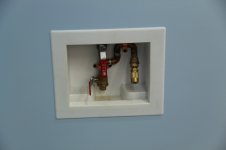
Gary S
Well-known member
It will look neat, but you will shoot yourself when the lines develop the first leak. When my brother upgraded his compressor from a 5hp to a 10hp, he decided to run his line pressure at 150psi. Every threaded joint started leaking with the extra pressure and the lines needed to be pulled apart. If those lines had been inside the walls, we would have run new line outside the walls and left the leaking ones to sit useless in the walls. With them on the outside, all we had to do is unthread them and add teflon tape to every joint and it worked.
Daz-scotland
Member
If you seal them up properly with Teflon tape in the beginning surely you should be fine.
Zrexxer
Well-known member
Water lines are in the wall and go for decades without leaking. Air lines can be made leak-free, too.It will look neat, but you will shoot yourself when the lines develop the first leak.
Richard D
Well-known member
Don't forget access to the drip legs.
rlitman
Well-known member
Don't forget access to the drip legs.
Kevro's picture is the nicest example of this I've seen to date.
A less elegant option would be to route the lines out of the wall, and close the hole with an escutcheon plate (like you would do with plumbing.
+1 on the excellent work by Kevro with the washer/dryer boxes.
When I get around to mine (already sheetrocked by prior owner), I hope to put larger 3/4 inch run in attic with smaller 1/2 inch feeder drops all in blackpipe either in wall, or surface mount on sheetrock.
Should gravity plan for drip legs to make horizontal runs NOT level on purpose and run any condensation down to drip legs? Any need to periodically put some lubricant in black pipe after it's been in use several years to help against rust?
When I get around to mine (already sheetrocked by prior owner), I hope to put larger 3/4 inch run in attic with smaller 1/2 inch feeder drops all in blackpipe either in wall, or surface mount on sheetrock.
Should gravity plan for drip legs to make horizontal runs NOT level on purpose and run any condensation down to drip legs? Any need to periodically put some lubricant in black pipe after it's been in use several years to help against rust?
Water lines are in the wall and go for decades without leaking. Air lines can be made leak-free, too.
True, very true.
I guess I would rather not take a chance though. Having them in the wall makes them more "permanent" and more difficult if you want to make a location change when a new piece of equipment (tool) is purchased.
Tim The Tool Man
Well-known member
When I get around to mine (already sheetrocked by prior owner), I hope to put larger 3/4 inch run in attic with smaller 1/2 inch feeder drops all in blackpipe either in wall, or surface mount on sheetrock.
Should gravity plan for drip legs to make horizontal runs NOT level on purpose and run any condensation down to drip legs? Any need to periodically put some lubricant in black pipe after it's been in use several years to help against rust?
+ 2 on Kevro's work! Nice and clean.
I put 3/4 pipe in the ceiling and pitched it down 1/4" per foot and my drops are all 1/2" If you plan on doing any painting then don't add any oil or have a separate leg for paint that is isolated from any injected lubricant.
Here is what I did with my outlets: The top ball valve is for the pneumatic tools, the bottom is my drip leg. I have four or five of these throughout the shop.
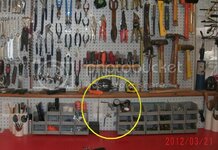

I also have three ceiling drops throughout the shop:
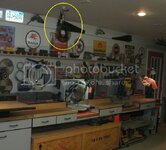
Tim The Tool Man:
Please come organize my garage! I'll pay in beer.
Didn't mean to hijack the thread.
A practicality thought.... I know sharp bends (such as right angles) is commonly considered in fluid dynamics for things such as efficiency of air-intake for car engines, HVAC ducting and exhaust fan ducting, meaning the more bends there are, the harder something has to work to move the same volume of air in the same time. Or something like that.
When putting pipe in to run air lines through the garage, should we expect the right angles to significantly decrease the flow rates or is this easily overcome by using larger diameter pipe?
Please come organize my garage! I'll pay in beer.
Didn't mean to hijack the thread.
A practicality thought.... I know sharp bends (such as right angles) is commonly considered in fluid dynamics for things such as efficiency of air-intake for car engines, HVAC ducting and exhaust fan ducting, meaning the more bends there are, the harder something has to work to move the same volume of air in the same time. Or something like that.
When putting pipe in to run air lines through the garage, should we expect the right angles to significantly decrease the flow rates or is this easily overcome by using larger diameter pipe?
Tim The Tool Man
Well-known member
A practicality thought.... I know sharp bends (such as right angles) is commonly considered in fluid dynamics for things such as efficiency of air-intake for car engines, HVAC ducting and exhaust fan ducting, meaning the more bends there are, the harder something has to work to move the same volume of air in the same time. Or something like that.
When putting pipe in to run air lines through the garage, should we expect the right angles to significantly decrease the flow rates or is this easily overcome by using larger diameter pipe?
I am no expert but my rationalization was that I am putting a few 1/2" and 3/4" 90 degree ells here and there but the air ultimately has to pass through a 3/8" air tool chuck so I am not going to worry about it.

sberry
Banned
I am no expert but my rationalization was that I am putting a few 1/2" and 3/4" 90 degree ells here and there but the air ultimately has to pass through a 3/8" air tool chuck so I am not going to worry about it.
Its nothing to worry about. You will never know. 3/4 is overkill in a small shop where runs are short and one or 2 users. I have no hydrants. Use a couple hose reels and hoses plumbed in as permanant whips, we dont have to disconnect hoses under pressure, only at the tool. I never actually have to plug a hose in.
Spudland_Dave
Well-known member
I guess I would rather not take a chance though. Having them in the wall makes them more "permanent" and more difficult if you want to make a location change when a new piece of equipment (tool) is purchased.
Damn you guys....now I got another thing to do before banging out the sheetrock... LOL
NUTTSGT... Its no different then electrical either... instead of changing the piping, just make it so you can add more or put enough all over the place so that you dont need to worry about it. With the recessed box like Krevo...no issue placing a toolbox up against the wall if needed.
All that being said...I had a similar but different thought from the get go, mine was to run a loop around the shop perimeter in the attic and then come down thru the cieling with a nicely painted surface mounted copper pipe wherever I needed/wanted air. Does having your air run thru Hot/Cold areas wreak havoc with the air itself?...Im just thinkin in the summer time, ambient air up there would be hotter then hell, winter time, it would be colder then heck...then the air would come into a semi-warm/heated area... OR should I not worry about it?
I ran my copper lines in the walls before drywall too. I used washing machine outlet boxes to terminate the drops for a completely flush installation, so when they're not being used, there's nothing sticking out of the wall.
That's a great idea, thanks!
Tim The Tool Man
Well-known member
With all the features Tim The Toolman has integrated into each air compressor port - - ie quick chuck, drain and air pressure gauge - - Wow, that's nice! Think I'll be stealing that idea for mine. Thanks Tim.
I bought (in bulk) those ball valves, gauges, and quick disconnects on Amazon for real cheap and with free shipping to boot.
GarageEnvy
Well-known member
Mine are mostly in the wall. However, I do have one drop at the front of the garage that is exposed and will allow for expansion in the future. Mine are 3/4" and I agree it's overkill for a home shop. My compressor came with a 3/4" output and I just wanted to match it. I'd do 1/2" if I did it again.
Attachments
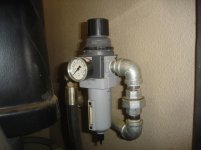


Nice setup GarageEnvy . . . HOW MUCH you have invested at each air compressor drop with those Norgren filters?? Specific part numbers?
Do they serve as water/particulate filter, shutoff, drain, gauge, and quick connect? How much for replacement filters and how long do they last?
Do they serve as water/particulate filter, shutoff, drain, gauge, and quick connect? How much for replacement filters and how long do they last?
GarageEnvy
Well-known member
You'd be surprised how cheap you can pick up those filters on Ebay for. I believe I paid $50 for 3 of them with the pressure gauges. Apparently businesses keep these on hand as spares. There's tons of them on Ebay all the time. I can regulate pressure at each leg. Honestly I've yet to replace a filter and maybe once a month I crack one open and let a small amount of moisture out. My climate is usually pretty dry. It really gets light usage in my home shop. The drop with the stainless steel backsplash is for my plasma cutter and it's nice to have a filter close to it. The kids always need air in bike tires so the front drop is usually set to 35psi. I couldn't really figure out how to put a filter regulator conveniently near the hose so it's just regulated with the main one ny the tank at 90psi. I can dig up part numbers for you later but I was just shopping Norgren, Parker, Wilkerson filters. There wasn't anything magical about the Norgren. They're metal bowls and 3/8" inlet/outlet.
yevangelis
Well-known member
Does having your air run thru Hot/Cold areas wreak havoc with the air itself?...Im just thinkin in the summer time, ambient air up there would be hotter then hell, winter time, it would be colder then heck...then the air would come into a semi-warm/heated area... OR should I not worry about it?
insulate your walls and ceiling, and the pipe
larry4406
Well-known member
I ran my air lines in the wall behind sheet rock. Used 1-inch black pipe for the main, and then 1/2-inch risers (not drops) at each point of use location. My main run is run down low (36 inches or less off floor) and continuously sloped downward in the direction of flow at 1/4-inch drop per foot of run. All point of use taps then rise up from the main and out of the drywall. I have a single 1-inch ball valve at the end of the run to drain the main. I did not want a drip leg valve at every point of use as this would impede placing work benches or cabinets against the wall (this would happen if the main were high and downward dead end drops were used). I have point of use taps every 6 feet or so around the perimter of the walls and overhead taps for house reels and future lift with pneumatic locks. The point ot use taps are trimmed with an escutcheon plate. I pressure tested piping to 120psi for one week before hanging drywall. I used Rector Seal No. 5 to seal all joints and did not use teflon tape.
Attachments

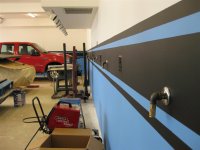

I ran my copper lines in the walls before drywall too. I used washing machine outlet boxes to terminate the drops for a completely flush installation, so when they're not being used, there's nothing sticking out of the wall.
now that is SLICK!!!!!!!


rickyboy
Well-known member
I ran my copper lines in the walls before drywall too. I used washing machine outlet boxes to terminate the drops for a completely flush installation, so when they're not being used, there's nothing sticking out of the wall.
This is a very clean look. I like it! But my walls are dry walled so my lines will be running around the wall/ceiling and down to where they're needed.
Denee007
Well-known member
Gee, I wish I seen this before I had my sheetrock put up a few years ago! I at least ran the electricl outlets where I'd be needing them. Great idea here!
dne'
dne'
69lm69gp
Well-known member
Seem to me you end up insulating your compressor pipe when you put it in a wall. So now you are maintaining the heat of the air in the line, making it impossible for the water in the line to condense or the air cool to the point your water trap can work effectively. This could really be a problem if you have a small compressor that has to work hard to supply volume of air you are using. Plus it makes it harder to add on to the system if you need to rearrange the garage for some new tool or if you find the layout isn't working for you.