To avoid these ads, REGISTER NOW!

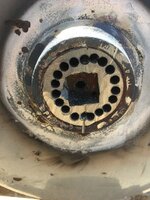
air compressor tank bung

alabamatoy

Member
Joined
Feb 16, 2013
Messages
10
So I have a old (circa 1988) Sanborn compressor with 80gal tank. The tank has 2 - 2" dia bungs, each with a cast plug screwed in. These are leaking significantly, but have rusted themselves in place. A 3/4" drive ratchet with a 3' DOM tube as a cheater will not budge either of them. (Aside, yes, the tank is vented of all pressure!) I have PBBlaster'ed the bungs extensively, no budge. I weigh about 250, Im hanging on the end of the 3' cheater plus the ratchet (24" or so?), so Im probably on the order of ~1000LbFt on these bungs to no avail.

SO.....can I just weld these threaded plugs into the bung to stop the leaking? Yeah, I know, welding cast plug to dissimilar steel....but can I do it without wrecking the integrity of the tank?
 

Attachments

  • Compressor_Tank_bung.jpg
    Compressor_Tank_bung.jpg
    400.6 KB · Views: 122
To avoid these ads, REGISTER NOW!

FMB4

Well-known member
Joined
Jan 19, 2017
Messages
2,926
Do not, repeat, do not weld on that tank. You might try heating the tank around the bungs with a heat gun (not a hair dryer).
 

seber

Well-known member
Joined
May 31, 2016
Messages
4,195
Location
Deep East Tx.
Have you tried alternate heat and quench? That followed by impact should break anything. If you do decide to use welding, I would suggest brazing instead. HAZ won't be nearly as bad.
 

rslaback

Well-known member
Joined
Jul 24, 2010
Messages
4,065
Location
Westcentral Wisconsin
If it were me and I didn't have much confidence in my ability to get them out I would probably opt for brazing.

However, I am pretty sure I could get them out with a last resort of using a hole saw to take out the majority of the plug and then snapping the rest of the thread by using a punch toward the middle to break the cast ring.
 

Rinspeed

Well-known member
Joined
Apr 26, 2020
Messages
1,819
Location
NY
I would start with a 5 foot cheater, be careful though as something might give other than the plugs.
 

Under_Pressure

Well-known member
Joined
May 13, 2014
Messages
113
Location
NE Wisconsin
As noted, technically you should not weld to the pressure boundary. It certainly voids the ASME certification, though I doubt that is a major concern for you (it wouldn't be for me). Now in this case, welding a small fillet between the plug and the relatively heavy fitting? The risk of causing an issue with the tank integrity is minimal. That said, I'm not sure how successful you would be. Welding around a circumference like that, with one material that may not be easily weldable, over threads, with moisture and sealant and whatever else is between the plug and the fitting, and getting the result to be pressure tight is a challenge. The leak might be smaller when you're done, but there is a good chance there will still be a leak. Those are inspection plugs, and on a tank that age it's probably not a bad idea to do what you need to do to get them out and use them for what they're for- take a look at the inside. Generally the area of concern is the bottom (low point) of the tank.
 

Davefr

Well-known member
Joined
Jan 7, 2010
Messages
11,822
Location
OR
Use an impact wrench, not a breaker bar. The constant jarring impacts will loosen the rust. Of course, without a functioning compressor, using the impact might be an issue. :)
I bet he could still use an impact even though the tank leaks. I don't see a big hole. It just means the pump would run longer. Sometime if a fastener won't budge in the removal direction you could see if there's any movement in the tightening direction and then work it back and forth.
 

Jswain

Well-known member
Joined
Apr 26, 2013
Messages
2,457
Location
Calgary, AB
Give it a few whacks with a hammer first then try again. If you can't get a 3/4" impact on it then I would try again with your previous setup with a friend giving it a good whack with the hammer when you're pulling on it.
 

sweetk30

Well-known member
Joined
Jan 2, 2011
Messages
2,306
Location
finger lakes area upstate ,ny
if that tank is like mine there is a huge o-ring between the fitting and tank .

and cast to reg steel might be bad stuff .

i have drilled a few stuck fittings before and took a die grinder and opened up the holes in a stright line and then split the fitting in 2 and got them out . but in your case you need that fitting or another like it . . . how clean is the inside of the tank for real ? drained a lot so no rust build up ? or like most and ready to blow out ? might not be worth the hassle to fix it . i have gotten lucky a few used OLD tanks / thick wall built and also tossed a few . i got one now the inside looks like the titanic . . . the ship might be better shape even .
 

Jswain

Well-known member
Joined
Apr 26, 2013
Messages
2,457
Location
Calgary, AB
Whatever you do do not hit it with an impact under while the tank is under pressure. There is a reason the manufacturer felt it was important enough to spend the extra money on that plug specifically labelling that. Things like to keep unscrewing when you have them under pressure and get them going in either direction
 

matt_i

Well-known member
Joined
Mar 14, 2008
Messages
10,725
Location
SE Michigan
I did this job and the bung was a reducing bushing. I had the same 5 ft bar on it and it wasn't moving. Basically just broke off the hex.

I did not want to use oxyacetylene and burn the reasonably good paint job.

I used a very small hacksaw blade in a supersawzall and sawed two slots from the center->out, stopping before I hit the minor diameter of the internal thread crests.

Then used the cold chisel to carefully crack out pieces so they wouldn't go into the tank. Once the first piece is out then they easily collapse back toward the center as the kerf bends.

50534890316_0cc3d96947_b.jpg

50516241433_d9035fcfee_b.jpg
 
To avoid these ads, REGISTER NOW!

metaldad

Well-known member
Joined
Aug 2, 2011
Messages
7,751
Location
nw indiana
I did this job and the bung was a reducing bushing. I had the same 5 ft bar on it and it wasn't moving. Basically just broke off the hex.

I did not want to use oxyacetylene and burn the reasonably good paint job.

I used a very small hacksaw blade in a supersawzall and sawed two slots from the center->out, stopping before I hit the minor diameter of the internal thread crests.

Then used the cold chisel to carefully crack out pieces so they wouldn't go into the tank. Once the first piece is out then they easily collapse back toward the center as the kerf bends.

50534890316_0cc3d96947_b.jpg

50516241433_d9035fcfee_b.jpg
called 'caping' a fitting out.
this, is the best suggestion.
 

jerry67

Well-known member
Joined
Aug 2, 2005
Messages
48
Location
pennsylvania
You say that compressor is from 1988, 35 years old, I would seriously consider treating yourself to new one its not worth taking chances
 

rlitman

Well-known member
Joined
Oct 18, 2010
Messages
24,591
Location
Long Island
You say that compressor is from 1988, 35 years old, I would seriously consider treating yourself to new one its not worth taking chances
Is it just me, or does that bird-**** weld around the drain look like it had some home-made repairs from previous leaks?
 

Under_Pressure

Well-known member
Joined
May 13, 2014
Messages
113
Location
NE Wisconsin
Is it just me, or does that bird-**** weld around the drain look like it had some home-made repairs from previous leaks?
Which indicates that there was severe corrosion in the bottom of the tank. The warning signs were ignored and patched up. While it's not really a code thing, most tanks will indeed give some indication there there is serious corrosion via a pinhole leak of some kind before completely unzipping like this one. The answer then is not to simply do whatever it takes to make that leak stop and keep going- you need to do some internal inspection. If the interior of the tank does in fact look good and it is just a pinhole in a weld or something that opened up after several years, then OK, it might be fixable. But if there is significant corrosion, the answer for pretty much any air-compressor type tank will be to scrap it an buy a new one. It would almost never be worthwhile to invest what would be necessary to do an extensive repair on a compressor tank.
 

Davefr

Well-known member
Joined
Jan 7, 2010
Messages
11,822
Location
OR
Pressure inside the tank high enough to run that impact will add significantly to the friction on the threads, and more importantly, will turn that plug into a projectile as it comes loose. Really really bad idea.
Good point but the objective would be to only use a couple trigger pulls to get some movement and then revert to manual tools.
 

jerry67

Well-known member
Joined
Aug 2, 2005
Messages
48
Location
pennsylvania
Here's the follow up to the first video. After watching these I checked mine over and did routine maintenance that was long overdue.
 

Davefr

Well-known member
Joined
Jan 7, 2010
Messages
11,822
Location
OR
It's a terrible idea, imagine if cast fitting breaks apart and you have 150psi in the tank and are standing directly in front of it.

You ALWAYS bleed pressure off entirely before working on pressurized systems, that rule is written with blood.
Good point
 

Citation

Well-known member
Joined
Jan 20, 2016
Messages
3,212
Location
Indy
You say that compressor is from 1988, 35 years old, I would seriously consider treating yourself to new one its not worth taking chances
Looking at that video did you see the welds around the drain plug? That tank failed because someone decided to "fix" it once it started to leak. 35 years old isn't bad so long as it wasn't "fixed".
 

PoorUB

Well-known member
Joined
Mar 29, 2021
Messages
11,625
Location
Fargo, ND
Which indicates that there was severe corrosion in the bottom of the tank. The warning signs were ignored and patched up. While it's not really a code thing, most tanks will indeed give some indication there there is serious corrosion via a pinhole leak of some kind before completely unzipping like this one. The answer then is not to simply do whatever it takes to make that leak stop and keep going- you need to do some internal inspection. If the interior of the tank does in fact look good and it is just a pinhole in a weld or something that opened up after several years, then OK, it might be fixable. But if there is significant corrosion, the answer for pretty much any air-compressor type tank will be to scrap it an buy a new one. It would almost never be worthwhile to invest what would be necessary to do an extensive repair on a compressor tank.
When I had my small engine shop I had a customer ask me if I would sell him and engine, then mount it to a air tank and compressor he provided and get it running. Sure, no problem. I got is ll together and ran it and it wouldn't make pressure. I shut the unit off and could hear air hissing. The tank was cracked around the leg near the bottom. The customer asked me to weld up the crack and I refused. He gave me some **** about it not working, I told him it wasn't my fault the equipment he provided was defective. He paid me and took the unit and left. He called me a couple days latter and told me he had a friend weld it and it works fine! I told him, good luck and never heard from him again.
 

Rinspeed

Well-known member
Joined
Apr 26, 2020
Messages
1,819
Location
NY
That tank failed because someone decided to "fix" it once it started to leak.


Just to live in the real world you have no clue if that is an accurate statement or not. That's just a guess on your part.
 

Citation

Well-known member
Joined
Jan 20, 2016
Messages
3,212
Location
Indy
Just to live in the real world you have no clue if that is an accurate statement or not. That's just a guess on your part.
The guy in the video did say he welded it when it first started leaking. Had he dumped it when it first told him it was worn out it won't have burst.
 

quickfarms

Well-known member
Joined
Feb 14, 2021
Messages
1,027
Location
Southern California
This is the best way I have found to remove them

using a cheater bar just deformed the socket

drill holes around the perimeter as close together as possible

drill and tap a hole in the center and inset a long bolt

use a chisel to connect the holes and remove the center

use the chisel to collapse the remaining outer ring
 

Attachments

  • 98400D82-7215-45A0-849A-443E8BB33ACE.jpeg
    98400D82-7215-45A0-849A-443E8BB33ACE.jpeg
    406.4 KB · Views: 63
  • 3294E5D2-712E-4D58-9C91-0319F00373F4.jpeg
    3294E5D2-712E-4D58-9C91-0319F00373F4.jpeg
    361.8 KB · Views: 49
  • C60D411E-AB4F-42A2-B1AA-8005EBC222B2.jpeg
    C60D411E-AB4F-42A2-B1AA-8005EBC222B2.jpeg
    563.9 KB · Views: 66

Rinspeed

Well-known member
Joined
Apr 26, 2020
Messages
1,819
Location
NY
The guy in the video did say he welded it when it first started leaking. Had he dumped it when it first told him it was worn out it won't have burst.


It very well might have burst if he didn't weld on it though, correct.
 
To avoid these ads, REGISTER NOW!
Top Bottom