To avoid these ads, REGISTER NOW!

Air Compressor Tank -- When to Retire

lothian

New member
Joined
Dec 10, 2015
Messages
1
Location
NC
I own a 17yo Craftsman air compressor (model: 919167240). It operates perfectly.

919.167240picture.jpg

Owners of this compressor are supposed to drain accumulated water from the tank after each use to prevent internal rust. Rust potentially weakens the tank walls and that creates the very real risk of explosive decompression.

Admittedly, I drain the tank only intermittently, and only when the schloshing of water within the tank reminds me that this minor maintenance item is overdue. I realize this is a bad policy in light of the previous paragraph. I also have never used an air dryer with the thing. I am a bad owner.

So now I'm pondering the following...
Given the age of this compressor, given the less-than-idea maintenance by yours truly, and given the consequences should those two facts conspire, is it prudent to replace the thing?

I've since bought an air dryer (after 17yrs without). I'm curious if an air compressor specific rust inhibitor commercial product exists explicitly for this issue.

Comments?
 
To avoid these ads, REGISTER NOW!

cvairwerks

Well-known member
Joined
Aug 12, 2016
Messages
7,223
Location
Within hearing distance of Texas Motor Speedway
The little Quincy I've got over in storage, ran for almost 55 years, with about 15 of that being on 24/7, before it developed a pinhole in the tank. If you are worried, pull the drain or the side plug and borescope it. If overly **** about, have it UT'd for thickness changes.
 

MoonRise

Well-known member
Joined
Nov 5, 2010
Messages
4,029
Location
NJ
Two things.

First, the air dryer.

Typically, an 'air dryer' is used to dry the compressed air. So that the moisture doesn't do bad things to the air tools at the end of the air hose. Spitting water through air tools or through a paint sprayer are not good and can lead to the utterance of NotGood words.

Not typically used to dry the air before it goes into the compressor. So you will still have moisture and water inside the air tank. Especially in humid North Carolina.

Next, you could do a complete NDI (non destructive inspection) using something like an ultrasonic tester to check the wall thickness and/or checking for defects/cracks. Probably cost less to just replace the tank though.

Or you could look inside the tank (fiber optic inspection camera) to visually try and evaluate the condition of the inside of the tank.
 

Wrench97

Well-known member
Joined
Jun 23, 2018
Messages
12,108
Location
Southeastern Pa
Ideal timing is the day before it fails.............................I retired one with a date code of 1932 about 10 years ago, I got from my grandpop after he passed had it for more then 20 years when I rolled it over I saw 4 - 1/8" pipe plugs in the bottom in a strange pattern my uncle later said yea I remember helping pop stand it up and drill and tap the spots that were leaking...................in the early 60's
 

finn

Well-known member
Joined
Mar 27, 2005
Messages
16,261
Location
The UP, God's country
Do a hydrostatic test with water and a grease gun. Fill the tank with water, then bring the tank to proof load by pumping in grease.

The water and grease are incompressible so it’s safe if the tank ruptures before hitting the proof load.

Do a search to determine how high to pressurize it above normal working pressure. Can’t remember what safety factor is normally used, but it’s published somewhere.
 

driz

Well-known member
Joined
May 22, 2008
Messages
701
Location
Northern NY
Run the thing till it dies. I had one like that my father gave me ages ago. I patch welded it a couple times then gave it the heave ho.
One of those HF auto bleeders works great on even those flat models. My current One is 21 YO and I use it daily.


Sent from my iPad using Tapatalk
 

Noworries

Banned
Joined
Dec 8, 2019
Messages
230
Location
Southern California
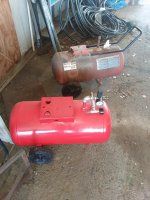
Wow..water and grease?? Not heard of that. ALL high pressure tanks are required by federal law to have visual and hydrostatic tests conducted regularly, the interval depends on the type of tank. Then the test date and testers mark is stamped on it (look at your welding gas and scuba tanks...) 125-150 psi is not considered high pressure and catastrophic failure is extreamly unlikely... as for when to retire it...IF it develops a pinhole i know a few guys that have just welded them up and continued to march... both of these tanks are at least 25 years old the bright red one has been welded... but thats just me..i also carry cocked and locked and ride a harley and been told im not right in the head😁
 

Attachments

  • 20200604_112646.jpg
    20200604_112646.jpg
    122.7 KB · Views: 84

Noworries

Banned
Joined
Dec 8, 2019
Messages
230
Location
Southern California
Do a hydrostatic test with water and a grease gun. Fill the tank with water, then bring the tank to proof load by pumping in grease.

The water and grease are incompressible so it’s safe if the tank ruptures before hitting the proof load.

Do a search to determine how high to pressurize it above normal working pressure. Can’t remember what safety factor is normally used, but it’s published somewhere.
Test pressure is typically 5/3 working pressure and it isnt to necessarily see if the tank will blow.. the test is done in water, as the tank is overpressured it expands and displaces water. That displacement is then measured to determine how much the tank expanded. If it expands beyond specs it is then determined to be unservicable..I would HIGHLY recommend you do not try this at home!!!
 

Citation

Well-known member
Joined
Jan 20, 2016
Messages
3,219
Location
Indy
I own a 17yo Craftsman air compressor (model: 919167240). It operates perfectly.

919.167240picture.jpg

Owners of this compressor are supposed to drain accumulated water from the tank after each use to prevent internal rust. Rust potentially weakens the tank walls and that creates the very real risk of explosive decompression.

Admittedly, I drain the tank only intermittently, and only when the schloshing of water within the tank reminds me that this minor maintenance item is overdue. I realize this is a bad policy in light of the previous paragraph. I also have never used an air dryer with the thing. I am a bad owner.

So now I'm pondering the following...
Given the age of this compressor, given the less-than-idea maintenance by yours truly, and given the consequences should those two facts conspire, is it prudent to replace the thing?

I've since bought an air dryer (after 17yrs without). I'm curious if an air compressor specific rust inhibitor commercial product exists explicitly for this issue.

Comments?
Keep using it. If/when you get a pinhole in the bottom of the tank scrap the tank.

These tanks are designed so that they fail via a pinhole vs a catastrophic failure. Its a "leak before break" design.
https://www.fose1.plymouth.ac.uk/fa...ractureMechanics/StressIntensity/KTheory4.htm

Basically you get a single pinhole that fails before the tank bursts. However, this assumes no one tries to weld up the tank once it springs a leak.
 

finn

Well-known member
Joined
Mar 27, 2005
Messages
16,261
Location
The UP, God's country
Test pressure is typically 5/3 working pressure and it isnt to necessarily see if the tank will blow.. the test is done in water, as the tank is overpressured it expands and displaces water. That displacement is then measured to determine how much the tank expanded. If it expands beyond specs it is then determined to be unservicable..I would HIGHLY recommend you do not try this at home!!!

That’s around 200 psi, since these homeowner grade compressors are typically rated at 125 psi.

I wouldn’t go that high with air, to be sure, but water is incompressible for all practical purposes, so there isn’t much potential energy stored, and violently converted to kinetic energy. if the tank ruptures at 200 psi. I would hazard a guess that measuring the tanks circumference established whether the pressure plasticly deforms. Permanent deformation would signify failure.

The grease gun is just a way to add additional pressure vis another incompressible Fluid, in a controlled manner.

Personally, I would just run it until it develops a pinhole, then scrap it. My three main compressors are all from the seventies, or early eighties, including one belt driven Craftsman. None have developed pinholes, although I am fairly diligent in draining them. I have dialed the two 80 gallon units (a Champion and an IR) down from their factory 175 psi cutout setting to around 150 psi, which is more than enough for myuse. Most air tools are rated at 90 psi.
 

Packard V8

Well-known member
Joined
Mar 16, 2009
Messages
7,380
Location
Spokane, WA
Those Craftsman tanks are garbage. I've been using air compressors for sixty years and seen more of those develop pinhole leaks in the bottom than all other brands combined. The only good thing I can say about them is I've never seen a Craftsman tank kill anyone yet. They usually just start leaking.

jack vines
 

Noworries

Banned
Joined
Dec 8, 2019
Messages
230
Location
Southern California
That’s around 200 psi, since these homeowner grade compressors are typically rated at 125 psi.

I wouldn’t go that high with air, to be sure, but water is incompressible for all practical purposes, so there isn’t much potential energy stored, and violently converted to kinetic energy. if the tank ruptures at 200 psi. I would hazard a guess that measuring the tanks circumference established whether the pressure plasticly deforms. Permanent deformation would signify failure.

The grease gun is just a way to add additional pressure vis another incompressible Fluid, in a controlled manner.

Personally, I would just run it until it develops a pinhole, then scrap it. My three main compressors are all from the seventies, or early eighties, including one belt driven Craftsman. None have developed pinholes, although I am fairly diligent in draining them. I have dialed the two 80 gallon units (a Champion and an IR) down from their factory 175 psi cutout setting to around 150 psi, which is more than enough for myuse. Most air tools are rated at 90 psi.

When tanks are tested it is first cleaned, then a visual inspection is conducted. Any suspect areas are then more closely examined. If/when the tank passes the visual then the hydro is conducted.. it is performed by pumping in water do the reason you stated..water is non compressable. The pressure test is not conducted to push the tanks structural integrity. These pressure tests are conducted in a bunker designed to contain a catastrophic high pressure tank failure... even a scuba tank blowing will completely destroy a building.. to fill a suspect airtank with a max psi of 125 full of water THEN start pumping in grease to further increase the pressure while standing next to it...well draw your own conclusions..
 

liliysdad

Well-known member
Joined
Jul 18, 2008
Messages
5,404
Use it until it leaks....surely no one actually takes the time for such inane stuff like the hydro test for an air compressor tank...
 

ambenz

Well-known member
Joined
Dec 12, 2010
Messages
4,236
Location
NW Chicago Suburbs
I have the same small Craftsman compressor. I try to keep it bled but it is forgot often. So one day I wanted to be proactive. I unscrewed the bleeder and poured the whole bottle of Rustoleum rust reformer into the tank, put the bleeder back in and swished the product around the bottom of the tank, being mindful not to tip the compressor all the way over. I didn't want to get any product into the exhaust pipe of the compressor.

100048873_HR.jpg


I kept it up for about 5 minutes and removed the bleeder again and poured out the remaining product, letting it drip out overnight.
In the morning I clean out the opening and put the bleeder back. I was afraid the product would come loose under pressure or plug the bleeder but so far, all is good. I don't know if it helped but I figured, it couldn't hurt.
 

csp

Well-known member
Joined
Mar 23, 2010
Messages
5,719
Location
Franktown, CO
These pressure tests are conducted in a bunker designed to contain a catastrophic high pressure tank failure... even a scuba tank blowing will completely destroy a building.. to fill a suspect airtank with a max psi of 125 full of water THEN start pumping in grease to further increase the pressure while standing next to it...well draw your own conclusions..

As you stated yourself, water is non-compressible. If a tank were to burst there's very little stored energy in that non-compressible water. It's not going to take out buildings or people. :dunno:
 

larry_g

Well-known member
Joined
Apr 28, 2007
Messages
16,883
Location
oregon
to fill a suspect airtank with a max psi of 125 full of water THEN start pumping in grease to further increase the pressure while standing next to it...well draw your own conclusions..

As you stated yourself, water is non-compressible. If a tank were to burst there's very little stored energy in that non-compressible water. It's not going to take out buildings or people. :dunno:

My conclusion would be that worst case you get your feet wet.

lg
no neat sig line
 

tarmy

Well-known member
Joined
May 28, 2014
Messages
4,681
Location
Nor Cal
This Speedaire lasted many decades...got a pinhole leak...cut it up for grins...

It was drained after most uses...not all though.


47A14E9A-F4C3-46D0-B122-E37ED910B5AC.jpg

D4EC0A26-373C-4055-9F98-D077A53A4EF1.jpeg

B236D52B-1535-4D7A-B2EE-6C7C06422479.jpeg
 

Mr_B

Well-known member
Joined
Nov 21, 2016
Messages
5,377
Location
Reading
they never explode in normal working pressure range scenario
all that happens is you get pin hole leaks if rusty (generally always happens at bottom of tanks anyway) and when you do that your time replace tank .
I got 2 tanks almost 30 years old and they fine, good quality steel tanks last decades before leaking ...
scabby air hose and fittings far more likely cause injury/damage than a tank ever will .
 
Last edited:

didit

Well-known member
Joined
Feb 11, 2020
Messages
892
Location
S.W. Ontario
I'm in the "don't fix it if it isn't broke" camp. I doubt that a rust inhibitor will be any more effective than simply regularly draining water out of the tank. There is enough of an oil residue coating inside the tank to prevent major corrosion. The effects of corrosive rust through is much more likely in a neglected, non drained tank.
 
To avoid these ads, REGISTER NOW!

foghorn1966

Well-known member
Joined
Aug 18, 2012
Messages
228
Location
N. Alberta
I've only seen them crack at mounting feet or pin hole rust out leaks. I would be more worried about replacing the old worn press relief valve more than anything, if at all. Have heard of more people being killed or seriously injured over filling tires than a home shop compressor tank failure.
 

Semi-hole mechanic

Well-known member
Joined
Feb 2, 2017
Messages
1,017
Just retired a 20 gal. Huskee from TSC, that my dad bought in the early 70s it was hardly ever drained but still held air. The only reason its retired is the motor went bad and I could buy a whole new compressor for less than a motor.
 

JBurt

Member
Joined
May 15, 2013
Messages
7
Good stuff in here. I've got an old craftsman that I've replaced the piston on a few times, but never thought about leaks in the tank. How do you tell if there is a pinhole leak in the tank? Spray it with soapy water?
 

driz

Well-known member
Joined
May 22, 2008
Messages
701
Location
Northern NY
Just retired a 20 gal. Huskee from TSC, that my dad bought in the early 70s it was hardly ever drained but still held air. The only reason its retired is the motor went bad and I could buy a whole new compressor for less than a motor.


Save it!! Set it up to accept a QD fitting. Then you can pal it off the new one if your sometimes using a lot of air, very handy.
Do your tools a solid and put a HF autodrain on that new one. All you’ll ever see is a rusty stain on the floor.
If you are painting and want to get water out route your plumbing off the motor straight to the old tank. Route The output from that old one back to the new one into your line to the garage. A nice vertical run of Copper or Black iron pipe will condense out most of the tiny bit of moisture that didnt condense in the tank. That will let you condense almost all of the water out for nice dry air.
A highly bastardized version of this is my rig. Anything like it does the deed. Metal line for cooling condensing, vertical to shed condensed moisture. I used soldered copper 3/4type L for mine. No leaks in 21 years.

https://www.tptools.com/SearchResult.aspx?searchPhrase=Diagram


Sent from my iPad using Tapatalk
 

carbureted iron

Active member
Joined
Jun 25, 2023
Messages
35
What is an... air compressor..?

You don't already have various cordless tools that do everything your air tools do; 'cept better and more conveniently? If not, well then, it's time. Just think of all the new stuff you can cramp into the space where you presently store that noisy, under-powered compressor!
 

Citation

Well-known member
Joined
Jan 20, 2016
Messages
3,219
Location
Indy
What is an... air compressor..?

You don't already have various cordless tools that do everything your air tools do; 'cept better and more conveniently? If not, well then, it's time. Just think of all the new stuff you can cramp into the space where you presently store that noisy, under-powered compressor!
Yeah, there have been a number of threads on that topic. I think the short version is non-air tools have done a great job of replacing air tools in a number of places but not all (electric sand blaster anyone?). Also, for many people, they have owned air tools for many years and replacing them all with battery tools might be expensive or even impossible in some cases. Also, if I need to get dust off of something a blow gun works really nicely.
 

cvairwerks

Well-known member
Joined
Aug 12, 2016
Messages
7,223
Location
Within hearing distance of Texas Motor Speedway
What is an... air compressor..?

You don't already have various cordless tools that do everything your air tools do; 'cept better and more conveniently? If not, well then, it's time. Just think of all the new stuff you can cramp into the space where you presently store that noisy, under-powered compressor!

LOL...Let's see you climb into a fuel tank and work with that electric, spark generating, tool.

Battery stuff isn't the endall for everything. Find me a battery powered drill motor that will turn 3000 rpm for hours on end and fits in the palm of my hand. How about a right angle drill motor that takes 1/4"x28 threaded bits and had a head small enough to fit thru a 1" hole. How about a die grinder that runs 28,000 rpm and fits in my palm....

Air powered still rules for a lot of jobs out there.
 

seber

Well-known member
Joined
May 31, 2016
Messages
4,196
Location
Deep East Tx.
I still haven't found an electric needle scaler. Not to mention decent paint sprayer or sand blaster. Some things are just better with air.
 

cgrutt

Well-known member
Joined
Mar 4, 2016
Messages
8,281
I realize this is an old thread but I'm currently going through this with an old 1980s compressor that recently developed a pinhole. I thought about just welding it but after some more thought and research I'm leaning towards replacing the tank (as a separate issue I can't believe how expensive tanks have gotten ... $400-$800 for a 20 gal tank!). Despite some statements above tanks can fail and fail catastrophically. Sometimes it's caused by not the tank itself but failure of the relief valve leading to more pressurization than tanks rating. Problem for me anyway is I wouldn't want to be around one in the unlikely event it fails catastrophically. Here's one video but I've seen others. It happens. Be safe everyone.


cgrutt

Well-known member
Joined
Mar 4, 2016
Messages
8,281
Look at the fitting welded into the bottom of that tank, something had already happened to do that.

OK how about this one...


This one actually has video of one exploding and injuring a person in garage. WARNING DONT WATCH IF YOU'RE SQUEAMISH


Do whatever you're comfortable with all I'm saying is it can and does happen despite what others have said in this thread above.
 
Last edited:

Citation

Well-known member
Joined
Jan 20, 2016
Messages
3,219
Location
Indy
I realize this is an old thread but I'm currently going through this with an old 1980s compressor that recently developed a pinhole. I thought about just welding it but after some more thought and research I'm leaning towards replacing the tank (as a separate issue I can't believe how expensive tanks have gotten ... $400-$800 for a 20 gal tank!). Despite some statements above tanks can fail and fail catastrophically. Sometimes it's caused by not the tank itself but failure of the relief valve leading to more pressurization than tanks rating. Problem for me anyway is I wouldn't want to be around one in the unlikely event it fails catastrophically. Here's one video but I've seen others. It happens. Be safe everyone.

I might be the person you are referring to above. I agree, tanks can explode but every time I've looked into this I've never found a case that was simply tank was old then failed. I've saw one case where a tank exploded due to oil fumes inside the tank igniting and a number of cases where the tank was repaired poorly then failed after the fact. In the video you linked it's clear that tank was repaired near the drain bung. Once it springs a leak in one spot the tank should have been retired.

My current compressor has a replacement tank. Much to my annoyance, my 20gal vertical tank (CH belt drive compressor, similar to that video) sprang a leak just after I finally got things setup in my current house and just after I decided not to take advantage of a $125 clearance prince on a 30 gallon, 2 stage belt drive compressor at Lowes :(

Fortunately I was able to find a 26 gallon CH tank from one of the oil free compressors that don't last. I cut the motor plate off the old tank and, with a plywood spacer, bolted it to the replacement tank's motor plate. The new setup is somewhat Frankenstein but works nicely. I will admit, I got lucky that a suitable tank was available when I needed it. A new replacement tank is just not cost effective.
 

cgrutt

Well-known member
Joined
Mar 4, 2016
Messages
8,281
@Citation no i wasn't referring to anybody in particular just got the impression many viewed catastrophic tank failure as unlikely or impossible to happen myself included. I only posted the videos above because I'm going through this same thought process right now with my own tank and recently watched these videos. Hope that it may help somebody decide for themselves if they want to repair or replace a tank in the future. Truth be told I'm still considering repairing my own tank but am leaning heavily towards replacing it after coming across the videos above.
 

MovingAlong

Well-known member
Joined
Aug 17, 2013
Messages
1,227
What is an... air compressor..?

You don't already have various cordless tools that do everything your air tools do; 'cept better and more conveniently? If not, well then, it's time. Just think of all the new stuff you can cramp into the space where you presently store that noisy, under-powered compressor!

I can pick up a new Metabo HPT framing nailer today for $150 at Lowes or off Amazon. Which battery powered nailer hits that price point again?

Bought a silly HVLP spray gun from HF for $10 years ago, painted a few cheaper cars for folks with it too. Which battery powered sprayer (rated for flammable materials) hits that price point again? 🤦‍♂️

Love my battery powered impact driver, drill, circular saw, etc.. Though I haven't gotten a battery powered tire inflator yet.

Air still has a place in a full service garage, it's a big world out there. (y)
 

MovingAlong

Well-known member
Joined
Aug 17, 2013
Messages
1,227
@Citation I'm still considering repairing my own tank ...

What repair methods are you looking at?

Some years before the internet and YouTube (when I was young and invincible) I ran a rubber gasketed metal roofing screw through a pinhole in the bottom of my tank to seal up a leak. Some years later, saw a few pictures online of what "can" happen when a tank lets go. Scared me quick!

Doesn't happen every time obviously, but once would be enough to ruin my day. Made a nice little Chiminea out of the tank...
 

cgrutt

Well-known member
Joined
Mar 4, 2016
Messages
8,281
What repair methods are you looking at?

Some years before the internet and YouTube (when I was young and invincible) I ran a rubber gasketed metal roofing screw through a pinhole in the bottom of my tank to seal up a leak. Some years later, saw a few pictures online of what "can" happen when a tank lets go. Scared me quick!

Doesn't happen every time obviously, but once would be enough to ruin my day. Made a nice little Chiminea out of the tank...

I still haven't actually inspected tank so don't know extent of damage. I started it up a couple weeks ago and it ran great but tank developed a pin hole while I was standing there. Compressor has been in storage at my buddy's place it's still there i need to bring it back next time I go upstate. First thought was welding it which would probably require cutting out any damaged area and replacing damaged steel. After researching I'm leaning towards buying a new tank but they are not cheap.
 
To avoid these ads, REGISTER NOW!
Top Bottom