DanoWheelero
Member
- Joined
- Dec 17, 2021
- Messages
- 7
Hi all,
I've got a new radiant system in new construction that I'm having a heck of a time with air in the system. I've been reading tons of info from posts on here and HeatingHelp.com trying to figure out what's going on. I got the kit from a company who has been great but I'm always up for more information or ideas so I decided to post here as well as HeatingHelp.com. I'm very technically minded but a total newbie at radiant hydronic. Here goes...
The System:
This is a small system - one zone, one pump, 3 circuits, 600 feet of tubing in a concrete slab. Tubing is 5/8ths OB. Circuit lengths are 194, 224 and 174. "Cabin" is 650 sq feet. It's a pretty standard system, a Grundfos pump, Electro Mini boiler, Watts air separator, expansion tank at 20PSI, etc. I've used all Sharkbite connectors and regular (non OB) PEX on the wall which I know is not ideal but I don't suspect it's contributing to my issue.
The Setup:
My well water is a bit dirty and I haven't used it since summer so I've been using a sump pump to purge and charge the system. I initially purged the lines clean with very clean river water in a tub then replaced that with Cryotek premix antifreeze using the sump pump. I go through a purging process on each circuit and get all the air out to the point where it's completely silent and no indication of air in the system.
The Problem:
With system cold, (or warm since I've been able to reproduce this a few times over the last few days) and to the best of my knowledge, all air out of the lines, I fire up the system and it starts heating up. Everything is going as expected but the pressure starts rising up to 30PSI. I'm told this is bad and will blow the pressure relief valve. So my instinct is to lower the pressure by opening a valve downstream of the pump to let some fluid out. This does lower the pressure but it continues to rise. So I let more out which lowers the pressure again. When I do this, the boiler gets angry and starts making bad noises. I assume it's boiling off or doing a tea kettle thing. Not good. If I'm feeling brave enough to not worry about destroying a brand new boiler, and the noise isn't too bad, I'll let it continue. Normally, it will get past this noise after a while once pressure and heat start rising again.
Now here's where the fun begins... when the system reaches its peak temperature or the boiler hits its setpoint, either the thermostat will click off or the boiler will cycle off. When this happens, my pressure gauge goes to zero as the system cools off. When I start it back up again, boom - I'm full of air and now I've got real issues with boiler noise and water noise running through the pipes. At this point, it's game over, I have to start from scratch again purging the air out with the sump pump.
I did read either here or HeatingHelp that the air separators can **** in air if they are behind the circulator pump. I believe this was happening any time my circulator turned off. I was able to turn the circulator on and off multiple times with my ear up to the top of the air separator and here a short air noise every time the circulator clicked off. I closed the cap on the separator and it stopped doing this. I suspect it was pulling air in. This solved one issue which was that every time the circulator would cycle on/off, even when cold, I'd get a bunch of new air into the system. So I'm not a big fan of those things or at the very least, I need to be very careful about when I open the cap, maybe only when the circulator is not running to let out any captured air.
My kit supplier thinks I need to ditch the antifreeze and fill with regular water filled via my domestic supply. He thinks my sump pump filling, purging and charging process is what's introducing the air and the antifreeze is making it hard to get the air out via the purging process.
I'm not so sure... but I also have zero experience with radiant systems and experts are almost always right.
My theory, based on the fact that I go from perfect, with no air, to full of air only after a cool down and system stop and restart, is that when I let pressure out when it hits 30, I'm creating a negative pressure situation when it cools and then sucking air in through one of the relief valves.
Which begs the question - why does my pressure keep going up and up and up as it heats?
I'm kind of stumped at this point. I'm going to check the pressure in the expansion tank. It's supposed to be factory set at 20 but I never checked it.
I'm probably going to ditch the antifreeze today replace with well water just to satisfy my supplier's suggestions so I can continue troubleshooting with them.
Any other ideas? Thoughts? Suggestions?
Thanks in advance for any help
Dan
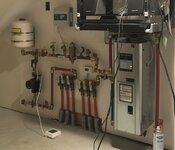
I've attached a picture of the system. The circulator is pumping DOWN into to 3 circuits on the left side.
Also, I have tried flipping that expansion tank down. I did get a little air out when I did this but at this point, I don't think there's any air in it and I'm leaving it down during all this troubleshooting.
I've got a new radiant system in new construction that I'm having a heck of a time with air in the system. I've been reading tons of info from posts on here and HeatingHelp.com trying to figure out what's going on. I got the kit from a company who has been great but I'm always up for more information or ideas so I decided to post here as well as HeatingHelp.com. I'm very technically minded but a total newbie at radiant hydronic. Here goes...
The System:
This is a small system - one zone, one pump, 3 circuits, 600 feet of tubing in a concrete slab. Tubing is 5/8ths OB. Circuit lengths are 194, 224 and 174. "Cabin" is 650 sq feet. It's a pretty standard system, a Grundfos pump, Electro Mini boiler, Watts air separator, expansion tank at 20PSI, etc. I've used all Sharkbite connectors and regular (non OB) PEX on the wall which I know is not ideal but I don't suspect it's contributing to my issue.
The Setup:
My well water is a bit dirty and I haven't used it since summer so I've been using a sump pump to purge and charge the system. I initially purged the lines clean with very clean river water in a tub then replaced that with Cryotek premix antifreeze using the sump pump. I go through a purging process on each circuit and get all the air out to the point where it's completely silent and no indication of air in the system.
The Problem:
With system cold, (or warm since I've been able to reproduce this a few times over the last few days) and to the best of my knowledge, all air out of the lines, I fire up the system and it starts heating up. Everything is going as expected but the pressure starts rising up to 30PSI. I'm told this is bad and will blow the pressure relief valve. So my instinct is to lower the pressure by opening a valve downstream of the pump to let some fluid out. This does lower the pressure but it continues to rise. So I let more out which lowers the pressure again. When I do this, the boiler gets angry and starts making bad noises. I assume it's boiling off or doing a tea kettle thing. Not good. If I'm feeling brave enough to not worry about destroying a brand new boiler, and the noise isn't too bad, I'll let it continue. Normally, it will get past this noise after a while once pressure and heat start rising again.
Now here's where the fun begins... when the system reaches its peak temperature or the boiler hits its setpoint, either the thermostat will click off or the boiler will cycle off. When this happens, my pressure gauge goes to zero as the system cools off. When I start it back up again, boom - I'm full of air and now I've got real issues with boiler noise and water noise running through the pipes. At this point, it's game over, I have to start from scratch again purging the air out with the sump pump.
I did read either here or HeatingHelp that the air separators can **** in air if they are behind the circulator pump. I believe this was happening any time my circulator turned off. I was able to turn the circulator on and off multiple times with my ear up to the top of the air separator and here a short air noise every time the circulator clicked off. I closed the cap on the separator and it stopped doing this. I suspect it was pulling air in. This solved one issue which was that every time the circulator would cycle on/off, even when cold, I'd get a bunch of new air into the system. So I'm not a big fan of those things or at the very least, I need to be very careful about when I open the cap, maybe only when the circulator is not running to let out any captured air.
My kit supplier thinks I need to ditch the antifreeze and fill with regular water filled via my domestic supply. He thinks my sump pump filling, purging and charging process is what's introducing the air and the antifreeze is making it hard to get the air out via the purging process.
I'm not so sure... but I also have zero experience with radiant systems and experts are almost always right.
My theory, based on the fact that I go from perfect, with no air, to full of air only after a cool down and system stop and restart, is that when I let pressure out when it hits 30, I'm creating a negative pressure situation when it cools and then sucking air in through one of the relief valves.
Which begs the question - why does my pressure keep going up and up and up as it heats?
I'm kind of stumped at this point. I'm going to check the pressure in the expansion tank. It's supposed to be factory set at 20 but I never checked it.
I'm probably going to ditch the antifreeze today replace with well water just to satisfy my supplier's suggestions so I can continue troubleshooting with them.
Any other ideas? Thoughts? Suggestions?
Thanks in advance for any help
Dan
I've attached a picture of the system. The circulator is pumping DOWN into to 3 circuits on the left side.
Also, I have tried flipping that expansion tank down. I did get a little air out when I did this but at this point, I don't think there's any air in it and I'm leaving it down during all this troubleshooting.