To avoid these ads, REGISTER NOW!

Air Line Coupler Size

squeakz28

Active member
Joined
Jul 24, 2014
Messages
28
Location
Nashville, Tn
Quick question. I'm in the process of installing compressor plumbing in the garage. This is being set up for a small, part time powder coat business. I've gone a little over kill for hopes of expanding in the future. The pipe is 3/4" and is being adapted down to 1/2" at the drops. My question is, what size fittings should I go with? I don't have many air tools yet, so I don't the knowledge on what a common coupler size is. I will be getting a couple of sand blasters in the near future, a pot blaster and a cabinet. Those will have a dedicated drop so it can stay 1/2" for air flow. The remaining drops can go to smaller size if need be. The would be running the normal garage tools. Can they stay 1/2" or would I need to drop them down in size? Thanks.
 
To avoid these ads, REGISTER NOW!

larry_g

Well-known member
Joined
Apr 28, 2007
Messages
16,872
Location
oregon
Standard in the automotive and light industrial is 1/4" fittings, and 3/8" hose. I suggest that you start there and if you find your tools and lacking because of airflow then up size that tools fittings. The standard stuff will accommodate 90% of the work.

lg
no neat sig line
 

Schurkey

Well-known member
Joined
Oct 27, 2011
Messages
2,366
Location
The Seasonally Frozen Wastelands
Leave the piping the maximum size you're willing to use--3/4 is good.

Don't adapt down until you get to the last fitting or two before the hose. Use the largest-diameter hose you can conveniently work with. I have 50 ft of 1/2" hose, 100 ft of 3/8" hose, and nothing smaller.

I suggest "high-flow" Milton "V" series couplers and plugs for 3/8 hose. I recently revamped my shop to eliminate my previous coupler/plug choice in favor of Milton "V" on all my 3/8 hoses.

Sand blasting takes a fairly large volume of air, but at no more than 90 psi at the blaster inlet, with the blaster in-use. Small-diameter plumbing is exactly the opposite of what you need.
 
OP
S

squeakz28

Active member
Joined
Jul 24, 2014
Messages
28
Location
Nashville, Tn
So if I run 1/2" hose with 3/8" milton v fittings, I should be good for most all air tools I'll need to use in the future, minus the blasters, correct? Or would the 1/2" hose cover the blasters as well? My garage is only 24x30, so a 50' hose would cover anything in the garage I would need.

Dumb question, would a 1/4" thread plug mate up to the 3/8" thread coupler, assuming they are both milton v style? Or would they be different? Thanks for the info. Sorry for the simple questions. I haven't had to ever worry about any of this before will smaller compressors. Lol.
 

Schurkey

Well-known member
Joined
Oct 27, 2011
Messages
2,366
Location
The Seasonally Frozen Wastelands
First Guess: Your blaster will work fine with 3/8 hose and "V" couplers. You could use 1/2" hose, but then there's no need for the "V" couplers. "V" couplers have an internal diameter almost as big as standard 3/8 couplers. Using the "V" coupler on 3/8 hose is a benefit.

My glass bead blaster is run from shop air regulated to 135 psi. There is an additional regulator on the bead blaster set to 90 psi. I'm still experimenting with air pressure; there's some chance I'll turn the pressure down a bit--perhaps 80 psi at the bead blaster.

The 1/2" air hose has a 3/8 pipe thread fitting on the end. This connects to a 3/8 coupler suitable for my 3/4" impact wrench. (Milton "P", I think.) I have an adapter to "reduce" from the 3/8 "P" coupler to a 1/4 Milton V. Therefore, I can use ALL my air tools from the 1/2" air hose, and all but the 3/4 impact from the 3/8 hose.
 

gsmith22

Well-known member
Joined
Jul 14, 2015
Messages
337
Location
Central NJ
For the output end of the coupler, there are multiple sizes and styles. For sizes, this is called the "basic flow size". 1/4, 3/8, 1/2 are common with 1/4 basic flow size by far the most popular, 3/8 or 1/2 if you need more flow (think larger the size number, bigger the orifice of the coupler = more flow). For styles of couplers, industrial and automotive are the most common but there are other less widely used varieties (such as Lincoln or ARO). Further confusing this basic size and style nomenclature is what are known as "hi-flow" couplers. These are typically 1/4" size basic flow couplers (outer overall size of coupler is the same as 1/4) but with a bigger internal orifice diameter for more air flow. A Milton "V" coupler is a 1/4 basic flow size coupler in an "Industrial" profile with an orifice that is larger than the standard 1/4 but slightly smaller than the standard 3/8 allowing for more flow than a normal 1/4 basic size (and very similar if not more than 3/8 basic flow size). A standard 1/4 size in an industrial profile would be an Milton "M" coupler. Milton has other letters designating other various sizes and profiles. They are just one manufacturer - other companies have other ways to note the basic flow size and profile.

For the input end of the coupler, there are also various sizes based on National Pipe Thread (NPT). The sizes seemingly have no correspondence to the inside diameter of the hose which is why you will see 3/8 NPT coupler on a 1/2" inside diameter hose and the 3/8 NPT end is essentially the same size as the 1/2" inside diameter hose (same thing with 1/4 NPT and 3/8 hose).

Only reason I know all this is because I was incredibly confused by it all and made a research project out of it so I wouldn't buy something I ended up regretting. Long story short, it would not be uncommon to find a 1/4 coupler (basic flow) with a 1/4 NPT fitting connected to a 3/8" diameter air hose. A Milton "V" makes this arrangement better because the output orifice of the coupler is larger (while keeping the body of a 1/4 coupler) essentially making it the same diameter of the NPT fitting and inside diameter of the hose reducing bottlenecks and increasing air flow rate. The Milton "P" noted prior would be the automotive style on a 3/8 basic flow size.
 

gsmith22

Well-known member
Joined
Jul 14, 2015
Messages
337
Location
Central NJ
I should point out, I can't speak to what you need in terms of flow but certainly get all the nomenclature and their various sizes/flow rates sorted out because you can easily end up with the wrong stuff or components that don't connect to one another.
 
To avoid these ads, REGISTER NOW!

gdocktor3

Well-known member
Joined
Apr 18, 2015
Messages
5,419
Location
Connecticut
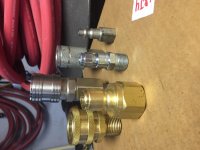
Just went through something similar. I picked up a 1/2" Parker filter/reg that comes directly off my compressor and goes into a 50' roll of 1/2" Goodyear hose on a reel. I then use the larger 1/2" Parker fittings to connect to a few different length hoses used for different things. Generally I use 3/8" Automotive quick couplers and coupler plugs on the smaller hoses and my air tools. I don't use any 1/4" fittings anymore. I've attached some pics showing the difference in diameter between 1/2", 3/8" and 1/4" fittings. Someone tried arguing with me on here one time that using 1/2" fittings and hose won't make a difference over the 3/8" and boyyy was he wrong. Huge difference. Just look at the pictures and you can see how much less restrictive the 1/2" fittings are.
 

Attachments

  • IMG_2544.jpg
    IMG_2544.jpg
    135.9 KB · Views: 57
  • IMG_2546.jpg
    IMG_2546.jpg
    134.7 KB · Views: 51

Schurkey

Well-known member
Joined
Oct 27, 2011
Messages
2,366
Location
The Seasonally Frozen Wastelands
Comparison of 1/4 and 3/8 couplers:

Compressed_Air_Couplers_01.jpg


Compressed_Air_Couplers_02.jpg


Compressed_Air_Couplers_03.jpg


Compressed_Air_Couplers_04.jpg
 

jrobb316

Well-known member
Joined
May 18, 2014
Messages
1,377
Location
WI
So if I run 1/2" hose with 3/8" milton v fittings, I should be good for most all air tools I'll need to use in the future, minus the blasters, correct? Or would the 1/2" hose cover the blasters as well? My garage is only 24x30, so a 50' hose would cover anything in the garage I would need.

Dumb question, would a 1/4" thread plug mate up to the 3/8" thread coupler, assuming they are both milton v style? Or would they be different? Thanks for the info. Sorry for the simple questions. I haven't had to ever worry about any of this before will smaller compressors. Lol.

My shop will have 3/8 hose with Milton m style connectors. There will be one 1/2 hose with v fittings. That's only for a 3/4" impact, the rest is just overkill and a pain to drag around a big 1/2" hose. Also 3/4" pipe until the hose reels. Also you need an adaptor for a 1/4" plug to a 3/8 thread. V fittings are sold in 1/4 or 3/8.
 
OP
S

squeakz28

Active member
Joined
Jul 24, 2014
Messages
28
Location
Nashville, Tn
Rocket, I've ran 3/4" black pipe throughout the garage including the drops. At the drop, I'll do the adapting to whatever size, which is starting to sound like 3/8 or 1/4. The compressor is an eaton 80 gal 7.5 hp. It makes 29 cfm at 100. I have 6 drops in a 24x30 garage. Little over kill I know, but it didn't cost much more for the extra for the way I was laying it out. I've zigzagged 35' on the wall to help cool the air and control moisture. Each drop has a ball valve water trap about 6" below where the future couplers will be. As of right now, I'm only going to have 2 regulators and motor guard tp style filter. Those will be dedicated to the powder gun and blaster. I'll get more regulators as/if I need them.


Sent from my iPhone using Tapatalk
 
Last edited:
OP
S

squeakz28

Active member
Joined
Jul 24, 2014
Messages
28
Location
Nashville, Tn
After catching up on everything, is sounds like either Milton V or Legacy will be the route to go. 1/4" couplers and probably 2 3/8" hoses sounds like it's going to cover me. Who knows what the future holds for me and what I'll get into next though. Lol. Thanks for ALL the info and advice. It would have taken me forever to find all the info y'all posted.


Sent from my iPhone using Tapatalk
 
To avoid these ads, REGISTER NOW!
Top Bottom