To avoid these ads, REGISTER NOW!

Air Line Layout - Guidance Needed!

moparfreak

Well-known member
Joined
Jan 24, 2005
Messages
853
Location
Milwaukee, WI
Folks,

So, with the finish electrical set for Monday, and a little bit of painting to finish up, probably by Thanksgiving I'll be setting up to start the air line plumbing.

My goals here are to supply air outlets in every working wall of the shop. Obviously A single rubber hose could service the entire shop but there's no fun in that! I have an IR 60 gal upright single stage that should get me ~18-20 cfm at 90 psi and that's probably where I'll keep it for most of its life. A/C is on a switch and won't be kept on all the time.

The shop is WW and auto restoration, so it'll entail all the usual air powered equipment. At this point I don't have experience with running the HVLP spray guns off the compressor (I've never had acompressor capable of running it before), and I just got my new Earlex HVLP which I love. So, HVLP maybe down the road but really not in the plans for now. Maybe a small HF benchtop sandblast cabinet at some point but not right now.

I plan to run this sytem in 1/2" PEX for the majority, with a bit of black pipe near the compressor to absorb and dissipate some of the initial heat. Looked at RapidAir systems but I believe I can get a lot more value out of PEX with the same relative safety margin, and instead put my $$ into the hardware which can be expensive as well (filters / dryers/ regulators / drains / lubricators / etc). Probably will opt for the UV-stabilized PEX as it will see flourescents and be surface mounted. PEX will also give me easier install and future flexibility for changes.

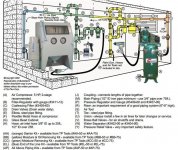
After researching air line layouts, I sketched the system out as shown below. I'm curious as to what experienced folk think, what am I missing or should be thinking about? Hardware? Are my drains and filtration units located correctly? Should I add more of them?

Air%2BLine%2BLayout%2B-%2BPic%2B1%2B-%2B11.6.14.png


Any suggestions are very appreciated!

Thanks,
Adam
 
To avoid these ads, REGISTER NOW!

sberry

Banned
Joined
Jun 18, 2005
Messages
35,747
Location
Brethren, Michigan
After researching air line layouts, I sketched the system out as shown below. I'm curious as to what experienced folk think, what am I missing or should be thinking about? Hardware? Are my drains and filtration units located correctly? Should I add more of them?
Depending on bench layout,, might add a fixed whip but I done this every which way you can and then some. Throw out but one or 2 of those regulators and locate a couple reels. The whole place will only need 2 or 3 couplers and you do all connecting at the tool and never need to move sections of hose.
My experience tells me you will put all that in and in the end finding yourself using one or 2 of them 95% of the time.
To start with feed the reels with a piece of hose, get them where they should go and plumb to it after the fact and you can use the left over hose eventually as extension for outdoor or special apps.
In my work area there is a plumbed hose that reaches and even overlaps. I cover about 4K sq ft with 4 possible places to hook a tool on plus aprons outside. 2 reels and 2 fixed. Could use 1 valve after the comp in this size shop that shuts the whole thing down, I have added one ahead of reg/filter on the far side of my building.
I have some more I added on as things came up but 2 reg combos do 90% of the work, I really like as many pieces as I can get on one, all running at the same potential. Move a tool to another hose and it runs the same.
 
Last edited:
OP
M

moparfreak

Well-known member
Joined
Jan 24, 2005
Messages
853
Location
Milwaukee, WI
Depending on bench layout,,

Good point, I forgot to add, there will be workbenches and/or fixed workstations (miter saw, band saw, drill press, router table, welding station, yada yada) covering about 75% of the wall perimeter other than the front part which is actually the 2-car portion for daily drivers. This is why I added so many fixed air ports to be able to easily use for detail work and blowing off stuff at the workbench areas, trying to cover each main wall.

Maybe I should consider a shorter 25' or so reel to add to the rear RH corner, where there's actually a door to the backyard, that way if I wanted to do anything in the backyard I've got that easy setup. Hmmm...

Thanks,
Adam
 

sberry

Banned
Joined
Jun 18, 2005
Messages
35,747
Location
Brethren, Michigan
Looked at RapidAir systems but I believe I can get a lot more value out of PEX with the same relative safety margin, and instead put my $$ into the hardware which can be expensive as well (filters / dryers/ regulators / drains / lubricators / etc).
Put way less $ in, 1 or 2 valves, 2 regs couple of couplings couple pcs of hose.
 

sberry

Banned
Joined
Jun 18, 2005
Messages
35,747
Location
Brethren, Michigan
I am a fan of trying to cover a little floor space and use less equipment, I really like a 50 ft reel. Its hard to reach around a car to fill a tire with 25, you run out of hose real fast.
I did a hydrant job a while back and got obsessed with covering it all and the next time I did it came back and increased the hose length a little and went from a dozen to 7 and it made it a lot easier to manage.
What you want to avoid is walking on hosing, easiest way is to roll it back after you blow the machine off. I put a simple T after the reg and you can use factory ends to screw hose too for a drop near a bench etc and the convenience doesn't cost much.
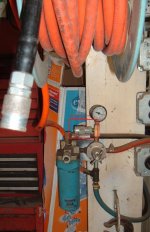
I put a red box over the thing to avoid,,, this kind of got left, we really don't use it. I post the second pic of the cobble job and I did add an extra valve as it feeds an out door reel and it was something I had. The extra coupling could and should be removed, its simply not needed and gives someone the opportunity to plug in a place they shouldn't although we really restrict that possibility with the available hoses etc.
Again, only coupling in the system is AT the tool.
 

Attachments

  • air reg combo hyd.jpg
    air reg combo hyd.jpg
    141.6 KB · Views: 198
  • air reg HD.JPG
    air reg HD.JPG
    35.2 KB · Views: 179

stonesfan68

Well-known member
Joined
Apr 19, 2012
Messages
2,758
Location
Houston, TX
Standard PEX is not rated for compressed air. The combination of temperature, pressure and oil used in the compressor will break the piping down. Make sure that the PEX that you are using is rated for compressed air. Otherwise, use copper, aluminum, back iron, or galvanized pipe.

In terms of your layout, I would install a single pressure regulator at the discharge of the compressor. Get an industrial pressure regulator, not a cheap one. The cost of the single, industrial pressure regulator will be less than the cost of all the smaller ones.
 

sberry

Banned
Joined
Jun 18, 2005
Messages
35,747
Location
Brethren, Michigan
Maybe I should consider a shorter 25' or so reel to add to the rear RH corner, where there's actually a door to the backyard, that way if I wanted to do anything in the backyard I've got that easy setup. Hmmm...
Use 50 ft and it will reach 25 ft in the yard and dam near to the other end of the building. Put another one down the other end with 50 ft and it will reach outside the other way as well as back in to the building.
Put a T and end plug instead of a coupling or elbow once in a while so its easy to tap but about 80 ft of 1/2 pipe. A union after the valve and the rest so simple would be willing to unscrew a couple pieces if I had to. T's are cheap and may be as simple as a reducing bushing and ****** to regulator connection.
 

sberry

Banned
Joined
Jun 18, 2005
Messages
35,747
Location
Brethren, Michigan
I moved one in my storage the other day. First time in a while I made a mod and its the second to this one circuit. I unscrewed a hydrant (air coupling) from an elbow, added a ****** and a T and turned one in to 2 by adding some more pipe in different directions. I even did the extension surface, I can change it again in even less time.
 

ford33

Well-known member
Joined
Feb 26, 2011
Messages
2,118
Location
Chicago, IL. USA
I believe you have two unnecessary regulators and couplings on the 64 ft wall and one too many on the opposite side. Consider a centrally located 50 foot reel mounted high on the wall or on the ceiling and with that you can cover a lot of area. Save the money on the regulators.

You might consider adding the piping for the drop downs now but not adding the drop down piping, regulator and couplings until later. Put a coupling near the entrance to run a hose outside for filling tires, blowing off the sidewalk and other chores.

As stated earlier, you will use one or two locations frequently and the remaining ones not at all.

Buy a commercial quality filter regulator.
 

sberry

Banned
Joined
Jun 18, 2005
Messages
35,747
Location
Brethren, Michigan
sink supply valve for a petcock, probably get one for free. The extension I made the other day was made all used pipe and existing threads by scrounging around. Yes, said above more clearly than I did.
 
Last edited:

sberry

Banned
Joined
Jun 18, 2005
Messages
35,747
Location
Brethren, Michigan
I don't know squat about puters. Don't care for the most part But a guy could possibly get this down to 5 pieces of pipe a half a dozen fittings, 6 niples and a couple bushings, a valve and union or as good a hose and a swivel. If you want to cross the room it takes another 30 ft f pipe and 3 or 4 more common fittings. 1/2 black unions and nips are cheap, could add one when t ing to go across, build the sections on the floor and hang it. Hang everything on one wall at a time. Screw regs on the drops when done.
 
Last edited:

C96

Well-known member
Joined
Nov 30, 2013
Messages
1,251
I would use all black iron for the entire job. I personally do not like plastic anything installed permanently exposed in a shop environment that can be dangerous to personnel if damaged. Exposed air lines and electrical are better off protected in metal piping in my opinion, but that’s just me…Lol
 

CNGsaves

Well-known member
Joined
Sep 26, 2012
Messages
13,233
Location
KS and OK
+1 for all black pipe steel or copper. So recommended choices are buy pipe threader w/ 2 dies, or learn to sweat copper !! :D

Contractor lengths of black pipe steel available at 21 ft & prices around $1/ft from wholesale vendor like WinNelson. Run 3/4" main trunk line and drops (ie first up, then down) of 1/2" and you'll have lifetime system (see URL below and picture attached).
https://www.tptools.com/tech-metal-piping.dlp

Other GJer idea of building drop location T is good idea, even if you don't actually install a drop there initially. Just plug the T hole for now and see how functionality works out with couple hanging reels at strategic locations.

Be sure to have a drop near garage door to reach vehicles outside garage.

Get a 3/4" hydraulic hose (3 ft) from Tractor Supply for your first connection to airline system to handle vibration.

Good luck, but do not use Pex.
 

Attachments

  • Airline system layout_TP Tools_black pipe steel.JPG
    Airline system layout_TP Tools_black pipe steel.JPG
    114.4 KB · Views: 256

Viper9087

New member
Joined
Jun 20, 2014
Messages
4
Pex is designed for water with usually runs 60-80 PSI Home depot or similar pex is rated for 65 psi from what they told me and true plumbing supply sells 150Psi pex most compressors run 175-200 psi prior to the regulator.

You would be wasting your money because it eventually will leak or burst.

your best bet is galvanized pipe for longevity and its almost the same price as black pipe. You can use black pipe to save a little but deal with rust over time. the downside to NPT pipe is if you need to swap or change one piece you will need to disassemble the entire system unless you use couplers.

My recommendation would be Plastic PVC line used in air suspensions with compression fittings and adapters at the ends to change to NPT. This will save you the most money and is super easy to run, route and make custom lengths. The only downside is little metal surface to condensate air.

Also for painting applications you have the pipe risers at the top of each outlet. I would add a second U BELOW each outlet with Tee and a straight down pipe under the U with a drain at the bottom .

You should just have one regulator at the compressor, with a small adjustable regulator at the tool should one or 2 need different pressures. This will also save money and put less stress on the wall lines.

Finally for more water removal you can plumb the compressor outlet down to the floor and back up again with galvanized and the cold pipe would aid in condensation (the more up and downs you have the better the effect) another trick is to run it parallel with and (zip) tied to a cold water line if one is near by. Plastic piping will not condensate well.

Thick walled copper pipe is the best but very expensive. It condensates the water well, is easily repaired, replaced and modified. Sweating copper is easier than threading black pipe and cheaper than buying a die to thread the pipe, and it will out last you and your kids (as long as someone doesn't steal it)

Just my 3 cents! (yes I gave you more than 2)
 
Last edited:

Steve in Mi

Well-known member
Joined
Mar 13, 2007
Messages
1,042
Location
Mid Michigan
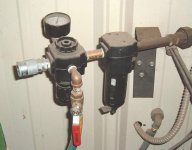
My shop has 17 air drops/outlets (with air lines in the walls) inside only 2 outside. I saved a bit on filter/regulator units by installing a ball valve w/bleed at each drop followed by a quick disconnect. Like this;


Then I set up a few floaters (as I call them) that could be used anywhere in the shop where filtered and regulated air is needed. Like these;

 
Last edited:

Friartuck

Well-known member
Joined
Apr 13, 2007
Messages
123
Location
Monmouth County, NJ
Every drop should have its own condensation drip. The TIP diagram posted by CNGsaves show this. I'd be a little nervous on using pex also.
 

sberry

Banned
Joined
Jun 18, 2005
Messages
35,747
Location
Brethren, Michigan
The tip drawing doesn't have a leg on the main, the whole thing would have to fill up for the most part to push water up and over. This setup is fine if there is air flow regularly going past each riser to carry the water along but for **** where its dead end.
Not every industrial idea is good at home. A drip leg at the reg will work if the water is allowed to come down the pipe.
Steve, just out of curiosity how big is the shop? 18 couplers before we even get to hose ends.
 
Last edited:

sberry

Banned
Joined
Jun 18, 2005
Messages
35,747
Location
Brethren, Michigan
The move to 3/4 doesn't do much here, slows down the air a pinch but it wont make much difference and just adds a layer of different fittings. My bud, a lic master for over 40 yrs still uses the 1/2 he put in the day.
My mentor when I was a kid was an obsessive compulsive about loss etc but the net has exasperated the issue to an extreme. I am a big fan of 1/2 most of the time, so much easier and simpler, stock one size fitting and can make lots of changes.
 
OP
M

moparfreak

Well-known member
Joined
Jan 24, 2005
Messages
853
Location
Milwaukee, WI
I love the variety of solutions found on GJ. Some folks would do two big hose reels on each and and call it done, and some have 17 outlets! I think I'll find myself somewhere in the middle.

A lot of folks talked about having one near the door. The QC fitting at the bottom left corner is actually going to be a couple feet from the garage door. I believe what I'll do there is have some good all-weather hose coiled up and ready to go there to at least stretch the length of the driveway, so I can blow air or fill up tires, etc.

Steve your idea about the shutoff w/ bleeder is also a good idea. Cuts down my valves from 2 to 1 for each leg, I am assuming it's as effective at bleeding out the moisture as a drip leg would be?

I'll cut back on the filter / regulator units. I really like Steve's idea of a floating F/R unit. I'll invest in a nicer unit at the compressor and maybe a cheap-o for the floater.

I used the TP Tools diagram to sketch it out intially, a great resource!

Thanks,
Adam
 
To avoid these ads, REGISTER NOW!

sberry

Banned
Joined
Jun 18, 2005
Messages
35,747
Location
Brethren, Michigan
The port in the valve isn't for moisture, its to let the pressure off downstream. All these ideas are not bad,,,,,,,,,,,,,,, burt you don't need them and they look better on paper. On above has 20 couplers not counting hose ends. There were born from "plant air" which is different than small garage floor. I put in 10 access points and had visions of air at each, in the end use 1/2 of them. Still eliminating things 20 yrs later.
I had a mechanical engineer here a while back, a safety type and he noticed and commented on the air and the fact the hook on all occurred at the hose end and that the rest of the connections were fixed. Any excess you see in my pics simply were not removed and plugged,,, they do not see service in daily use.
A lot of this is what is called parked investment, while its also great to have a 240 outlet every 6 ft everywhere with number 6 wire its simply not needed and never gets used.
The bleeder helps Steves from a safety point as he doesn't have to disconnect a hot hose but I can almost bank on there will be a couple outlets in time that do the real work and it gets old moving a hose 5 ft and not really set up to take advantage of reels.
Reels are psychological for sure but they work. As easy as it is to hang longer hoses it seems they are forever on the floor, its just human nature, put a reel there and it gets used. I am fine with manuals but I like 50 ft on a hundred reel so it doesn't have to be fussy level wind and rubber hosed are big and grow if left on.
The point of regulating and filtering down stream is 2 fold but again there is the temptation to keep adding parts. There is no reason for anything from the comp but a valve and a union and a hose to go to hard line.
 
Last edited:
OP
M

moparfreak

Well-known member
Joined
Jan 24, 2005
Messages
853
Location
Milwaukee, WI
I also see a lot of comments regarding my decision to go PEX. I've hung back low on the many debates of the copper vs. iron vs. nylon (Rapidair) vs. PEX (note: don't even mention PVC here). For the most part everyone brings their own personal experience and it's usually a single data point. I'll bring in my perspective for a moment and why I am going to build my system this way. Of course it's only my installation that I discuss here, each and every individual should make their own conclusions.

I come from a background of spending a lot of time with both PE and Nylon. I am an ME in work for a large player in the small engine industry and have worked on several plastic fuel tank programs, and have a lot of testing and development time with both HDPE and nylon. Although many of the PE tanks are being phased out for evaporative emissions reasons, it is an incredibly tough material. I've personally tested it and seen its toughness in the face of all sorts of hydrocarbon fluids (i.e. oils and fuels), solvents & chemicals. PE can handle 95C - 100C temps before the material modulus gets to a point where you need to be concerned.

Speaking of carrying pressure, as you can imagine with a fuel tank application I also test far beyond operating pressures and although a lot has to do with design of the part, the PE can withstand several magnitudes higher pressure than it will see. 150 psi line pressure doesn't concern me when I've witnessed tanks withstand 500 psi time and time again.


PEX is actually PE taken one step further. The PE molecules undergo a secondary catalyzing & curing process where they establish cross-links ("bridges") between themselves. This improves properties across the board including chemical resistance (oil from A/C), heat (from A/C), etc. I have some pretty good connections in the plastic / polymer industry with whom I've talked to regarding this and across the board all the big plastic developers / compounders are getting into the mix and pushing PEX into more applications and adding more capabilities to it to be able to handle far more extreme situations than what we are speaking of here.

Furthermore any material concerns relating to pressure and temperature can be mitigated with the design of my layout, and by isolating the PEX from the extreme temperature (by starting w/ a stretch of metal) and pressure (with a regulator at the compressor). This only increases the SF of the overall system.

Either way, no matter what material you choose, the design can be good but the implementation of it needs to be done skillfully. Just like pipe needs to be threaded and sealed properly, copper needs to be fluxed and soldered properly just like PEX needs to be crimped properly with the right fittings and tools. In my own plumbing experiences I have seen iron pipe, copper and PEX fail, all at the joint, a testament to the above comment that you can have a good design in any of these materials, but need good quality and process to see it through.

- The iron pipe failure was due to corrosion at the threads in its service life and caused me $10k of damage. Never again will I bring that **** into my house for anything.

- Copper pipe was at a solder in its service life and nearly ruined my entire first floor of hardwood flooring if my M.I.L wasn't home watching my daughter at the time it popped & notified me to rush home and shut the water off. The joint was exposed to undue cold because of exposure during the construction but PEX would not have failed in that case. I won't swear off copper but not my 1st choice.

- I replumbed 2/3 of my house into PEX and of over 200 joints made, had one single crimp with a drip leak on startup. Careful inspection of the clamp shows I simply had not compressed the tool enough. Easily fixed in 5 seconds.

Once again, these are all just personal data points I've experienced which lead me to my decision. We are all influenced by our own experiences and discussions. Not a rule, not telling anyone what to do in their own case. Just my own decision and the rationale on why I am doing it this way, since I saw so many comments about it.

Thanks,
Adam
 

Steve in Mi

Well-known member
Joined
Mar 13, 2007
Messages
1,042
Location
Mid Michigan
To answer on some points;

My shop is 28' X 48' 2 story - Hobby Shop

Correct, the bleed is not a condensate drain - rather a safety as was mentioned.

When you buy filter/regulator units be sure they are rated for the feed pressure. I have a 3/4" regulator at the compressor for regulating overall system pressure.
 

MoonRise

Well-known member
Joined
Nov 5, 2010
Messages
4,028
Location
NJ
Right from NIBCO's PEX usage/installation manual:

Q: Can I use NIBCO® PEX for compressed air or natural gas?
A: These are not intended or approved uses of the product.

PEX is not approved/rated/intended for use with compressed air.

and you have a 60 gallon compressor putting out 18-20 CFM??

Not that common from what I've seen. Most of the time the compressors with60 gallon tanks usually go up to about a 3 hp motor, and that is only good to about 12 CFM, give or take.

Usually, to get near 20 CFM output you need a 5-7 hp motor driving and adequate pump. And that size motor/pump combo usually comes on the 80+ gallon tank units.

YMMV, etc, etc.
 

C96

Well-known member
Joined
Nov 30, 2013
Messages
1,251
You can talk yourself into the Pex all you want, bottom line; it’s not approved for compressed air lines.

Why you would knowingly want to use a product for a specific purpose that it is not intended for is beyond me.

Sounds like you’re looking for a cheep half *** job that’s easy to throw up on the fly by using water tubing for compressed air lines and then expect approval from the members here.

Not going to happen!

By all means use approved materials for the job at hand.

Compressed air can become dangerous should a rupture take place unexpectedly
 

rparent

Member
Joined
Jan 23, 2012
Messages
22
Location
Maine
I put 1" pex in my shop over a year ago and I don't have a leak or a regret. I ran the pex in the walls and pitched it back to the compressor. Best of luck! Ryan
 

coljar

Well-known member
Joined
Sep 26, 2010
Messages
6,243
Location
Belpre, Ohio
I can't say it much better than sberry did, and I find myself using my Reelcraft hose reels about 98% of the time.
 
OP
M

moparfreak

Well-known member
Joined
Jan 24, 2005
Messages
853
Location
Milwaukee, WI
you have a 60 gallon compressor putting out 18-20 CFM??

Not that common from what I've seen. Most of the time the compressors with60 gallon tanks usually go up to about a 3 hp motor, and that is only good to about 12 CFM, give or take.

Usually, to get near 20 CFM output you need a 5-7 hp motor driving and adequate pump. And that size motor/pump combo usually comes on the 80+ gallon tank units.

YMMV, etc, etc.

IR 60 gal, 5 HP, 230V, Model SS5L5 - 18.1 cfm at 90 psi.

http://www.northerntool.com/shop/tools/product_211720_211720

Sounds like you’re looking for a cheep half *** job that’s easy to throw up on the fly by using water tubing for compressed air lines and then expect approval from the members here.

*sigh* no that's clearly not my point. If you look at my original post, it was to obtain feedback on the system design and layout, not material choice. After several posts I thought it might be worthwhile to put out my thoughts on the matter since it was brought up so much. Take it for what you will. You'll be very happy with your iron/copper system. I'll enjoy my PEX.

I can't say it much better than sberry did, and I find myself using my Reelcraft hose reels about 98% of the time.

After this thread, I'm defintily going to add another reel on the other end!

Thanks,
Adam
 

blatterjr

Well-known member
Joined
Nov 21, 2011
Messages
157
My neighbor used PEX for his system... we discussed it late last year and I voiced my concern. A pipe shattered this weekend. Luckily, he was on the other side of the shop. He swears the pressure was only at 90 PSI when it happened.

The failure occurred about 2-feet from a bend. He's moving to a copper system next weekend. Take from this what you will as YMMV.
 

Thumper68

Well-known member
Joined
May 16, 2013
Messages
5,134
Location
Duluth MN
+ *** on the use of hose reels, I just added a second one to the shop, I can't even remember the last time I used a regular hose.
 

AffableCurmudgeon

Well-known member
Joined
Jan 26, 2009
Messages
1,906
Location
Triad Area NC
....I come from a background of spending a lot of time with both PE and Nylon. I am an ME in work for a large player in the small engine industry and have worked on several plastic fuel tank programs.....

Speaking of carrying pressure, as you can imagine with a fuel tank application I also test far beyond operating pressures and although a lot has to do with design of the part, the PE can withstand several magnitudes higher pressure than it will see. 150 psi line pressure doesn't concern me when I've witnessed tanks withstand 500 psi time and time again.

....

- The iron pipe failure was due to corrosion at the threads in its service life and caused me $10k of damage. Never again will I bring that **** into my house for anything.

- Copper pipe was at a solder in its service life and nearly ruined my entire first floor of hardwood flooring
....

You sound like an intelligent person. Let me just say, with all due respect, that perhaps experience with fuel tanks does not translate into experience with tubing of the same principal material. Are you sure that the materials used to construct fuel tanks is exactly the same as that used to manufacture tubing? No additives for each application? Also no differences arise due to the design of the piece or manufacturing/molding process?

Also, you have had two bad experiences when iron pipe and copper pipes were being used per manufacturer's recommendation with respect to usage. You now are trying to AVOID a third mishap by totally ignoring the manufacturer's usage recommendation and rating and are expecting it work?

It is your build and you will do as you see fit. I would just say that you be careful and don't stand too close to the tubing.

Good luck.
 

CNGsaves

Well-known member
Joined
Sep 26, 2012
Messages
13,233
Location
KS and OK
Can someone post pictures of the pipe you recommend using for air lines for a shop and where can I buy it. Thanks Frenchy

Here's an example of 10 ft stick of black pipe steel - - - -
- - - - - 3/4" x 10 ft for $10.82 at my HD location . . . YMMV

http://www.homedepot.com/p/Mueller-...-Steel-Pipe-584-1200HC/100540481?N=5yc1vZbqn5

Above could be your mainline if you have heavy air use like sand blasting, DA sanding, etc. Otherwise, for typical hobby garage then 1/2" black pipe steel would be fine.
 

justin1795

Well-known member
Joined
Aug 7, 2013
Messages
442
Location
blue grass IA
to many regulators. we have them everywhere at work and eventually they leak. for a good pex like uponor you will be spending some money on brass fittings. i think a t is about 10 bucks
 

saabman

Well-known member
Joined
Oct 8, 2009
Messages
594
Location
Sebago Lake, Maine
I ran black 3/4 black iron around the perimeter of my shop (high on the walls), with 1/2 black iron drops (pretty closely followed the TP Tools diagram). Sure it is a bit harder to work with but it is rugged and the iron can condense vapor so it makes your water traps more efficient
 

C96

Well-known member
Joined
Nov 30, 2013
Messages
1,251
How will you trap the rust before it gets into your air tools ?

Easy, a simple combination filter/regulator unit such as this installed at the service point will solve that problem.

ARRPB754GW.jpg


Besides, the piping system / compressor tank needs to be blown-down daily regardless of what material the piping is made from in order to rid the system of condensate and contaminates. Doing this regularly keeps the system free of such issues.
 
To avoid these ads, REGISTER NOW!
Top Bottom