Those with compressed air systems (hard plumbed, not one of the pre-packaged kits with air outlets) in their garage: What are you using for final fittings for your air drops? A 45 degree elbow, 90 degree elbow, straight drop and connect to the bottom. I assume it ultimately connects to a coupler, but what is right before the coupler? Pics appreciated. Also, if you are running 1" plus pipe, are you just running a big reducing fitting before the outlets to size down to 3/8" outs?


You are using an out of date browser. It may not display this or other websites correctly.
You should upgrade or use an alternative browser.
You should upgrade or use an alternative browser.
Air outlets
- Thread starter DRJZ1974
- Start date
Crusty Nut
Well-known member
- Joined
- Mar 16, 2008
- Messages
- 475
On my drops I have a T with the coupler and the drop continues down another 12" or so with a drain.
Makes sense, so your couple points out to the side?
On my drops I have a T with the coupler and the drop continues down another 12" or so with a drain.
Crusty Nut
Well-known member
- Joined
- Mar 16, 2008
- Messages
- 475
the coupler points right at you if you are facing the wall. No pics, it's just a pipe on the wall.
Smokey
Well-known member
Here are a few shots of my old garage setup. I know that folks here will post about the use of Sch-40 piping. It worked for me for the 5 years we had that home, but I didn't leave my compressor unattended, it was only on when I was using it. My next shop will have a more appropriate material as it'll be dedicated as a workshop.


Smokey
Well-known member
Smokey,
Nice looking work! What size pipe is that and what size coupler? Did you use a bushing to size down to your outlet?
Sorry, can't recall what the specifics of the step down were. But I started with 1" PVC. My recommendation would be to have both the t-fitting and the airline coupling in hand and head to the plumbing isle.
Vinko
Well-known member
The bottom of the sch 40 is a pressure release valve? Or?
Torque1st
MEMBER EMERITUS
A 1/2" drop is sufficient for most purposes. If you have a blast cabinet you might want to consider 3/4 or 1". Of course you would need an appropriately sized compressor to make use of pipe that size for a blast cabinet. A bushing is commonly used to reduce to the coupler. Whether you use a 90° or 45° fitting is largely personal preference. The 45° fitting leaves the hose looking a little better when coiled up and points it at the floor during use. The thing you have to remember is that all the air in the hose is going to blast out when you disconnect the hose.
NEVER use PVC even if it is cheap and looks good. It is extremely dangerous and can explode at any time. PVC is brittle and can throw nasty splinters a long way with enough force to maim and kill. It is not safe to use even when "attended". I just don't understand that logic. Getting caught in the resulting explosion does not make it any "safer" for anyone. Remember it might even be your wife or kids that get blasted also. If it is the visiting neighbor he WILL sue you. None of the PVC pipe manufacturers allow the use of PVC for compressed air or gasses. There used to be a grade of ABS that was allowed but it may not even be available anymore. Even if available it would be special order. The home box stores don't carry it.
Use copper with brazed joints (not plumbing solder) or steel pipe.
Vinko- That bottom valve is on the "drip leg" used to collect water. It typically will have a petcock or a small ball valve used to drain out the collected water.
NEVER use PVC even if it is cheap and looks good. It is extremely dangerous and can explode at any time. PVC is brittle and can throw nasty splinters a long way with enough force to maim and kill. It is not safe to use even when "attended". I just don't understand that logic. Getting caught in the resulting explosion does not make it any "safer" for anyone. Remember it might even be your wife or kids that get blasted also. If it is the visiting neighbor he WILL sue you. None of the PVC pipe manufacturers allow the use of PVC for compressed air or gasses. There used to be a grade of ABS that was allowed but it may not even be available anymore. Even if available it would be special order. The home box stores don't carry it.
Use copper with brazed joints (not plumbing solder) or steel pipe.
Vinko- That bottom valve is on the "drip leg" used to collect water. It typically will have a petcock or a small ball valve used to drain out the collected water.
Last edited:
RbrtAWhyt
Well-known member
A 1/2" drop is sufficient for most purposes. If you have a blast cabinet you might want to consider 3/4 or 1". Of course you would need an appropriately sized compressor to make use of pipe that size for a blast cabinet. A bushing is commonly used to reduce to the coupler. Whether you use a 90° or 45° fitting is largely personal preference. The 45° fitting leaves the hose looking a little better when coiled up and points it at the floor during use. The thing you have to remember is that all the air in the hose is going to blast out when you disconnect the hose.
NEVER use PVC even if it is cheap and looks good. It is extremely dangerous and can explode at any time. PVC is brittle and can throw nasty splinters a long way with enough force to maim and kill. It is not safe to use even when "attended". I just don't understand that logic. Getting caught in the resulting explosion does not make it any "safer" for anyone. Remember it might even be your wife or kids that get blasted also. If it is the visiting neighbor he WILL sue you. None of the PVC pipe manufacturers allow the use of PVC for compressed air or gasses. There used to be a grade of ABS that was allowed but it may not even be available anymore. Even if available it would be special order. The home box stores don't carry it.
Use copper with brazed joints (not plumbing solder) or steel pipe.
Vinko- That bottom valve is on the "drip leg" used to collect water. It typically will have a petcock or a small ball valve used to drain out the collected water.
I like your avatar. Intrestingly, everytime someone posts something about PVC you post the same response about how it kills. Apparently you do give a damn...

jdaallen
Well-known member
A 1/2" drop is sufficient for most purposes. If you have a blast cabinet you might want to consider 3/4 or 1". Of course you would need an appropriately sized compressor to make use of pipe that size for a blast cabinet. A bushing is commonly used to reduce to the coupler. Whether you use a 90° or 45° fitting is largely personal preference. The 45° fitting leaves the hose looking a little better when coiled up and points it at the floor during use. The thing you have to remember is that all the air in the hose is going to blast out when you disconnect the hose.
NEVER use PVC even if it is cheap and looks good. It is extremely dangerous and can explode at any time. PVC is brittle and can throw nasty splinters a long way with enough force to maim and kill. It is not safe to use even when "attended". I just don't understand that logic. Getting caught in the resulting explosion does not make it any "safer" for anyone. Remember it might even be your wife or kids that get blasted also. If it is the visiting neighbor he WILL sue you. None of the PVC pipe manufacturers allow the use of PVC for compressed air or gasses. There used to be a grade of ABS that was allowed but it may not even be available anymore. Even if available it would be special order. The home box stores don't carry it.
Use copper with brazed joints (not plumbing solder) or steel pipe.
Vinko- That bottom valve is on the "drip leg" used to collect water. It typically will have a petcock or a small ball valve used to drain out the collected water.
Amen on the PVC!!! It will kill you or someone else!!! PVC has NO shock resistance, will not tollerate tork (twisting), or any impact at all. It is very temperature reactive and becomes as brittle as glass when cold.

Torque1st
MEMBER EMERITUS
Thanks! Maybe on some days.I like your avatar. Intrestingly, everytime someone posts something about PVC you post the same response about how it kills. Apparently you do give a damn...
I might have been a little more skeptical about the PVC problem if I had not seen the results an a shop down the road. Some people report it has "worked" for them. They just didn't know they had a ticking bomb around...

GeorgiaHybrid
Well-known member
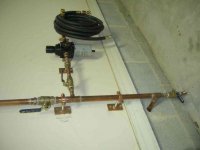
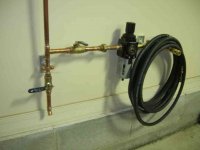
I plumbed with 3/4 type "L" copper and reduced at the overhead drop with a reducing "T" (3/4x3/4x1/2). All of them have a cutoff at the reducer/filter and a drip valve drain. the coupler itself comes straight out of the wall. I used silver solder on the copper joints per Quincy's manual.
Attachments

hetkind
Banned
My setup is 1/2 black iron pipe, and when I join two pieces, I used a T and instead of the coupler. At the middle of the T I have a 1/2" to 1/4" npt reducing bushing, with a MALE quick connect coupler. Very simple...Every pipe run runs downhill with a drain at the low point.
Don't forget the drip legs also.
Howard
Don't forget the drip legs also.
Howard
67 455 Bird ragtop
Well-known member
Why braze instead of regular solder?? I used that on my air system and it's not been a problem.
larry4406
Well-known member
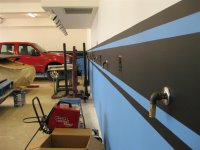
Here are pictures of mine. I ran my piping behind the walls using 1-inch mains. The main is continuously sloped to a single drain at the end of the line. All taps come off the top of the main. Using black pipe you can then get standard escutcheons for trim.
Attachments

Looks good Larry,
I am doing a very similar set up to yours with multiple outlets along the wall. I even have a strip painted on the wall. Heck, I even have the same hose reel as you do! But mine will not be hidden in the wall since the sheet rock is already up and there is spray foam in the wall.
I am doing a very similar set up to yours with multiple outlets along the wall. I even have a strip painted on the wall. Heck, I even have the same hose reel as you do! But mine will not be hidden in the wall since the sheet rock is already up and there is spray foam in the wall.
Here are pictures of mine. I ran my piping behind the walls using 1-inch mains. The main is continuously sloped to a single drain at the end of the line. All taps come off the top of the main. Using black pipe you can then get standard escutcheons for trim.
djjsr
Well-known member
I did this on each of my drops. I'm not a plumber and I don't know what these fittings are called but they're easy to find and come in different sizes. That brown block is just a 1/2" spacer and is not needed if you want your lines right up against the wall.
The fittings actually have 2 ears for mounting, you just can't see the other one.

The fittings actually have 2 ears for mounting, you just can't see the other one.

Torque1st
MEMBER EMERITUS
I am not sure, but from what I have found in several code listings they consider regular solder a fire hazard. Those same fire codes ban copper air lines maybe because the inspectors cannot tell what the lines were joined with?? I suppose if you had a smoldering fire it could generate enough heat to weaken the plumbing solder. The resulting rush of air would accelerate the fire dramatically. References like the Quincy site list Silver Solder or other high temp brazing methods for copper air lines. Black iron pipe is considered the required method by many codes.Why braze instead of regular solder?? I used that on my air system and it's not been a problem.
larry4406
Well-known member
I did this on each of my drops. I'm not a plumber and I don't know what these fittings are called but they're easy to find and come in different sizes. That brown block is just a 1/2" spacer and is not needed if you want your lines right up against the wall.
The fittings actually have 2 ears for mounting, you just can't see the other one.
They are called "drop ear 90's". They are what are used to attach the shower head and routing to the diverter (faucet).
I would not have the air connection pointing to the side or up. By mounting the connection chest height or lower and pointing down there is little chance of any of the compressed air or its contaminates blowing into your face and possiby eyes. Also pointing down allows you to use the connection as a drain point.
Never trust a quick connect fitting for sealing. Install a 1/4 turn valve and then the always-open quick connect fitting. The automatic shutoff fittings can leak and then you have no way to stop the leak. Rust and other contaminates can get into the fittings and block, a partial or complete blockage, the airflow thru these fittings also.
When possible use a non-corrosive material for the valves and fittings. Any carbon steel piece will rust overtime and give you problems.
Roger
Never trust a quick connect fitting for sealing. Install a 1/4 turn valve and then the always-open quick connect fitting. The automatic shutoff fittings can leak and then you have no way to stop the leak. Rust and other contaminates can get into the fittings and block, a partial or complete blockage, the airflow thru these fittings also.
When possible use a non-corrosive material for the valves and fittings. Any carbon steel piece will rust overtime and give you problems.
Roger
Keith_MN
Well-known member
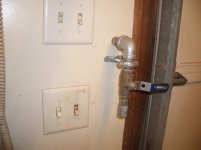
I attached two pictures of how I plumbed my outlets. The pictures show before and after the drywall installation.
I ran 3/4" copper pipe. The 90 degree fitting reduces it down to 1/2 inch for the valve, then I used a reducing bushing in the valve down to 3/8 inch for the coupler.
I installed a ball valve because it seems that the couplers always seem to leak, at least the ones I have do. Also, I like the coupler to be facing down to lessen the torque stresses on the coupler and pipe when the hose is connected.
I planned ahead before I installed the rock and put in a mounting block for the clamp to lessen the stress on the pipe in the wall should someone tug on the hose.
-Keith
I ran 3/4" copper pipe. The 90 degree fitting reduces it down to 1/2 inch for the valve, then I used a reducing bushing in the valve down to 3/8 inch for the coupler.
I installed a ball valve because it seems that the couplers always seem to leak, at least the ones I have do. Also, I like the coupler to be facing down to lessen the torque stresses on the coupler and pipe when the hose is connected.
I planned ahead before I installed the rock and put in a mounting block for the clamp to lessen the stress on the pipe in the wall should someone tug on the hose.
-Keith
Attachments

Vinko
Well-known member
That bottom valve is on the "drip leg" used to collect water. It typically will have a petcock or a small ball valve used to drain out the collected water.
Thanks. Maybe I'll put T's on my drops, and do a small ball valve at the end of a 6-"12" pipe. Or rather, use the existing T, and switch things around.
Here's what I've got right now:

67 455 Bird ragtop
Well-known member
I am not sure, but from what I have found in several code listings they consider regular solder a fire hazard. Those same fire codes ban copper air lines maybe because the inspectors cannot tell what the lines were joined with?? I suppose if you had a smoldering fire it could generate enough heat to weaken the plumbing solder. The resulting rush of air would accelerate the fire dramatically. References like the Quincy site list Silver Solder or other high temp brazing methods for copper air lines. Black iron pipe is considered the required method by many codes.
I guess that makes sense. Thanks.
Falcon67
Well-known member
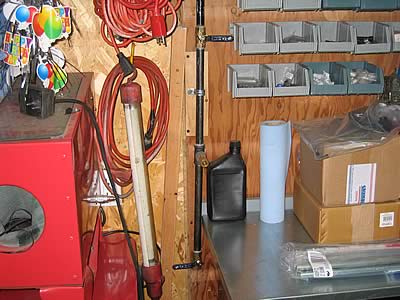
Here's how all mine look - 1/2 drop, shutoff, T to outlet, drip leg with valve. I put a shutoff on each drop because I usually leave something hooked up and about all the hoses, etc leak - some more than others. I actually shut the whole system off at the compressor when I leave.
bluesman2a
Well-known member
Here's mine:
3/4" all the way around up top, with 1/2" on the drops.
The sand-blasting cabinet has it's own dedicated 3/4" drop with filter bowl at the end of the hard line.
Each of the remaining drops is setup like this with a 45* elbow to a 3/8" reducer at the fitting itself. Using Milton M-Style fittings. 1/2" drip leg and ball valve below the fitting.

3/4" all the way around up top, with 1/2" on the drops.
The sand-blasting cabinet has it's own dedicated 3/4" drop with filter bowl at the end of the hard line.
Each of the remaining drops is setup like this with a 45* elbow to a 3/8" reducer at the fitting itself. Using Milton M-Style fittings. 1/2" drip leg and ball valve below the fitting.
Vinko
Well-known member
For those who use ball valve at the end of drop in a commercial or work setting, do you know what OSHA has to say about it? I'm curious, I think I'll try to read the regs. on that today.
tonydanzah
Well-known member
if you want to go cheap nonmetal route, use nylon air line that they use on semi air brake systems
Steve in Mi
Well-known member
I have 17 outlets in my shop that look like this with purging ball valves;

plus 2 3/4" ball valve outlets outside. Inside I plug in one of these if I need a regulator/filter.

plus 2 3/4" ball valve outlets outside. Inside I plug in one of these if I need a regulator/filter.
tonydanzah
Well-known member
what brand of regulator/filter are those
tcianci
Well-known member
They look like Norgren Filter/regulators.
As anyone knows you need sufficient line diameter to ensure delivery of large quantities of air without an excessive pressure drop. What puzzles me is why folks use 3/4 and 1 inch lines for normal shop equipment. The biggest air hog in the average shop is the blast cabinet or a production HVLP gun. Take a look at the size of the air passages in a HVLP gun, then check the specs of how many CFM it uses and then tell me why you need to feed it with a 3/4 or 1" line...
As anyone knows you need sufficient line diameter to ensure delivery of large quantities of air without an excessive pressure drop. What puzzles me is why folks use 3/4 and 1 inch lines for normal shop equipment. The biggest air hog in the average shop is the blast cabinet or a production HVLP gun. Take a look at the size of the air passages in a HVLP gun, then check the specs of how many CFM it uses and then tell me why you need to feed it with a 3/4 or 1" line...
wineslob
Well-known member
They look like Norgren Filter/regulators.
As anyone knows you need sufficient line diameter to ensure delivery of large quantities of air without an excessive pressure drop. What puzzles me is why folks use 3/4 and 1 inch lines for normal shop equipment. The biggest air hog in the average shop is the blast cabinet or a production HVLP gun. Take a look at the size of the air passages in a HVLP gun, then check the specs of how many CFM it uses and then tell me why you need to feed it with a 3/4 or 1" line...
What peeps need to do is have 1" or 3/4" mainlines and then 1/2" drops to the equipment. Remember, 1/2" black pipe can flow over 200 cfm @ 100 psi.
tcianci
Well-known member
See, that's what I'm asking... why would you need to install piping that can flow 200cfm when you would be hard pressed to find an air tool, blast cabinet or spray gun that would use more than 30 cfm?
See, that's what I'm asking... why would you need to install piping that can flow 200cfm when you would be hard pressed to find an air tool, blast cabinet or spray gun that would use more than 30 cfm?
I have been down this road before-- but the audience here is all about bigger and more power, practicality and realism aren't strong suits when size gets mentioned.
There are few tools for most any mechanical type work that will draw even 50CFM and I bet less than 1% here even own one. Blast cabinets excepted. Some Spray guns will have big numbers in the lit but you also have to couple that with the fact that you are talking 10-20psi not 120psi...learn the difference in SCFM and CFM and you will quickly realize that spray equipment uses very little air compared to most tools.
GeorgiaHybrid
Well-known member
Air flow in piping is dependent upon the length of the pipe, the diameter, the number of bends, humidity, air temperature and the internal friction loss. Your 200 cfm pipe might do that in a 1 foot length. Make that pipe 200 feet long however with the typical turns that our home shops have and you might be lucky to get 50-75 cfm. Add in the restrictions on the couplers (they don't have a straight shot thru them), a rubber hose and restrictive inlets on the tools themselves and you can begin to understand why some of us plumb our systems the way we do.
Vinko
Well-known member
I was thinking about what a few of you suggested about my having a drop leg or legs on my lines. Maybe I need to post more pics or make a diagram, because I got to thinking:
that even if I switched the T's on my lines so that there was a drop leg where the drop/filter/regulator/coupler/hose is now, and switched that assembly over to a capped off T - and even if I interspersed even a few drop legs here or there, I don't see why the moisture is going to necessarily collect in the drop leg.
What's to prevent it from just collecting in the path of the assembly at the T rather than at a drop leg. I don't think that gravity has anything to do with it; and it seems to me to be irrelevant if the moisture is in the air, because compressed air wouldn't discriminate, and lastly, even if when the moisture is condensed in the lines after, say, I turn off the compressor for 7 hours before turning it back on for 16-17 hours at a time, what's to prevent from not taking advantage of a drip leg?
I'm just trying to picture how this would work - - and I think if I could actually make a decent drawing of this thing in different views - - you all might see where I'm coming from.


that even if I switched the T's on my lines so that there was a drop leg where the drop/filter/regulator/coupler/hose is now, and switched that assembly over to a capped off T - and even if I interspersed even a few drop legs here or there, I don't see why the moisture is going to necessarily collect in the drop leg.
What's to prevent it from just collecting in the path of the assembly at the T rather than at a drop leg. I don't think that gravity has anything to do with it; and it seems to me to be irrelevant if the moisture is in the air, because compressed air wouldn't discriminate, and lastly, even if when the moisture is condensed in the lines after, say, I turn off the compressor for 7 hours before turning it back on for 16-17 hours at a time, what's to prevent from not taking advantage of a drip leg?
I'm just trying to picture how this would work - - and I think if I could actually make a decent drawing of this thing in different views - - you all might see where I'm coming from.
I plumbed with 3/4 type "L" copper and reduced at the overhead drop with a reducing "T" (3/4x3/4x1/2). All of them have a cutoff at the reducer/filter and a drip valve drain. the coupler itself comes straight out of the wall. I used silver solder on the copper joints per Quincy's manual.
How easy is silver solder to work with compared to plumbers solder?