To avoid these ads, REGISTER NOW!

Air outlets

GeorgiaHybrid

Well-known member
Joined
Sep 9, 2008
Messages
3,763
Location
Extreme NW Georgia
You can use a plumbing type torch, just make sure it is designed for use with MAPP gas and use that instead of a regular tank. If you have an oxy/fuel torch, it works a little quicker but costs just a TAD bit more...:)
 
To avoid these ads, REGISTER NOW!

MP&C

Well-known member
Joined
Oct 21, 2009
Messages
4,396
Location
Leonardtown, MD
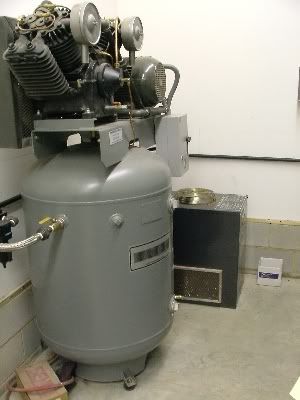
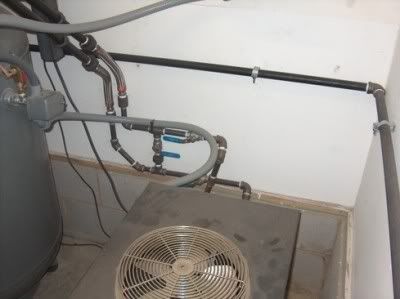
Starting at the air compressor, my system uses 3/4 black pipe around the perimeter of the shop, it slopes at 1" drop every 10' and has a timered drain at the end. All of the Outlets go up first, then out. This allows gravity to help in keeping water out of your tools (the outlets) and on the way to the end drain.

Picture185.jpg


Picture058.jpg


Picture060.jpg


The pneumatech dryer is used inline with the pump in that the original plumbing from the compressor head to the tank was removed. It now is plumbed from the compressor head to the dryer, then back into the tank. I did install a bypass with some SS ball valves in case I have issues with the dryer and need to remove it, I still will have air. The starter switch on the compressor had an extra set of contacts, so the dryer was wired in there so it comes on every time the compressor does.

Picture055.jpg
 
Last edited:

Vinko

Well-known member
Joined
Jul 7, 2008
Messages
5,829
Location
Los Angeles
I did install a bypass with some SS ball valves in case I have issues with the dryer and need to remove it, I still will have air.


I found your post helpful in thinking about a revamp of mine. Any problems with galvanized to SS or black pipe to SS that you know of? I've been meaning to ask this. I have galv. and was going to put SS ball valves. Sooner or later. Probably later:)

Edit: is the slope - a slope on the 3/4" main black piping? If so, is it a subtle slope? Can't tell if you actually shot a pic of the slope itself, or if you're just describing it. Thanks.
 

MP&C

Well-known member
Joined
Oct 21, 2009
Messages
4,396
Location
Leonardtown, MD
The only reason I used SS was I bought a qty lot of them on ebay, otherwise they likely would have been brass.

On the slope, I was just desribing it. It's hard to see the slope but if you compare it where it starts at the compressor and then again on the opposite wall, you can tell there is definitely a drop. I have about a 2' run on the bottom of my wall covering. Here where it starts, you can see the pipe is about 2/3 up on the span

Picture055.jpg


And here on the opposite wall it is just below dead center


Picture058.jpg
 
Last edited:

tcianci

Well-known member
Joined
Feb 7, 2009
Messages
4,242
Location
Walpole, Ma
Air flow in piping is dependent upon the length of the pipe, the diameter, the number of bends, humidity, air temperature and the internal friction loss. Your 200 cfm pipe might do that in a 1 foot length. Make that pipe 200 feet long however with the typical turns that our home shops have and you might be lucky to get 50-75 cfm. Add in the restrictions on the couplers (they don't have a straight shot thru them), a rubber hose and restrictive inlets on the tools themselves and you can begin to understand why some of us plumb our systems the way we do.

I think you have just answered my question...folks use huge pipes because they don't know any better. Your post gives the best example, stating that "you may be lucky to get 50-75 cfm." I would be interested to know of anyone on GJ who has either a compressor that will put out that much air or a device that will use that much air. Your comment about the restrictive properties of the couplers, and tools themselves is the best indication that the oversized distribution system is a waste of money. Also the tool manufacturers are well aware of the inlet size and the air consumption rates of their products. If you have a tool with a 1/4 NPT inlet, connecting to a 4" line will not help you to realize any more performance from the tool. As I said earlier, look at the air passages of a HVLP gun than can flow around 12-15 CFM...do you see anything an inch in diameter there? A half inch? how about maybe .030". Don't waste your money doing things over the top, there are plenty of other details and features you can install in your garage to make it a fun functional, place.
 

Torque1st

MEMBER EMERITUS
Joined
Sep 14, 2008
Messages
5,668
Location
KC Metro, Kansas
I think you have just answered my question...folks use huge pipes because they don't know any better. Your post gives the best example, stating that "you may be lucky to get 50-75 cfm." I would be interested to know of anyone on GJ who has either a compressor that will put out that much air or a device that will use that much air. Your comment about the restrictive properties of the couplers, and tools themselves is the best indication that the oversized distribution system is a waste of money. Also the tool manufacturers are well aware of the inlet size and the air consumption rates of their products. If you have a tool with a 1/4 NPT inlet, connecting to a 4" line will not help you to realize any more performance from the tool. As I said earlier, look at the air passages of a HVLP gun than can flow around 12-15 CFM...do you see anything an inch in diameter there? A half inch? how about maybe .030". Don't waste your money doing things over the top, there are plenty of other details and features you can install in your garage to make it a fun functional, place.

You may have misunderstood... The restrictions are additive, so that every restriction in the line, every bend, every foot of line, etc adds up. The aim is to keep the pressure drop to the tool at a minimum. For home shops you can probably live with 10PSI drop to the tool. That way if the tank pressure is at 100PSI you can still get 90PSI to the impact wrench. The size of the line does matter. For an example run a 1/4" OD copper or nylon line all around your shop and see how well it works... :spit:
 

GeorgiaHybrid

Well-known member
Joined
Sep 9, 2008
Messages
3,763
Location
Extreme NW Georgia
I think you have just answered my question...folks use huge pipes because they don't know any better. Your post gives the best example, stating that "you may be lucky to get 50-75 cfm." I would be interested to know of anyone on GJ who has either a compressor that will put out that much air or a device that will use that much air. Your comment about the restrictive properties of the couplers, and tools themselves is the best indication that the oversized distribution system is a waste of money. Also the tool manufacturers are well aware of the inlet size and the air consumption rates of their products. If you have a tool with a 1/4 NPT inlet, connecting to a 4" line will not help you to realize any more performance from the tool. As I said earlier, look at the air passages of a HVLP gun than can flow around 12-15 CFM...do you see anything an inch in diameter there? A half inch? how about maybe .030". Don't waste your money doing things over the top, there are plenty of other details and features you can install in your garage to make it a fun functional, place.

I tell you what, you do YOUR shop in 1/4" if you want to and you might even use 3/8 for your main line if some of your tools use a 3/8" NPT inlet. That is what makes the world a great place. You have the option to do what you wish regarding airline size in your garage. Myself? I feel comfortable about running 3/4" mainlines (to maximize airflow from the 3/4" outlet on the tank) and 1/2" airlines for my drops.

Why? Several reasons:

1) Because I can.

2) It maximizes performance of my air tools (try running a 3/4" or 1" drive impact on a 1/4 main line....).

3) I might have several people using air tools at the same time. With over 250 feet of piping, the pressure drops are not acceptable to me with smaller pipe.

4) I asked an ME friend of mine at the local compressor shop what he recommended given my requirements.
 

tcianci

Well-known member
Joined
Feb 7, 2009
Messages
4,242
Location
Walpole, Ma
Seems like I got someone a little hot under the collar :) My main intent was to get people to think... This whole site has a pervasive "bigger is better" attitude. That type of thinking flies in the face of what we are expected to do on so many different levels in our everyday lives. None of us would be to popular with our employers or our customers if we just threw the biggest most expensive equipment at every task that was assigned to us. When we are faced with making or designing something for the people that pay us, we need to be accurate, and have sound technical reasons for the solutions we implement. Not providing adequate reason, (other than the "because I can") for doing a task a certain way does not serve to help anyone who is truly interested in not only doing something for himself, but also to gain a working knowledge that can be applied to the next project. Do you run big air lines because they are warranted for your application or just because they need to be bigger than the other guys, or because you don't have a clue as to how to properly engineer your way out of a problem?
Please note that I mentioned the passages in a HVLP gun, that was to provide a "yardstick" for those who are truly unsure of how to calculate the size line required for their application. Often when hard data or the inability to do any hard and fast calculations for whatever reason, it is advantageous to look around us to similar situations and see how they were designed and glean from that the reasoning behind the design that can be applied to your own situation. That's how you bail your *** out of any technical problem when there is little to go on.
Any one of us can feel good about the things we do for different reasons, maybe it's "little man syndrome" and we just try to compensate for things by having the biggest, baddest stuff all around us, or maybe we can get satisfaction in a different form: knowing that we have designed or built something that is not only functional, but technically elegant and efficient. There was a guy who had a signature on here that stated something about a design being great not when there was nothing else to add, but when there was nothing else to take away.

Learn and implement, don't imitate.
 

GeorgiaHybrid

Well-known member
Joined
Sep 9, 2008
Messages
3,763
Location
Extreme NW Georgia
tcianci,

I'm not hot under the collar; just trying to point out that everyone’s situation is different. In my case I have a friend that will drop by with a dump truck, dozer, track loader or whatever else he is running that day to make a quick fix if he is nearby. Otherwise he would be making a trip to the other end of the county to get back to his shop.

He is one of the reasons I bought the new Miller mig and oxy/acet torch rig. FM knows that I have the 3/4 and 1" impacts, sockets and wrenches that his rigs require and he treats my shop with respect and cleans up before leaving. I also use DA sanders, die grinders, and other high CFM tools which is the reason I asked a mechanical engineer friend who is in the business for his insight and recommendations on my airlines.

That is why answers number 2, 3 and 4 above are noted as they are. One thing to remember, when Mark was asking questions about what I wanted to do, he reminded me that air is compressible and does not act like a hydraulic system where 100 psi on one end of a 100 foot long 1/4 pipe will cause 100 psi of pressure on the other end.

Airflow is subject to a lot of variables and sometimes things are done just "because". In my case, with the tools that I have, the length of airlines, pressure requirements, airflow requirements and the capacity of my Quincy pump, the system that I have is not considered "overkill" but is considered "adequate"

If all you are going to use is low CFM tools, then by all means, use a smaller pipe if you desire. If you think your future might require higher flow requirements, why not install the larger pipe on the initial install? The cost difference is minor and does not change the overall cost of the total system (compressor, wiring, airlines, regulators, filters, couplers, air hoses, etc.) by an appreciable amount.
 

Torque1st

MEMBER EMERITUS
Joined
Sep 14, 2008
Messages
5,668
Location
KC Metro, Kansas
This whole site has a pervasive "bigger is better" attitude.
I can certainly agree with that! :lol_hitti

It isn't just this site, it seems to be the problem everywhere.

-If 8.5:1 compression is good then 9.5:1 is better.
-If a 3.75:1 rear gear is good then a 4.11 is better.
-If one shock is good then two is better.
-If a 500CFM carb is good then a 750 is better.
-If a 24x30 shop is good then a 30x60 two story shop is better.
-If a 125PSI compressor is good then 175PSI is better.
-If 5" concrete is good then 6" is better.
-If a 5HP compressor is good then a 7HP is better.
-If a 3/4" mainline is good then a 1-1/2" is better.
-If 3500# concrete is good then 5000# is better.
-If 38DD are good the 40EE are better.
-If 16" tires are good then 20's are better.
-If #4 rebar is good then #6 is better.
-If you have HF tools then you need Craftsman.
-If you have HUSKY tools you need SK.
-If you need tools at all then you need Snap-On tools.

-Sometimes it is best to just stand back and evaluate what we are doing and what we actually need to do the job.:beer:

And NO, PVC is not what anyone needs for airlines...:lol_hitti

That one comparison in there is for Merk.
 

DannyG

Active member
Joined
Dec 30, 2005
Messages
39
Location
Colorado Springs
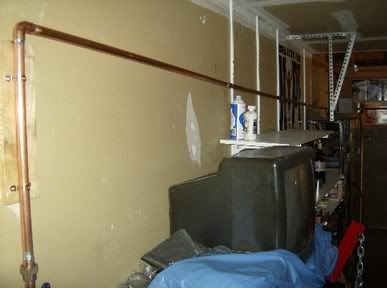
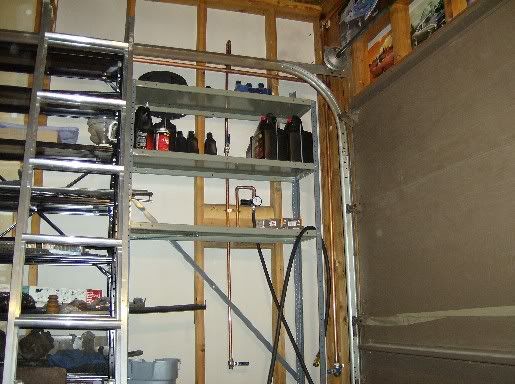
I have some pics from a few years back I'd like to share. My main intent is clean dry air for paint. Overkill on piping the drops, really wanted 1/2" piping, but I was on a low bugdet and wanted to use the extra pipes and fittings I had laying around. It was around $10 for 10 feet of 3/4 copper at the time. Still no leaks, but I turn every thing off and the shut off valve at the tank, heres a pic with a 3/4" ball valve and 1'' hydraulic hose I got at northern tool.
HPIM0097.jpg


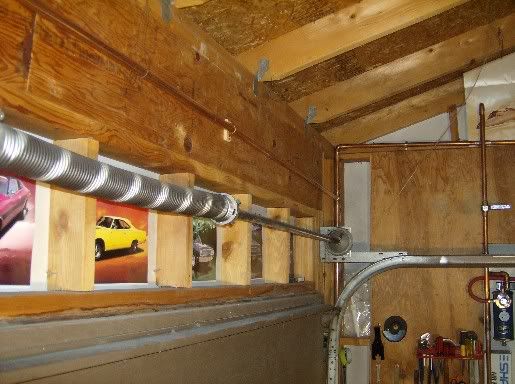
I have it slope away from the tank 5" every 25 ft. And shoot back up and then slope again to the other corner of the garage.
HPIM0090.jpg


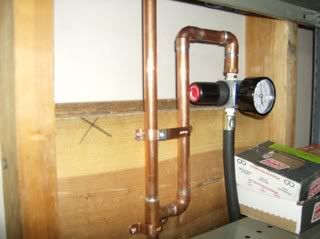
Heres the first drop, 20 ft away with 1/2". I made it after everything else was done and noticed I could use one there for engine stuff. Its no filter, just reg.
HPIM0083.jpg

HPIM0081.jpg

HPIM0086.jpg


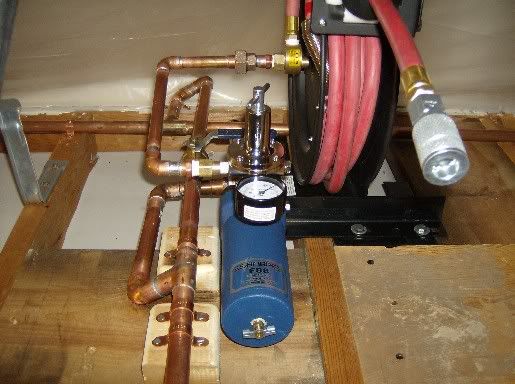
And heres the silly paint drop, would be alot more practical to use 1/2". But using what I had. 65 ft away with very little pressure drop, and 25 ft hose and Sharpe flter. Still works great and always use another filter at the gun.
HPIM0066.jpg
 

katit

Well-known member
Joined
May 5, 2006
Messages
862
Location
St. Louis, MO
What if I want to put my lines behind drywall? Did anybody do something like this? I can only think of routing pipe around perimeter on attic and then dropping otlets between studs.

How will I do moisture prevention?
 
To avoid these ads, REGISTER NOW!

Torque1st

MEMBER EMERITUS
Joined
Sep 14, 2008
Messages
5,668
Location
KC Metro, Kansas
Free air is air that moves. Convection currents are needed to carry off the heat from the lines. Dead air spaces are areas where there is little or no air movement. Check the websites that have air-line diagrams for more airline layout information. I think one is TP Tools and Oldsmobility. The links have been posted literally hundreds of times here and at other sites.

These terms are also listed in online dictionaries.
 

kwb

Well-known member
Joined
May 1, 2009
Messages
1,769
Location
PNW
The lines in my shop have never been warm even after running the 9" Mud Hog until there wasn't enough air to keep it running, letting it rebuild pressure and run it down again.

I will say it again - I think many of you are not working from practical experience, or are running oiless compressors with way too small of a tank for the demands that you put onto your system.

I once worked in a body shop that had a monster of a compressor probably on the order of 20-30 HP, no dryer/chiller and just a maze of 3/4" black iron pipe, the paint shop drops were first off the compressor and air there wasn't warm. The discharge pipe from the compressor was but once through the tank it had cooled to ambient. This compressor could come up to pressure if a hose popped the end off and was whipping around.
 

Torque1st

MEMBER EMERITUS
Joined
Sep 14, 2008
Messages
5,668
Location
KC Metro, Kansas
The lines in my shop have never been warm even after running the 9" Mud Hog until there wasn't enough air to keep it running, letting it rebuild pressure and run it down again.

I will say it again - I think many of you are not working from practical experience, or are running oiless compressors with way too small of a tank for the demands that you put onto your system.

I once worked in a body shop that had a monster of a compressor probably on the order of 20-30 HP, no dryer/chiller and just a maze of 3/4" black iron pipe, the paint shop drops were first off the compressor and air there wasn't warm. The discharge pipe from the compressor was but once through the tank it had cooled to ambient. This compressor could come up to pressure if a hose popped the end off and was whipping around.

Heresay and opinions are nice, -but... I am talking about accepted professional design standards in use in hundreds of thousands of installations for many years. If that is not enough practical experience I don't know what would be. Certainly it is better than anecdotal evidence from a handful of systems or less. The heat that is dissipated may only be the result of cooling a few degrees but it makes a difference in the dew point and hence moisture condensation, -simple physics. Air or gasses always cool when they expand, -again simple physics. The reservoir is the main cooling element in the system with its large surface area. The distribution lines are secondary but they are an important part and must be installed properly for optimum performance, moisture separation, and removal. Large industrial systems are designed by fluid power engineering professionals. They use many of the same principals as the home/small shop uses when they design those systems. Since a home/small shop does not usually have an engineer to design the system a "cut and paste", or "cookie cutter" method is used to provide a standard design for those systems. The standardized designs for home/small shops have been refined over the course of many years. Do not dismiss that experience out of hand because you do not understand the reasons for parts of it.
 

kwb

Well-known member
Joined
May 1, 2009
Messages
1,769
Location
PNW
Heresay and opinions are nice, -but... I am talking about accepted professional design standards in use in hundreds of thousands of installations for many years. If that is not enough practical experience I don't know what would be. Certainly it is better than anecdotal evidence from a handful of systems or less. The heat that is dissipated may only be the result of cooling a few degrees but it makes a difference in the dew point and hence moisture condensation, -simple physics. Air or gasses always cool when they expand, -again simple physics. The reservoir is the main cooling element in the system with its large surface area. The distribution lines are secondary but they are an important part and must be installed properly for optimum performance, moisture separation, and removal. Large industrial systems are designed by fluid power engineering professionals. They use many of the same principals as the home/small shop uses when they design those systems. Since a home/small shop does not usually have an engineer to design the system a "cut and paste", or "cookie cutter" method is used to provide a standard design for those systems. The standardized designs for home/small shops have been refined over the course of many years. Do not dismiss that experience out of hand because you do not understand the reasons for parts of it.

Blah Blah Blah--- I have both practical and theoretical knowledge on the subject. PE in Mechanical Engineering so I might have a clue on fluid systems.

Factory I work for has 2 300HP Compressors and has more piping than you could ever imagine I have troubleshot more air supply problems to tools than you might expect. I can tell you that 99% of guys on this board do not need to have the system that others tell them they need for what they are doing, the other 1% probably do need the system but they already know that and aren't asking the questions.

I am done with these threads... not everyone needs a looped 3/4 pipe system. Bigger isn't always needed and it just ends up costing more to install and change when time comes to move things around. A 5 or 7.5 HP compressor just can't move that much air and not many have the tools to demand it either. Anything bigger and you need to get your utility co involved with motor loads larger than 7.5HP (at least around here)
 

gumbudah

Well-known member
Joined
Jul 20, 2009
Messages
290
Location
Northern Wisconsin
I see many references to Type L copper, but in the research I've done, I don't see why for residential applications Type M wouldn't be just fine. According to copper.org at http://www.copper.org/applications/plumbing/techref/cth/tables/cth_table3c.html Type M copper (annealed) is good for 332 psi at 200f. This is about double what my compressor will run. That'd give me a safety factor of nearly 2:1. I'd think this would be fine, although I havn't checked any codes on the subject. This is also assuming two things, first the wall thickness of they type M listed here is equivalent to what I'd get at my local home store, and second that I do actually have annealed tubing. both are assumptions I havn't looked into.....

as far as the outlets, I'm using 1/2" drops with a 3/4" trunk going up to 80' to my compressor. I'm trying to put the header below the outlet so I don't need a drip leg on each, this presents it's own problems though as drilling through all those studs will be tuff.
If needed on some of my drops, I plan to run the discharge of the drip leg back into my pvc floor and sink drain system so no mess on the floor. I intend to do so using an air break though so I couldn't pressurize the dwv system.
 

red

Well-known member
Joined
Feb 20, 2009
Messages
719
Location
Hudson Valley, NY
Thanks for all the information Still toying with what I am going to do in my garage. As to oversizing and the Bigger is Better theory I always thought that it was cheaper and stronger to go to the next size higher than to pay an engineering fee. Also cheaper than redoing it. Then they came out with "Code-Plus" using the exact same principles. It does annoy me on how it is now acceptable to "attack" anything bigger except for the one thing that should be challenged. . .Big Gov't. Opps not getting political! Thanks again! -Ed
 

larry4406

Well-known member
Joined
Jan 27, 2006
Messages
18,966
Location
Northern Virginia
I would have to agree that in home shops/small garages (99.9999% of the forum users?), that excessive heating of the air lines from use is a bogus argument for prescribing that pipe be installed in free air. Exposed piping would need pretty good air-flow across it to provide any appreciable cooling effect.

I would wager that air lines are exposed for the simple fact that they are a retro-fit/after thought to an existing building. Many industrial buildings do not have finished walls (drywall) like our garages. Putting the lines up high probably keeps them out of the way of existing machines/materials etc. The vertical tap does make sense.

That said, I ran 1" inch black pipe mains, put then in my walls, ran them around the shop at about 2 to 3 feet above floor, main pitched 1/4 inch per foot in direction of flow, single end point drain (one valve at end, not a valve at every point of use), all taps are 1/2 or 3/4 inch and come vertically off the main into a riser and terminate out the wall (picture posted earlier). I have taps every 6 feet along the wall and 4 feet above floor. Mine is similar to that shown by MP&C in post 42. I used Rectorseal, and charged it to 120 psi for 2+ weeks before concealment and checked every joint and fitting with soap suds.

Produced a very clean look without stuff on the walls.
 

Steve in Mi

Well-known member
Joined
Mar 13, 2007
Messages
1,042
Location
Mid Michigan
As to oversizing and the Bigger is Better theory I always thought that it was cheaper and stronger to go to the next size higher than to pay an engineering fee. -Ed

Take care Ed, the bigger the size the lower the pressure rating all else remaining the same. (as can be seen in the engineering data tables of Copper.org given above) Checking with an engineer can be a GOOD thing at times.
 

red

Well-known member
Joined
Feb 20, 2009
Messages
719
Location
Hudson Valley, NY
Take care Ed, the bigger the size the lower the pressure rating all else remaining the same. (as can be seen in the engineering data tables of Copper.org given above) Checking with an engineer can be a GOOD thing at times.

Thanks! Makes sense for water but does that apply to air as well?
 

Steve in Mi

Well-known member
Joined
Mar 13, 2007
Messages
1,042
Location
Mid Michigan
Thanks! Makes sense for water but does that apply to air as well?

Those are properties for the copper tube (material properties) makes no difference how the pressure is applied, be it by air or water. Pounds per square inch (psi.)
 

WinFred

Well-known member
Joined
Dec 6, 2009
Messages
134
1" pipe...
1/2" outlets
3/8L fittings...
reducing T at the fitting so that each fitting has a 6" drip leg and petcock...
 

gumbudah

Well-known member
Joined
Jul 20, 2009
Messages
290
Location
Northern Wisconsin
Well, the only two things that are different in whether it is for water or air is the amount of stored energy and temp changes due to compression/expansion. Yes both can have the same pressure, the difference is how they blow something apart. In the pipeline industry we're concerned about toughness of pipe, which plays into the equation when you think of what will happen when a pipe does have a flaw in it. A pipe with low toughess will exhibit brittle fracture (as what happens when PVC fails, it explodes), meaning it will completely fail and the crack tip will continue to propogate. With tougher (more maleable, in this discussion an example would be copper)pipe, the crack will not propogate as easily, and the pipe will end up with a split in it but will have a better chance of not blowing apart. Back to the water/air question, the difference is when you have pressure from water on a pipe and create a hole in it, you will get out a relatively small amount of water in a short amount of time because water is incompressible. Whereas with air, you will get a higher volume of air to come out for a longer period of time. Sooo when a rupture does happen, ruptures from air are much more catastrophic than from liquid. The other differince I can think of is the concept of compression and expansion from a heat perspective. As others have pointed out, air will heat under compression, and cool under expansion, so these temps need to be in consideration when figuring materials. :beer:
 

WinFred

Well-known member
Joined
Dec 6, 2009
Messages
134
so be safer all the way around and use iron pipe....

PVC in a cold climate fails often...
 

red

Well-known member
Joined
Feb 20, 2009
Messages
719
Location
Hudson Valley, NY
Well, the only two things that are different in whether it is for water or air is the amount of stored energy and temp changes due to compression/expansion. Yes both can have the same pressure, the difference is how they blow something apart. In the pipeline industry we're concerned about toughness of pipe, which plays into the equation when you think of what will happen when a pipe does have a flaw in it. A pipe with low toughess will exhibit brittle fracture (as what happens when PVC fails, it explodes), meaning it will completely fail and the crack tip will continue to propogate. With tougher (more maleable, in this discussion an example would be copper)pipe, the crack will not propogate as easily, and the pipe will end up with a split in it but will have a better chance of not blowing apart. Back to the water/air question, the difference is when you have pressure from water on a pipe and create a hole in it, you will get out a relatively small amount of water in a short amount of time because water is incompressible. Whereas with air, you will get a higher volume of air to come out for a longer period of time. Sooo when a rupture does happen, ruptures from air are much more catastrophic than from liquid. The other differince I can think of is the concept of compression and expansion from a heat perspective. As others have pointed out, air will heat under compression, and cool under expansion, so these temps need to be in consideration when figuring materials. :beer:

Thanks now I understand why PVC is so deadly with air. Did not think that air pressure would drop in a larger size pipe because it is compressible where water is not. The larger size pipe would hold more air while maintaining the same pressure.

Also is there any negative effects to using galvanized pipe? Know it is a no-no for natural gas but would it help to keep rust and debris to a min?
 

WinFred

Well-known member
Joined
Dec 6, 2009
Messages
134
Also is there any negative effects to using galvanized pipe? Know it is a no-no for natural gas but would it help to keep rust and debris to a min?


galv is used all the time for air.. use drip legs and drain ***** often an you'll be good to go...
 

Torque1st

MEMBER EMERITUS
Joined
Sep 14, 2008
Messages
5,668
Location
KC Metro, Kansas
... Also is there any negative effects to using galvanized pipe? Know it is a no-no for natural gas but would it help to keep rust and debris to a min?

The codes usually specify black pipe for gasses. However we often use copper and galvanized pipe for compressed air also. The only negative I have heard of when galvanized pipe is used pertains to flakes of zinc breaking off and entering the air stream. High quality pipe would probably help prevent that problem. Once the pipe is installed and flushed with air and a little solvent to remove any metal or zinc chips I would not have any problem using it. Black pipe is also subject to metal chips from machining operations and rust flakes. The zinc galvanizing will protect the pipe from accumulating rust deposits. Copper pipe can have small particles of flux and brazing material break off over time also. A coalescing filter used at any point sensitive to particulates or water would be a good idea no matter what type of pipe is used.
 
To avoid these ads, REGISTER NOW!
Top Bottom