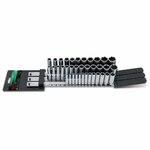
These are an old style if French box wrenches.
As RTM mentioned, the French term is “Cles-A-Pipes”.
The design goes back almost 100 years, maybe longer.
Facom made the style forever, and the Facom wrenches used to be somewhat readily available in the USA.
After Stanley purchased Facom, the Facom wrenches were still sold in the USA under the Proto brand, maybe still with the Facom markings.
Facom made both metric and fractional sizes.
Craftsman also sold the Facom made wrenches under the Craftsman brand for a while when Sears was selling SK and Facom tools (this was back before Stanley bought Facom, when Facom was French owned, and owned SK Tools, and when SK was making some of the Craftsman tools).
The Facom series 75 wrenches were 6 point wrenches on both ends.
The Facom 76 series wrenches were 6 point on the long end and 12 point on the short bent end.
Most French tool manufacturers offered this style of wrench, although quality could vary.
SAM Outillage is likely the other higher quality manufacturer of these wrenches in France, since SAM and Facom used to supply the French military.
https://www.sam-outillage.fr/outillage-cles-a-pipe-92.htm
I think SAM may just make metric versions.
MOB Outillage s another French tool manufacturer, thatvoffers these, but their wrenches were likely made in Eastern Europe by another tool manufacturer they purchased, but I forget the name.
Clés à pipe débouchées professionnelles

moboutillage.com
Beta and USAG (formerly part of Facom and now part of Stanley) also produce these wrenches.
Some Asian tool brands such as Toptul also produce the design now.
The neat thing about the design is how the wrenches are likely made.
They look like they’re formed as a long double ended “socket”, with the wrench sockets formed on both end similarly rather than machine broached with a cutting tool like most wrenches.
The round body may be turned round to smooth it.
One of the socket ends is then notched on the side thru to the internal socket void, and that end then bent at an angle.
The round body of the wrench makes the wrenches less likely to dig into your hand on a tight bolt.
The major drawback is that the wrenches may be heavier than a similar length of forged wrench.
If you need to turn a bolt in a deep recess, the long end can be used to reach the bolt head, and then a screwdriver or bar placed thru the short end for leverage.
McMaster-Carr used to even carry these years ago.