To avoid these ads, REGISTER NOW!

Alternate or upscale tire plugs?

vavet

Well-known member
Joined
Mar 6, 2012
Messages
5,330
Location
Ashland, VA
I’ve used the string type tire plugs, but I don’t love them. My wife’s fairly new car (almost 1 year old) recently had a punctured tire that I could’ve easily plugged, but I dropped it off at a local shop to have them plug-patch it because I feel that’s a superior repair.
Project Farm on YouTube put out this video recently
I liked the look of the grand pit stop kit because it’s almost like a plug-patch, but it does not require the tire to be removed, but the performance wasn’t great.
The Western weld and the dynaplug don’t seem that much different than a typical string type plug, maybe just better materials or adhesives.
the convenience of having something in my garage to Repair punctures would be nice.
thoughts?
 
To avoid these ads, REGISTER NOW!

Tools4Me

Well-known member
Joined
Jun 22, 2021
Messages
546
The only ones I trust for a permanent repair are the type where you remove the tire from the wheel, scuff up and clean the inside of the tire, install an oval shaped patch with the required patch cement, and then reinstall the tire on the wheel. I consider the string type plugs to be temporary repairs, designed to get me home or to last until I can get a replacement tire if the tire was about at the end of its' life anyways. That being said, the string type plugs have worked okay for me in the past, but the installation t-handles do seem very fragile on the cheaper sets. I might be missing something new and amazing though, because I haven't used any patch kits in the last couple years. My last two tire punctures were in the tire sidewall and the tire didn't go flat until I was already at home. The tires were taken to my local tire shop and replaced instead of repaired.

There was one type of plug I saw a couple years ago that interested me. It was a rubber umbrella type design that you pushed through the hole and the umbrella would open up. When you pulled back out on the installation tool it would seal the rubber umbrella against the inside of the tire. I don't know how well one of those would work though, because you aren't able to scuff up and clean the inside of the tire before trying to get a good plug seal like you would with a normal internal patch.
 

BolognaBlake

Well-known member
Joined
Apr 30, 2016
Messages
196
I'm a fan of Xtra Seal separate plug and patch kits. I follow TIA guidelines, so if they have a push plug, they're junk.
 

Neggy

Well-known member
Joined
May 30, 2021
Messages
754
Plugs are for getting you back on the road, if you had a plug kit and a compressor you could probably make it to your destination....

To do it RIGHT.... patch it from the inside
 

Alienbaby17

Well-known member
Joined
Jan 27, 2014
Messages
338
Location
Minnesota
While I agree that applying a patch from the inside is the “best” repair I’ve probably installed 100’s of plugs without any problems.

I don’t think we use anything special as far as plugs go.

I do always light the plug on fire after it’s installed and burn the ends down. The rest of the guys in the shop think Im crazy but it’s the way an old-timer showed me when I first started and I’ve always done it too.
 

rlitman

Well-known member
Joined
Oct 18, 2010
Messages
24,651
Location
Long Island
The only ones I trust for a permanent repair are the type where you remove the tire from the wheel, scuff up and clean the inside of the tire, install an oval shaped patch with the required patch cement, and then reinstall the tire on the wheel...
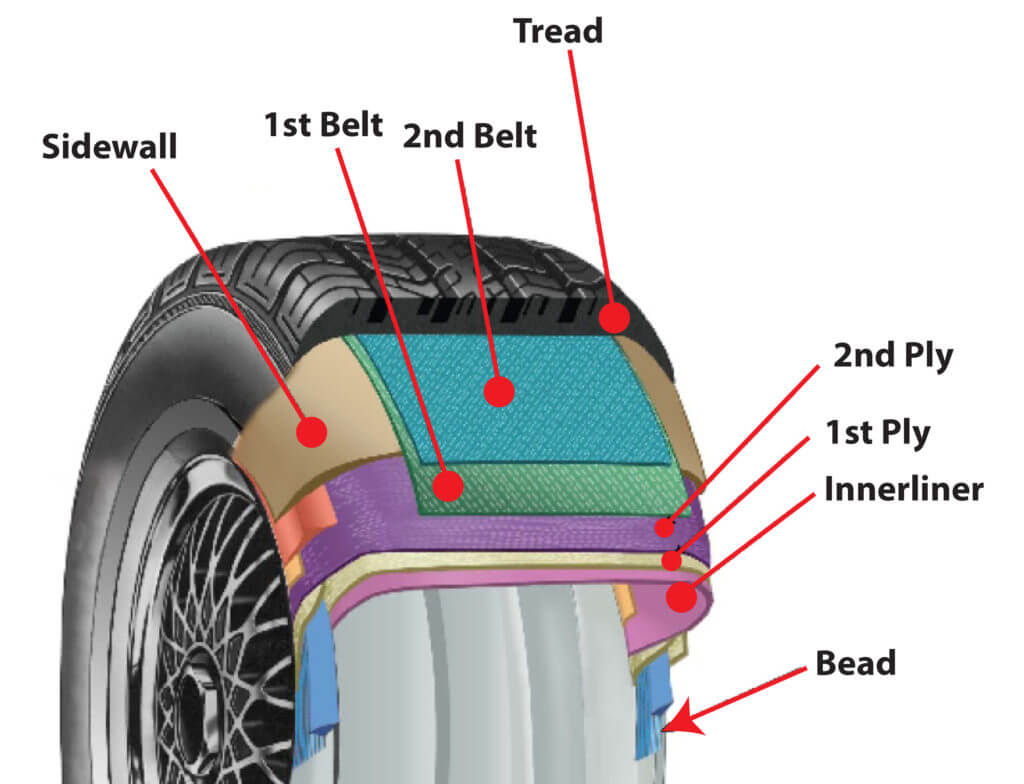
I'll strongly disagree with these. Internal patches allow water to be forced into the exterior hole, which can cause rusting of the steel belts leading to catastrophic failure. That's why tire manufacturers only certify plug patches that also fill the hole. At least with a plug, you know that the interior seal is at least as good as the exterior.

I've done a lot of plugs, and have yet to see one fall out or leak. My guess is that plug failures come from people trying to plug a hole that's too large, too close to the sidewall, or perhaps from not properly preparing the hole for plugging (cleaning).
 

Tools4Me

Well-known member
Joined
Jun 22, 2021
Messages
546
I'll strongly disagree with these. Internal patches allow water to be forced into the exterior hole, which can cause rusting of the steel belts leading to catastrophic failure. That's why tire manufacturers only certify plug patches that also fill the hole. At least with a plug, you know that the interior seal is at least as good as the exterior.

I've done a lot of plugs, and have yet to see one fall out or leak. My guess is that plug failures come from people trying to plug a hole that's too large, too close to the sidewall, or perhaps from not properly preparing the hole for plugging (cleaning).
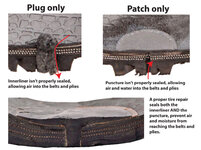
I had never heard this before, but it makes sense and I'm always looking for better quality solutions, so I looked into it a bit more. Intuitively, I like the thought of a plug patch combination repair even more than just a patch, because it's a more complete repair, so I will start doing that in the future. A plug by itself is also not approved or recommended, because a plug can allow air from inside the tire to migrate into the internal belts and plies causing early tire failure.


Attachments

  • patch-plug-both-1024x767.jpg
    patch-plug-both-1024x767.jpg
    143.5 KB · Views: 146

rcbk00

Well-known member
Joined
Sep 10, 2018
Messages
107
Location
NJ
I use the plugs Wal-Mart sells. Never had a problem with one. I also use rubber cement when I install them (Wal-Mart sells that too). To each their own I guess.
 

RedneckWelder

Well-known member
Joined
Nov 12, 2013
Messages
5,705
Location
The Ghetto Kingdom of Methlandia
I've used Safety Seal plugs for years. I had one develop a slow leak. I pulled it out and put another in and it held up until I got new tires. I use the Safety Seal lubricant.

I keep a Safety seal kit in my truck rated for big rig and tractor tires (got a good price on it through work) and it works just fine on regular tires. The real stars of this kit are the tools. All metal, beefy, high quality.

I have never had an issue with the standard gummy string type plug, even one installed early in the tires life. I’m not dismounting a tire when these work more than fine.
 

carmantl

Well-known member
Joined
Dec 19, 2015
Messages
237
If you need to plug a tire on heavy equipment check out the Nealey kit. Super long plugs and insertion tool to get through 12 ply road grader and skytrak tires. I work in heavy construction and they work well. Plus a lot cheaper than a $400.00 Fleet tire on jobsite repair. Guess what Fleet uses? The Nealey if it's a small hole.
 

LA1

Well-known member
Joined
Oct 9, 2012
Messages
62
Location
EAST COASTER
i have been pluging my tires since the 80s used the camel repair kits the ones w/ the little tube of cement and the stepped plugs. tried the gooey string ones did not seem as good. I bought a HF manual tire changer about 5 years ago. can change a tire in 10-15 minutes as long as the bead breaking goes well. in fact tonight i had to replace a tire valve. i noticed that the tire was low, when i unscrewed the top the whole metal top of the valve shot off...was glad that did not happen on the freeway. just broke the beed on both sides pushed the tire down cut the end off on the inside of the rim on the outside pulled the stem through. I took a new T413 valve stem inserted it through then screwed my valave stem tool on and poped the stem in place, filled with air.

so now that i can take my tires off i found these tire patches , its a patch with a stem. first you mark then remove the nail, then on the inside you scuff up around the puncture, put rubber cement ( bought a 6 oz can) on the area. push the stem through ftom inside the tire. then on the outside grab the stem protrussion with plyers and pull till the patch flattens. then you take something called a stitching tool, really need this, its a roller that has knurling and a wooden handle. and keep running back and forth over the patch till it becomes one with the tire. cut off the stem sticking out of the tred and the tire is ready. The manufacturers of the patch have more clinical instructions...more tools.. more chemicals which is more $$$ the way i described works just fine.
 

beemerphile

Well-known member
Joined
Jul 9, 2021
Messages
727
Location
Danielsville, GA USA
I've carried and used them all. I've had punctures that a Stop-n-go couldn't seal and
I don't carry one anymore. I've never had a puncture that one or more gummy worms couldn't seal. My favorite gummy worms are from The Nealey Company. I got a wide shale cut in my rear tire on the Dempster Highway in Canada and I made it out with six Nealey gummy worms crammed into a wide slash. I had to stop twice to air it up again. On the Dempster a tow truck is tomorrow and $1,000.

DSC00208-M.jpg

DSC00190-M.jpg
 

ike

Well-known member
Joined
Apr 9, 2009
Messages
332
i've always been of the opinion that people who say string plugs are a temporary fix either work at a tire shop or heard that from someone that worked at a tire shop. i started plugging tires before i could drive, and i've used well into the hundreds of string plugs with the worst result being a very, very slow leak around (if i recall correctly) two of them. i've had more string plugs than i can count last the life of a tire with no issue. i never find the hammer that falls off the back of a truck, but i always find the nails, and my wife finds the box with the rest of the nails.
 
To avoid these ads, REGISTER NOW!

bwringer

Well-known member
Joined
Jan 1, 2013
Messages
10,318
Location
Indianapolis
If you need to plug a tire on heavy equipment check out the Nealey kit. Super long plugs and insertion tool to get through 12 ply road grader and skytrak tires. I work in heavy construction and they work well. Plus a lot cheaper than a $400.00 Fleet tire on jobsite repair. Guess what Fleet uses? The Nealey if it's a small hole.

And Nealey's "mini" kit is the cat's patoot for tubeless car and motorcycle tires.

I have a kit in or on each of my vehicles.

They don't need any extra lube, and they're installed in a different way that ties a knot inside the tire, and leaves four thicknesses of the string in the hole.

Seriously next level stuff.

 
Last edited:

xjfish

Well-known member
Joined
Feb 22, 2014
Messages
1,296
I've had extremely good luck with quality tire plugs. (not Walmart specials) Quick, easy, done. Patch plugs are typically the best, i've installed many. I used to get aggressive with tire repairs/prep and had never had a comeback. Keep an eye on PSI. Plugs near the sidewall are more prone to FAIL...
 

seber

Well-known member
Joined
May 31, 2016
Messages
4,205
Location
Deep East Tx.
I've used the string plugs successfully many times. but when I tried them on my dually, they popped right back out. They really don't like 80 psi. Since then I've used the same thing I use on my motorcycle. It is a combination string and glue patch from the inside. Super easy to install and extremely reliable. I've even used them on the sidewall at 80 psi with no problem.
 
Last edited:

fsae0607

Well-known member
Joined
Aug 15, 2011
Messages
2,290
Location
San Fernando Valley, CA
i've always been of the opinion that people who say string plugs are a temporary fix either work at a tire shop or heard that from someone that worked at a tire shop. i started plugging tires before i could drive, and i've used well into the hundreds of string plugs with the worst result being a very, very slow leak around (if i recall correctly) two of them. i've had more string plugs than i can count last the life of a tire with no issue. i never find the hammer that falls off the back of a truck, but i always find the nails, and my wife finds the box with the rest of the nails.
IMO it's said that they're a temporary fix for liability reasons. There's plenty of empirical data out there that shows that they're a permanent fix.
 

FMB4

Well-known member
Joined
Jan 19, 2017
Messages
2,926
Internal patches are old school and have never been very reliable as per my nearly 40 years of experience. Internal patches are a very thin 'patch' that covers a very much thicker tire tread cross-section. Such differences in patch thickness and tread cross-section thickness will result in very different expansion rates between the two due to heat buildup. Plugs fill tire tread cross-sections and then some. Internal patches date back to inner tube patches (where the patch cross-section thickness was more or less equal to the thickness of the tube.
 

65ranchero

Well-known member
Joined
Dec 16, 2020
Messages
5,087
Location
Danville, VT left NJ forever
Tire patches are only as good the prep. If the area is prepped properly and the tire is in a relaxed state (meaning its sitting in a normal state not being in the tire spreader) It's an art to patch a tire.
With that said I have been using the rope plugs for over 50 years both on personal and customer cars with good results.
Matter of fact I just refilled my repair stash with Slime plugs
 

sparky 1971

Well-known member
Joined
Oct 9, 2018
Messages
7,996
Location
Central Iowa
I use the Slime plugs sold at Wal-Mart on my service truck. There are probably six plugs total in the four tires right now going back over two years. No leaks...yet. The "good" vehicles get patched at the tire shop unless the tires are getting close to needing replaced, then I break out the plug kit.
 

dscheidt

Well-known member
Joined
Apr 26, 2017
Messages
2,909
IMO it's said that they're a temporary fix for liability reasons. There's plenty of empirical data out there that shows that they're a permanent fix.
having repaired a few thousand tires, (and condemned a bunch as unrepairable), the really big problem with reairing a tire with a plug is you don't get to inspect the inside of the tire. I have seen lots of tires with what should have been very repairable injuries, that a plug would have worked for, but which had been driven flat or low long enough that the inner liner was coming apart from the heat. That's a blow out waiting to happen, and the way to find it is to dismount the tire.
 

dimichele

Well-known member
Joined
Jan 21, 2008
Messages
101
I use the string plugs as a permanant fix. I've had 1 develop a slow leak out of a couple dozen repairs.
 

Milton Shaw

Well-known member
Joined
Feb 11, 2011
Messages
4,845
Dscheidt is right you have to inspect the inside of a tire to see if you can repair it. I remember years ago getting cussed out about a Firestone tire he'd had repaired 5 times elsewhere that was still leaking. We finally got him to let us inspect the tire. Five plugs in 5 new holes in the tire with a 16 penny headless nail still in the middle of the holes. Must take off the rim and inspect.
 

qqzj

Well-known member
Joined
Nov 28, 2017
Messages
3,747
In an ideal world, of course the best thing to do is

1 take it off and inspect
2 use a string plug to plug the hole in the tread and structure
3 use a patch to seal the inside

I guess the point here is that for people who are diligent about their tires, using the string type is good enough most of the time.
 

AA/FC

Well-known member
Joined
Dec 9, 2010
Messages
2,080
I don't know.... Decades ago tire plugs were considered a permanent repair. When I was a kid in high school working at a busy gas station along a busy state highway (back when gas stations had mechanics, tow trucks and service bays) I personally installed hundreds if not thousands of tire plugs and I do not recall ever having a customer return with a leaky plug. Not once! Then, somewhere in the past 30 years or so the tire industry changed their opinion on plugs (they like to sell tires) and they now tell everyone who works in the auto repair business that "plugs are bad". In my opinion the people who claim plugs are bad today are only repeating what they've been told by various "authorities" in the tire or automotive repair industry. Anyone who has ever ACTUALLY installed dozens or hundreds of plugs know the truth.

As for the interior patch. They're fine. They hold air. But I would NEVER claim they are BETTER than a plug. That little microscopic thin layer of rubber glued to the inside of the tire DOES NOT restore any structural integrity back into the tire after it's been punctured.... and neither does a plug. The hole in the tire will always be there once it's punctured.

I get the part about inspecting the inside of the tire.... but you can usually tell by the size of the puncture if the tire need to be dismounted and inspected. And 9 times out of 10, the nail or screw is still in the tire and needs to be pulled out before plugging anyway. In that case, you know there is no interior damage from pieces rolling around inside.

In the past I have helped many customers change their flat tires on-scene. There have been a few times that I asked the customer... "Would you rather drive on your space saver spare tire, or have me plug your normal tire and fill it back up with air"? One guy had just landed at the airport at midnight on a Sunday after being gone for a week only to find a flat tire on his car. He still had about 350 miles to drive that night before he was finally home. No tire repair shops open anywhere at midnight on Sunday..... guess which option he chose???

Plugs are just fine.

I've always used Safety Seal. IMO they are the industry standard.
 

rlitman

Well-known member
Joined
Oct 18, 2010
Messages
24,651
Location
Long Island
Dscheidt is right you have to inspect the inside of a tire to see if you can repair it. I remember years ago getting cussed out about a Firestone tire he'd had repaired 5 times elsewhere that was still leaking. We finally got him to let us inspect the tire. Five plugs in 5 new holes in the tire with a 16 penny headless nail still in the middle of the holes. Must take off the rim and inspect.
So some incompetent guy put in plugs without first removing the nail? I suppose one day I'll run into a tire where the object that did the damage isn't obvious, but in the hundred or so plugs I've done, it hasn't come up, yet. If that eventually happens, I'll bother dismounting the tire. When I see a nail or screw, I'll just pull it out, clean the hole and plug it.

The closest I've come to this scenario was what appeared to be a staple from a T50. Flat, thin and sharp, and it leaked so slowly that I had to significantly overfill the tire to get it to bubble at all. But I did eventually find and pull the metal.

OTOH, when I couldn't find the source of a leak on a friend's tire, I started searching for a bead leak, and found a crack in the rim.
 

welder4956

Well-known member
Joined
Apr 8, 2010
Messages
3,074
Location
Birmingham, AL USA
When I see a nail or screw, I'll just pull it out, clean the hole and plug it.
Same here. I've installed dozens of the string plugs in radial and bias ply tires over the last 45 years and never had one leak or fail before the tires eventually wore out naturally. I keep a tire plug kit and portable air compressor in every vehicle I own and it has helped me numerous times. I think the typical recommendation to remove the tire and patch or replace the tire comes from folks that are worried about being held liable for a tire failure.
 

Gunfixr

Well-known member
Joined
Feb 9, 2021
Messages
677
Location
behind the house
Well, this might be considered "old school", but it worked, period. Back in the day, I had a 4x4 i'd built, first on 38s, later 44s, which I off-roaded extensively. So, tire repairs were a regular thing.
I bought the "heavy duty" tire kit, which was nicer t-handle tools with the same **** string plugs. Tossed the string plugs in the trash. Napa sells rubber vulcanizing cement, bought that. Went to a local rubber, bearing industrial supply, and purchased a scrap of sheet rubber roughly 1/16" thick, it was prob 6"-8" wide, a little over a foot long. So, maybe $20 in it all.
When I had a puncture, I cut a strip of rubber based on what I pulled out of the hole, eyeballing it, whether nail, screw, bolt, etc. Used the reamer to clean the hole, liberally applied the cement to the rubber, forced it in. Trimmed to not hang out past the tread.
This did not ever leak, or fail, and I have done it at 1am in the woods.
I paid a shop for my first repair, and mimicked what they did, for much less.
 

Jlarson

Well-known member
Joined
Mar 27, 2015
Messages
738
Location
AZ
We run safety seal truck and also heavy equipment plugs. We'll plug off highway and ag equipment and our own service truck tires but customer on highway equipment gets patched by our tire guys if it's viable. We actually have our trucks patched when time allows too, it's real nice to know what's going on inside the tire.
 

CHRIII

Well-known member
Joined
Jun 12, 2020
Messages
234
Location
NE TN
but i always find the nails, and my wife finds the box with the rest of the nail
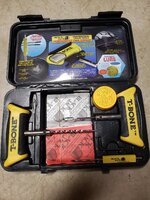
When we lived in Maryland we had the same experiences. In the 13 years we lived there I may have picked up 1 or 2 nails/screws while my wife found the rest. I had my shop repair the first couple, then bought a cheap kit (HF?) and tried myself. The T handle on the plug tool broke! I finally got the plug in, after quoting from The Book of Threats. Then next day I went to my shop and told them I what happened and that I wanted a 'good' repair kit. They told me it was expensive and at that point I didn't care and told them to order it. It cost $105 (in Jan 2016) and apparently it has magical properties as I've not had to use it (I've probably just jinxed myself).20210926_220223.jpg20210926_220331.jpg
 

bwringer

Well-known member
Joined
Jan 1, 2013
Messages
10,318
Location
Indianapolis
A data point for all's y'alls.

I'm a BIG fan of Nealey's tire plugs; they are installed differently, so that you end up with a knot inside the tire and four thicknesses of the sticky string in the hole. They're a little thinner than the usual, and they don't require added glue or lubricants (which inevitably dry up). There's a Nealy Mini Kit in every vehicle.

I changed the rear tire on one of my motorcycles today, and it was still wearing a Nealey plug from nail hole a couple thousand miles ago.

I pulled the plug out from the inside using pliers, and it took a LOT of force and three or four tries. It was STUCK in there.

Close up of the inside of the tire showing the knot.
nealeytireplugknot.jpg

Wider view; this tire is a 180/55-17.
nealeytireplugknot2.jpg
 
To avoid these ads, REGISTER NOW!
Top Bottom