To avoid these ads, REGISTER NOW!

Amateur structural engineers wanted

Innovate1

Well-known member
Joined
Jul 28, 2014
Messages
4,283
Location
Illinois near St. Louis, Missouri
It's just blocking, because the 16' span is on the long side for 2x10s, so those long joists will need to be I-beams.

I could make that blocking into a real beam, and that would reduce the span, but then I'd have to move it back toward the house to tie it into the bay window, and it wouldn't be in the middle anymore, but it would work, and would allow regular 2x10s.
Not necessarily. Reduce the blocking by one span. Then make the blocking a beam and the joist at the end also a beam. Then you should be able to have the other joists not beams. I would be very concerned about sheer loads unless this is tied to other structure.

I would support the roof with separate beams under the roof. Supporting both the roof and the floor together can be done but I like the idea of separating the loads.

I live outside St. Louis and all I need for residential construction on my own property is a site plan, floor plan, and 1 wall cross section and they don't need to be stamped. I submitted the 3 as 8.5 by 11 sheets for my 30 x 40 detached garage and had no issues. I lived in a more rural area in Indiana that didn't even need that. But St. Louis city and county is the other extreme.

As for PE (it's an additional exam separate from engineering degree), I'm electrical engineer and many jobs don't require a PE and it isn't really even considered a plus. It's much more common in civil and mechanical engineering. As others have noted a person can be a professional engineer such as myself without having a PE.
 
To avoid these ads, REGISTER NOW!

Innovate1

Well-known member
Joined
Jul 28, 2014
Messages
4,283
Location
Illinois near St. Louis, Missouri
Depends on what chain you are climbing and how high you want to go. If Civil Engineering and you are submitting plans (site, road, utility, house over 3000 sf, etc.) to government entities, someone will have to seal the plans.
Not necessarily. Non-comercial in many areas doesn't require engineering stamps. Especially if it's being done by the land owner.
 

larry4406

Well-known member
Joined
Jan 27, 2006
Messages
19,073
Location
Northern Virginia
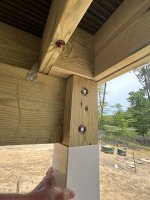
Here is an example of a deck with roof from the day job. Maybe this will give the OP some ideas. These are pics from different units.
  • Ledger at house
  • 2x10 joists
  • Dropped 2 or 3-ply 2x10 beam to support deck (these vary amongst our house types)
  • 6x6 PT posts on concrete sonnotubes
  • Solid blocking within the deck to support the roof 6x6 posts (not continuous posts from pier).
  • Underneath the deck is diagonal bracing on the joists so they can't rack within plane of deck. If this were solid subfloor, then the sheeting would provide this same function.
  • This deck example is 12' deep and 21' wide
  • Work in progress photo
1764965016059.jpeg
1764965537937.jpeg
1764965974103.jpeg
 

larry4406

Well-known member
Joined
Jan 27, 2006
Messages
19,073
Location
Northern Virginia
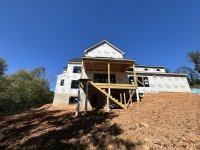
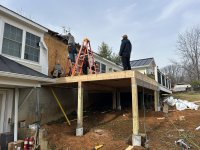
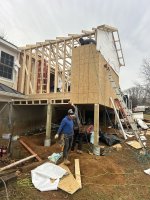
We are currently building a master bath addition on our walkout home. Similar to what I think the OP is trying to do. It is 15' deep and 13' wide with 8' walls.

The joist framing is let into the house setting on the existing sill, new joists sister the existing joists. This was needed for HVAC and plumbing waste to run in the bays.

We have an intermediate beam and an end beam on the new floor system. Posts from the beams go downwards to the sonotube pier footings. Continuously sheathed framing of the bathroom with a portal frame detail on the end gable wall. We used a standard portal frame using a 3-ply 1.5x11.25" continuous header with king studs on the ends and minimum 16" wide portal frame detail on the ends (ours is 19" from corner to window edge). Portal framing requires certain nailing pattern and straps.

We framed the first deck with beams first, marked the post centers, then installed the pier footings using a plumb bob to ensure they were dead nuts on. We left the sheathing off to keep weight low while was on temporary posts. Framing and permanent posts resumed after 7 day cure.

Joists are 2x10's to match the house. Intermediate beam was spec'd as 3-ply 1.75x9.25" LVL (large soaking tub in bath room). End beam was spec'd as 2-ply 1.75"x9.25" LVL (I upped it to 3-ply to better fit the Simpson BC6 post connector).

Hopefully this give the OP some ideas.
1764966285701.jpeg
1764966317606.jpeg
1764966370545.jpeg
1764966413205.jpeg
1764966493575.png
1764966551002.jpeg
 
Last edited:
OP
J

JackOfDiamonds

Well-known member
Joined
Jul 31, 2020
Messages
706
Location
Idaho (USA)
If I missed this I apologize but is new room a bedroom or more like a living room? Per code that's either 30 PSF or 40 PSF.

And do you intend the vertical 6x6s to be continuous to top plate? Insulation weakness but probably solves lateral bracing.
I intended to run at least the corner 6x6 posts all the way to the second story sill plate for overkill purposes, and drywall the interior corners with a small fillet if necessary to hide the posts. If I make 2x6, 24" stud spacing walls, it will help hide the 6x6 in the corners and also improve insulation overall.

I used standard 40psf loading and standard snow loading and found the posts are more than strong enough if placed on good piers. Regardless of vertical strength the original design is not allowed per plain-as-day wording in the IBC that says habitable rooms cannot be supported by posts unless it's an engineered steel shear frame, or has shear walls on the first floor.

I might draw it up with a couple 4x8 or 6x8 shear walls on the lower level corners, and see what the city says. On one of the corners the shear walls would actually be beneficial by blocking some sunlight and traffic noise.
 
Last edited:

billconner

Well-known member
Joined
Jul 20, 2021
Messages
6,941
Location
Thousand Islands NYS
is not allowed per plain-as-day wording in the IBC that says habitable rooms cannot be supported by posts
Did you intend to say IRC or IBC? I'll admit, I thought this was a one or two family dwelling and therefore under some version of the IRC. Pretty sure IRC allows habitable rooms on posts because I've seen many and built one myself.
 

kwb

Well-known member
Joined
May 1, 2009
Messages
1,771
Location
PNW
Off topic question but I see it all the time on here - why do so many people sheet the walls after standing them up?
It is a lot faster to use gravity than fight it when positioning the sheets. It is also a lot easier to square your walls.
 

larry4406

Well-known member
Joined
Jan 27, 2006
Messages
19,073
Location
Northern Virginia
Off topic question but I see it all the time on here - why do so many people sheet the walls after standing them up?
It is a lot faster to use gravity than fight it when positioning the sheets. It is also a lot easier to square your walls.
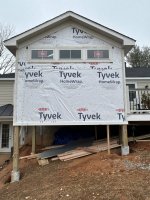
In my case, the sheathing was done after walls were stood upright so that the sheathing was continuous from the band boards upwards. This ensures the walls are rigidly connected to the deck system and greatly aids the shear strength of the wall. Leaving the sheathing off also allows the framer to pull and tweak the framing to ensure the room is plumb and square.

My sheathing also was dropped so as to conceal the beams below. On the sides, an infill ladder framing was used. Later after trades are complete, a dropped framing system will be installed so that the bottom of the structure is a single plane for installing the MDO bottom lid.

At the day job, they will build walls on the deck, sheath them but leave a tail long enough to fully engage the band, then stand up and nail off. The walls are much heavier to place into position when fully sheathed.
1765121342562.jpeg
 
To avoid these ads, REGISTER NOW!

larry4406

Well-known member
Joined
Jan 27, 2006
Messages
19,073
Location
Northern Virginia
Off topic question but I see it all the time on here - why do so many people sheet the walls after standing them up?
It is a lot faster to use gravity than fight it when positioning the sheets. It is also a lot easier to square your walls.
Here is an example from the day job where panel wall systems are used.

The wall panel segments have sheathing partially installed in the middle but not at the top or the bottom. Latter, infill panel sections are installed. These are 4' tall infill sections. This is done to stitch the panels together across the decks and into the gable trusses. Otherwise, metal straps are needed which can affect siding. This is required to consider the wall framing as "continuously sheathed".

1765122092968.jpeg
1765122251152.png
 

Hank11

Well-known member
Joined
Aug 19, 2019
Messages
1,142
Location
Tennessee
I intended to run at least the corner 6x6 posts all the way to the second story sill plate for overkill purposes, and drywall the interior corners with a small fillet if necessary to hide the posts. If I make 2x6, 24" stud spacing walls, it will help hide the 6x6 in the corners and also improve insulation overall.

I used standard 40psf loading and standard snow loading and found the posts are more than strong enough if placed on good piers. Regardless of vertical strength the original design is not allowed per plain-as-day wording in the IBC that says habitable rooms cannot be supported by posts unless it's an engineered steel shear frame, or has shear walls on the first floor.

I might draw it up with a couple 4x8 or 6x8 shear walls on the lower level corners, and see what the city says. On one of the corners the shear walls would actually be beneficial by blocking some sunlight and traffic noise.
You could also consider making the support for the room overhead a bolted together post and beam structure with braces. That’s sorta what I was envisioning in my first answer. You can satisfy sheer requirements that way. Site built sheer panels on the corners of the room overhead would be easy enough to add and increase stiffness significantly. In addition to that you can also add a strict nailing pattern to your sheathing on the upstairs room. The right sheathing and proper nailing gets really stiff, and it’s an acceptable method. I think if you have the design signed off by an engineer, you’re gonna be good to go.

Unless you’re building a barn that’s not really gonna be finished out, running long 6 x 6 posts up two stories is nothing but asking for trouble with any kind of finish you apply unless it’s very rustic. You’re also complicating the framing of the upstairs floor system and walls. Solid post like that are gonna try to twist and bend. Save yourself the trouble.
 

bluedog225

Well-known member
Joined
Jan 31, 2012
Messages
3,261
Location
Texas
People have been building houses on "dead reckoning" and "how pawpaw did it when he helped his uncle back before the big war" for centuries. The vast majority don't fall down.


True. and sometimes the earth shakes 100,000 people die.

edit-800,000
 
OP
J

JackOfDiamonds

Well-known member
Joined
Jul 31, 2020
Messages
706
Location
Idaho (USA)
You could also consider making the support for the room overhead a bolted together post and beam structure with braces. That’s sorta what I was envisioning in my first answer. You can satisfy sheer requirements that way.

I could put bracing on the lower poles, like 45-degree bracing members between the poles and the deck. The problem with that is the space below is still going to be a usable patio space. AIngular braces don't look good and are places for people to bang their head.

That's why, before I really started thinking about shear requirements, I had the idea to extend the posts to the 2nd story, and that was my intuitive way to make the structure stiffer laterally without having to have angular, headbanger braces on the poles. I figured between that, and attaching the whole thing to the house, it would be laterally stiff enough. But now I'm starting to doubt that and think poles aren't going to cut it, even if they extend the full height. But I still don't want to install angular braces. I'm more likely to build a couple whole shear wall sections on the 1st floor corners. That should look better than angular braces, and be just as good or better at bracing, and also add some shade/wind protection to the 1st level patio.
 

jar944

Well-known member
Joined
Jul 26, 2010
Messages
5,901
Location
Northern VA
I intended to run at least the corner 6x6 posts all the way to the second story sill plate for overkill purposes, and drywall the interior corners with a small fillet if necessary to hide the posts. If I make 2x6, 24" stud spacing walls, it will help hide the 6x6 in the corners and also improve insulation overall.

I used standard 40psf loading and standard snow loading and found the posts are more than strong enough if placed on good piers. Regardless of vertical strength the original design is not allowed per plain-as-day wording in the IBC that says habitable rooms cannot be supported by posts unless it's an engineered steel shear frame, or has shear walls on the first floor.

I might draw it up with a couple 4x8 or 6x8 shear walls on the lower level corners, and see what the city says. On one of the corners the shear walls would actually be beneficial by blocking some sunlight and traffic noise.

If you are in Idaho and it's a single family detached home (some context would help here) why are you looking at IBC and not 2018 IRC (unless you live in some specific jurisdiction requiring a different code application for some reason)

Short of the initial framing members being undersized nothing was out of bounds.

And you should not need cross/angle bracing on the posts if you have a single span and the appropriate connection to the house framing.
 

billconner

Well-known member
Joined
Jul 20, 2021
Messages
6,941
Location
Thousand Islands NYS
Unless you’re building a barn that’s not really gonna be finished out, running long 6 x 6 posts up two stories is nothing but asking for trouble with any kind of finish you apply unless it’s very rustic. You’re also complicating the framing of the upstairs floor system and walls. Solid post like that are gonna try to twist and bend. Save yourself the trouble.
I was thinking laminated posts which seem to resist the twisting and bending of a sawn 6x6.
 

C-S-H

Well-known member
Joined
Jan 18, 2024
Messages
145
Idaho has pretty high earthquake design accelerations. Your 6x6 2-story posts are flexible, so most all of the lateral load from your new construction will be taken by the floor plate and roof plates. So, they need to be designed for it, especially where they attach to the existing structure. Even at that your posts might still not be able to take the moments they will see from lateral load, and lateral deflection and vertical load. It is bad practice to build a soft first story in a higher earthquake zone. We usually aim for a regular shaped foundation footprint, and with perimeter shear walls and other symmetrically placed shear walls.
 

Steve_P

Well-known member
Joined
Sep 15, 2010
Messages
5,182
I do feel compelled to mention the vast vast majority of people with engineering degrees, who are employed as engineers, do not, and have no reason to posess a PE license.

Like the several thousand engineers involved in designing an iPhone, for example.

True, but we're talking about Civil Engineering, and not iPhones. When bridges and buildings fall down, people tend to die - people don't die very often when their iPhone prematurely fails.

I'm a BSME with no PE. It would have been helpful many times in the middle of my career working as a consultant, but it wasn't necessary as we had a few PEs on staff to check and sign off on my calculation reports. Later in my career, it didn't matter as everything was internally used.

If you're a Civil Engineer, doing structural design, you pretty much need a PE license if you want to advance in your career. If you're a CE and helping on surveying on road paving, then maybe not. But for structural, then yes.

I'm in TN. One of my former neighbors built a custom steel frame "Barndominium" to be built in the county, rural location. He drew up his concepts in Autocad, had an architect fix it up so it was buildable, and it still had to be stamped by a PE- in rural TN.
 

Hank11

Well-known member
Joined
Aug 19, 2019
Messages
1,142
Location
Tennessee
True, but we're talking about Civil Engineering, and not iPhones. When bridges and buildings fall down, people tend to die - people don't die very often when their iPhone prematurely fails.

I'm a BSME with no PE. It would have been helpful many times in the middle of my career working as a consultant, but it wasn't necessary as we had a few PEs on staff to check and sign off on my calculation reports. Later in my career, it didn't matter as everything was internally used.

If you're a Civil Engineer, doing structural design, you pretty much need a PE license if you want to advance in your career. If you're a CE and helping on surveying on road paving, then maybe not. But for structural, then yes.

I'm in TN. One of my former neighbors built a custom steel frame "Barndominium" to be built in the county, rural location. He drew up his concepts in Autocad, had an architect fix it up so it was buildable, and it still had to be stamped by a PE- in rural TN.
And along with the PE comes education, examinations, experience, and licensing. For unusual structures or repairs it’s absolutely worth hiring a qualified engineer (PE) to sign off on them.
 
To avoid these ads, REGISTER NOW!
Top Bottom