To avoid these ads, REGISTER NOW!

Ames dial indicator set

I8AWRENCH

Well-known member
Joined
Aug 10, 2016
Messages
81
Location
South carolina
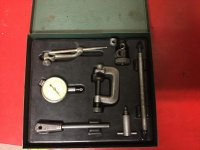
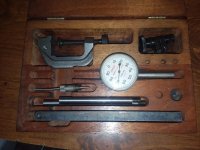
What am I missing here ? I’m trying to set up this dial indicator set and I can’t figure out how it all goes together. Picked it up in a sale and it seemed to be complete. I have it all together but cannot figure out how the dial attaches to the clamp and arm - the holes the right size but has part of it intruding into it so the round arm doesn’t fit in . I’ll post pics of what I’m trying to explain.
IMG_3434.jpg
IMG_3435.jpg
This shows the hole I’m talking about that should clamp on to the other arm with clamp attached.
IMG_3436.jpg
Anyone have this set or any ideas / thanks.


Sent from my iPhone using Tapatalk
 
To avoid these ads, REGISTER NOW!

Provincial

Well-known member
Joined
Sep 21, 2011
Messages
6,865
Location
Near Salem, OR
You have it set up for internal measurement, like indicating in the bore of a bushing chucked in a lathe.

To use it for external measurement, like indicating in the outside diameter of a bushing chucked in a lathe, remove the "teeter totter" attachment and use the end of the plunger that is now touching the "teeter totter."

I assume that you know how to use the clamp and adjustable stem?
 
OP
I

I8AWRENCH

Well-known member
Joined
Aug 10, 2016
Messages
81
Location
South carolina
No I don’t really know how to use it :D. I do have a project that needs it tho ( measuring cam lift) but the pictures are really just to show it put together and the piece I can’t figure out. It’s the arm/stem like you describe doesn’t fit as far a I can tell.
 

Bob-B

Well-known member
Joined
Jul 21, 2011
Messages
451
Location
Long Island, NY
FWIW, that indicator will only measure about .200". Not sure it will do what you want.
 
Last edited:

whateg01

Well-known member
Joined
Mar 13, 2006
Messages
11,227
Location
doo dah, kansas, usa
Does the clamping stud have a cove machined in it somewhere that isn't visible with the clamp installed? I guess the post doesn't have a matching flat on one side, huh?

Dave
 

whateg01

Well-known member
Joined
Mar 13, 2006
Messages
11,227
Location
doo dah, kansas, usa
Looking at the pics on ebay, I think you have the clamp installed wrong. Don't know if it makes a difference or not, though.

s-l1600.jpg


s-l1600.jpg


edit: on second thought, maybe you do have it right. alt-tabbing between the pics got confusing. It does look complete, though. What does the clamping bolt and the clamp look like taken apart? How does it actually lock to the bar that you have going through the bolt?
 
Last edited:
OP
I

I8AWRENCH

Well-known member
Joined
Aug 10, 2016
Messages
81
Location
South carolina
That set above is a little different As it looks like it has an extra long square piece for the arm/stem to screw into but shouldn’t matter. No the stem is perfectly round and fits into the hole until it hits the intrusion of the screw piece. One of the pictures above shows is going through and the other shows the hole blocked not the same but similar to what I’m saying. I will be putting in a new cam in a motor and checking lift against degrees but doesn’t matter if this dial won’t work for it I’d like to know how’s it’s set up right.
 

leg17

Well-known member
Joined
Aug 11, 2011
Messages
1,370
Location
Kentucky
You don't have to use all, or any, of the attachments. It is designed to be somewhat 'universal' and adaptable.
The various swivel joints are to allow the indicator to be positioned where needed and sometimes to provide fine adjustment. (Remember that the dial can rotate to set "zero")
Google "dial indicator setup" and look over the 'images' to see the many different setups. An inexpensive magnetic base is quite useful.
As stated already, you will probably not need to use the inside attachment for your application.
You simply need to mount the indicator solidly and position it over the workpiece. People use C-clamps, and all sorts of things. Use a little imagination.

You may get some feedback from other machinists about accuracy and high-dollar accessories, but for the occasional use you describe, cheaper is better.

Look at google. Easier than wandering around a machinist site. Its just a tool and your need is a perfect application.
 
To avoid these ads, REGISTER NOW!
OP
I

I8AWRENCH

Well-known member
Joined
Aug 10, 2016
Messages
81
Location
South carolina
You don't have to use all, or any, of the attachments. It is designed to be somewhat 'universal' and adaptable.
The various swivel joints are to allow the indicator to be positioned where needed and sometimes to provide fine adjustment. (Remember that the dial can rotate to set "zero")
Google "dial indicator setup" and look over the 'images' to see the many different setups. An inexpensive magnetic base is quite useful.
As stated already, you will probably not need to use the inside attachment for your application.
You simply need to mount the indicator solidly and position it over the workpiece. People use C-clamps, and all sorts of things. Use a little imagination.
Thanks for all the reply’s and I get that but I really just want to know how the arm with the c clamp end attaches to the indicator seems like it should go in the hole but it doesn’t fit. I did look at some magnetic bases from HF today and might give one a shot.
 

leg17

Well-known member
Joined
Aug 11, 2011
Messages
1,370
Location
Kentucky
Thanks for all the reply’s and I get that but I really just want to know how the arm with the c clamp end attaches to the indicator seems like it should go in the hole but it doesn’t fit. I did look at some magnetic bases from HF today and might give one a shot.

See if that protruding part will rotate and will allow the rod to enter. It may actually be split into two pieces that will clamp the rod when tightened. Try to take that apart.
 

davethorik

Well-known member
Joined
Sep 14, 2013
Messages
4,992
Location
Norka, Ohio
Is there a cutout on the shaft running thru the clamp that could possibly line up w/ the other hole? That's all I got
 
OP
I

I8AWRENCH

Well-known member
Joined
Aug 10, 2016
Messages
81
Location
South carolina
See if that protruding part will rotate and will allow the rod to enter. It may actually be split into two pieces that will clamp the rod when tightened. Try to take that apart.
Just tried this and it does rotate like a sleeve inside but no indentation to allow the arm to fit through.
 

Provincial

Well-known member
Joined
Sep 21, 2011
Messages
6,865
Location
Near Salem, OR
Here is Starrett's version of that indicator. The illustration shows it assembled with the swivel joint on the tool post holder, but using the c-clamp holder works the same way.

http://www.starrett.com/metrology/product-detail/196A1Z

EDIT: Here is a video that shows a little more about how it works. There are several other videos shown that will help you understand it better.


You can hold the indicator stem with a conventional magnetic base, or a flex magnetic base as well.
 
Last edited:

davethorik

Well-known member
Joined
Sep 14, 2013
Messages
4,992
Location
Norka, Ohio
Here is Starrett's version of that indicator. The illustration shows it assembled with the swivel joint on the tool post holder, but using the c-clamp holder works the same way.

http://www.starrett.com/metrology/product-detail/196A1Z

EDIT: Here is a video that shows a little more about how it works. There are several other videos shown that will help you understand it better.


You can hold the indicator stem with a conventional magnetic base, or a flex magnetic base as well.

Looks like op's setup is slightly different than the linked Starrett. It appears the Ames doesn't have the slit as leg17 mentioned. Now, I have never had or used an Ames indicator- my experience comes from using Starrett and Lufkin kits, both of which came with the slit clamps. The way the rod protrudes into the other bore made me think of a cam-style clamp like Lufkin used on their micrometers with a spindle lock lever (Not the lock ring, those are a different way of accomplishing same thing). However if everything is uniform diameter, this goes out the window.

Thinking about this more, does swapping the clamp end to end have any effect? It's possible it's backwards or something else is going on, like rods are slightly different diameters, which a clamp flip should remedy, but isn't guaranteed. Indicator snugs and rods shouldn't be this challenging to figure out, usually the only obstacle is finding rods and clamps that are compatible size-wise, although kits usually eliminate that possibility. Also possible there is a slit or bushing or other method for tightening I just can't see.

Another guess is that one, or some of the accessories aren't original to the set, or parts are missing. In my experience when these indicator sets are shop-owned, the snug, indicator itself, and the c-clamp are usually the first pieces to wind up growing legs and disappearing, in that order. Some ham-fists have been known to over-tighten the knurled finger wheel, usually with pliers, which can result in the more fragile pieces breaking, which then results in shop sets being cannibalized for parts.

Having multiple snugs is sometimes the only way to Rube Goldberg together a solution for an odd setup, and those snugs can be pricy when purchased individually. I remember one previous employer had such a problem with the shop Starretts going MIA, he used to order spare snugs 10 at a time and kept them locked away in the tool crib.

I have a feeling there also may be a missing outer sleeve somewhere in that setup, but again...with no experience on an Ames indicator, these are just guesses.

Here is a pic of my Lufkin set, which is similar to Starrett. I bought this set for $20 because the indicator was gummed up from machine coolant, to the point it would only return sluggishly halfway back to zero without assistance.

$20 is about what a snug itself costs new from Starrett, I figured why not give it a try to salvage the Lufkin...worst case, indicator is junk or needs professionally repaired, accessories worth more than $20. A few squirts of CRC QD aerosol electronics cleaner, applied over a few days to the innards, along with gentle cycling, solved this problem (trick I learned from an old timer, he referred to it as 'gage repair facility in a can' http://www.crcindustries.com/products/qd-174-electronic-cleaner-11-wt-oz-05103.html , I personally have used this on many indicators with very good results). I should point out here NEVER attempt to clean an indicator with an air blow gun, the tiny jewels don't like that, and can shatter and fall out of the assembly, causing all kinds of fun problems.

Point being, if you can find other indicator sets with accessories compatible to yours on the cheap, might as well pick them up. Never hurts to have more.

Good luck with it, op. I'm still scratching my head.
 

Attachments

  • 20180411_071857.jpg
    20180411_071857.jpg
    150 KB · Views: 9
Last edited:

bugnut

ALLIANCE MEMBER
Joined
Jul 14, 2012
Messages
3,870
Location
Central Ohio
Your second image. If you remove the thumb nut in the second image and look at the threaded end it should have a radius cut in it to allow the shaft for the clamp to come thru also while apart check the diameter of the clamping rod to insure if fits thru the hole. Before trying to assembly you need to align the threaded shaft with the rod of the clamp and then assemble. If this is not all of the same parts and was cobbled together the diameters and bores are of different sizes. Most shops/machinist end up with a hodge podge of parts trying to put them together. good luck
 

BDT/NWMN

Well-known member
Joined
Jan 22, 2012
Messages
3,762
Location
Erskine, Mn
I have dial indicators with attachments specifically designed for measuring cam lobe lifts. These dial indicators are scaled in .001 inch, and the scale goes up to 100, ( .100 inch per round) at which time a smaller needle points to a second scale that indicates the rounds ( of .100 inch each ) that the main needle has turned. These dial indicators have a measuring limit of 1 inch ( ten rounds of that main needle at .100 inch each )


Looking at the dial indicator You have pictured,,, The measuring scale is in .001 inch.. the scale goes up to 50 on the dial..... that means that dial indicator has the capacity to measure a part movement up to .050 inch...


If you want to measure cam lobe lift, You will have to add the proper dial indicator to that set, and while you are at it, get a magnetic base. What You have is great for smaller measurements such as gear backlash and end play..

I have another dial indicator that was designed for measuring cylinder wall taper.
All four of these gauges look similar at a glance, but hopefully I have clarified some of the differences and purposes of some of the variations.
 
OP
I

I8AWRENCH

Well-known member
Joined
Aug 10, 2016
Messages
81
Location
South carolina
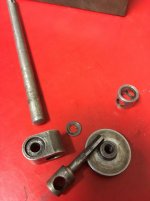
This is the piece disassembled.
IMG_3438.jpg
There is a corner of the edge of the sleeve that has been shaved but that doesn’t relieve the other pass through hole and I don’t see it’s purpose. The sleeve will spin and is round on the OD the whole way. This pic is the other end. The other short sleeve with the hole fits on the end where the dial indicator/arm slides into and I don’t see it’s purpose either as seen in previous pictures.
IMG_3439.jpg
The arm/stem that has the screw in clamp on one end is the same diameter the whole way and fits perfectly into the whole until it hits the sleeve. I’m wondering if the sleeve is not original but it just seems so well made/complete why would someone put another piece in it that doesn’t work ? . I’m still at a loss.
IMG_3440.jpg
Another picture of the sleeve intrusion.


Sent from my iPhone using Tapatalk
 
Last edited:
To avoid these ads, REGISTER NOW!
Top Bottom