To avoid these ads, REGISTER NOW!

AMP Clamp Meter

Jsf721

Well-known member
Joined
Dec 23, 2012
Messages
4,132
Location
LI, NY
I have a Klien Electric meter 320 and I have been learning how to use it.

I am working on a DC powered piece of equipment. I need to measure how many AMPS the motor is pulling white it is being used. To do this the tech service suggested I use an AMP clamp on the battery positive. I asked if I could somehow use a meter. He said, get an auto ranging AMP clamp meter.

Just checking here before I order on off amazon. anything I need to know before I order one so I get what I need ? Like to I need an AMP Clamp to also measure temperature?

Some I have looked at:

Thanks for any suggestions as to must have features or models. I am a Lite DIYer looking to do more.

 
To avoid these ads, REGISTER NOW!

nadogail

Well-known member
Joined
Jan 23, 2009
Messages
32,214
Location
Coronado, CA
My clamp on meter measures (with leads) AC & DC voltage, Frequency, resistance and checks continuity. I can also determine AC & DC current levels in a conductor.
The instrument was made by Amprobe and it has been in my tool box for about 25 years. I no longer use it frequently but I apppreciate it when i have need for it.
 

wyliesdiesels

Well-known member
Joined
Aug 14, 2012
Messages
20,192
Location
Modesto, CA
None of the meters you linked to do DC current via the clamp.

I wouls NOT trust those cheapo meters either...

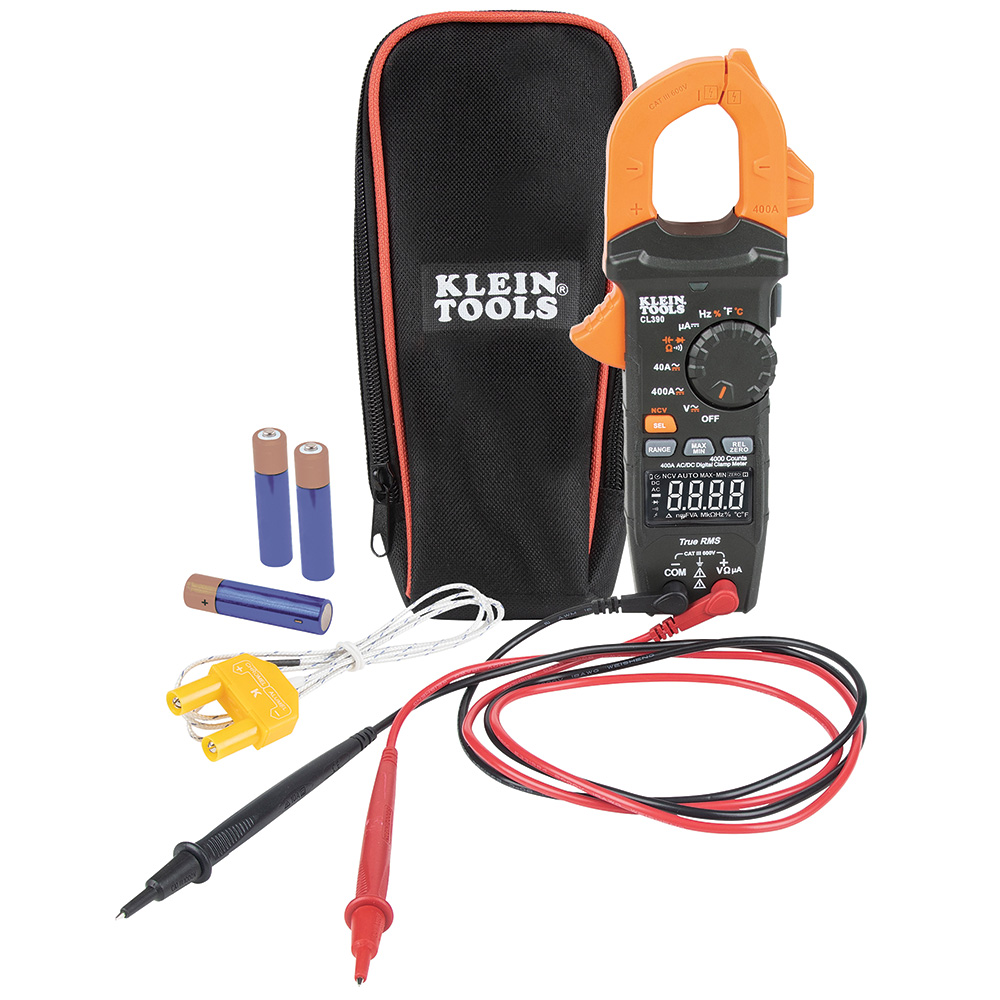
If you want DC current measurement capability, then you need the Klein CL390.


rlitman

Well-known member
Joined
Oct 18, 2010
Messages
24,738
Location
Long Island
None of the meters you linked to do DC current via the clamp.

I wouls NOT trust those cheapo meters either...

If you want DC current measurement capability, then you need the Klein CL390.

Actually, the HT206D (third link) meter claims DC current, and the scale shows that too. Would I trust it. No.
Then again, the Klein clamp meters are barely trustworthy either.

For those not familiar with DC clamp metering, for best results: click the clamp a few times, then close it on your wire, then re-zero it before taking a reading.
 

PoorUB

Well-known member
Joined
Mar 29, 2021
Messages
11,889
Location
Fargo, ND
The KAIWEETS HT206D will do DC amps with the clamp. Quality is questionable!

For some reason DC amps with a clamp is a problem for most manufacturers. Not sure if the demand if low or if the electronics is a problem. I have an add on amp clamp I bought second hand that will plug into most meters.
 

wyliesdiesels

Well-known member
Joined
Aug 14, 2012
Messages
20,192
Location
Modesto, CA
Actually, the HT206D (third link) meter claims DC current, and the scale shows that too. Would I trust it. No.
Then again, the Klein clamp meters are barely trustworthy either.

For those not familiar with DC clamp metering, for best results: click the clamp a few times, then close it on your wire, then re-zero it before taking a reading.
oh whoops. i missed that.... regardless i wouldnt trust those POS meters as far as i can throw them.... All my meters are fluke and for good reason.

My 381 does DC current but i doubt the OP wants to spring for that kind of money
 

Uofime

Well-known member
Joined
Jan 11, 2021
Messages
175
Location
Charleston SC
The uni-t ut210e is the gold standard for cheap DC clamp meters. You can get them for less than 30$ on aliexpress or 50on scamazon.

measuring current on an electric motor is however always a mess because the wave form is nasty. There is going to be a lot of averaging from the equipment itself and software.
 

PoorUB

Well-known member
Joined
Mar 29, 2021
Messages
11,889
Location
Fargo, ND
For some reason DC amps with a clamp is a problem for most manufacturers. Not sure if the demand if low or if the electronics is a problem. I have an add on amp clamp I bought second hand that will plug into most meters.

The physics are different. AC induces a current into the clamp. DC does not.
Well that was insightful! But fairly useless information.

DC produces a static magnetic wave so the clamp has to be designed to "read" it.

AC creates an alternating magnetic field. The amp clamps are designed differently on how they read the magnetic field.

That doesn't answer the question of why there are not very many clamp style DC amp meters. It is the cost of the electronics to read DC, or just the lack of demand?
 

rlitman

Well-known member
Joined
Oct 18, 2010
Messages
24,738
Location
Long Island
Well that was insightful! But fairly useless information.

DC produces a static magnetic wave so the clamp has to be designed to "read" it.

AC creates an alternating magnetic field. The amp clamps are designed differently on how they read the magnetic field.

That doesn't answer the question of why there are not very many clamp style DC amp meters. It is the cost of the electronics to read DC, or just the lack of demand?
Ok, you want a more in depth answer. I'll try.

CT type inexpensive AC clamp meters are simple devices based on a Current Transformer. CTs are AC transformer devices designed where the primary current is very close in proportion to the secondary current. For a clamp meter, they utilize a split core (this reduces accuracy quite a bit from a closed loop core), and the wire being measured acts as the primary loop. A winding hidden in the meter jaws that wraps this split core acts as a secondary loop, which is closed via a calibrated shunt, and voltage across that shunt is measured to calculate the current across it (typical of all current metering devices) to infer the current in the primary.

It's "simple", because it relies on the age-old technology of a transformer. Transformers work on AC sine waves, but DC does not pass through a transformer. So, if you look at the left half of the image from Fluke below, the CT type AC only meter jaws act contain the secondary winding, and the wire(s) that pass inside the loop are the 1 (or more, since you can multiply the output by wrapping multiple turns in here) turn primary.

inside-hall-effect-clamp-meters-1500x1000.jpg
Here, I'll point out that in split CT type meters, eddy currents will flow through the core, so the opening in the tip should be recessed, or else the operator risks being shocked.

Now for the AC/DC clamp meter on the right, you have no secondary coil, since the meter is directly measuring the magnetic flux in the ferrite core using a Hall Effect sensor. The meter actually utilizes strategically placed gaps in the core to funnel the magnetic field past the sensor, which puts out a voltage that's proportional to the magnetic field (and to the current that's flowing through it, but that variable is carefully controlled). If you're really interested in the Hall effect, you can read more here:

There's a third type of split core non-contact current meter which is also AC only. Rogowski coils have a helical winding but no iron core, so they're flexible. Like the Hall Effect type, there is no closed loop, but similarly, the loop must be nearly closed to work accurately. A Rogowski coil's voltage output is the derivative of the current in the measured conductor, and when that voltage is integrated, you can use it to measure current.

 
To avoid these ads, REGISTER NOW!

cannuck

Well-known member
Joined
Nov 30, 2021
Messages
4,704
Location
Rural SK
rlitman: THANKS for that brief explanation. Most of the electrical guys I work with are quite knowledgeable (that 's what we pay them to be) but are AC only types. When I ask my automotive DC questions the answers are sometimes nothing but a blank stare. The DC we work with is usually 460KV and is really a compilation of AC, but I have not seen voltage on a screen to understand what it looks like going down the transmission lines (one side of the waves going the DC- wire the other side of them going to DC+ wire. For a purely mechanical guy, interesting but sometime confusing.
 

PoorUB

Well-known member
Joined
Mar 29, 2021
Messages
11,889
Location
Fargo, ND
Ok, you want a more in depth answer. I'll try.

CT type inexpensive AC clamp meters are simple devices based on a Current Transformer. CTs are AC transformer devices designed where the primary current is very close in proportion to the secondary current. For a clamp meter, they utilize a split core (this reduces accuracy quite a bit from a closed loop core), and the wire being measured acts as the primary loop. A winding hidden in the meter jaws that wraps this split core acts as a secondary loop, which is closed via a calibrated shunt, and voltage across that shunt is measured to calculate the current across it (typical of all current metering devices) to infer the current in the primary.

It's "simple", because it relies on the age-old technology of a transformer. Transformers work on AC sine waves, but DC does not pass through a transformer. So, if you look at the left half of the image from Fluke below, the CT type AC only meter jaws act contain the secondary winding, and the wire(s) that pass inside the loop are the 1 (or more, since you can multiply the output by wrapping multiple turns in here) turn primary.

inside-hall-effect-clamp-meters-1500x1000.jpg
Here, I'll point out that in split CT type meters, eddy currents will flow through the core, so the opening in the tip should be recessed, or else the operator risks being shocked.

Now for the AC/DC clamp meter on the right, you have no secondary coil, since the meter is directly measuring the magnetic flux in the ferrite core using a Hall Effect sensor. The meter actually utilizes strategically placed gaps in the core to funnel the magnetic field past the sensor, which puts out a voltage that's proportional to the magnetic field (and to the current that's flowing through it, but that variable is carefully controlled). If you're really interested in the Hall effect, you can read more here:

There's a third type of split core non-contact current meter which is also AC only. Rogowski coils have a helical winding but no iron core, so they're flexible. Like the Hall Effect type, there is no closed loop, but similarly, the loop must be nearly closed to work accurately. A Rogowski coil's voltage output is the derivative of the current in the measured conductor, and when that voltage is integrated, you can use it to measure current.

You still have not answered my question!

I never asked how the clamps differ or why they need to be different!
 
Last edited:

rlitman

Well-known member
Joined
Oct 18, 2010
Messages
24,738
Location
Long Island
You still have not answered my question!

I never asked how the clamps differ or why they need to be different!
You asked:
That doesn't answer the question of why there are not very many clamp style DC amp meters. It is the cost of the electronics to read DC, or just the lack of demand?

I thought I was clear. Cheap construction that could be engineered by a high-school student and made by unskilled labor will get you a serviceable AC clamp. DC metering is done with a Hall Effect sensor, and that's neither simple to engineer nor cheap to manufacture.
 

PoorUB

Well-known member
Joined
Mar 29, 2021
Messages
11,889
Location
Fargo, ND
I thought I was clear. Cheap construction that could be engineered by a high-school student and made by unskilled labor will get you a serviceable AC clamp. DC metering is done with a Hall Effect sensor, and that's neither simple to engineer nor cheap to manufacture.
Well, the Chinese are building them for $50 so it can't be to diffecult to make.
 

bwringer

Well-known member
Joined
Jan 1, 2013
Messages
10,373
Location
Indianapolis
DC amp clamps are ridiculously handy for vehicle work, yet are weirdly hard to find. I have a Craftsman that was under $100, probably made by one of the better-tier Chinese places. It's been plenty accurate enough; there aren't many situations where that last 1/100 amp accuracy makes any difference.

However, the OP never specified what voltages are in play here. 12V is pretty easy, and any decent Chinese meter would do the trick.

Higher voltages, you'll want to step up to a major brand with the safety certifications you can trust. For example, EV or hybrid battery systems.
 

mikedodge

Well-known member
Joined
Jun 27, 2017
Messages
2,918
If you're not using it regularly go for a cheap meter. They're usually pretty accurate. I use them more then my good one. Get one with 9v battery. AA/AAA don't last as long a pretty much guarantee they'll leak at some point.
 
To avoid these ads, REGISTER NOW!
Top Bottom