To avoid these ads, REGISTER NOW!

An Alternative Source of Cabinets

glentre

Well-known member
Joined
May 21, 2016
Messages
909
Location
Gloucester, Virginia
At the suggestion from another member who is following my garage build and the selection of my cabinets, I am starting this thread to talk about an alternative source of garage cabinets that may be of interest to folks in the market for that kind of product.

Having owned a commercial architectural woodworking business for nearly twenty years, I am familiar with commercial custom cabinets. There have been significant advances in that industry in the last ten years to the point that most successful local shops are now fully automated and run with a minimum amount of skilled labor. Most folks are familiar with the computer kitchen design programs used in the big box stores where you sit down with the designer and select standard size cabinets and go home with plan and elevation drawings of your new kitchen. The commercial and kitchen cabinet shops now have programs that take that concept several steps further.

First, these programs are not designed for standard sized cabinets but allow you to build any width, depth or height cabinet you want subject only to common sense limitations. For example, the programs will allow you to design a 48" wide wall cabinet with a single door but that would be impractable as two 24" doors might be as wide as you would want to go. Once your design is finalized, the computer generates a sheet goods cut list, and a list of how much edge tape you will need, the exact number of hinges, shelf clips and pulls and assembly dowels required. In a matter of minutes, this allows the shop all the information it needs to quote a price for the job. The design is then directly downloaded to a computerized saw or cnc router which cuts the parts, drills the hinge, dowel and shelf clip holes, runs any dados required and generates a stick-on label for each part showing the job name, room and cabinet number and the exact width and length of that particular part.

The parts then go to an automated edge bander which applies the color and thickness of edging you want on your cabinets. Following this, the parts go to an automatic dowel insertion machine and then off to the assembly area. Instead of going to assembly, the finished parts can be loaded in your vehicle and off to your shop if you want to save money by assembling them yourself.

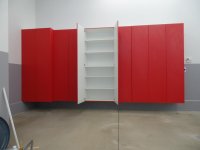
Attached are drawings of my cabinets. They are built with 3/4" white malamine panels and with red plastic laminate on all exterior surfaces. I will follow up in subsequent posts showing the assembly of the cabinets and the finished products when they are done.

For those interested in having cabinets built exactly as they want, the size they want, in the color they want and with the material they want (melamine panels, plywood, OSB, particleboard or any other sheet material ), then this approach might interest you. Your price levels will not be the cheapest but will be competitive with most mid-range metal cabinets on the market. Most cities of any size in the country have cabinet shops equiped with these tools. Either kitchen cabinet or commercial cabinet shops in your area can build your cabinets however you want. Some may even be willing to design your cabinets and furnish you with detailed cut lists, material requirements and part labels if you want to do everything yourself.

Glen

Note: I tried to upload the cabinet design sheets for my build but apparently, they are too large so I'll look into some other way to get them posted and follow up as soon as I can
 
To avoid these ads, REGISTER NOW!

51Ford

New member
Joined
May 11, 2017
Messages
3
Location
Nc
Awesome info. Can you list examples of the software used by the machine shops? I am new to cnc and learning cad now. Always looking to grow capabilities.
 
OP
G

glentre

Well-known member
Joined
May 21, 2016
Messages
909
Location
Gloucester, Virginia
51Ford,

One of the most popular programs seems to be Cabinet Vision which is sold by factory reps throughout the country to independent cabinet shops. My son happens to be one of these reps. He was able to land a job with them about 15 years ago after spending weekends and summers throughout high school and college working in our shop before we sold it and retired.

Great you are learning CAD as the days of the draftsman sitting at his drawing board are long gone. Obviously, computers in every aspect of our lives are here to stay. Taking a job as a designer in a cabinet shop in only one of the many opportunities open to you. Best of luck in the future.

Glen

Glen

Glen
 
OP
G

glentre

Well-known member
Joined
May 21, 2016
Messages
909
Location
Gloucester, Virginia
These computerized cabinet programs are capable of designing any type of cabinet you want and each shop seems to have their preferred way of building them. Often, the construction method chosen has a lot to do with the way the business owner is used to building. If he had always built face frame cabinets, then he would have his program set up to build that style. If he built frameless box cabinets, that's the way he would set up. Other variations include how the box is assembled which might include dowels only, dowels with pocket screws, or full 3/4" backs dadoed into the sides and top to form a more rigid construction. Shops with large case clamp machines into which the full cabinet fits would not have pocket screws while those without case clamps would likely choose some method of drawing the parts together using pocket screws or other similar method.

So, while there might be different construction methods for each shop, the end result is a highly dimensionally accurate, square and stable cabinet built to your specifications.

I will post photos of the various parts with descriptions as soon as I can get a batch of pictures taken. The one here is a photo of a typical label stuck onto each part.

Glen
 

Attachments

  • SAM_2344.jpg
    SAM_2344.jpg
    159.1 KB · Views: 125

ard

Well-known member
Joined
Feb 16, 2015
Messages
4,391
Location
Sierra Foothills... California
I've been buiding cabinets for years, but for myself. Maybe 60-80 'boxes' over the last 15 years. Most face frame, some frameless. Some of this was furniture, desks, wall units, shelving, etc.

Basically I will sit at the kitchen table or granite counter, and lay out the project on a scaled elevation view. Dimension each box. Then letter code each box.

Then each letter code gets a one or two page detail. Box/carcase and faceframe. And at the bottom a cut list (with rabbet/routing details). Nowadays these are NOT scaled- needless work. I just do these to get to the dimensioned cut list.

This takes me a few hours, 1-2 hrs a night over the course of a few nights with an eye on the TV.

All with pencil and paper. (Honestly, doing this is an opportunity to 'build' it on paper, while my brain is working out the connections and process.)

IMO, I would need to be doing a kitchen once a month or so to see the need for a software package. But, I dont do this for a living, it is a hobby- so how much of a drag it would be to work this out all the time is an unknown.

So how much DOES a 'Cabinet Vision" package cost? For a super, super low volume shop. Just a ballpark. $100? $1000? $2500? Annual?


I am in the middle of a garage cabinet design- all custom sized, some very deep (30") uppers, very tall wall cabinets (70" tall, 18" deep) that will create the entire wall of a 30 ft garage. Overhangs, soffit, custom benches, drawer units, etc. IMO it would be impossible to achieve the same with any of the vendors here, or with home depot, etc. While I like many of the metal systems, when you are filling up a 11ft+ tall wall, the cabinet systems built to fit a 8ft ceiling are inadequate. (and I see this in many pictures- 8ft wall systems with 3ft of open space above...)


Question for the pros:

I found a very nice 'baltic' type ply- 3/4", 17 or so plys, with melamine on each face. (Its a chinese product, at least here on the west coast) Id love to build at least the uppers (which hang from the wall and a ceiling support) out of this. HOWEVER, the outer color of the boxes (these will be face frame) will be a paint finish, not a standard color. (Likely a SW kemvar or maybe Sayerblack urethane, still uncertain) I am concerned with the durability of ANY paint on melamine. What Id really like is melamine one side, decent wood veneer on the other- in a ply substrate. Anyone heard of this?

(FWIW, this material WILL be great for shelving... slap an extruded AL stiffener as edge trim on front and back, and this will be far more stable than a PB shelf.)

Or is this a custom order- HPL on one side, a 'veneer core' in the middle and any old wood venner on the other? (Veneer core being a ply center, then some MDF layer to create a uniform surface for bonding).

Any thoughts?
 
OP
G

glentre

Well-known member
Joined
May 21, 2016
Messages
909
Location
Gloucester, Virginia
ard,

It's great that as a hobby, you enjoy designing cabinets and working out cut sheets and construction methods. In the days before computers, I did the same thing in our shop and enjoyed doing it just as you do. However, we found we could not compete against the shops that began to automate so we were forced to follow if we wanted to stay alive and grow our business.

The design programs and automated machinery that works with those programs is certainly not inexpensive. Less than $1k can get you a good cut list generator which will print out diagrams and labels for an operator to use to cut parts on a regular table saw. Or, a design program with all the bells and whistles, a cnc router, edge bander, and case clamp might set you back $150k.

Making an investment of this magnitude for your super, super low volume shop would be foolish as the machinery would sit idle for long periods of time. However, there are many shops these days that can do high volumes of cabinetry, keeping the machines running fairly constantly and with no skilled and highly paid experienced cabinet makers. The payback on a large investment therefore becomes reasonable if you can do the same volume after having eliminated perhaps four cabinet makers and instead, hired two low skilled machine operators to produce the same volume of work. I know kitchen cabinet businesses operating at good volumes with only two or three workers in the shop.

Regarding your question for the pros, the melamine faced Baltic ply did not exist when I had my business as far as I know. But, so long as the melamine is properly fused to the plywood, it would appear to be a superior product to use. Painting melamine is not normally done because of adhesion problems but it can be accomplished providing the surface is lightly sanded to remove the sheen and to provide a "bite" for the finish. Rather than paint, I would suggest you use plastic laminate which is available in a huge selection of colors.

Regarding melamine on one side and a good wood veneer on the other, all you would need to do is take your melamine ply panels and veneer one face with either peel and stick veneer or straight veneer and contact glue.

On your last paragraph, all panels must be a balanced construction to prevent entry of moisture on one face and not the other or the panel will warp. Melamine on both faces of the core is a sealed and balanced product. Adding plastic laminate or veneer over one of the faces is no problem as the moisture can't enter either face. A product with HPL on one face and wood veneer on the other would be questionable as the veneer face, unless quickly and completely sealed, would pick up moisture while the HPL would not. The result is a warped panel. Using mdf in the mix on one face only makes the situation worse.

Thanks for your input and continue having fun designing and building your own cabinets. It's a great hobby.

Glen
 

ard

Well-known member
Joined
Feb 16, 2015
Messages
4,391
Location
Sierra Foothills... California
Thanks for the prospective.

(I'm an afflicted hobbiest- just picked up a trashed Ritter face frame table and pocket hole machine- totally rebuilt them. ;) )

I do like the idea of just putting laminate on the exposed end panels- then the challenge is getting a perfectly matching paint for the face frames, in terms of gloss and color- which I think is probably doable.

Ihave had some custom laminates done, and always had to get a matching surface on the opposing size- 'gatorply' is one term. I'd forgotten it was done to stabilize the panels.

Thx again
 

readhead

Well-known member
Joined
Dec 8, 2012
Messages
6,175
Location
Durango, Co.
We have a closet shop that has the kind of capability you describe. Their main business is closet interiors but they will build anything you want. I had them build some wall mounted display cases complete with glass doors.
 
OP
G

glentre

Well-known member
Joined
May 21, 2016
Messages
909
Location
Gloucester, Virginia
ard,

The Ritter face frame machine is a good product and has been on the market for many years and is used by many shops. The difficulty with DIY framless cabinets is getting the box perfectly square so doors and drawers fit properly. The Ritter will give you a square frame which does not require the cabinet box to be perfect since the frame is mounted to the box after the box is assembled.

If you are laminating exposed cabinet ends, why not also laminate the face frames instead of trying to match color and texture with paint. Laminate the ends first and the frames last so the overlap seam will not be seen from the front of the cabinet.

Gatorply is also referred to as backing sheet or cabinet liner. It is a lower cost alternative to using HPL on the opposite face of a laminated panel to prevent entry of moisture. It used to come in only brown or white but other colors may now be available. Another alternative is to use V32 laminate as a backer. It is the same as regular HPL but only half the thickness at 1/32" but availabe is most of the standard laminate colors.

If you havn't tried HPL laminate yourself, it is a fun project and the skills are easily learned. Trim routers, bits and hand files to finish up the edge are not expensive.

Glen
 
To avoid these ads, REGISTER NOW!
OP
G

glentre

Well-known member
Joined
May 21, 2016
Messages
909
Location
Gloucester, Virginia
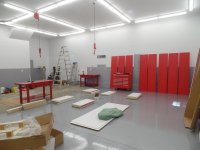
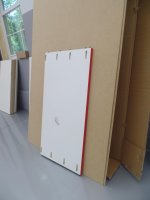
Here are some photos of the cabinet parts laid out on the floor ready to be assembled. The red laminate faced cabinet doors are leaning against the walls. The second photo is a cabinet top and the bottom piece is almost identical. The pre-inserted dowels fit into holes drilled in the sides while the pocket screws tighten the top against the sides. The exposed front edge of the top is banded with 3 mm durable pvc edge banding applied completely by machine.

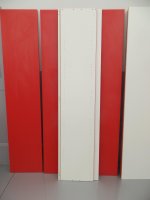
The third pic shows a cabinet side. When assembled, the 1/4" white back slides into the dado machined into the rear of the side. The assembly dowel holes, the shelf clip holes and the holes for mounting the hinges are all done by a machine that reads the label bar code and determines exactly where all the holes need to be drilled. This side panel is also edge banded on the front exposed edge.

More assembly photos to follow.

Glen
 

Attachments

  • SAM_2341.jpg
    SAM_2341.jpg
    125.8 KB · Views: 95
  • SAM_2342.jpg
    SAM_2342.jpg
    133.6 KB · Views: 72
  • SAM_2347.jpg
    SAM_2347.jpg
    131.7 KB · Views: 70

theoldwizard1

Well-known member
Joined
Feb 22, 2011
Messages
43,072
Location
SE MI
Attached are drawings of my cabinets. They are built with 3/4" white malamine panels and with red plastic laminate on all exterior surfaces.
I don't know about your material, but stuff like that, bought at "big box stores" ***** in garages around here ! The are made with particle board which pulls moisture right out of the air. Then they swell and the door and drawers will on operate properly. In less than 10 years, you will have to replace them.
 
OP
G

glentre

Well-known member
Joined
May 21, 2016
Messages
909
Location
Gloucester, Virginia
There are several grades of melamine panels with particleboard cores in both the density of the core used as well as the quality of the fused melamine surfaces. For competitive reasons and the customers they cater to, the big box stores generally don't offer cabinets made with the higher quality material. The cabinets they sell for use in work shops or garages made with melamine appear to be made with lower quality products than their kitchen cabinets. This is likely the reason they do not list the densities of the Particleboard products they sell.

I have never heard of any kitchen or commercial cabinet shop buying their material from the big box stores even though it might be cheaper for them to do so. They use wholesale suppliers who only carry industrial grade panels which are more dense, more durable and more resistant to moisture than the lesser quality products.

However, melamine panels should never be subject to water at any unfinished edges because, indeed, they will expand. Wetting the flat melamine surface is no problem but not the edges. For high humidity situations, all exposed edges should be edged banded to keep out moisture. I would not recommend particleboard cabinets sitting directly on a floor in a shop or garage that will be hosed out. Mount them on a more suitable solid wood or plywood base. If the edges are banded, I also would not hesitate to use this product in high humidity areas within reason. Houston would be ok but installing them in a steam room would not be prudent.

My cabinets will be installed one foot off the floor on the stem wall ledge and I do not hose out my garage so did not feel it necessary to band the lower raw edges of the cabinet sides.

Using common sense, these cabinets provide many plusses and few negatives. Most importantly, you can get any dimension cabinet you want, fill a wall-to-wall installation with identical width cabinets, get any shelf arrangement you want and have any color you want.

It's just an alternative source of cabinets for those who want what they want.

Glen
 

yeldogt

Well-known member
Joined
Jan 2, 2012
Messages
18,184
Nice information -- I have used cabinet shops for most of my projects spanning 30+ years ... especially when doing smaller spaces where custom sizes can maximize usage.
 

Firebrick43

Well-known member
Joined
May 12, 2015
Messages
13,971
Location
West central Indiana
I've been buiding cabinets for years, but for myself. Maybe 60-80 'boxes' over the last 15 years. Most face frame, some frameless. Some of this was furniture, desks, wall units, shelving, etc.

Basically I will sit at the kitchen table or granite counter, and lay out the project on a scaled elevation view. Dimension each box. Then letter code each box.

Then each letter code gets a one or two page detail. Box/carcase and faceframe. And at the bottom a cut list (with rabbet/routing details). Nowadays these are NOT scaled- needless work. I just do these to get to the dimensioned cut list.

This takes me a few hours, 1-2 hrs a night over the course of a few nights with an eye on the TV.

All with pencil and paper. (Honestly, doing this is an opportunity to 'build' it on paper, while my brain is working out the connections and process.)

IMO, I would need to be doing a kitchen once a month or so to see the need for a software package. But, I dont do this for a living, it is a hobby- so how much of a drag it would be to work this out all the time is an unknown.

So how much DOES a 'Cabinet Vision" package cost? For a super, super low volume shop. Just a ballpark. $100? $1000? $2500? Annual?


Question for the pros:

I found a very nice 'baltic' type ply- 3/4", 17 or so plys, with melamine on each face. (Its a chinese product, at least here on the west coast) Id love to build at least the uppers (which hang from the wall and a ceiling support) out of this. HOWEVER, the outer color of the boxes (these will be face frame) will be a paint finish, not a standard color. (Likely a SW kemvar or maybe Sayerblack urethane, still uncertain) I am concerned with the durability of ANY paint on melamine. What Id really like is melamine one side, decent wood veneer on the other- in a ply substrate. Anyone heard of this?

(FWIW, this material WILL be great for shelving... slap an extruded AL stiffener as edge trim on front and back, and this will be far more stable than a PB shelf.)

Or is this a custom order- HPL on one side, a 'veneer core' in the middle and any old wood venner on the other? (Veneer core being a ply center, then some MDF layer to create a uniform surface for bonding).

Any thoughts?

I am an extreme DIY and a decent woodworker(mainly craftsman style done entirely with hand tools). I have a metric s$&t ton of cabinets for the house and garage to do so I am setting up some power tools to speed things up. I was appalled by the quality of even custom cabinets and I am not paying 15 grand either.

Any way I have done much research on cabinet plywoods and all I can say is I wouldn't touch Chinese ply after all the horror stories. Warping, delamination, extreme levels of formaldehyde, voids, and stress so bad it stops the blade as soon as you get into it a few inches. Local Menards carries tiger ply which is their "Baltic birch" they push as an equivalent. I bought a small project panel and the stuff was just as described above. Pure ****. For a few dollars more you can special order real Baltic birch. If I wanted to paint it I would get the pre finished uv cured "Baltic birch" as to hasten finishing and provide a durable surface.
 
OP
G

glentre

Well-known member
Joined
May 21, 2016
Messages
909
Location
Gloucester, Virginia
Firebrick,

I agree on the problem with plywood. Although Baltic Birch panels are a better grade of ply, the sheets don't come in commercial 4x10 or 5x10 sizes as I recall and they also tend to warp a little and are not perfectly flat.

Beside custom commercial cabinets for offices, medical facilities, banks, restaurants etc, our business also built large reception desks, nurses stations, teller lines, elevator lobbies, and high end board room furniture but we would never use plywood for our projects for the reasons mentioned. While most of the cabinets we built were done with melamine panels with a particleboard core, most everything else we made was with mdf in thicknesses from 3/4" to 1 1/2".

Glen
 
OP
G

glentre

Well-known member
Joined
May 21, 2016
Messages
909
Location
Gloucester, Virginia
More photos of the cabinet assembly. The left photo is the first cabinet assembled and is just dry fit to check that all the dowels mate with the holes and the parts are cut to the correct size. You are looking at the top of the cabinet. There are six dowels in each edge of the tops and bottom panels which get inserted into corresponding holes in the sides. All dowels are glued with regular carpenters glue before assembly.

The three support stringers as seen in the second photo are also doweled into the sides after which the 1/4" melamine back panel is inserted from the top and slides in the machined dados in the sides until it bottoms out in the dado cut in the bottom panel. A bar clamp is used to draw the sides firmly to the top, bottom and stringers and the pocket screws tightened to hold everything in place.

The finished cabinet is shown in the right photo with the hinge plates mounted and ready for the doors to be attached. Actually, the cabinets will be mounted on the wall with the rear edge resting on the stem wall so the doors will not be installed until they are fastened to the wall. Euro type quick connect hinges are used so the door hinges will quickly clip to the hinge plates inside the cabinets.

Each cabinet takes about 15 minutes to assemble. Because of the large size, it was done with one person and a helper

Glen
 

Attachments

  • SAM_2354.jpg
    SAM_2354.jpg
    123.2 KB · Views: 30
  • SAM_2356.jpg
    SAM_2356.jpg
    124.6 KB · Views: 33
  • SAM_2350.jpg
    SAM_2350.jpg
    134.4 KB · Views: 32
OP
G

glentre

Well-known member
Joined
May 21, 2016
Messages
909
Location
Gloucester, Virginia
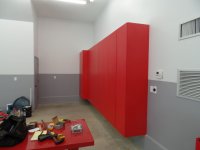
For those not following my garage build thread, here are some photos of the finished cabinets. We are having a family reunion this weekend and got help from the guys for mounting the cabinets to the wall. Actually, they took over and I only stood by to watch and offer occasional suggestions.

I really like the flush and smooth look of the cabinets and will likely leave the pulls off since the doors are easily opened by pulling them outward with your foot. We have the pulls and can mount them in the future if I change my mind. Since getting back into the car hobby only a few years ago, I do not have the kind of expansive collection of tools that many GJ members do. So, I should be able to get everything I have behind closed doors and keep the garage neat, clean and uncluttered as I like.

I started this thread to show there are alternatives to buying standard size and color cabinets and that you can design custom cabinets to meet your specific needs. And, every city in the country now has shops that can do this work for a reasonable cost. They are not the cheapest way to go but are less costly than the mid to high end garage cabinets now on the market. I have only shown one construction method but local shops make a variety of styles. One geared to DIY customers uses cam lock fittings for really fast assembly.

A previous post asked how much these cabinet planning programs cost and I have since found that Cabinet Vision sells a basic program for $1,000 that will produce plan, elevation and perspective drawings as well as giving a list of all required materials and a cut list and diagram of how the parts should be cut on your saw.

Glen
 

Attachments

  • SAM_2372.jpg
    SAM_2372.jpg
    122.1 KB · Views: 32
  • SAM_2380.jpg
    SAM_2380.jpg
    120.3 KB · Views: 29
  • SAM_2382.jpg
    SAM_2382.jpg
    127 KB · Views: 27
To avoid these ads, REGISTER NOW!
Top Bottom