To avoid these ads, REGISTER NOW!

AN Numbered Tools

Provincial

Well-known member
Joined
Sep 21, 2011
Messages
6,869
Location
Near Salem, OR
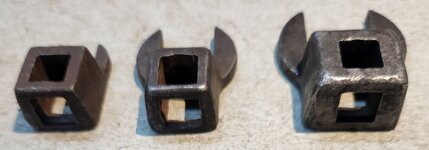
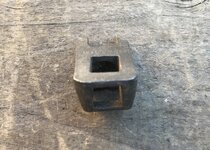
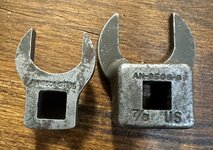
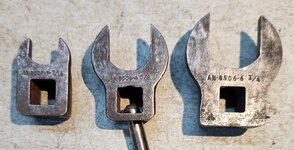
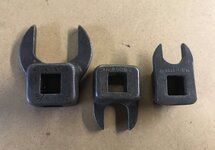
Someone posted a crowfoot wrench recently with an AN- number stamped on it. I identified it as US military. These are very distinctive crowfoots, because they have 3/8" square drives in two directions.

Here are photos of some that I have.
20240413_153258.jpg
Ignore the steel rod. It is just there to keep the 5/8" crowfoot from tipping over.
20240413_153317.jpgAN8506 end.jpg
The AN-8506- series begins with a -1, which has a 7/16" opening. The sizes appear to increase in 1/16" increments. These crowfeet are kind of flimsy, and I'm sure most of them were ruined by too much torque. I'm pretty sure that their original intended use was for hydraulic fittings.

These were made for the US military, and the AN- prefix stands for "Army Navy". This was active at least in the 1930's, and may even be older than that. I am aware of hydraulic fittings that were used in Douglas DC-3's that were probably chosen for use by Douglas in building the prototype DC-1, which flew in 1932. These were AC-810 and AC-811 series fittings. Even the last DC-3's used AC fittings in a few locations, while almost all others were updated to AN fittings.

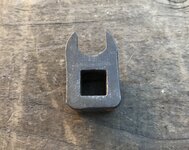
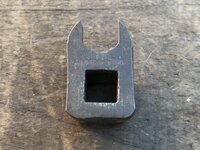
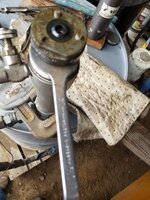
I also have an AN-8505 double open end wrench, which is very thin. These were probably used on hydraulic fittings and I've used mine on a very thin jam nut.
AN 8505 Wrench 1.jpg
AN 8505 Wrench 2.jpg

I'm starting this thread so people can post any other AN- tools they find, and it will show up in a search.

Please post your AN- finds here!
 
Last edited:
To avoid these ads, REGISTER NOW!
OP
P

Provincial

Well-known member
Joined
Sep 21, 2011
Messages
6,869
Location
Near Salem, OR
Edit:

Pvt. Lugnutz gives a much more accurate history of the AN standard in post #17 in this thread. This post centers on the aspects where it addresses aviation hydraulics.

AN is associated with hydraulics, especially a standard of fittings and hoses widely used in WWII. Here is the Wikipedia entry about AN thread, which is really a 60 degree thread with a 37degree flare :

https://en.wikipedia.org/wiki/AN_thread

A history of the AN fitting, courtesy of the Motion and Flow Connector Products website. Note the reference to the AC fittings, with a 30 degree flare instead of 37 degrees:

History​

Parker actually pioneered the flare fitting technology in the 1920s with the introduction of the inverted flare fitting followed by the Parker Triple Fitting in the early 1930s. They were adopted by the Air Corps, a part of the U.S. Army at that time, as AC-810 and AC-811. As the operating pressures increased, the inverted flare did not perform as well as the Triple Fitting, and its use started declining. The ease of manufacture of Triple Fitting provided additional advantages that resulted in its quick acceptance in various industrial and military applications. The Triple Fitting was a patented three-piece design similar to the current Parker Triple-Lok 37° flare fitting, except it had a 30° flare angle instead of the 37°. This fitting design was the forerunner of the current AN and SAE 37° flare fittings.

The U.S. Air Force, with help from Wright Patterson Air Force base, developed a fitting with 37° flare angle, before WWII, which became known as the "AN" fitting. This fitting had precision 3A/3B threads. The use of "AN" fittings proliferated from the 1930s through the 1960s to include most branches of the U.S. Military, Military Contractors, General Aviation, and Commercial Aviation. These fittings were even adopted for use in many land and sea applications of the U.S. Military as well, leading to confusion between AN and its industrial counterpart, the SAE 37° fitting. After the war, several versions of 37° flare fittings flooded the industrial market, creating a nightmare for the users. The Joint Industry Conference (JIC), an organization of manufacturers, decided to standardize on the "AN" design, except with 2A/2B thread class for ease in manufacturing. These fittings came to be known, throughout the world, as "JIC" fittings. The JIC wanted the prestige of SAE for the fitting standard. They convinced SAE to take on the task and helped in the development of the standard. Thus, the SAE standard 37° flare fitting became part of SAE J514 in 1950. The fitting became an ISO standard, ISO 8434, in 1986, replaced by ISO 8434-2 in 1996.
 
Last edited:
four.cycle

Well-known member
Joined
Oct 19, 2015
Messages
28,901
Location
Tacoma, Washington
^ I've seen those widgets in photos and wondered what they were for.
Just a wild guess, but I'm going to posit they didn't last a long time in service, for reasons which should be clearly obvious-
Be pretty easy to turn one of those into a pretzel with a 22-inch breaker.
 

Farmer J.

Well-known member
Joined
Sep 18, 2016
Messages
1,995
Location
UK, Cornwall/Hertfordshire.
Interesting thread (y)
I had a look at the few crowfoot wrenches I have, and just checked the current online Snap On catalogue, and it looks like every SAE crowfoot wrench they make starts with part number AN8508***
I presume a continuation of use of the original numbers?
Metric crowfoots are just numbered ANM**
 

Zrxrunner

Well-known member
Joined
Jan 14, 2018
Messages
522
Location
Eastern Iowa
I went until I was 44 years old without usimg a crowsfoot. Now I work on hydraulics and forklifts, and use them at least once a week. Getting into tight spots in the mast and on hydraulic hoses and fittings underneath framework on lifts.
 
OP
P

Provincial

Well-known member
Joined
Sep 21, 2011
Messages
6,869
Location
Near Salem, OR
From what I have observed, I am seeing the number sequence make sense. I'll start a list, and everybody chip in with examples, especially of unrecorded numbers.

Codes: X= Sample posted here
O= Example found online
S= Standard found

AN-8505 X, S Thin Double Open End Wrench, Offset
AN-8506 X, S Crowfoot open end
AN-8507 ,S Bar, Telescopic, 1 in. O.D. 43-3/4 Extended Length
AN-8508 O, S Crowfoot (tubing) 12-point
AN-8509 X Socket,
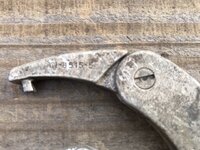
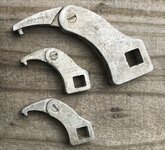
AN-8514 X, S Adjustable Pin Spanner Crowfoot
AN-8515 X, S Adjustable Hook Spanner Crowfoot

I did a search on the internet, and came up with this information, which seems to omit numbers that were obsoleted long ago:

AN1000 AN9999​

Welcome to EverySpec.com, your premiere source for free downloads of government and military standards, specifications, handbooks, and documents.
AN8500 (REV. 4) (NOTICE OF CANCELLATION), ARMY-NAVY AERONAUTICAL STANDARD: STAMP, INSPECTOR, AN, STEEL, IMPRESSION (28 OCT 1964)
AN8505
AN8505, ARMY-NAVY AERONAUTICAL STANDARD: WRENCH-THIN DOUBLE END OPEN END (20 APR 1944) [NO S/S DOCUMENT]
AN8507
A
AN8507 (REV. A) (NOTICE 1), ARMY-NAVY AERONAUTICAL STANDARD: BAR - TELESCOPIC (1 OD, 43-3/4 EXTENDED LENGTH) (15-SEP-1978) [NO S/S DOCUMENT]
AN8514
2
AN8514 (REV. 2), AIR FORCE - NAVY AERONAUTICAL STANDARD: WRENCH - 3/8 INCH SQUARE DRIVE ADJUSTABLE SPANNER (.75 TO 2 INCHES DIAMETER) (15 SEP 1981) [NO S/S DOCUMENT]
AN8515
2
AN8515 (REV. 2), AIR FORCE-NAVY AERONAUTICAL STANDARD: WRENCH - 1/2 INCH SQUARE DRIVE ADJUSTABLE SPANNER (1.75 TO 4 INCHES DIAMETER) (15 SEO 1981) [NO S/S DOCUMENT]
AN8516
A
AN8516 (REV. A) (NOTICE 1), MILITARY SPECIFICATION: WRENCH AND 1-2 INCH SQUARE DRIVE ADJUSTABLE SPANNER (3.5 TO 6 INCHES DIA) (10-OCT-1995) [NO S/S DOCUMENT]
AN8019
1
AN8019 (REV. 1), AIR FORCE-NAVY AERONAUTICAL STANDARD: TEE AND FLYER'S RELIEF TUBE (12 AUG 1954)
AN8019
1
AN8019 (REV. 1) (NOTICE 2), AERONAUTICAL STANDARD: TEE AND FLYER'S RELIEF TUBE (11 SEP 1998)
 
Last edited:

Private Lugnutz

Well-known member
Joined
Mar 30, 2012
Messages
30,574
Location
The Authentic Jersey Shore
These were made for the US military, and the AN- prefix stands for "Army Navy". This was active at least in the 1930's, and may even be older than that.
The Army-Navy Aeronautics Board was established by law in 1937. It was an aviation-focused offshoot of the Army-Navy Munitions Board, which was established in 1922. Same goal. Standardize as much as possible for interchangeability. They published "AN" standards. It didn't really take hold until 1942, though, when the Joint Army-Navy Committee for Specifications published something like 1,100 "AN" specs.
AN is associated with hydraulics,...
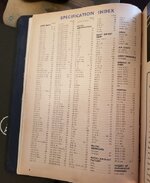
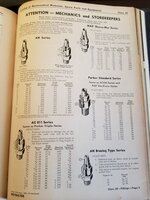
Not exclusively, Jock. I think you'll recall that I have a Navy Aviation Supply Office (ASO) "Blue Book."

20190428_063436.jpg

Most of the supply classes in here, dated mid- to late-war, or early postwar, are chock full of "AN" numbers. The committee specified everything from plywood to runway lighting and everything in between. Every supply class section is preceded by a stock number index that cross-references various Army, Navy, Manufacturers and other numbers, including "AN" type. Some examples...

Here's Class M-1's title page just to give you an idea of the types of things in it.

20240415_114231_resized.jpg

And here's the Spec Index page. Hard to read the individual numbers, sorry, but you can see the categories. The first two columns are all "Army-Navy" (AN) numbers!

20240415_114319_resized.jpg

...especially a standard of fittings and hoses widely used in WWII.
On that particular subject, you'll REALLY enjoy these scans.

20240415_114509_resized.jpg20240415_114523_resized.jpg20240415_114537_resized.jpg20240415_122157_resized.jpg
 
Last edited:

Private Lugnutz

Well-known member
Joined
Mar 30, 2012
Messages
30,574
Location
The Authentic Jersey Shore
I did a search on the internet, and came up with this information, which seems to omit numbers that were obsoleted long ago:
THIS LINK... is a complete list of wartime "AN" parts, in ascending order, by "AN" number (and description), from AN3-2 (Bolt, aircraft, #10-32) to AN8519 (Reamer, hand spiral rivet pilot). It includes tools, including the crow foot wrenches, but not only crow foot wrenches. EDIT: Missing lots of suffixes, though.

It's a November 1946 publication by the Dept of Commerce, Office of Technical Services, called Bibliography of Scientific and Industrial Reports. If the link doesn't take you to the right section, the "AN" list runs from page 589 to page 600.
 
Last edited:
Private Lugnutz

Well-known member
Joined
Mar 30, 2012
Messages
30,574
Location
The Authentic Jersey Shore
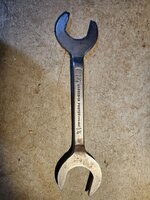
I have several wartime open end and box end crow foot wrenches, but they are either duplicates of what has already been posted, or PWA marked. I do have this interesting postwar 8505-13. Jock says he has one too, but he didn't say if it had a suffix, and if so, what it was.

20220715_142629.jpg
 
To avoid these ads, REGISTER NOW!

PSCo1867

Well-known member
Joined
Nov 11, 2020
Messages
306
Location
PA
Fantastic compilation & presentation of information in a very short duration. Interesting to finally learn about AN, from the basic to the deep-dive.
 

Private Lugnutz

Well-known member
Joined
Mar 30, 2012
Messages
30,574
Location
The Authentic Jersey Shore
Circling back to complete my inputs with the Navy ASO Blue Book..., oddly enough, the Class 41 section has no "AN" numbers. All the tools, including the crow foot wrenches, are listed only with N.A.F. numbers, mfgrs numbers, or FSNs. It's from 1944. It's possible that a later edition included them. As I said earlier, all my wartime Bonney crowfoot wrenches are PWA marked.
 

Attachments

  • 20240417_061321.jpg
    20240417_061321.jpg
    583.6 KB · Views: 36
  • 20240416_214834.jpg
    20240416_214834.jpg
    2.2 MB · Views: 17
OP
P

Provincial

Well-known member
Joined
Sep 21, 2011
Messages
6,869
Location
Near Salem, OR
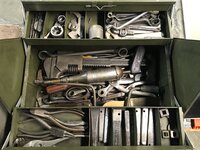
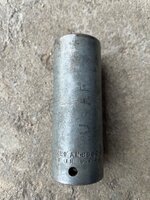
Coincidentally, today, while picking up a FB Marketplace $20.00 toolbox with tools not too far from Wright Patterson I found this old Plomb.
Mr. X, please inform us of the specifics of the socket so I can update the list in post #3. Thanks!

I like the other items in your pick, especially the hook spanner!
 

MR.X

Well-known member
Joined
Dec 13, 2010
Messages
1,792
Plomb AN-8509-1 7/8 .....I'm sure I have a couple more of these AN marked deep sockets on the West coast but they might be the same size.
 

bmwrd0

Well-known member
Joined
Nov 7, 2010
Messages
5,463
Location
Beaver Fever Oregon
Drill a hole through the top of the trunk, for the mounting stud. The underside is reinforced, so you cannot get a regular wrench on the nut to fix it, which needs to be very tight. So a crowsfoot on a breaker bar is inserted, the foot at a 90* angle. And, for those of you following at home, this is where the tommy bar comes in real handy, gives the leverage you need.
 
OP
P

Provincial

Well-known member
Joined
Sep 21, 2011
Messages
6,869
Location
Near Salem, OR
AN standards were applied in more ways than the prefix numbers indicate. I am familiar with the WWII versions of Pratt & Whitney R-985 450 HP aircraft radial engines that were used on a number of aircraft, in my case the Beechcraft Model 18 variants. These were twin-engine airplanes ranging between 7,000 and 9,000 pounds gross weight that served as trainers and support aircraft for the Army, Navy, and Marines. Each branch originally ordered a specific model of engine with their designation, but sometime around 1940-41 the Services decided to use the AN system to avoid confusion in purchasing similar variations of a common item, and they standardized the R-985 models with two variants, the R=985-AN1 and -AN3. These were close enough in practice that either could be used on the Beech 18 variants with Hamilton Standard 2D-30 variable-pitch propellers, and as constant-speed propellers when the proper governor was installed. The R-985-AN14B was a little different, and had provisions in the crankshaft to accommodate a Hamilton Standard 22D-30 propeller which could be feathered (turn the blades edge-on to the direction of flight) to reduce drag if an engine had to be shut down in flight. This involved a separate electric pump that overrode the normal system pressure to move the blades beyond the normal operating range. The AN-14B engines were also used on helicopters later on.

During WWII, the Aeroproducts Division of General Motors produced a feathering propeller that would work on the AN-1 and AN-3 versions, but these were never approved for civilian use.

The Army Air Force used the designation AT- for training versions, and C- for cargo. The Navy used the designation SNB- and I believe the Coast Guard did too. I flew an AT-11 some hauling skydivers. It was the bomber training version, and had a plexiglass nose area where the Norden bombsight was installed.
 

outofbounds

Well-known member
Joined
Oct 23, 2019
Messages
1,393
Location
Michigan
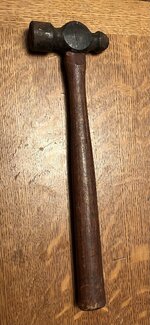
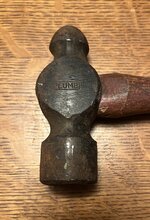
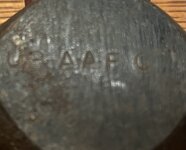
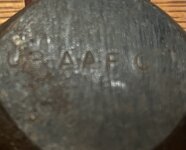
Not a "numbered" tool per se but this Plumb Ball Pein hammer is clearly mark with USAAFC. Fair to ascribe this as military GMTK related?

Apologies in advance if this is the wrong place for this hammer, but I could not find a sticky for plumb or GMTK
 

Attachments

  • IMG_8305.jpeg
    IMG_8305.jpeg
    771.2 KB · Views: 11
  • IMG_8304.jpeg
    IMG_8304.jpeg
    713.3 KB · Views: 10
  • IMG_8303.jpeg
    IMG_8303.jpeg
    226.8 KB · Views: 13
  • IMG_8303.jpeg
    IMG_8303.jpeg
    226.8 KB · Views: 16

RTM

Well-known member
Joined
May 13, 2019
Messages
13,164
Location
SF Bay Area
Apologies in advance if this is the wrong place for this hammer, but I could not find a sticky for plumb or GMTK
Here maybe?


Private Lugnutz

Well-known member
Joined
Mar 30, 2012
Messages
30,574
Location
The Authentic Jersey Shore
...clearly mark with USAAFC. Fair to ascribe this as military GMTK related?
The USAAF could very well signify US Army Air Forces, OOB, but I'm not sure what the "C" is supposed to mean. The most commonly seen abbreviations for US Army Air Corps and US Army Air Forces on tags, tools, and equipment, etc during WWII were AC, AAF, USAC, and USAAF. Either way, the WWII "GMTK" (Motor Vehicle Mechanics Tool-Set, and General Mechanics Tool-Set) was only issued to general mechanics in the Quartermaster Corps, which was responsible for all wheeled vehicle maintenance up to mid 1943, and the Ordnance Dept., which was responsible for all tracked vehicle maintenance throughout the war, and all tracked and wheeled vehicles after mid 1943. Air Corps hangar and flight line mechanics had a number of kits, but were most well-known for the large hip roof cantilevered boxes. They were not issued GMTKs.
 

Snaparxon

Well-known member
Joined
Aug 24, 2009
Messages
1,682
Location
Eastor
AN8505 thin wrenches appear to always be odd numbered. There are also identical shaped wrenches with a shiny finish and a little rougher edges marked Drew that drop the AN8505 but use the 1,3,5 etc. I also have a #1 wrench labeled Mechanicraft.

AN8505-1, 11/32" - 3/8"
AN8505-3, 7/16" - 1/2"
AN8505-5, 9/16" - 5/8"
AN8505-7, 11/16 - 3/4"
AN8508-9, 13/16" - 7/8"
AN8505-11, 15/16" - 1"
AN8505-13, 1-1/16" - 1-1/8"
AN8505-15, 1-3/16" - 1-1/4"
AN8505-17, 1-5/16 - 1-3/8"
AN8505-19, 1-7/16 - 1-1/2"
AN8505-21, 1-9/16" - 1-5/8"
AN8505-23, 1-11/16" - 1-3/4"
AN8505-25, 1-13/16 - 1-7/8"
AN8505-27, 1-15/16" - 2"
*AN8505-29, 2-1/16" - 2-1/8"*
*AN8505-31, 2-3/16" - 2-1/4"*
*AN8505-33, 2-5/16" - 2-3/8"*
AN8505-35, 2-7/16" - 2-1/2"
*AN8505-37, 2-9/16" - 2-5/8"*
*AN8505-39, 2-11/16" - 2-3/4"*
AN8505-41, 2-13/16" - 2-7/8"
AN8505-43, 2-15/16" - 3"
*not verified*
 
To avoid these ads, REGISTER NOW!
Top Bottom