To avoid these ads, REGISTER NOW!

Anchoring conduits in floor before slab pour?

Innovate1

Well-known member
Joined
Jul 28, 2014
Messages
4,288
Location
Illinois near St. Louis, Missouri
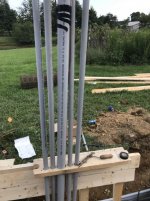
How do people anchor pipes and conduits so they don't move during slab pour? For several in one wall I am thinking I could strap them to a 2x4 to keep them in line. Or does the gravel keep them in position well enough? What about keeping them from moving when placing gravel. Is this just done by hand and they keep position?
 
To avoid these ads, REGISTER NOW!

larry4406

Well-known member
Joined
Jan 27, 2006
Messages
19,154
Location
Northern Virginia
I used a piece of rebar bent into a j-hook. Pound straight end into earth, hook conduit with other end, and Bob’s your uncle.
 

Terry D

Well-known member
Joined
Mar 25, 2015
Messages
2,202
Location
St. Louis, MO.
As long as they are under the gravel. That will hold them down. If you have stub ups out of the concrete, I drive a short piece of 1/2 emt next to it just below the surface and duct tape the stub up to it to keep it straight. As long as it is below the surface, you wont see it.

Sent from my SM-G960U using The Garage Journal mobile app
 

dcg9381

Well-known member
Joined
Jun 20, 2018
Messages
11,711
Location
Austin, TX
Here, I wire tie to rebar. Or I may tie into the framing of the foundation as long I'm not messing up the ability for them to float the finish surface.
Getting them secure is important... Course, the concrete crew just pulled out two of mine tonight, so secure yours better than mine... :)
 

larry4406

Well-known member
Joined
Jan 27, 2006
Messages
19,154
Location
Northern Virginia
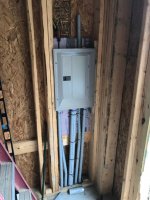
For my barn build, which is a turn down slab construction, I made a wood form to hold the conduits exactly where I wanted them. As the slab set up and conduits were firmly in place, the conduit form was released to finish troweling the slab.

My panel is flush mounted in the 2x6 wall.

The copper wire is the continuous UFER ground which is wire tied to the footing rebar cage and run direct to the panel without splice.

I have done similar conduit form to hold conduit in stem walls during pours for flush panels.
 

Attachments

  • Conduit Forms.jpg
    Conduit Forms.jpg
    92.1 KB · Views: 116
  • Conduit Forms - other side.jpg
    Conduit Forms - other side.jpg
    80 KB · Views: 93
  • Conduit Forms - removed to finsh slab.jpg
    Conduit Forms - removed to finsh slab.jpg
    131 KB · Views: 110
  • Conduits in Wall for Flush Panel.jpg
    Conduits in Wall for Flush Panel.jpg
    125.1 KB · Views: 104
To avoid these ads, REGISTER NOW!

Aceman

Well-known member
Joined
Jan 28, 2007
Messages
2,513
Location
Eastern Oregon
We always put the conduits at least a couple inches down into the dirt or gravel below the concrete.

We've seen too many cut through conduits when someone comes in and sawcuts the slab for one reason or another.

In some instances when it just isn't possible to get it down below the concrete level, we cut short pieces of 1/2" emt, maybe 18" or so, stick it into the hitch of pickup and bend it into the shape of a big staple. I like emt better than rebar because it's easier to bend, and when it's bent into a staple shape, it gives you a nice flat surface across the top thats easier to drive into the ground with a baby sledge versus the curved shape you usually get with rebar.

It also works well to hold groups of conduit because you can make it as wide as you need.
 

Norcal

Well-known member
Joined
Mar 16, 2008
Messages
13,753
We always put the conduits at least a couple inches down into the dirt or gravel below the concrete.

We've seen too many cut through conduits when someone comes in and sawcuts the slab for one reason or another.

In some instances when it just isn't possible to get it down below the concrete level, we cut short pieces of 1/2" emt, maybe 18" or so, stick it into the hitch of pickup and bend it into the shape of a big staple. I like emt better than rebar because it's easier to bend, and when it's bent into a staple shape, it gives you a nice flat surface across the top thats easier to drive into the ground with a baby sledge versus the curved shape you usually get with rebar.

It also works well to hold groups of conduit because you can make it as wide as you need.

Another reason to put them below, is the concrete can crack along the conduit run when in the slab.
 

Terry D

Well-known member
Joined
Mar 25, 2015
Messages
2,202
Location
St. Louis, MO.
How do people anchor pipes and conduits so they don't move during slab pour? For several in one wall I am thinking I could strap them to a 2x4 to keep them in line. Or does the gravel keep them in position well enough? What about keeping them from moving when placing gravel. Is this just done by hand and they keep position?

I am licensed in St. Louis County, I am sure you are going to get inspected on this. All the times that I have been inspected prior to the concrete, they do not want the conduit in the pour. So make sure they are below the gravel before the ground inspection.
 

59 wagon man

Well-known member
Joined
Oct 25, 2010
Messages
1,589
Location
hollywood fla
1/2" conduit cut into 3ft lengths pounded into ground,sometimes it was 2 pieces about a foot apart with a horizontal piece to strap the waste and water
 
OP
I

Innovate1

Well-known member
Joined
Jul 28, 2014
Messages
4,288
Location
Illinois near St. Louis, Missouri
I am licensed in St. Louis County, I am sure you are going to get inspected on this. All the times that I have been inspected prior to the concrete, they do not want the conduit in the pour. So make sure they are below the gravel before the ground inspection.

Was actually asking about vertical stub outs. Understand the need to keep horizontal runs under the slab. Currently building across the river in Illinois. Was told they didn't inspect under slab electrical, only plumbing. Maybe commercial property is different. Used thin wall metal conduit and taped the conduit stub outs to that. Also used that for plumbing.
 

Terry D

Well-known member
Joined
Mar 25, 2015
Messages
2,202
Location
St. Louis, MO.
Was actually asking about vertical stub outs. Understand the need to keep horizontal runs under the slab. Currently building across the river in Illinois. Was told they didn't inspect under slab electrical, only plumbing. Maybe commercial property is different. Used thin wall metal conduit and taped the conduit stub outs to that. Also used that for plumbing.

Yep, that's what I use. I bang the EMT down until its below the concrete surface and duct tape the PVC to it. Unless its inside a wall, then seeing the EMT doesn't matter.
 
To avoid these ads, REGISTER NOW!
Top Bottom