To avoid these ads, REGISTER NOW!

Anchors

omowright

Well-known member
Joined
Dec 2, 2015
Messages
82
Location
Freetown, Sierra Leone
Does it make sense to use, instead of the 4" drop-in anchors supplied by the manufacturer, two "double-ended" anchors? I am not sure about the integrity of my flooring.

Is a thicker slab and longer anchors (or more than one double ended anchors) better than the shorter ones supplied for 2-post lifts?

I saw some pictures of lift failures and have become apprehensive of lift fixtures ...
 
To avoid these ads, REGISTER NOW!

GMCGarage

Well-known member
Joined
Jan 31, 2017
Messages
1,264
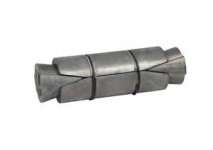
Whats a double ended anchor?

Your best bet is a chemical anchor, usually much stronger. a drop in will not spall the bottom of the slab out like a expansion anchor could.

How thick is your slab?
 

lakeroadster

Well-known member
Joined
Jan 19, 2015
Messages
5,166
Location
Central Colorado
Does it make sense to use, instead of the 4" drop-in anchors supplied by the manufacturer, two "double-ended" anchors? I am not sure about the integrity of my flooring.

Is a thicker slab and longer anchors (or more than one double ended anchors) better than the shorter ones supplied for 2-post lifts?

I saw some pictures of lift failures and have become apprehensive of lift fixtures ...
No it doesn't make sense, don't use a double anchor. Follow sberry's advice and follow the lift manufacturer's instructions.

Epoxy anchors are also a good choice, as GMCGarage mentioned. Contact your lift manufacturer and ask them what chemical anchor they recommend, and what thickness concrete is needed, for whatever anchor you choose.

On my Rotary lift the concrete requirement was 4-1/4" for mechanical anchors.. and 5" for epoxy anchors.

Whats a double ended anchor?

https://www.confast.com/products-double-expansion
 

Attachments

  • Double Expansion Anchor.jpeg
    Double Expansion Anchor.jpeg
    4.1 KB · Views: 36
Last edited:

Lootenny

Well-known member
Joined
Jan 6, 2014
Messages
105
I rented a hammer drill to use the drop in expansion anchors with my BendPak two post lift. It wasn’t until I went to drop in the anchor that I found out that the rental place had accidently given me a 7/8” Drill bit, not the 3/4” I asked for. The second side got drilled to the correct size, and I contacted BendPak about what to do. They said to get some 1/2” all thread and A7 epoxy. Hole prep is critical, you must blow it out and use a bore brush on it followed by more blowing to make sure all loose material is out. After, I can tell you the epoxied anchors feel much more solid than the expansion anchors.


Sent from my iPhone using Tapatalk
 
OP
O

omowright

Well-known member
Joined
Dec 2, 2015
Messages
82
Location
Freetown, Sierra Leone
I am still obsessed with the use of two anchors.

Should the drilled hole be made right through the slab in case I should want to punch out the anchors?

Is there room for innovation in this field? Whilst American manufacturers recommend 4" slabs, reputable European manufacturers recommend 8" (Wolf for instance). I have made an 8" slab and think 4" anchors are too small. I really was hoping that there will be some experienced guys in this vast forum, who have experimented with two anchors in one hole or with double expansion anchors ...
 

GMCGarage

Well-known member
Joined
Jan 31, 2017
Messages
1,264
I saw some pictures of lift failures and have become apprehensive of lift fixtures ...

I am still obsessed with the use of two anchors.

Is there room for innovation in this field? Whilst American manufacturers recommend 4" slabs, reputable European manufacturers recommend 8" (Wolf for instance). I have made an 8" slab and think 4" anchors are too small. I really was hoping that there will be some experienced guys in this vast forum, who have experimented with two anchors in one hole or with double expansion anchors ...


How about you call and discuss with the lift manufacture engineers? They could give you the loads, and then you could consult the other anchors engineers to see if its appropriate.

You already said you are apprehensive, why not do it right?
 

lakeroadster

Well-known member
Joined
Jan 19, 2015
Messages
5,166
Location
Central Colorado
I am still obsessed with the use of two anchors.

Should the drilled hole be made right through the slab in case I should want to punch out the anchors?

Is there room for innovation in this field? Whilst American manufacturers recommend 4" slabs, reputable European manufacturers recommend 8" (Wolf for instance). I have made an 8" slab and think 4" anchors are too small. I really was hoping that there will be some experienced guys in this vast forum, who have experimented with two anchors in one hole or with double expansion anchors ...

Innovation? Epoxy. Mechanical anchors add stress to the concrete, epoxy anchors don't. You can use 10" long studs if you want and get the full slab thickness engagement.

Whatever you do, it should be per the manufacturer's specifications. All reputable lift manufacturers can tell you what brand and type of epoxy they specify for their lift.

All that being said, the manufacturer their lifts and how it was deigned and manufactured better then anyone here on this forum. You chose to buy their lift, do you trust it's design and construction?
 

EOC_Jason

Well-known member
Joined
Jun 25, 2012
Messages
11,388
Location
Bentonville, AR
Epoxy... The concrete will fail before the epoxy if properly installed.

Much like how wood glue is stronger than than the wood it joins... The epoxy bond is stronger than the concrete...
 
To avoid these ads, REGISTER NOW!

rlitman

Well-known member
Joined
Oct 18, 2010
Messages
24,601
Location
Long Island
Innovation? Epoxy. Mechanical anchors add stress to the concrete, epoxy anchors don't...

That's not necessarily a problem.

Epoxy... The concrete will fail before the epoxy if properly installed.

Much like how wood glue is stronger than than the wood it joins... The epoxy bond is stronger than the concrete...

Do you have in-slab heat? Adhesive fasteners suffer from creep. This is exacerbated by elevated temperatures. Not all adhesive anchors are rated for sustained loading. That's not necessarily an issue with a lift, but if the lift's stability is at all dependent on preloading the anchor, it could be.
 

lakeroadster

Well-known member
Joined
Jan 19, 2015
Messages
5,166
Location
Central Colorado
Do you have in-slab heat? Adhesive fasteners suffer from creep. This is exacerbated by elevated temperatures. Not all adhesive anchors are rated for sustained loading. That's not necessarily an issue with a lift, but if the lift's stability is at all dependent on preloading the anchor, it could be.

I hate to sound like broken record but lift owners need to follow the lift manufacturers recommendation.

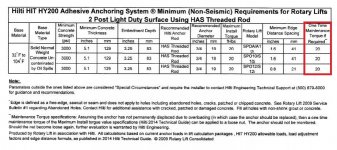
Here's what I learned from Rotary Lift and Hilti.

Creep is not a problem for a lift. Creep happens with high loads. The nuts only need to be snug, not loaded high enough for creep to be an issue.

As for "a stability issue"... if their is a stability issue with your lift, you've done something incorrect.

attachment.php
 

Attachments

  • Rotary Spec for Hilti HY200 Epoxy.jpg
    Rotary Spec for Hilti HY200 Epoxy.jpg
    98.4 KB · Views: 369
Last edited:

Ben W

Well-known member
Joined
Oct 20, 2008
Messages
67
Location
NY
In tension an anchor can fail in three ways -
1) the steel can yield (think stretch or break)
2) the steel to concrete engagement can fail (think of the steel anchor pulling out of the concrete hole)
3) the concrete can fracture (think a cone shaped concrete lollipop pulling coming up with the anchor still attached)

Hilti or whoever is supplying the anchor has considered each of the failure modes and bases their recommended depth off of the critical failure mode. If you can meet all of their criteria, then you're all set. And to put you more at ease, they're probably working with a factor of safety of somewhere around 3.

The reason I'd consider going deeper would be if the surface of your concrete is in poor condition (cracked, spalling, soaked in oil). They want you to have the full design depth of sound concrete.
 

rlitman

Well-known member
Joined
Oct 18, 2010
Messages
24,601
Location
Long Island
I hate to sound like broken record but lift owners need to follow the lift manufacturers recommendation.

Here's what I learned from Rotary Lift and Hilti.

Creep is not a problem for a lift. Creep happens with high loads. The nuts only need to be snug, not loaded high enough for creep to be an issue....

Exactly! The lift manufacturer's have done the engineering.

As for creep, I agree that a lift should be sitting on the floor, with the bolts only tight enough to keep it from moving. And I'm guessing that all of the major manufacturers have called for that (you've quoted one). What I don't know for sure, is if some fly by night has engineered some asymmetric monstrosity that does require preload. I certainly hope not, but at least, if that were the case, the manufacturer would clear it up in the instructions.

However, note that Hilti only lists up to 104F. That's awfully close to the water temperature in in-slab heating. Now we all know that the tubes shouldn't be near where you're drilling, so again, this is probably not a big concern, but not all adhesive anchors will necessarily list the same maximum temperatures, and this is something you need to look at.
 
Last edited:

firebirdparts

Well-known member
Joined
Jun 8, 2016
Messages
10,619
Location
Kingsport, TN
Well, I say don't overdo it when you are making up the facts. The wedge anchors require a lot of preload, whether we like them or not. Better to be succinct. The epoxy and the wedge are two different sets of instructions. Better to get both sets from the manufacturer. FWIW.
 
Last edited:

Lootenny

Well-known member
Joined
Jan 6, 2014
Messages
105
However, note that Hilti only lists up to 104F. That's awfully close to the water temperature in in-slab heating. Now we all know that the tubes shouldn't be near where you're drilling, so again, this is probably not a big concern, but not all adhesive anchors will necessarily list the same maximum temperatures, and this is something you need to look at.


You’re never going to get the slab temp anywhere near 104F. I keep my shop at 64F, and I work in a tee shirt. The water circulating around rarely gets above 80F. Even with ambient temps above 104F, the mass of the slab won’t get that hot as it will be radiating the heat out all night.

Denny, has radiant slab and epoxy lift anchors.


Sent from my iPhone using Tapatalk
 
OP
O

omowright

Well-known member
Joined
Dec 2, 2015
Messages
82
Location
Freetown, Sierra Leone
Our weather is usually 40+ degrees Celsius in the dries and same for many days in the wet season. Plenty of heating, cooling, wet, and drying. I expected the rebar and aggregates (I used 1/2" granite) should help with creeping. But is the main reason I want to use two instead of one anchor in each hole. The "cones" will have different apices and spread into different areas of the slab with about equal strength.

The Europeans experiment a lot but don't have forums like this one. And in West Africa, we improvise a lot with luck. I want to be a little more safe ...
 

GMCGarage

Well-known member
Joined
Jan 31, 2017
Messages
1,264
Our weather is usually 40+ degrees Celsius in the dries and same for many days in the wet season. Plenty of heating, cooling, wet, and drying. I expected the rebar and aggregates (I used 1/2" granite) should help with creeping. But is the main reason I want to use two instead of one anchor in each hole. The "cones" will have different apices and spread into different areas of the slab with about equal strength.

The Europeans experiment a lot but don't have forums like this one. And in West Africa, we improvise a lot with luck. I want to be a little more safe ...

Run the numbers on both anchors. You have steel failure, pullout failure, concrete failure all to check. Some anchors are not apples to apples comparison, some may have a different failure mode than others.

Its alot of work, but then you can decide which anchor gives you the best factor of safety.

Start with your concrete, look at your test results for the slab and see what it was test to. You buy 3000psi, but it might test out to 4000 or higher.
 

Coach James

Well-known member
Joined
Jun 24, 2005
Messages
8,933
Location
Sandhills of North Carolina
This is an interesting thread to me. I don't have a lift, but in my gym we do use floor anchors for gymnastics equipment. We just finished drilling a series of 1.5" diameter holes 4" deep to put in anchors for a new high bar.

The coolest part of this thread is that someone from west Africa is having an online discussion with people from North America.

Coach
 
To avoid these ads, REGISTER NOW!
Top Bottom