Let's take a step back.
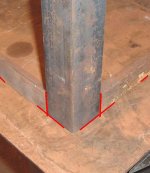
Strength is simply not an issue for the junction between the border pieces for the top of a bench. The important joint -- from that perspective -- is going to be the one that joins the legs to the top frame, along with what other type of support the legs might get (lower crossmembers, diagonals, etc.).
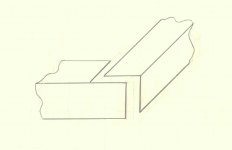
That said, the interlocking joint has one advantage over a miter joint. It's less likely to tear open like a zipper if you were prying the two pieces apart. A weld is theoretically as strong (or stronger) than the metal it joins. In practice, that's often not the case (we'd all like to be theory-level perfect welders, but we aren't). Interlocked seams might not fail in the same kind of zipper-like fashion (meaning: one straight-line seam that can be opened a millimeter at a time instead of having to fail all at once).
Then again, I'm not an engineer. So I could be way off base.
But as I said, the corner really gets no stress at all. I mean, you're attaching a top to this thing, right?