I'm having trouble following you. My post to your thread a few days ago produced no information? Seriously...I appreciate the compliment! I've copied and pasted it below. What kind of research did you do on the Atlas and Puma Compressors?
While it's nice acquiring manuals, parts lists, etc. I'd be hesitant on ripping into the compressor itself. I'd assume parts due to vintage are long obsolete and once head gaskets and o-rings get torn up, now they must be custom made.
A few months back I helped a friend get an old Kellogg 5HP 2-Stage compressor from the early 60's up and running. All we did was drain the oil and replenish with new synthetic compressor oil. Sometimes the best approach is "if it ain't broke, don't fix it".
http://www.garagejournal.com/forum/s...d.php?t=113115
With respect to what RPM to run the compressor at, it's really dependent upon how long you want the compressor to last or what CFM you want it to produce (to a certain degree of course). Most will concur the slower the compressor RPM, the longer it will last. Most reciprocating compressors spin anywhere from 700 RPM up to 1500 RPM (from what I have seen). For instance, my IR 2475N5 compressor spins at 1000 RPM and puts out 16.8 cfm. That same compressor IR2475N7.5 coupled to a 7.5HP motor spins at 1450 RPM and puts out 24 cfm.
Now the million dollar question, how fast to spin the compressor and what size motor to use. The simple route would be to do some research on other current manufacturers products. There are still 3-stg single stage compressor suppliers out there. Atlas and Puma are a few I found with a quick web search. You'd have to find a comparable compressor that has equivalent bore/stroke and find out at what RPM the compressor spins and what HP rating/RPM the motor is. Once that is established, you can work backwards to calculate motor pulley size based on diameter of flywheel on your compressor.
Per engineeringtoolbox.com (
http://www.engineeringtoolbox.com/ai...pes-d_441.html) 1HP ~ 4 cfm @ 100 psi.
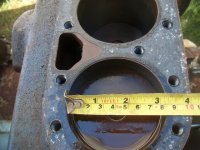
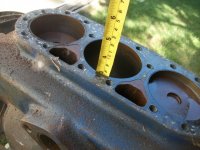
I calculate volume of each cylinder bore to be 0.01435 ft3 based off of 3.25" bore x 3.00" stroke. Multiply by 3 cylinders and you have 0.04305 ft3 total volume. If I'm doing my math correct and assuming pump spins at 700 RPM/2 x 0.04305 ft3 = 15.067 CFM. I divided pump RPM by 2 since pump cylinder only compresses air every other revolution of the crankshaft.
I'm sure the mechanical engineers will hop on here and provide a more realistic equation to calculate this.
Steve