To avoid these ads, REGISTER NOW!

Another Mystery Tool?

KesterHouse

Active member
Joined
Nov 27, 2012
Messages
34
Location
Massachusetts
Hi ho,

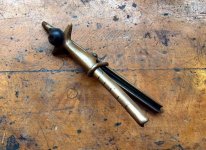
I posted a tool passed to me by a neighbor the other day here, and you folks identified that in less than 10 minutes. I showed him what you said it was (even printed out that wonderful ad) and gave it back to him today. He then gave me this thing...

This was found in his long past uncle's box of stuff collected by his father 30 years ago when he passed. His uncle worked as an ironworker, as well as a wooden boatbuilder, and was an avid saltwater sport fisherman in the 50s and 60s. That's all he knows about it. It appears to be solid brass, and has a rubber knob on the bottom of it. The handles are spring loaded, and can be held open in a number of positions by squeezing, then sliding the ring to engage on the notches on the handle. I added a 6" rule to the photos to help give a sense of scale.

Is it a tool? Is it some thing for fishing? Anyone?

-JeffK
 

Attachments

  • brass_thing1.jpg
    brass_thing1.jpg
    115.1 KB · Views: 417
  • brass_thing2.jpg
    brass_thing2.jpg
    121.8 KB · Views: 413
  • brass_thing3.jpg
    brass_thing3.jpg
    121.9 KB · Views: 406
  • brass_thing4.jpg
    brass_thing4.jpg
    113 KB · Views: 344
To avoid these ads, REGISTER NOW!

Outlawmws

Well-known member
Joined
Aug 9, 2011
Messages
39,156
Location
The Badlands
I would say something for fishing, boat building or possibly working with rope. Clearly a spreader, and it has the lock for keeping it open. Maybe for working with larger ropes, when splicing and the like
 
Last edited:

onewaydave

Well-known member
Joined
Sep 28, 2009
Messages
961
Location
Down the road from Dorothy and Toto
Closest to a medical device I could get to would be a bander. To slip those tight rubber bands on guys that shouldn't be allowed to reproduce.

But I'll wait patiently until someone comes up with the correct answer.

Dave.
 

Danglerb

Well-known member
Joined
Sep 6, 2007
Messages
9,736
Location
SoCal
Features;

Medium size for pliers, 8" overall
Brass
squeezing grips open jaws.
Stop or cross bar on jaws.
Rubber bumper on bottom jaw.
Inside of jaw is smooth, suggesting that is the working surface.
Spring closes jaws.
Outer ring limits jaw closing, holds jaws open against spring.

Nothing comes to mind that requires all of those features.
 
OP
K

KesterHouse

Active member
Joined
Nov 27, 2012
Messages
34
Location
Massachusetts
Not sure why I thought of this, but what about some manner of piano, pipe organ, or other musical instrument tool? That depth stop/cross bar and rubber bumper are the things that lead me away from some manner of marlin-spike or cable splice tool.

It doesn't have anything to do with the fellow that had it, but the history is pretty much unknown anyway. Keep those ideas coming - we'll figure this out eventually!

-JeffK
 

dj spanners

Well-known member
Joined
Jul 20, 2010
Messages
105
Location
uk
seen as fishing and spreader seems to the theme here, maybe its used for keeping a fishes mouth open while hook is removed, mainly those with very sharp teeth
 

nimbleVagrant

Member
Joined
Dec 22, 2012
Messages
16
It's certainly an esoteric piece.

With that rubber bumper I'd guess this tool is interfacing with a surface or material that shouldn't be damaged. Couldn't say if that's an aesthetic or mechanical requirement. I'd be interested to know how that bumper is attached; whether it was meant as a consumable or if it's expected to last the life of the tool.
 

Steevo

Well-known member
Joined
Aug 18, 2009
Messages
8,738
Location
43.49600, -112.04300
I think Kesterhouse is focusing on the pertinent aspects of the tool.
1. T-shaped depth stop that limits insertion distance.
2. Rubber bumper is for keeping the tool a specific distance off a surface when used. (is that rubber or wood?)

These features would indicate the tool slides into a slot in something, up to a specific depth.

Then we look at features 3, 4, and 5.
3. Jaw is spring loaded to close down against the platen of the t-stop, probably not to hold something, but to set the upper jaw into it's starting position for whatever operation is performed.
4. Handle has sliding lock, with multiple stops which would place the upper jaw at several different heights above the lower t-shaped jaw.
5. Upper jaw has a purpose-built groove along it's top surface. This appears to be to cup whatever is being raised by squeezing the handles together.

So, you slide it into a slot just the width of the rubber bumper, to the pre-set depth of the T-stop, squeeze the handle to spread/raise something that mates with the slot in the top jaw, lock it into place to hold it there, and then perform whatever task this i meant to enable.

I'm still stumped.
 
Last edited:
OP
K

KesterHouse

Active member
Joined
Nov 27, 2012
Messages
34
Location
Massachusetts
(...)
2. Rubber bumper is for keeping the tool a specific distance off a surface when used. (is that rubber or wood?)
(...)

It is rubber and not wood or hard plastic. Someone else wondered what the connection method was for that rubber to the handle - I'll have to get another look at it to verify if it's glued, or has a threaded connection (I gave the tool back to the owner as soon as I finished snapping a few photos).

While looking through lots of wrenches and pliers image searches yesterday I ran across "The Wrenching News" site. I'll fire an email off to those guys and see if they have any ideas as well.

-JeffK
 
OP
K

KesterHouse

Active member
Joined
Nov 27, 2012
Messages
34
Location
Massachusetts
Another update: The tool owner called this afternoon to see if we'd made any progress (and I gave him the bad news). I asked about the rubber bit, and he says it appears to be threaded into the bottom handle, as he can just make out the end of what appears to be a steel shaft on the opposite side of the rubber.

So, captive blot of some sort with the rubber molded around it. He didn't try to loosen it for fear of breaking it off, which is perfectly understandable. I also asked if his uncle was a musician back in the day, and he said he was in a band, and had his old autoharp in the basement as well. Perhaps this is some kind of musicians tool after all?

No response yet from The Wrenching News of course. I also took a look through many pages of Antique Piano Tools at the Mark Shepard Piano website, but didn't see anything close. Lost Art Press is coming out with a book next year that catalogs all the contents of the H.O. Studley tool chest... perhaps there's one of these in there too?

That is all,
-JeffK
 

Conductor562

Well-known member
Joined
Oct 2, 2012
Messages
2,312
Location
West "By God" Virginia
I think we can rule out a fishing item. A fishing appliance would have no need for the rubber pad. The fact that its made of brass is what's peculiar to me. Brass was a more commonly used metal in the past, but never a real common material for tools unless it was being used for an application where they were shooting for spark or corrosion resistance. Corrosion resistance would be key in some fishing applications, but again, the rubber pad just rules it out in my mind.
 

nimbleVagrant

Member
Joined
Dec 22, 2012
Messages
16
My guess is it would take someone familiar with turn of the century washing machine repair or whaling harpoon maintenance or some equally specialized trade to identify something like that.
 
To avoid these ads, REGISTER NOW!

rick carpenter

Well-known member
Joined
Jan 20, 2011
Messages
3,773
Location
Huntsville, East Texas
I can't afford regular health insurance, so I go with a guy working out of the back of his van. He used this on me for my colonoscopy. I'm going to someone else for my root canal tho.
 
OP
K

KesterHouse

Active member
Joined
Nov 27, 2012
Messages
34
Location
Massachusetts
Hi ho,

My first guess was a fid or marlinespike as well, but that depth stop and rubber bumper on the bottom jaw seems very out of place for such a tool. Also, I don't get why there'd be a notch in the top of the upper jaw when the locking spring action appears to be there to allow the user to perform some function on whatever is between the jaws when the tool is locked open.

Either that or it engages some kind of sprung or loaded component and pushes it up while the tool sits on some surface that you don't want to scratch, and allows you to work on the other end of the loaded component (like some manner of valve adjuster, for example).

@Steevo - It could very well be Bronze or Beryllium for all I know. Perhaps it's something for use in the gas industry to make repairs or adjustments in explosive environments?

An upholstery tool is certainly within the realm of possibility too, but that rubber pad makes me think it's a 20th century tool, not 18th or 19th.

-JeffK
 

burgie

Well-known member
Joined
Mar 26, 2007
Messages
239
Location
Falcon, Colorado
This is probably gonna make people laugh but when I first saw the pics it looked like a rather large staple puller.

But then I got to thinking...cedar strip canoes and other small wooden boats are glued and nailed and frequently employ the use of staples to hold the strips and/or planks together. I wonder if this may be some type of staple (or similar fastener) remover? That bumper would cushion the device against the wood and the scissor grip would afford the necessary leverage to pluch the staple from the wood?

I know...I know...what have I been smoking...but I figured I'd throw it out there :D:D:D
 

Danglerb

Well-known member
Joined
Sep 6, 2007
Messages
9,736
Location
SoCal
Does look more bronze than brass to me too.

Is the spring strong enough to consider it any kind of clamp?
 

JeepinMike

Well-known member
Joined
Jan 11, 2007
Messages
67
Sprinkler tongs. Used to stop the water flow of an activated sprinkler head.


-mike
 
Last edited:

omr

Banned
Joined
Jun 1, 2011
Messages
723
AAHHH!!! Stick it in the sprinkler, give it a squeeze, then slide the ring back to keep pressure on..lol
 
OP
K

KesterHouse

Active member
Joined
Nov 27, 2012
Messages
34
Location
Massachusetts
Wow! I knew someone would figure it out eventually! It all makes sense now, doesn't it? Very nicely done, JeepinMike. Can't wait to let the tool owner know what it is. Wonder if his uncle was a volunteer firefighter at some point, and that's why he had it?

Thanks again to all who contributed to figure this one out.
-JeffK
 

bullnerd

Well-known member
Joined
Sep 17, 2012
Messages
5,690
Location
Jersey
So,how many of these would one carry?

Arent there many sprinkler heads per room of a building?
 

Outlawmws

Well-known member
Joined
Aug 9, 2011
Messages
39,156
Location
The Badlands
So,how many of these would one carry?

Arent there many sprinkler heads per room of a building?

I would guess no more than one or two per man, as you aren't going to use it on every sprinkler; probably just in a room or area cleared for a "staging area" while they fight the rest of the fire. Possibly to minimize damage to what is in a particular room if they were so inclined.
 

Danglerb

Well-known member
Joined
Sep 6, 2007
Messages
9,736
Location
SoCal
Whats odd is that it seems like these are both considered "antique" and maybe still in use. Google is VERY little help, but could be its one of the many things that are not sold on the net, but only through old school channels to fire depts.

The idea behind sprinkler tongs or sprinkler wedges is to turn off the sprinklers that opened automatically in areas that the fire is out so water damage is minimized, but without turning off the main valve to the sprinkler system, which apparently requires some level of authority to do.
 
To avoid these ads, REGISTER NOW!
Top Bottom