To avoid these ads, REGISTER NOW!

Another Wet Concrete Floor Thread ----- Need advice -------------

brettd85

Active member
Joined
Oct 29, 2006
Messages
34
Have a 32x40 shop but the floor is often damp. I have excellent drainage around the shop so figured it was condensation. I had it insulated and sheet rocked thinking that would take care of the condensation by stabilizing the temperature. Well now its summer, completely dry outside so I don't think its water pressure below. The shop is very well insulated because I walk in on a hot July day and its much cooler inside but the floor is still wet. I leave a ceiling fan running 24/7 but floor is still damp. I do have an in floor drain that constantly has some water sitting in it. Could it be the drain?? Should I fill it in? What else could I do? Dehumidifier? I store classic cars and a wet floor is not ideal. :dunno:

Thanks for your help!

Heres some pics of the shop:

shop_zpsa2e3744a.jpg

photo1_zpsf2296a8c.jpg
 
Last edited:
To avoid these ads, REGISTER NOW!

A_Pmech

Well-known member
Joined
May 8, 2007
Messages
8,002
Location
IL
I'd begin by measuring the floor temperature. If it's below the dewpoint on days when you notice the floor becoming damp then that's the cause.
 

BillK

Well-known member
Joined
Aug 24, 2006
Messages
9,295
Location
Beautiful Southern Maryland
Brett,

You did not mention where you are located, but I am thinking the only way you are going to cut down on the humidity is with AC or at least a dehumidifier.

Have you put a humidity meter in the garage to see what the humidity really is ? Cut out a 2ft square piece of clear plastic and tape it to the floor. Make sure you tape it down on all edges real good. Pull it up after a day and see if it is wet under it. If so there is a good chance the moisture is coming up through the floor.
 
OP
B

brettd85

Active member
Joined
Oct 29, 2006
Messages
34
THanks, guys. I'm in Seattle, Wa. I'll try the tape plastic method. Its been pretty dry lately and about 70-80 degrees outside, usually 10-15 degrees cooler in the shop.
 

nehog

Well-known member
Joined
Jan 2, 2010
Messages
7,935
Location
Jaffrey, NH
I'd throw a big dehumidifier in there and see if it helps...

Or, if you have the ability and the toy(s) measure the dew point, and the slab temperature. That will tell you if the slab is having condensation problems, or seepage.
 

EpoxyCoat2

Well-known member
Joined
Jun 11, 2014
Messages
81
If moisture is coming up through the floor, you can purchase a Vapor Gauge Test to determine exactly how much moisture.

Brett,

You did not mention where you are located, but I am thinking the only way you are going to cut down on the humidity is with AC or at least a dehumidifier.

Have you put a humidity meter in the garage to see what the humidity really is ? Cut out a 2ft square piece of clear plastic and tape it to the floor. Make sure you tape it down on all edges real good. Pull it up after a day and see if it is wet under it. If so there is a good chance the moisture is coming up through the floor.
 

pauls340

Well-known member
Joined
Jan 27, 2009
Messages
321
Location
North of Motown
Brett, the root of your problem is the moisture in your concrete. The MVE or moisture vapor emission is coming out of your slab do to a number of reasons; air temp vs. slab temp, humidity, diff-head pressure under the slab, etc, but the root of the problem is the 32 gallons of water/ cyd used at the Batch Plant to mfg concrete. Your slab uses only 15 of those gallons to actually make a cyd, leaving 17 gallons of Free Water to wreck havoc in our lives. Understand, there is nothing the Batch Plant can do short of using a water vapor reducing admixture in the mix design to prevent that MVE. Please don't spend a penny on any moisture meter or god forbid a calcium chloride test. All those will give you is a #, that you probably won't know what to do with, and you will still have the problem, but you will be poorer. You can entertain yourself and tape a sandwich bag on the slab and see the moisture the next day, I've done it in my attached garage. I used a WVRA in my detached garage and there is ZERO moisture, anywhere on that slab. Even under the anti-fatigue mats....4 years later and counting. I researched the hell out of WVRA's before I went with Vapor Lock 20/20 by specialty products group. I'm using their topical system coming up in the attached garage. Good luck:thumbup:
 
OP
B

brettd85

Active member
Joined
Oct 29, 2006
Messages
34
Bumping up my super old thread. I still have the shop. I have a humidifier, heater, and a fan that runs 24x7. The garage floor stays dry with all of that but I get alot of white powder coming up through the concrete. This is year round and is coming up throuhg the concrete, it is not condensation. It gets all over my shoes, I drag it into cars etc. Any ideas? I was thinking about just getting some vinyl garage mats. Yes they will stay went underneath but I dont see the harm in that?
 

Shea

Well-known member
Joined
Sep 19, 2012
Messages
2,863
Location
California
Bumping up my super old thread. I still have the shop. I have a humidifier, heater, and a fan that runs 24x7. The garage floor stays dry with all of that but I get alot of white powder coming up through the concrete. This is year round and is coming up throuhg the concrete, it is not condensation. It gets all over my shoes, I drag it into cars etc. Any ideas? I was thinking about just getting some vinyl garage mats. Yes they will stay went underneath but I dont see the harm in that?
The white powder is efflorescence. With all the active remediation efforts, the moisture traveling up through the slab is evaporating as soon as it nears the surface. As it travels up through the slab, it picks up and carries various concrete minerals and fines with it. When it evaporates, those minerals are left behind in the form of the white powder.

Out of curiosity, did you ever treat the concrete with a densifier?
 
OP
B

brettd85

Active member
Joined
Oct 29, 2006
Messages
34
Agree that it’s efflorescence. No I did not treat the concrete. Is that something than can go on afterwards? For some reason I thought it had to be in the mix. I’ll do some searching.
 
OP
B

brettd85

Active member
Joined
Oct 29, 2006
Messages
34
The dissolved minerals can be swept up and rinsed away.
But they just come back. I'm constantly sweeping up white powder.

Did some reading on the densifier. Is that something I should try? Looks like I can just pressure wash the floor, then roll it on. Doesnt appear extremely expensive.
 
OP
B

brettd85

Active member
Joined
Oct 29, 2006
Messages
34
In more reading seems like a sealer would work?
Like spec shield - SpecShield WB is a 100% reactive, waterborne silane-siloxane sealer.

or

MasonryDefender 1 Gallon Penetrating Concrete Sealer for Driveways, Patios, Sidewalks - Clear Water-Based Silane Siloxane Sealer Waterproofer with De-Icing Salt Protection​


Shea

Well-known member
Joined
Sep 19, 2012
Messages
2,863
Location
California
Agree that it’s efflorescence. No I did not treat the concrete. Is that something than can go on afterwards? For some reason I thought it had to be in the mix. I’ll do some searching.
I posted an article below that explains how they work along with a link to a quality product we recommend. They can also do fairly well slowing down moisture intrusion from below the slab.

 
To avoid these ads, REGISTER NOW!
OP
B

brettd85

Active member
Joined
Oct 29, 2006
Messages
34
OK thanks, both. I'll look into the densifier and maybe do a test section.
 

ConCretin

Well-known member
Joined
Jan 20, 2011
Messages
3,378
Location
Central Maine
I'm not sure what you are seeing is efflorescence but rather dusting. As mentioned previously, efflorescence is dissolved salts being brought to the surface by moisture whereas dusting is caused by abrasion of a weak concrete surface. This occurs if the mix is too wet, bleed water is worked back into the surface or water is added during finishing. The result is a high ratio of water to cement in the surface paste and a weak cap. Efflorescence will usually exhibit as isolated deposits on the surface while dusting is a general chalkiness that shows when you sweep.

IThe solution may be similar in that you want to seal and hopefully strengthen the surface by applying a densifier and sealer.
 

C-S-H

Well-known member
Joined
Jan 18, 2024
Messages
144
I think you have two problems to solve, in this order:

1. Water issue
2. Poor quality permeable concrete (high mix water, no pozzolans, etc.)

Solutions:

1. The water is coming from somewhere. Surface water from rain entering foundation, ground water, plumbing/sump, condensation, etc.
2. The efflorescence is largely calcium hydroxide, and is indication of no pozzolans (fly ash, slag, etc.) in your concrete mix. Big mistake especially since type F fly ash is much cheaper than the portland cement it replaces. The silicate type sealers react with the calcium hydroxide much the same way as the missing pozzolans were supposed to, but only treat the concrete near the surface. I would use one of these silicate densifiers.
 
OP
B

brettd85

Active member
Joined
Oct 29, 2006
Messages
34
I ordered the PS104 Densifier and will let the group know how it goes. Thanks all for the input.
 
OP
B

brettd85

Active member
Joined
Oct 29, 2006
Messages
34
Cleaned half the shop, spot cleaned grease, pressure washed, and applied one coat of PS104 yesterday. Seems to have absorbed it. Will take a photo and upload to the thread. Hopefully it works! Then I will do the other half of the shop.
 
OP
B

brettd85

Active member
Joined
Oct 29, 2006
Messages
34
One coat is all I should need right? Some spots came out with a bit of a sheen, other areas look dry. A few white areas where it may have pooled some.

IMG_5381.jpeg
 
OP
B

brettd85

Active member
Joined
Oct 29, 2006
Messages
34
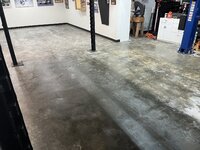
Still having trouble with white powder all over the floor even after the surface densifier and sealer. Any ideas?

floor.jpg
 

ConCretin

Well-known member
Joined
Jan 20, 2011
Messages
3,378
Location
Central Maine
As I mentioned in an earlier post, you have dusting. Sealers and densifiers can sometimes mitigate the symptoms but they can't fix the underlying problem. Unfortunately there is no solution other than removing the compromised concrete surface and that is obviously complicated. I'm afraid there is no easy answer to your problem.
 
Last edited:

C-S-H

Well-known member
Joined
Jan 18, 2024
Messages
144
Looking at the photo in post #22, your concrete looks to be severely low quality. Maybe it was retempered rejected concrete from another project. Hopefully you gave it all the densifier that it could drink. Sweep up a small test sample of the white dust and mix it with some vinegar and tell us what you see.

How old is this slab? What materials are under this slab? Are you over a spring or on a sand strata between clay layers or at the base of a hill? You need to dig some test holes around the garage to see what is going on.
 
OP
B

brettd85

Active member
Joined
Oct 29, 2006
Messages
34
It looks that bad??? I've lived here 11 years. I'm not sure when the shop was put in, I would guess 2005 ish? Unfortunately I dont know the history of the slab. The shop is at a lower point in my property, surrounded by asphalt, but behind the shop it grades down to some wetland/drainage type areas. I did probably 2-3 coats of densifier but it wouldnt absorb into alot of it, just sat on the surface.
 

JohnS

Member
Joined
Jan 12, 2008
Messages
13
Suggest you purchase a couple of test kits to check the water vapor coming through the floor . You can purchase from a local Geotech Testing firm . Geotech can give you the acceptable range for water vapor in a 24hr test. Water vapor coming through the slab will make the floor sweat. Water vapor does not cause dusting of the concrete .

If the dusting of the concrete continues , then the floor was poured with substandard concrete and/or the finishing of the concrete was not done correctly or in bad weather . I have seen concrete crews come back to a slab they poured that got rained on and refinish the next day to address the cosmetic concerns. Almost always this causes issues later . You can pay the Geotech firm to core the floor in a couple of spots , and they will take the cores back to their lab and determine compressive strength of the core samples. It should be a minimum of 2000 psi, and a decent contractor would have used a 3000 psi mix. They should core through the slab in a couple of places, which will also give you a peek at whether / or not you have plastic vapor barrier between the concrete and subgrade .

If the floor is determined to be structurally sound, I would not take it out . Geotech can make a recommendation about what to do if they determine you have subsurface water/water vapor . I estimate the Geotech will cost you $1,000 - $1,500 (which I am sure you do not want to spend) . They will provide accurate testing, identify the problem and provide some options . Otherwise you are forced to guess at the source of the issue and the fix .

Last option is to leave as is and install Racedeck over the concrete so you do not see the dusting and occasional dampness. Which may be the most cost effective repair .
 

tncatadjuster

Well-known member
Joined
Jan 3, 2010
Messages
1,981
Location
Memphis, TN
The only success I had was shot blasting and Kosters VAP 2000 epoxy coating. I installed this on multiple FedEx new facilities with great success. Not cheap but it worked as intended. I'm retired now but this was the answer 5 years ago.
 
To avoid these ads, REGISTER NOW!
Top Bottom