EAMC
New member
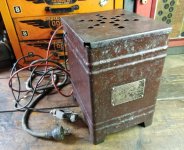
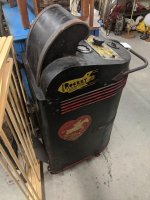
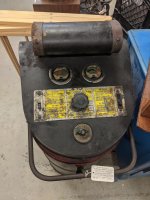
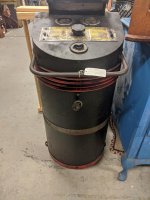
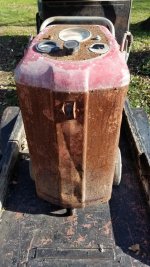
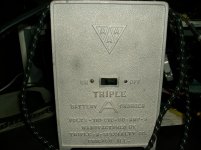
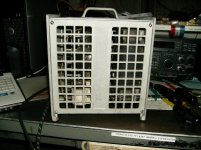
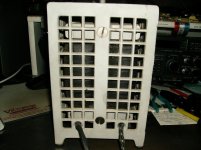
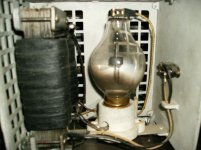
Triple A Specialty Co. Chicago, IL manufactured this charger. Any information will be appreciated, Looks like it might be from the1920's or 30's. It is old.
Attachments

Last edited:

Look at the GE booklet for Tungar tubes. They say they are low noise, but I guess that is relative. Ebay is full of replacements. A battery is a great filter capacitor. I think it would work on a modern car. That thing is really neat. Rectifier tubed like the 6X4, 5Y3, 5U4 and the high voltage 1B3 kept us entertained with radio and TV for a lot of years. What was really a loser were selinuum rectifiers. They were short lived and I can still remember the smell when they burned.Wow, a vacuum tube rectifier!! Sadly, tubes are consumable items; in normal use the filament is eroded by all the electrons boiling off it. With enough erosion, the filament breaks and burns out. Of course, when that happens you can replace the tube with solid state rectifiers (plus some other stuff to get the output voltage right). Not worth the time and effort just to have a battery charger.
Best to preserve and love it, just fire it up once in a while to enjoy the glowing tube, and have a living piece of history.
Let's see - it consumes 550 watts. Efficiency somewhere around 50%. At 12V it should put out something like 20A. But, with only half wave rectification it would be VERY noisy DC. Don't hook it up to any vehicle made since 1969!!

Very nice. It even has voltage taps to select output. Museum piece!I'm not sure why vladim bumped a three-year old thread, but it reminded me I had one, too! Made in 1922.
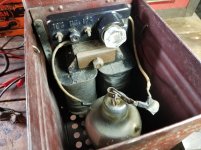
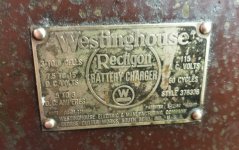
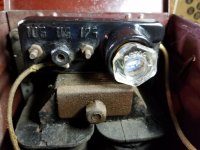
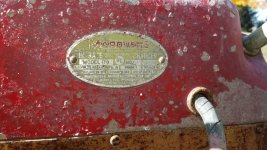
Thank you, sir. I've never seen another one like it. There are a number of Westinghouse "Rectigon" type battery charger YouTube videos on the web (as popular with old radio guys and electronics geeks as their competitor's GE "Tungar" model), and they pop up for sale on eBay and elsewhere from time to time. They all have the same basic brown steel housing. Most have a fixed handle on the top, not a baling wire, as mine does. Most have a newer looking data plate or even a foil sticker where my riveted brass data plate is. Most don't have a glass fixture on the fuse. And most have the output taps on the back. I haven't dived deep enough into it to look at model numbers etc, but I think mine is pretty old. At least 1923. The patent on the Royal fuse is 1917.Very nice. It even has voltage taps to select output.
Funny you should say that! A slightly newer model actually has been. The Simeon Foundation in Philly had one in their automobile museum that was eventually sold (for $187!) by Bonham’s in a “Preserving the Automobile” Auction several years ago. You can see it here.Museum piece!
I'm not sure why vladim bumped a three-year old thread, but it reminded me I had one, too! Made in 1922.