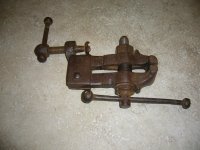
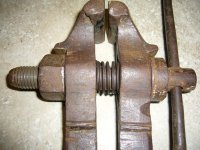
Hello Gentlemen, was hoping you could help identify a vice i have found in my Great Grandfathers tool chest. I know he left County Derry in the late 1920 early 1930 to work in the steel mills of Port Elizabeth and he apparently brought this home. No markings visible apart from some lettering stamped on the screw shaft but these are virtually worn away....Many thanks


You are using an out of date browser. It may not display this or other websites correctly.
You should upgrade or use an alternative browser.
You should upgrade or use an alternative browser.
Antique vice
- Thread starter dodger44
- Start date


2mJps
Well-known member
It looks like a commen blacksmith vice that some one riged up to clamp to a table but i could be wrong. How big is it?
neophyte
Well-known member
doesn't look rigged up, looks like it was made like that to be a portable vise. sure looks like it would be from the 20's - 30's era
I'm not ultra familiar with old blacksmith vises, but I'd guess that vise is older than the 20's - 30's era. The reason I'm saying that is the workmanship looks hand done, but consistently so like hand worked production. I'd guess 1800s but it would just be a guess. It might be old Sheffield production since it came from Ireland. If you can check the thread for size, screw pitch, etc. you might be able to match this up to thread standards to better guess the age. All of this is speculation though. Really cool vise.

Many thanks for the replies. The thread is whitworth for sure, i do not know what profession my Great Grandfather followed in America. The only clue was his bible which i have included a few pictures and a pic of my Grandfathers bible which he was extremely protective....Thanks again gentlemen.
Attachments



Modifieddriver
Well-known member
Looks like it was made that way, but might be missing a part that would allow it to be clamped to a table/bench top. Look for it, it's probably still in with his stuff.
2mJps
Well-known member
I have looked at a lot of blacksmith vices and this one doesnt look right. I dont remember a spring like this one has or a nut like it has. Did they make vices like this that clamped on. I am not looking to start argument just wondered.
neophyte
Well-known member
I have looked at a lot of blacksmith vices and this one doesnt look right. I dont remember a spring like this one has or a nut like it has. Did they make vices like this that clamped on. I am not looking to start argument just wondered.
The main body of the vise looks like a blacksmith's leg vise. Normally there would be a leg sticking out of the bottom of the vise that would rest on the floor. The part of that vise that comes out of the bottom then bends at a right angle with the screw going thru it is were the leg would normally be. The vise could have been modified after manufacture or a manufacturer might have modified a vise they already made for a different purpose. A lot of leg vises seem to have leaf springs, but if the spring broke at some point in the past it might have been replaced. A coil spring would probably be easier to retrofit.
jkeller
Well-known member
It looks alot like a wagon tongue vise to me. Missing a piece, as you can see from the one in this thread.
JasonW
Well-known member
I am no expert but to me that looks like a purpose made (or purpose adapted) vise maybe starting with a (broken?) blacksmiths vise. I would propose that it was made to slide into a groove in some fixed surface then locked in place with the lower screw, binding the fixed surface between the lower screw plate and the shoulder in the fixed jaw. The only problem with that is it looks like it would have potentially limited the travel of the active jaw. The curved arm of the anchor screw could be a bent and shortened remnant of an original leg. Otherwise, I don't see how it would have been mounted. There seems to be a lot of wear in the area between the hinge and the collar on the jaw which would be consistent with such a use. I know that doesn't help much. Hopefully someone has a better answer.