To avoid these ads, REGISTER NOW!

Any Duct Air Flow Engineers/Experts Here?

DC73

Well-known member
Joined
Dec 27, 2014
Messages
1,627
Location
Lubbock TX
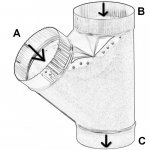
Looking for some math help with regards to airflow through a duct branch wye (see attachment). Assume each side of the wye is 12" diameter.

If I connect a fan rated at 1000 CFM to input A of the wye, and I connect a 15 foot flex duct to output C of the wye, and I connect nothing to input B, what would be the CFM of the airflow through input B?

DC
 

Attachments
  • Duct Wye.jpg
    Duct Wye.jpg
    89.6 KB · Views: 15
Last edited:
To avoid these ads, REGISTER NOW!

tab2

Well-known member
Joined
Apr 9, 2009
Messages
381
Location
Boston
Maybe, but I am certainly not one of them. Anyone would need more info to formally respond to that.

Is B capped or does ductwork run off of that? Is that duct flex or metal? What is at the end of the the 15' flex? Since is it 12" ductwork, does it have internal vanes?

You are referring to A & B as inputs, in this fitting, they are the outputs.
 

htmdude57

Well-known member
Joined
Apr 28, 2014
Messages
173
Location
Hudson Valley, New York
I'm not an engineer, but I would guess that some of the air you blow into A is going to come out of B. Exiting out of port B would offer less resistance than the 15 feet of duct on port C.
 

Jackfre

Well-known member
Joined
Dec 26, 2010
Messages
4,417
Location
N CA
Venturi effect may **** air into B. Not sure how to actually figure it out though, or figure out the CFM.

Agreed. In order to get flow out of B you would have to restrict the air flow to create enough pressure to push out of B. I have no idea how to lay out the numbers on that. I think a re-pipe is in order.
 
To avoid these ads, REGISTER NOW!
OP
D

DC73

Well-known member
Joined
Dec 27, 2014
Messages
1,627
Location
Lubbock TX
Is B capped or does ductwork run off of that? Is that duct flex or metal? What is at the end of the the 15' flex? Since is it 12" ductwork, does it have internal vanes?


You are referring to A & B as inputs, in this fitting, they are the outputs.

Assume B is open and not connected to anything. The end of the 15' flex duct will also be open and not connected to anything. The flex duct will be stretched tight but no internal vanes.

This is an experiment and a non-standard application. For my use, A & B will be inputs, C will the output.


Venturi effect may **** air into B. Not sure how to actually figure it out though, or figure out the CFM.

Agreed. In order to get flow out of B you would have to restrict the air flow to create enough pressure to push out of B. I have no idea how to lay out the numbers on that. I think a re-pipe is in order.

Agree as well. I know enough to believe that air will enter and flow through input B but I can't find a resource that will teach me how to calculate that airflow. It seems like it would be a fairly decent airflow but if it turns out to be insignificant, there's no point in buying any materials and I'll be looking for Plan B.

DC
 
Last edited:
OP
D

DC73

Well-known member
Joined
Dec 27, 2014
Messages
1,627
Location
Lubbock TX
http://www.billpentz.com/Woodworking/Cyclone/measurement.cfm
This is for dust collection, but there is a lot of duct design data here. My eyes started rolling in different directions, but it is a great site. I hope you can get something out of it

Thanks. That was a tough read but informative. Didn't learn how to do the math but there is enough info there to know how to actually measure the airflow. Just didn't want to spend any money chasing this until I get a better handle on the potential. I think I'll email the owner of that site and see if he has anything to offer.

DC
 

Jackfre

Well-known member
Joined
Dec 26, 2010
Messages
4,417
Location
N CA
This would not be such a mystery if you would feed into C and size the two outlets for the air flow you want. Rule of thumb says about 700 cfm out of 12".
 
OP
D

DC73

Well-known member
Joined
Dec 27, 2014
Messages
1,627
Location
Lubbock TX
This would not be such a mystery if you would feed into C and size the two outlets for the air flow you want. Rule of thumb says about 700 cfm out of 12".

But that's not what I'm after. As I said, this is an experiment and a non-standard application. I don't need a fan to blow air into two ducts. I want to create a situation where air is pulled into input B without that air flowing through a fan.

DC
 
To avoid these ads, REGISTER NOW!
Top Bottom