To avoid these ads, REGISTER NOW!

Any good Electricians here?

Outlawmws

Well-known member
Joined
Aug 9, 2011
Messages
39,310
Location
The Badlands
I have an old late 1930's Craftsman 1 HP Repulsion-Induction motor, and the outside cords are completely gone.

It is also currently setup without a grounded cord. since it is a brushed, motor, (AC/ DC I assume) Can I assume it can get a modern grounded power cord? there is no "official" grounding point, but I can get something to work.

It also came with a "special switch" which appears to be more for thermal/load protection than for starting (This is NOT a Capacitor start motor)

OK to ground? or does that screw up the safety worse? :dunno:

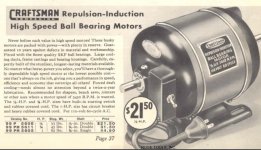
Here is what an 1938 Craftsman catalog has to say about it:

attachment.php
 

Attachments

  • C-M 5605 1 HP motor 1938.jpg
    C-M 5605 1 HP motor 1938.jpg
    93.6 KB · Views: 180
To avoid these ads, REGISTER NOW!

dittle fart around

Well-known member
Joined
Jan 9, 2011
Messages
2,455
Location
Vancouver, Washington, USA
A two prong plug is for double insulated tools. The motor is insulated from the case of the tool. With three prong plug the case is grounded, run the green ground wire to the metal case inside the wire box. A motor usually has a cover where the wire connections are made. Put a round hole lug on the green wire and have the cover screw hold the wire.
If the wiring cover isn't screwed down make sure your not hitting any part of the motor and drill a hole and use a sheet metal screw to secure the ground wire.
 

Grogan14

Well-known member
Joined
Sep 6, 2009
Messages
197
Perhaps it dates from a time before equipment grounding conductors?

I'd think any means of attachment you provide to the housing should be done with a threaded connection, either tapped, or with a nut and locking washer. I'm sure code states that the means of attachment should serve no other purpose, such as using the cover screw.
 
OP
O

Outlawmws

Well-known member
Joined
Aug 9, 2011
Messages
39,310
Location
The Badlands
Thanks guys, but I know HOW to do it and properly too. What I'm after is if this will defeat the 1930's design for safety. I don't think so, and if it were a capacitor start motor, I wouldn't hesitate. This is NOT a standard motor by today's standards...
 
OP
O

Outlawmws

Well-known member
Joined
Aug 9, 2011
Messages
39,310
Location
The Badlands
Your probably right, I was thinking I was working on a power tool (Planer Joiner) and did it here.

Mod's - Feel free to move it or leave it...
 

Greatbear

Well-known member
Joined
Jan 17, 2008
Messages
1,702
Location
Columbia/Fulton, MD
If it is truly a repulsion start/induction run, the brushes and commutator are used only when the motor is starting, giving it the strong starting torque of a universal motor. Once up to speed, the brushes are lifted and the commutator is shorted with a ring, turning the armature into the equivalent of a squirrel cage induction motor setup. This give you the near constant speed and quiet operation of an induction motor, with no brush wear. It's worth fixing up!

The only issue faced with using a grounded supply to old motors like this is the potential for damage if the insulation of the windings has broken down and there exists a short to the case. The grounding saves your bacon, of course, but you can damage the motor. You should have the motor tested with an insulation tester just to be on the safe side. You can use the megohm range on your DMM in a pinch, though this does not put a high voltage to stress the potentially worn insulation into breaking down as does an insulation tester. If you read wide open on a 20 (or more) megohm scale, you are probably good to go.
 
OP
O

Outlawmws

Well-known member
Joined
Aug 9, 2011
Messages
39,310
Location
The Badlands
That's the kind of answer I was looking for; and good news ["It's worth fixing up!"]. Thank you. My basic DVM has a 2000K Ohms, scale. Sufficient?

What about the commutator, test with it in contact? Do I need to test with it in contact and switched out manually?

I guess if it Ohms out, I'm inclined to make some basic running tests without it grounded, and carefully look for any stray voltage while doing that as well, and if it all checks out, then ground it.

The switch I have, I'm assuming its a circuit breaker, switch. Keep it? False security with modern circuit breakers?

Lastly if I do run it ungrounded, what about using a GFIC? That should trip if anything bad happens, even without a ground? or does it need a ground?
 
OP
O

Outlawmws

Well-known member
Joined
Aug 9, 2011
Messages
39,310
Location
The Badlands
Preliminary report:

With a Simpson 260 (Analog) set at RX 10,000, slight wavering when I spin the motor by hand (Fast or slow), but essentially 0.

With that cheap DVM, it gets low fluttery readings, but is basically near zero doing the same thing.

:dunno:
 
OP
O

Outlawmws

Well-known member
Joined
Aug 9, 2011
Messages
39,310
Location
The Badlands
If it is truly a repulsion start/induction run, SNIP

Pretty sure; here is a better shot of the Catalog page, and the MFG code on the motor says that this is made by the Diehl Manufacturing Co. if that helps.


attachment.php
 

Attachments

  • C-M 5605 1 HP motor 1938a.jpg
    C-M 5605 1 HP motor 1938a.jpg
    101.8 KB · Views: 115

Milton Shaw

Well-known member
Joined
Feb 11, 2011
Messages
4,845
Those repulsion induction brush lifting motors are usually rated low on horsepower. I put one on a homemade pressure washer several years ago. The 3/4 hp motor put out pressures that were what was shown to be from a 3hp motor. They are worth fixing up. They do make noise of brushes when they first start but then run quiet as a mouse. A friend heard it and said you need to oil that motor-no is the brushes. Back when these motors were made they didn't inflate the hp rating like they do now. Now Hp ratings are inflated and are actually the Hp produced as the motor stalls and burns out.
 

Greatbear

Well-known member
Joined
Jan 17, 2008
Messages
1,702
Location
Columbia/Fulton, MD
Your measurement between the power wires showing zero is proper, and spinning the motor can generate a little bit of current to affect the reading, so it sounds good so far!

For a ground test, measure from the either one of the supply leads to the case. You should read open. This is the safety test. If you read less than about 100kOhms from the supply leads to the case, you have the beginnings of electrical leakage and a ground fault. All is not lost, though, since old motors that have sat about can accumulate moisture in the paper, cloth or bakelite insulation between the windings and the case. Warm up the motor either by running it (ungrounded) or popping it in a warm oven (less than 200 degrees).

As for GFCI: if the motor has leakage (usually less than 10kOhms to ground from the hot terminal) and the case is grounded, it can trip the GFCI. If you run the thing ungrounded, it won't trip, but you can have a dangerous condition. Since polarity was not much of an issue back then, you can swap the line leads and often "move" the leakage to the neutral side, making things mostly safe. The test to do here is to run the motor with the case ungrounded, plugging the motor into a grounded outlet. Setting your meter to AC voltage, connect a lead to the motor shell and the other lead to the ground pin or faceplate screw. Ideally there will be no voltage at all, but depending on your meter and its loading of the circuit, you can read quite a few volts. You have a Simpson 260, which is perfect for this test, since its AC loading is enough to squelch stray, harmless currents. Make note of the reading, then reverse the two supply wires and plug the motor in again, repeating the measurement. Again, ideally the reading should be low, but if it's not, use the polarity that results in the lowest voltage.

The breaker is sized to mach the motor loading if it actually came with the motor, so it's wise to keep it around assuming it is still functional.
 
OP
O

Outlawmws

Well-known member
Joined
Aug 9, 2011
Messages
39,310
Location
The Badlands
Thanks Greatbear, With that Info, I think I'm off to the races! I'll update as the testing and test operation of this beast progresses! I think this is the heaviest electric motor I've ever had in my shop, definitely the oldest, (Nearly 75 years old)...
 
To avoid these ads, REGISTER NOW!
OP
O

Outlawmws

Well-known member
Joined
Aug 9, 2011
Messages
39,310
Location
The Badlands
OK an update:

The motor seemed to test out fine in all the static tests, so I cleared off the old cracking external wires, and put on a temp plug with wire nuts, ungrounded, and gave it a quick shot. Scared the **** out of both me and my daughter as I was expecting nothing or half expecting sparks and maybe smoke (It IS almost 75 years old..), but it it simply snapped into action!

After getting my wits back together, I plugged it in again and watched carefully for any issues; hot wire, ugly noises, or of course, smoke or bad smells. The bearings are not as quiet as I'd hoped, but overall not too bad for a motor that is 10 years past retirement!

Follow up testing:

I did check from the frame to ground with the volt meter, to see if any stray voltage was present. Not happy to see about 25V AC on the frame while it's running...

I shut it down and reversed the plug, and tried the test again: Still 25V AC...

It this OK, or is it potential problem?

I'll be starting a new thread for restoring the Jointer/Planer from the ground up, starting with the base...
 

Greatbear

Well-known member
Joined
Jan 17, 2008
Messages
1,702
Location
Columbia/Fulton, MD
Being that swapping the lines did not change the stray voltage, I think you are good to go. If you have a resistor of about 1000 ohms or so laying around, place it across your meter leads when you measure the stray voltage. If the reading falls to nearly zero, you are golden. You can substitute a small incandescent lamp for the loading resistor, a 7 watt night light works fine for this.

Good luck!
 

malibu101

Well-known member
Joined
Jul 1, 2005
Messages
3,908
Location
Walnutport PA
On reading voltage from motor case to ground------
If resistance is added as suggested; What does that do? What is that showing?
I think any digital VOM is a high impedence meter as opposed to an analog meter. A true RMS meter can often show "ghost" voltages, I can see resistance helping to make that go away.
What am I missing?
 
OP
O

Outlawmws

Well-known member
Joined
Aug 9, 2011
Messages
39,310
Location
The Badlands
I'm just guessing here, and I'm not a fully trained electrician, not an electronics tech, and I haven't played on in a movie either :) but based on a lot of exposure to all levels of "electrical theory"

- Electrical devices are 99% science and 1% black magic. While the first order electrical [anything] is very well understood, (by those with PROPER training) the secondary (and above) can do strange things.

My guess is that the motor while running is generating a slight current on the frame; the resistor provides a "bleed off" of this tiny current (assuming it is tiny) and allows the meter to read the "true" state of the voltage on the frame.

I had to do the same thing on measuring the DC offset of a stereo a year or so ago, because I was getting odd spurious reading caused by the design of the output amplifier stage. While the voltage is real, the current is insignificant and if bled off, you can see the "real" state. I just didn't even think to try that in this application, (which is why I ask experts when I feel I'm over my head.)
 

Sparkfarmer

Well-known member
Joined
Jun 11, 2010
Messages
235
Location
Toronto Canada
I'm just guessing here, and I'm not a fully trained electrician, not an electronics tech, and I haven't played on in a movie either :) but based on a lot of exposure to all levels of "electrical theory"

- Electrical devices are 99% science and 1% black magic. While the first order electrical [anything] is very well understood, (by those with PROPER training) the secondary (and above) can do strange things.

My guess is that the motor while running is generating a slight current on the frame; the resistor provides a "bleed off" of this tiny current (assuming it is tiny) and allows the meter to read the "true" state of the voltage on the frame.

I had to do the same thing on measuring the DC offset of a stereo a year or so ago, because I was getting odd spurious reading caused by the design of the output amplifier stage. While the voltage is real, the current is insignificant and if bled off, you can see the "real" state. I just didn't even think to try that in this application, (which is why I ask experts when I feel I'm over my head.)

Correct.
and if it is not a ghost voltage you'll have about 0.625 watts drawn so if its a small 1/4 watt style resistor it will smoke (no big deal) in a couple seconds so stand back or use a serious resistor.

Cheers
SF
 

bassman

Well-known member
Joined
Feb 13, 2005
Messages
198
Location
florida
You guys are thinking too much here. Just ground it. If the windings are shorted to the case, let it trip the breaker, because ir you continue to use it with the windings shorted to the case, you're just gonna get knocked on you're **** one of these days when the right conditions present themselves. Ground it by drilling a pilot hole, then tap it with a 10-32 tap, and use a 10-32 screw to the green wire and you're done, you're not going to ruin anything on the motor by grounding it. They didn't ground things back in the old days.
 
OP
O

Outlawmws

Well-known member
Joined
Aug 9, 2011
Messages
39,310
Location
The Badlands
I don't think you read the whole thread. The motor itself is almost 75 years old, and the design is much older. I'm going through this step by step because I don't want to destroy the motor before it even has a chance to get put into use.

As far as "just grounding it"; that was discussed. there are pro's and con's and it's not happening until I'm satisfied that:

a. The motor is as safe as it can be all things considered
b. It's installed and ready to go, and
c. every reasonable safety device I can put into the chain is in place.

This motor is one of the older things I have in my garage, and I have a LOT of older tools. I'll give it all the respect I can, both for it's age, and it's early design.
 

bassman

Well-known member
Joined
Feb 13, 2005
Messages
198
Location
florida
There are no cons to grounding it. Its just a motor, if its not grounded, and there is a short in it, that means the the metal enclosure will be live. If someone touches it, they could be electricuted, simple as that.
 
OP
O

Outlawmws

Well-known member
Joined
Aug 9, 2011
Messages
39,310
Location
The Badlands
Since you haven't bothered to read the rest of the Thread:

The only issue faced with using a grounded supply to old motors like this is the potential for damage if the insulation of the windings has broken down and there exists a short to the case. The grounding saves your bacon, of course, but you can damage the motor.
 

bassman

Well-known member
Joined
Feb 13, 2005
Messages
198
Location
florida
If the windings shorted to the case, the motor is no good anyway. You'll need to take it to a motor shop and have it rewound, you shouldn't just use it with no ground if it's shorted and risk somebody getting shocked
 
To avoid these ads, REGISTER NOW!
Top Bottom