To avoid these ads, REGISTER NOW!

Any help with garage sub-panel would be appreciated.

Mark C

Member
Joined
Apr 6, 2013
Messages
11
Hello fellow garage enthusiasts,

I would like to install a 200 amp sub-panel in my 20X20 UN-attached garage which is just 15 feet from the 200 amp main panel in my house.

My original intent intent was to route the sub-panel feed via existing underground conduit from the main panel.

(Which is located just inside in the laundry/utility room door just to the right from where the attached image of the outside view between the garage and the house was taken).

It contained the 220 feed from the pool pump breaker which was to be relocated to the new sub panel.

After closer inspection, I found that the conduit is only 3/4 inch, so it appears that I will need to add larger conduit for a larger wire.

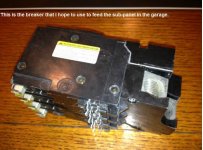
I have been told by two vendors that the Square D QO2200 2 pole plug-in breaker shown in the attached image IS compatible with my panel and will fit if there is room in my panel for it.

At this point, I believe that the breaker, (which will actually take up four spaces) will work (I would have the room after juggling a couple of breakers around),

However, I just need to confirm that and make sure of what wire sizes to use (2 hots, neutral, ground if needed) from the breaker to the sub panel.

The run, with all of the turns, will be about 45 feet from breaker to breaker.

The existing main panel in the house is a -

Square D 200 amp QO Load Center.
Box Cat No. QOB 40 225
Series: E5

The absolute most I could conceive of running at once in the garage is a welder, CNC plasma table, air compressor, lighting, upright freezer, lighting, radio and small shop fan. There is space available for the breaker in the main panel.

Demand inside of the house would be minimal at that time as wife and kids would be gone during the day.

In addition to the above, I'd like to add a Mig and Tig welder. One day, I'd like to extend the garage to the south, and and a South Bend Heavy 10 lathe and a Bridgeport mill.

Based on the information provided above, do you feel that this breaker can be used to feed the planned sub-panel from the existing main panel and that it would meet my needs?

Also - Can anyone recommend the best wire size to use from the breaker to the sub panel?

I am open to any insight, experience, ideas and suggestions.

(Images that may be helpful are shown below).

Thank You for your help.

Mark C
 

Attachments

  • 009.jpg
    009.jpg
    147.7 KB · Views: 50
  • 12.jpg
    12.jpg
    145.1 KB · Views: 75
  • SQUARE D QO2200 200A Circuit Breaker 2 Poles  Img 2.jpg
    SQUARE D QO2200 200A Circuit Breaker 2 Poles Img 2.jpg
    66.6 KB · Views: 64
Last edited:
To avoid these ads, REGISTER NOW!

Alchymist

Well-known member
Joined
Mar 1, 2009
Messages
4,423
Location
Central PA
Are you sure you need 200 amps in the garage? You're looking at #2-0 copper or 4-0 aluminum, expensive. And the breaker you show doesn't appear to be a QO2200 -
 

Attachments

  • QO2200.JPG
    QO2200.JPG
    44.1 KB · Views: 31

wyliesdiesels

Well-known member
Joined
Aug 14, 2012
Messages
20,022
Location
Modesto, CA
Are you sure you need 200 amps in the garage? You're looking at #2-0 copper or 4-0 aluminum, expensive. And the breaker you show doesn't appear to be a QO2200 -

Im not sure if the breaker u referenced is 200a as evidenced by only 2 digits on the handle. I did a google search and one that looks similar to the OPs:

http://www.superbreakers.net/qo2200.html

OP- As Alchymist has said, are u really sure u need 200a? Though i doubt the wire will cost a huge amount since your total wire length is only around 45'!

Here are some things to consider before figuring out what size feeder/wire u need:

Is this a solo shop or will there be multiple people using multiple tools at once?
What are the load ratings of your tools and what tools will be on at the same time such as compressor and plasma cutter?
Will u have A/C in the shop?
What size is the pool pump motor(s) and equipment?
Is the pool heater gas or electric?
What equipment do u plan on POSSIBLY adding in the future?
 

Alchymist

Well-known member
Joined
Mar 1, 2009
Messages
4,423
Location
Central PA
Im not sure if the breaker u referenced is 200a as evidenced by only 2 digits on the handle. I did a google search and one that looks similar to the OPs:

OP- As Alchymist has said, are u really sure u need 200a? Though i doubt the wire will cost a huge amount since your total wire length is only around 45'!

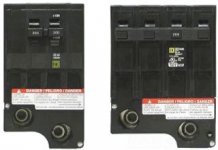
Interesting, could there be 2 Square D breakers with the same number? Or is the 4 slot one used for a mains disconnect, and the 2 slot one for other use in panel?

As to cost, 2-0 copper is somewhere around $4 a foot, X45, x3 will be over $500 plus ground wire.
 

Attachments

  • QO2200_2.JPG
    QO2200_2.JPG
    142.1 KB · Views: 13

theoldwizard1

Well-known member
Joined
Feb 22, 2011
Messages
43,191
Location
SE MI
I concur with the others. Any money you save trying to use that breaker, you will spend on wire. I would go with either a 100A panel in the garage and a 90A breaker in the main panel.
 

koditten

Well-known member
Joined
Apr 10, 2008
Messages
5,528
Location
Midland, Michigan
I've got all listed above on my 100 amp service. I think you might have overestimated your needs.

Please tell us what tools you intend to run.

KO
 

wyliesdiesels

Well-known member
Joined
Aug 14, 2012
Messages
20,022
Location
Modesto, CA
Interesting, could there be 2 Square D breakers with the same number? Or is the 4 slot one used for a mains disconnect, and the 2 slot one for other use in panel?

As to cost, 2-0 copper is somewhere around $4 a foot, X45, x3 will be over $500 plus ground wire.

Good point. I was gonna mention this but forgot. It could be a mains disconnect however, all the mains disconnects I've seen are straight rated(240v) such as the main disconnect in my Bryant panel. The breaker i linked to is slash rated(120v/240v) so it would be a good idea for the OP to make sure the breaker he has is slash rated.

And $500 isnt all that much for some people!
 

brewchief

Well-known member
Joined
Sep 20, 2008
Messages
2,370
Location
Michigan
I've got all listed above on my 100 amp service. I think you might have overestimated your needs.

Please tell us what tools you intend to run.

KO

I agree with the overestimation, unless there are a bunch of people running everything at once.

A 200 amp panel fed with wire/breaker rated for 90-100 amps would likely be plenty, if the whole run was made in conduit large enough for wire rated at 200 amps then the ability to upgrade later would be there.
 

Alchymist

Well-known member
Joined
Mar 1, 2009
Messages
4,423
Location
Central PA
I agree with the overestimation, unless there are a bunch of people running everything at once.

A 200 amp panel fed with wire/breaker rated for 90-100 amps would likely be plenty, if the whole run was made in conduit large enough for wire rated at 200 amps then the ability to upgrade later would be there.

WTH - if you run the wire for 200 amps, and put in the 200 amp panel, why not just put in the 200 amp breaker? (Provided of course the main panel is rated for a 200 amp breaker for the subfeed. Some panels restrict the largest breaker that can be installed). And if you really need the 200 amp service, and run it at near capacity, you run the risk of kicking the main in the house panel.
 
OP
M

Mark C

Member
Joined
Apr 6, 2013
Messages
11
Are you sure you need 200 amps in the garage? You're looking at #2-0 copper or 4-0 aluminum, expensive. And the breaker you show doesn't appear to be a QO2200 -

Alchymist -

Thank You for your insight. I really do appreciate it.

I gotten a considerable amount of advice stating that 200 amps is overkill and recommending a 125 amp sub panel. This makes me nervous, but, I'm being advised by those more experienced in such than myself.

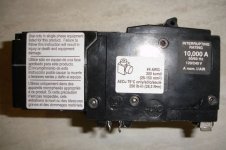
As for the breaker, The more I look into it, the more breakers I see with the same part number (three so far) I've sent an email to the vendor of the breaker concerning the variations and am waiting to hear back from him.

Here's a few more images of the QO2200.

Mark
 

Attachments

  • Square D QO2200 200ACircuit Breaker 2 Poles Img 7.JPG
    Square D QO2200 200ACircuit Breaker 2 Poles Img 7.JPG
    16.3 KB · Views: 18
  • Square D QO2200 200ACircuit Breaker 2 Poles Img 6.JPG
    Square D QO2200 200ACircuit Breaker 2 Poles Img 6.JPG
    74.5 KB · Views: 16
  • Square D QO2200 200ACircuit Breaker 2 Poles Img 5.JPG
    Square D QO2200 200ACircuit Breaker 2 Poles Img 5.JPG
    53.1 KB · Views: 15
OP
M

Mark C

Member
Joined
Apr 6, 2013
Messages
11
Im not sure if the breaker u referenced is 200a as evidenced by only 2 digits on the handle. I did a google search and one that looks similar to the OPs:

http://www.superbreakers.net/qo2200.html

OP- As Alchymist has said, are u really sure u need 200a? Though i doubt the wire will cost a huge amount since your total wire length is only around 45'!

Here are some things to consider before figuring out what size feeder/wire u need:

Is this a solo shop or will there be multiple people using multiple tools at once?
What are the load ratings of your tools and what tools will be on at the same time such as compressor and plasma cutter?
Will u have A/C in the shop?
What size is the pool pump motor(s) and equipment?
Is the pool heater gas or electric?
What equipment do u plan on POSSIBLY adding in the future?


Hello Wylie - Thank you for your reply.

As I replied to Alchymist, Due to advise already received, I am reconsidering.

To answer your questions.

Is this a solo shop or will there be multiple people using multiple tools at once?

Just me.

What are the load ratings of your tools and what tools will be on at the same time such as compressor and plasma cutter?

I'm not sure of the load rating as I have not decided on the exact equipment that I will be using. It will be equipment in the smaller size range (Lincoln AC/DC 225, Miller 211 or 252, Syncrowave 200, Spectrum 625 Plasma Cutter) The only other tool that may be on at the same time as the compressor and plasma cutter would be a welder.

Will u have A/C in the shop?

No A/C.

What size is the pool pump motor(s) and equipment?

I believe it is 1.0 hp.

Is the pool heater gas or electric?

No heater.

What equipment do u plan on POSSIBLY adding in the future?

Other than what is on the list, I wont have much room for anything else. The garage is 20X20.

Mark
 
OP
M

Mark C

Member
Joined
Apr 6, 2013
Messages
11
You guys think limiting tool use and going with a 125 Amp sub panel would be a better choice?
 

snorky18

Well-known member
Joined
Oct 1, 2007
Messages
1,170
Location
Southeast Tennessee
For the use you have described, I think you could NOT limit your tool use, do use a 125 amp sub panel, and have no problems at all, and yes that would certainly be a better choice.
 
Joined
Apr 6, 2013
Messages
11
Location
manitoba , canad
I agree with most of the posts. The first thing to do is a load calculation. This is different than a building or work shop with several users doing the different tasks with all the machines. I do not think that you can find a 2 pole 200 amp breaker to fit the branch circuit buss space. Good luck I have never seen one as described. The 100 Amp sub is the correct solution. I am an electrician.
 
Last edited:

Charles (in GA)

Well-known member
Joined
Jan 11, 2006
Messages
12,489
Location
50 mi south of Atlanta
Go with a large panel in the shop, a 30 or 40 space panel is nice to work in and run wires in, lots of space to work. Its amp rating does NOT have to match the breaker feeding it in the house, it can be greater than the feeder breaker, but CANNOT be a lower rating than the feeder breaker.

ie. A 200 amp panel on a 90 amp breaker is OK

A 60 amp panel on a 125 amp breaker is NOT OK.

If you want a larger panel and a 200 amp feed, by all means go for it, you will be moving that pool breaker to it, which will add to the load. It only cost a little additional money in the big scheme of things. A 3/4 conduit is not big enough for much of anything and you will end up replacing it, probably no matter what you do.

Question, where is your main breaker? Either the pic is upside down or the panel is mounted "upside down" and I don't see a main breaker, just main lugs.

Charles
 
To avoid these ads, REGISTER NOW!
OP
M

Mark C

Member
Joined
Apr 6, 2013
Messages
11
Thanks to all for your help.

I really appreciate it.

Charles -

The main panel is located just inside the laundry/utility room door, just to the right of the outside image.

Attached is a full picture of the panel.

Thanks for the help.
 

Attachments

  • 6.jpg
    6.jpg
    138.8 KB · Views: 40

brewchief

Well-known member
Joined
Sep 20, 2008
Messages
2,370
Location
Michigan
WTH - if you run the wire for 200 amps, and put in the 200 amp panel, why not just put in the 200 amp breaker? (Provided of course the main panel is rated for a 200 amp breaker for the subfeed. Some panels restrict the largest breaker that can be installed). And if you really need the 200 amp service, and run it at near capacity, you run the risk of kicking the main in the house panel.

What I meant was to use wire and breaker rated 90-100 amps but upsize the conduit size. Instead of using 2" conduit for example use 3", this way if he does find out down the road that he needs the full 200 amps he could simply pull the larger wire, of course if he finds he truly needs 200 amps in the shop then it may be time for a service upgrade anyway. Upsizing the conduit would add little cost to the job now and would prevent having to dig up the yard later.
 

G'ord

Member
Joined
Apr 8, 2013
Messages
11
Location
Provo Utah
I have a few questions.

Does your meter base have Breakers?

Why are you choosing to go with the QO series? (homeline will do what you're looking for and is still made by Square D?)

How many amps is your meter base rated? (not the load center inside)

Do you know that the two pole breakers allow you to have up to double their rated amperage @ 120volt?

DO you know the power requirements of all of your tools?

If possible use S.E.R. it's cheaper, will be easier to pull, comes pre-bundled with appropriate sized ground.

Depending on local codes you might need a disconnect at/in the panel. If not, you might want to consider a hom612L100s (surface mount) or hom612L100f (flush mounted). if 6-12 circuits seem to be not enough, or if you need a main breaker in the panel inside the garage homeline has 125 A panels with main breaker options with up to 24 spaces (circuits).

Also check local code as to what grounding requirement you will need. (this panel may need it's own set of 2 grounding rods set 6-8 feet apart.

If you want to stay with the QO line the load centers for 1 phase 100A provides up to 30ish spaces.

Basically the type(brand or series) of breakers in panel does not matter of the next panel. figure how many circuits you want to run, and their amp/volt requirements. Check code for panel main breaker requirement (if i remember correctly they are needed if you will be running more that 6 circuits from the panel even with the small breeze way. Check grounding requirement. Decided if you want the high QO line. Once you know Post it and I can help you with what you would need to get.

Oh one more thing check local code requirements for the conduit. neighboring citys in my area allow PVC sch 80, I.M.C, but here we are required to GRC.

If you are only using this when everyone is gone, Is it for a Business? If so, perhaps you may wish to consider just starting another meterbase for the shop (might be cheaper that way)

Sorry for the long Chore shopping list (I'm not an electrician I just know a lot of them.)
 

Charles (in GA)

Well-known member
Joined
Jan 11, 2006
Messages
12,489
Location
50 mi south of Atlanta
I'm not the OP but I'm going to answer/counter a few of the things you have noted.

I have a few questions.

Does your meter base have Breakers?

Why are you choosing to go with the QO series? (homeline will do what you're looking for and is still made by Square D?)

Probably because it makes sense to keep the same breakers throughout, easier when replacing and swapping around. If he eliminates a breaker one place and moves it to the other, he doesn't have to buy another breaker to fit that odd panel

How many amps is your meter base rated? (not the load center inside)

Do you know that the two pole breakers allow you to have up to double their rated amperage @ 120volt?

No they do not, not sure where you got this idea. Well, they do if you look at it from the standpoint of two 120v breakers, or as used in a multiwire circuit, but as far as wattage, it all comes out the same. But this statement is of no real value to the OPs issue.

DO you know the power requirements of all of your tools?

If possible use S.E.R. it's cheaper, will be easier to pull, comes pre-bundled with appropriate sized ground.

The OP needs to go underground, and you cannot run SER underground, in conduit or otherwise.

Depending on local codes you might need a disconnect at/in the panel. If not, you might want to consider a hom612L100s (surface mount) or hom612L100f (flush mounted). if 6-12 circuits seem to be not enough, or if you need a main breaker in the panel inside the garage homeline has 125 A panels with main breaker options with up to 24 spaces (circuits).

Its not local code, its the NEC, since the garage is detached, if the panel has more than 6 breaker handles in it, then it will need a disconnect. Some local codes require this to be outside the building, some do not.

Also check local code as to what grounding requirement you will need. (this panel may need it's own set of 2 grounding rods set 6-8 feet apart.

Again, not local code, but rather NEC requires the grounding rods on a detached building.

If you want to stay with the QO line the load centers for 1 phase 100A provides up to 30ish spaces.

Basically the type(brand or series) of breakers in panel does not matter of the next panel. figure how many circuits you want to run, and their amp/volt requirements. Check code for panel main breaker requirement (if i remember correctly they are needed if you will be running more that 6 circuits from the panel even with the small breeze way. Check grounding requirement. Decided if you want the high QO line. Once you know Post it and I can help you with what you would need to get.

Oh one more thing check local code requirements for the conduit. neighboring citys in my area allow PVC sch 80, I.M.C, but here we are required to GRC.

If you are only using this when everyone is gone, Is it for a Business? If so, perhaps you may wish to consider just starting another meterbase for the shop (might be cheaper that way)

If the OP were doing this for business (which I highly doubt as he said nothing about it) he could just as easily submeter it and not have to pay the additional costs each month for a second meter, he would avoid having his yard torn up running the second service, and he would avoid paying commercial rates, and its possible his local planning and zoning won't even allow a second meter on a residential property, many will not.

Sorry for the long Chore shopping list (I'm not an electrician I just know a lot of them.)

Charles
 
Last edited:

Charles (in GA)

Well-known member
Joined
Jan 11, 2006
Messages
12,489
Location
50 mi south of Atlanta
OP also needs to be aware that the pool pump breaker is not currently a GFCI breaker and it is supposed to be. I know they are expensive, but code requires it and its a safety thing. You really need to install a GFCI either now, or no later than when you move that circuit to the garage panel.

Also, you are allowed only one circuit between the garage and the house, thats four wires (two hots, a neutral and a ground) if you have other circuits they need to be pulled out and supplied from the garage panel.

Charles
 

wyliesdiesels

Well-known member
Joined
Aug 14, 2012
Messages
20,022
Location
Modesto, CA
...
Depending on local codes you might need a disconnect at/in the panel....

Also check local code as to what grounding requirement you will need. (this panel may need it's own set of 2 grounding rods set 6-8 feet apart....

If you are only using this when everyone is gone, Is it for a Business? If so, perhaps you may wish to consider just starting another meterbase for the shop (might be cheaper that way)....

A panel in a detached building needs a main disconnect if there is more than 6 breaker handles!

2 ground rods are ALWAYS required for detached buildings!

And running the garage on a separate meter will almost always be more expensive than running it off the house because of monthly base meter charges and the policy of most PoCos to charge commercial rates on a second meter!
 
Last edited:

Alchymist

Well-known member
Joined
Mar 1, 2009
Messages
4,423
Location
Central PA
Thanks Charles & wyliesdiesels for the responses. I have tended to refrain from comments on posts like G'ord's, and bit my tongue when I read it. ;)
 

wyliesdiesels

Well-known member
Joined
Aug 14, 2012
Messages
20,022
Location
Modesto, CA
Yeah, i was gonna mention the conflict with the SER too but forgot. I'm typing on an iPhone and its a real pain in the **** to cut up people's quotes so i can respond to them!
 

Coolerman

Well-known member
Joined
May 2, 2012
Messages
133
Location
Paint Lick, KY
2 ground rods are ALWAYS required for detached buildings!

Really? Why two at the garage, but not at the main panel the garage is fed from? Reason I ask is I only have one at my main house panel and only one at the garage (Well one and 5/8's of another read on). The garage rod had to be placed in a ditch 36" deep and 8 feet long. Why? ROCK! I tried driving one into the ground in several places (had to use a Hi-Lift jack to remove the darn thing from each failed attempt), but got about 5' down when I hit solid rock. I left the last one I tried in the ground, and bonded it to the other one I dug the ditch for. See pic. The #6 is also bonded to the steel frame of the building right before it enters the breaker panel in the garage.

It was a royal pain digging that ditch by hand in hard clay... :sad: I'd rather not have to buy another rod, and connecting #6 wire, and dig another ditch if I don't have to! I'm going for my inspection in a couple of weeks so can you tell me where in the code it requires this? (BTW the house passed inspection with just one.)
 

Attachments

  • IMG_5997W.jpg
    IMG_5997W.jpg
    96.5 KB · Views: 17

pattenp

Well-known member
Joined
Jun 4, 2008
Messages
10,175
Location
Virginia - USA
NEC 250.53 One rod or pipe is enough if the resistance to earth is 25 ohms or less. It's easier to just use two rods than showing the one has resistance of 25 ohms or less. This is now required for the main structure as well as a detached structure supplied by a feeder (NEC 250.32).
 
Last edited:

Coolerman

Well-known member
Joined
May 2, 2012
Messages
133
Location
Paint Lick, KY
Wouldn't the inspector have to prove that it's more than 25 ohms before requiring another rod? ;) I'm just joking of course, inspectors don't have to prove anything right? :lol:

Seems I recall from electrical class it can be a bit difficult to measure this resistance as the question becomes, " 25 ohms In relation to what?" I think I will take a chance with what I have. I'm not above telling him to prove it's NOT <25 ohms... ;)

Oh one other thing: There is another ground rod on the other side of the building that the Satellite guys drove (easy to get 8 foot deep there) that is bonded to the building. Would that qualify as the second rod?
 
Last edited:

theoldwizard1

Well-known member
Joined
Feb 22, 2011
Messages
43,191
Location
SE MI
NEC 250.53 One rod or pipe is enough if the resistance to earth is 25 ohms or less. It's easier to just use two rods than showing the one has resistance of 25 ohms or less. This is now required for the main structure as well as a detached structure supplied by a feeder (NEC 250.32).

This is for "new" work. Old work does not have to be brought up to current code unless you are making "major" changes (like going from fuses to breakers).

Seems I recall from electrical class it can be a bit difficult to measure this resistance as the question becomes, " 25 ohms In relation to what?" I think I will take a chance with what I have. I'm not above telling him to prove it's NOT <25 ohms... ;)
There are special meters that will measure it and your inspector may or may not have one. Or he may require you to have a licensed electrician come in and sign off that it is below 25 ohms. Do you want to antagonize the guy who can hold up the whole operation ? Cheaper/quicker to just bang in 2 rods.

Oh one other thing: There is another ground rod on the other side of the building that the Satellite guys drove (easy to get 8 foot deep there) that is bonded to the building. Would that qualify as the second rod?
IIRC, the two rods must be at least 6' (?) apart and the ground conductor must be continuous bare copper from the box to both rods !
 

Coolerman

Well-known member
Joined
May 2, 2012
Messages
133
Location
Paint Lick, KY
This is for "new" work. Old work does not have to be brought up to current code unless you are making "major" changes (like going from fuses to breakers).


There are special meters that will measure it and your inspector may or may not have one. Or he may require you to have a licensed electrician come in and sign off that it is below 25 ohms. Do you want to antagonize the guy who can hold up the whole operation ? Cheaper/quicker to just bang in 2 rods.


IIRC, the two rods must be at least 6' (?) apart and the ground conductor must be continuous bare copper from the box to both rods !

Well this is new construction as the building is only two years old and I just finished the wiring. I'll see what my electrician says. If he says install another rod I'll do it. I don't think he has a way to truly test for ground.

BTW the single "rod" on the house is actually a connection to a 10' stub of copper pipe 6' under ground. I have plastic water line that connects to the copper stub then the stub comes through the concrete basement wall. The electrician used #2 copper wire to create the connection from the stub to the panel.
 

G'ord

Member
Joined
Apr 8, 2013
Messages
11
Location
Provo Utah
I wish to apologize for my previous post to both the other readers and the OP and thank those who corrected me. By know I should know I cannot trust my translation into English when I'm that tired and distracted.

It appears my memory is off more than I thought.

The only reason i had thought of another meter base is because in my area most of the power come in overhead. So, i had thought of it as a way to avoid all the trenching and such.

It was also pointed out to me that i tend to be more aware of the amps of my heavy draw tools because I don't have accessible to me some of the cues that most people have to them.
 
Last edited:
To avoid these ads, REGISTER NOW!
Top Bottom