To avoid these ads, REGISTER NOW!

anyone built a "hydrogen booster"??

bookittyrun

Well-known member
Joined
Jul 16, 2012
Messages
96
Location
hiding in your closet...
found out about this years ago, but never felt the need for it...

until now.

i drive a pig of an suv, and 16-18mpg during the last two years has hurt. is there anyone who can offer feedback on a home-built hydrogen booster for their vehicle? what started off as being "free plans" and info online, now seems to be dominated by plans costing upwards of 300 dollars. currently in a 2003 nissan pathfinder, and the loan suggests i'll be keeping this truck for a while... exactly how much of an increase in fuel efficiency could one expect? i'd be happy with 24-26mpg...

help?? :dunno:
 
To avoid these ads, REGISTER NOW!

jrlp

Well-known member
Joined
Mar 20, 2012
Messages
459
Location
Laredo, Texas
Waste of money, search. Uses more power than it makes. That electricity adds drag to the engine from the alternator which lowers mpg more than the hydrogen improves it. Net loss. Nothing is 100% efficient and you lose energy through the belt, through the alternator, through the electrolysis tank.. More energy is used to create the hydrogen than the hydrogen produces.

Snake oil.

Sent from my Galaxy Nexus using Tapatalk 2
 

jrlp

Well-known member
Joined
Mar 20, 2012
Messages
459
Location
Laredo, Texas
I'll add, do a full tune up, plugs, new cat since yours is probably partially clogged, etc.. Maybe increase timing

Sent from my Galaxy Nexus using Tapatalk 2
 

jrlp

Well-known member
Joined
Mar 20, 2012
Messages
459
Location
Laredo, Texas
Sorry meant to say it's gains are snake oil. It doesn't take much to make hydrogen I've probably made a few liters in the last week with my rust removal electrolysis tank, but using it to supplement fuel does nothing if you have to create it in the first place!

Sent from my Galaxy Nexus using Tapatalk 2
 

theoldwizard1

Well-known member
Joined
Feb 22, 2011
Messages
43,137
Location
SE MI
Quickest way to improve fuel economy is remove weight. Unused seats, interior panels, spare tire. Lighter wheels and tires. (15" steel rim and tire weights less than and 18" aluminum and oversized tire. Cheaper too.)

Car manufacturers have to double their average fuel economy in the next 10 years. They have already dismissed those ideas and are currently concentrating at weight reduction (which will mean more cost to you and I).
 

luvit

Well-known member
Joined
Jul 11, 2011
Messages
1,580
I've never had a vehicle where i could not exceed the declared mpg.
You have to drive like a grandpa, though.

visit ecomodder.com -- i'm not recommeding to transform your SUV into a streamlined spaceship, but there are MANY tips on there to brake less often, accel less often, less aggressive driving.
 

EOC_Jason

Well-known member
Joined
Jun 25, 2012
Messages
11,388
Location
Bentonville, AR
I picked up a couple MPG just by cleaning my MAF, throttle body, and changing the air filter...

+1 on the hydrogen kits not being what people expect. I knew a guy that made some high-end retrofit kits (before the economy collapsed). He even made a custom computer controller to control the power usage and hydrogen generated.... You know what? He went bankrupt, people were pissed it didn't work. If things like that did really work you would be seeing them on store shelves everywhere. ;)
 

kald

Well-known member
Joined
Mar 31, 2012
Messages
672
Location
Central Fl
I had a couple of retired guys(Massholes) stop by my shop and ask me about it a few years ago. I'm the industrial battery business and since the process is very similar they thought I could get them going. It was ten minutes of comedy, they would ask me a question and after a few replies on my part I realized I was dealing a couple of pretty challenged individuals. They wouldn't answer any of my questions because it was "proprietary" and "revolutionary". I gathered they were going to use some type/form of battery and charge it excessively. They were going to introduce the hydrogen and oxygen produced into the engines intake (completely unregulated of course). They wanted me to help them with an onboard cell/battery setup and alt connections. I finally just warned them that just 2% concentration of hydrogen is highly explosive and sent them on their way.
 
OP
B

bookittyrun

Well-known member
Joined
Jul 16, 2012
Messages
96
Location
hiding in your closet...
thanks, guys...

ya, did a full tune, including cleaning out the intake system real good. these pathfinders have a known issue of exhaust leaks near the o2 sensor, mine suffers from that condition (nissan refused to cover under warranty), so my check engine light is on. knowing i may be able to get closer to 18-20mpg if this condition is repaired (as advertised), i was hoping the addition of something like a hydrogen booster would get me closer to that 25mph mark. i have had great luck getting well over advertised mpg on prior cars, they have all been manual transmissions, and i feel being able to control the shift and engine load is the key to that (35mpg from '85 saab 9000s, 278k miles), and ('97 vw golf 36mpg 170k miles) to name the most recent. out of about 20 cars under my belt, this is the second auto transmission i've owned, and i tend to blame that for keeping me close to the advertised mpg. i have heard stories, and had a friend, who ran metered propane into diesel engines for increased power and mpg, thought this hydrogen thing might be similar for gas engines (but i'm not looking for more power, i drive like an elderly person already!) i think the nissan is really nice, and i don't think i could look at it the same without the stock 16" alloy rims... this feeling was confirmed when i had to install the spare!

sooo... if diesel engines can be converted to use waste cooking oil, can gas engines be converted to run on snake oil? :)

wishful thinking!!

thanks again.
 
OP
B

bookittyrun

Well-known member
Joined
Jul 16, 2012
Messages
96
Location
hiding in your closet...
hey, luvit... wanted to let you know i've spent several hours trying to identify your grandfather's item you aquired... haven't given up, still trying to figure it out!
 

luvit

Well-known member
Joined
Jul 11, 2011
Messages
1,580
.
hey, thanks.. i hung it up next to my 4ft levels.. so i see it several times a week..
if i throw it out, then i'll learn that i wanted to keep it.. lol.
.
 
Last edited:
OP
B

bookittyrun

Well-known member
Joined
Jul 16, 2012
Messages
96
Location
hiding in your closet...
luvit,
i know i should switch this to your post, but i noticed one of the aluminum clamp parts has "ght" and maybe "52" on it... are there any other markings? i think i understand how it works, with the cam lobes (similar to motorcycle chain tensioners) and rusty pin that must poke through the bottom when the lever is pulled up (alignment, and light securing). ght brings up universal pillar tools, but your item doesn't quite seem to fit that... good thing i don't sleep much more than 3-5 hours a night, this has kept me up for a while!
 

geologist

Well-known member
Joined
Dec 14, 2011
Messages
5,326
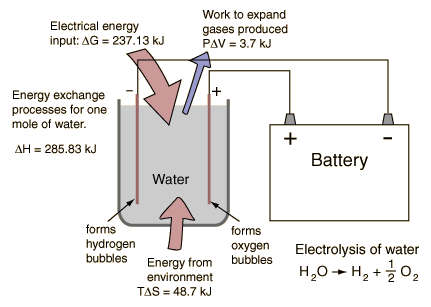
electrol.gif


http://hyperphysics.phy-astr.gsu.edu/hbase/thermo/electrol.html
 

Toolhorder

Well-known member
Joined
Nov 9, 2009
Messages
5,711
Location
Montana
I don't get people that try these things. Do they not know that car companies spend millions on R&D to get the best MPG they can to meet CAFE standards already? If they worked they would be on the car from the factory.
 
OP
B

bookittyrun

Well-known member
Joined
Jul 16, 2012
Messages
96
Location
hiding in your closet...

ok... but assuming i can understand the weird math and chemistry shown, is like assuming i understand women... i get the pictures, don't know how to interpret the rest... i'm not saying i'm uneducated in any way, but my brain comprehends things like shapes and spacial relationships, just not numbers... some of you may be able to interpret this? i do understand that running the energy from the car, to make the hydrogen robs engine efficiency, but it can't be much more than installing a "bumping" stereo system. some guys add a second battery and alternator for these extreme types of systems, never have i heard of needing a secondary alternator to operate hydrogen boosters, to relieve strain from the stock electrical system.

I don't get people that try these things. Do they not know that car companies spend millions on R&D to get the best MPG they can to meet CAFE standards already? If they worked they would be on the car from the factory.

i find it interesting that if car manufacturers really spent that much time and money soley for the interest of fuel efficiency, 35-45mpg cars would have been standard years ago... i don't believe the (us) auto industry had a vested interest in fuel efficiencey until they were mandated to improve their numbers. japanese cars have traditionally always kicked our butts when it came to efficiency, our american corporate mentality has always been one of waste. forced air systems (turbo) increase fuel efficiency at minimal increase of cost and production, but has never been "standard" equipment... we're seeing it more now on production cars, as a means of meeting the newer mpg guidelines. i don't believe us automakers are on the side of "saving consumers money", or "protecting the enviroment"... it's just not the capitalist way. my air conditioner robs more power than not having a tune up, but this has nearly become standard equipment on most cars.

I find that most folks have no idea what the true intent of the booster is in terms of its effect on a typical internal combustion engine. As a result of this lack of understanding, people assume that just bolting one up and turning it on should immediately double your gas mileage and this just isn't true...

...Sorry for the long winded response. I hate seeing technology written off as **** when in fact the technology and theory behind it is sound, but the implementation is ****.

Here is a link to a university study on this very topic complete with test results.

http://www.panaceauniversity.org/Hydrogen Enriched Hydrocarbon Combustion.pdf

This is absolutly real technology when implemented correctly.

i deleted most of this quote to save space, but if you're reading this post, you may have read the entire "quoted" response already. the additional information you've provided piques my interest in the subject again (thanks for not explaining this with lots of weird math).

when you say you've done this with great success, how do you define "great success"?? what steps did you take to ensure this was economical for you? can you give some real-world feedback, not university studies?

remember guys, i originally posted asking if anyone had built and used a hydrogen booster... getting the same response from multiple members may have had me partially convinced at first, but if this board member has actually built a booster, and had success, i'd like to hear more. every other response has been based on non-implementation of this subject... except you, racingtadpole

i appreciate all levels of feedback!
 
Last edited:
OP
B

bookittyrun

Well-known member
Joined
Jul 16, 2012
Messages
96
Location
hiding in your closet...
i'd also like to add the following:

when i owned a diesel car, cost for a gallon of diesel was $1.09, while gas was almost double that. 48mpg at that price was beautiful. it had always been explained that diesel was less costly to manufacture, it was a less refined, more "dirty" fuel, which was why diesel engines require such different parameters to operate than gas engines, hence the price. about 6 months after i sold the car, the price of diesel went through the roof, costing much more than regular gas. i believe this happened at a time when operating a diesel vehicle was becoming more popular, as vw was eventually intoducing the "tdi" to america, and european diesel cars were becoming a more prevelant part of the us market. after diesel prices went up, companies using diesel vehicles for fleet service demanded justification, and things like ups and fedex, and other shipping companies going out of business became a very stark reality. it was then explained that diesel was now costing more to produce. i think the fuel companies saw an inevitable decline in revenue with diesel becoming more popular with the general public. to further this point, when cold weather would knock on the doorstep, gas prices would go up, being explained that "winter grade gas" was more expensive to produce. but in the warm weather, when prices continued to rise, it was explained that the summer grade gas was more expensive to produce. doesn't anyone remember the multiple billion dollar profits oil companies were posting at that time? the end cost to the consumer didn't match the price of crude. we all know how capitalism and politics work together... and this is not a debate over "republican and democrat"... perhaps hydrogen assisted performance will become standard over the next ten years... but i don't want to wait that long for some "oil company bribed, us auto engineer" to dictate when that will be...

emerging technology from small indedpendent organizations is always worth unbiased consideration... look at the current space program... while nasa did a good job of getting the ball rolling, having (only) government run programs mandate how much money, time, and resources it takes to do something, is a slap in the face for the average, small time entrepreneur. it was just a matter of time before someone was allowed to prove everyone wrong. i've worked government jobs, and i've seen firsthand the amout of waste that is considered acceptable by our government.

i'm out of breath... for now!
 
Last edited:
OP
B

bookittyrun

Well-known member
Joined
Jul 16, 2012
Messages
96
Location
hiding in your closet...
Sorry meant to say it's gains are snake oil. It doesn't take much to make hydrogen I've probably made a few liters in the last week with my rust removal electrolysis tank, but using it to supplement fuel does nothing if you have to create it in the first place!

Sent from my Galaxy Nexus using Tapatalk 2

do we all feel the same about electric vehicles? after all, these cars need to be charged...
 

Big-Foot

Well-known member
Joined
Jan 30, 2005
Messages
1,951
Location
Midlothian, TX
One the engine is operating in good tune - the Number 1 thing you can do to increase fuel economy is to inflate your tires to the max pressure on the sidewall (hot). And get the front end ( as well as rear end) aligned..

Note that the inflation pressure is what is recommended by the tire mfgr and may be 5 PSI less when not warmed up on the road.

Using cruise control helps some people, but actually hurts others. If you are out on the open highway, you can "surf" the hills as truckers do. Slowing slightly going up the hill and picking up momentum going down the other side. Make sure that you are not holding up traffic nor breaking speed limits.

I routinely break the EPA rating for fuel economy by a substantial margin (up to 10 MPG) just by observing a few things and driving consciously...

BTW. Re Hydrogen's burning faster than gasoline. I believe you are mistaken. If that were true, the octane rating of hydrogen would be substantially less than that of gasoline instead of the other way around.
 
To avoid these ads, REGISTER NOW!

geologist

Well-known member
Joined
Dec 14, 2011
Messages
5,326
do we all feel the same about electric vehicles? after all, these cars need to be charged...

The benefit of the electric car are sort of a toss up. Yes, it needs charged, but power plants run at a given capacity, especially during peak hours, so that (in theory) there is plenty of juice to go around. The problem with this is that some of that electricity is simply not consumed / subject to line loss, etc.

So, if a power plant produces 1,000,000 lbs of CO2 a year, and a gasoline car produces 2,000 lbs of CO2 a year, by switching to the electric car, there is an offset of 2,000 lbs of CO2. The problem is that if they ever become widely available and rival gas cars, eventually power plants will have to crank out more power to fill the demand, most likely in non-peak hours (people charging their car while they sleep). With that said, the power plant would end up producing more C02 and theoretically more than the gasoline car by itself due to various efficiencies from star to finish, etc.

As for diesel prices, diesel is THE alternative liquid fossil fuel because it can be derived (in a sense) from other feedstocks. For example, the Fischer–Tropsch process can be used to convert coal into viable diesel. The Karrick process has potential as well.

In the Karrick process, 1 short ton of coal yields up to 1 barrel of oils and coal tars (12% by weight), and produces 3,000 cubic feet (85 m³) of rich coal gas and 1,500 pounds (680 kg) of solid smokeless char or semi-coke (for one metric ton, 0.175 m³ of oils and coal tars, 95 m³ of gas, and 750 kg of semi-coke). Yields by volume of approximately 25% gasoline, 10% kerosene and 20% good quality fuel oil are obtainable from coal. Gasoline obtained from coal by the Karrick process combined with cracking and refining is equal in quality to tetraethyl lead gasolines. More power is developed in internal combustion engines and an increase in fuel economy of approximately 20% is obtainable under identical operating conditions.

Unfortunately, the EPA kneecapped diesel with ultra low sulfur and emissions requirements.
 

kmacht

Well-known member
Joined
Apr 12, 2010
Messages
2,769
Location
Connecticut
Here is a link to a university study on this very topic complete with test results.

http://www.panaceauniversity.org/Hydrogen Enriched Hydrocarbon Combustion.pdf

This is absolutly real technology when implemented correctly.


How about a real source of information. A publication from "panecea" university isn't really relavant. A quick google search shows panacea university is actually a non-profit organization. It isn't an accredited university. It doesn't even appear to offer a degree in anything. Its sole purpose appears to be to promote different forms of snake oil as "research projects". Any serious research paper that has links to yahoo groups and youtube can't be taken seriously.

Keith
 

Lotek

Well-known member
Joined
Dec 9, 2007
Messages
9,098
Location
Los Angeles, Ca.
Snake oil... Direct from Spencyg's cite.
Performance of a commercial electrolysis unit that
produces 6.7 ml/s at 169 W was assumed as the
baseline for on-board hydrogen production [7]. It was
assumed that electrolysis products contain only
hydrogen and oxygen, no radicals. Also, no timing
adjustments were made in this setup to optimize
performance. This study concluded that an electrolysis
unit would not provide enough performance increase to
offset the energy required to run the electrolysis process


Yes hydrogen has a potential as a fuel or component of a fuel mixture, but the system needs to be designed for it, the safety concerns must be met, and above all it must produce more power than it consumes. The **** that is advertised on the internet fails on all accounts.
 

geologist

Well-known member
Joined
Dec 14, 2011
Messages
5,326
Hydrogen has been called one of the least efficient and most expensive possible replacements for gasoline (petrol) in terms of reducing greenhouse gases; other technologies may be less expensive and more quickly implemented. A comprehensive study of hydrogen in transportation applications has found that "there are major hurdles on the path to achieving the vision of the hydrogen economy; the path will not be simple or straightforward". Although Ford Motor Company and French Renault-Nissan cancelled their hydrogen car R&D efforts in 2008 and 2009, respectively, they signed a 2009 letter of intent with the other manufacturers and Now GMBH in September 2009 supporting the commercial introduction of FCVs by 2015.

An accounting of the energy utilized during a thermodynamic process, known as an energy balance, can be applied to automotive fuels. With today's technology, the manufacture of hydrogen via steam reforming can be accomplished with a thermal efficiency of 75 to 80 percent. Additional energy will be required to liquefy or compress the hydrogen, and to transport it to the filling station via truck or pipeline. The energy that must be utilized per kilogram to produce, transport and deliver hydrogen (i.e., its well-to-tank energy use) is approximately 50 megajoules using technology available in 2004. Subtracting this energy from the enthalpy of one kilogram of hydrogen, which is 141 megajoules, and dividing by the enthalpy, yields a thermal energy efficiency of roughly 60%. Gasoline, by comparison, requires less energy input, per gallon, at the refinery, and comparatively little energy is required to transport it and store it owing to its high energy density per gallon at ambient temperatures. Well-to-tank, the supply chain for gasoline is roughly 80% efficient (Wang, 2002). The most efficient distribution however is electrical, which is typically 95% efficient. Electric vehicles are typically 3 to 4 times as efficient as hydrogen powered vehicles.

640px-Battery_EV_vs._Hydrogen_EV.png


A study of the well-to-wheels efficiency of hydrogen vehicles compared to other vehicles in the Norwegian energy system indicates that hydrogen fuel-cell vehicles tend to be about a third as efficient as EVs when electrolysis is used, with hydrogen Internal Combustion Engines (ICE) being barely a sixth as efficient. Even in the case where hydrogen fuel cells get their hydrogen from natural gas reformation rather than electrolysis, and EVs get their power from a natural gas power plant, the EVs still come out ahead 35% to 25% (and only 13% for a H2 ICE). This compares to 14% for a gasoline ICE, 27% for a gasoline ICE hybrid, and 17% for a diesel ICE, also on a well-to-wheels basis.
 

ZRX61

Well-known member
Joined
Aug 15, 2006
Messages
28,716
Location
Solar Blight Valley, SoCal
Car manufacturers have to double their average fuel economy in the next 10 years.

That's easy, all they have to do is get rid of the insane EPA/DOT regulations that prevent diesel versions of all the popular Japanese/Euro vehicles that get 60mpg from being sold here.

They could double the MPG as soon as a boat load of those vehicles gets here... My parents full size Audi station wagon gets 60mpg.
 
OP
B

bookittyrun

Well-known member
Joined
Jul 16, 2012
Messages
96
Location
hiding in your closet...
this continues to be interesting... and thanks for keeping it closer to "layman's terms" for me... while i'm here, i'd like to apologize for the rant earlier, too. but right now, my belly is full from a sushi dinner, and all is right in my world again.

but one thing... i'm not interested in converting my vehicle to a purely hydrogen powered car, the interest was in hydrogen's possible ability to help gas combustion happen more efficiently... yes, a tune up is of utmost importance, and tire pressure, alignment, weight (almost never put more than 1/3-1/2 tank of gas in at a time... every pound helps, right? besides, filling this car all at once hurts! better to be less shocked more often, than really shocked all at once!)... these are all factors that come into play. where did the guy go, who was all for this? racingtadpole, did you make other modifications to your vehicle when you tried this out? things like changing the timing are a little beyond my capabilities, not set up to reprogram the ecu (if possible). i wish i had an older, more adjustable "secondary" car to try this stuff out firsthand. but secondary car and tinker money goes into fuel and payments for my current "whip".

ok, so i think i may be ready to concede... unless there is someone else out there, who has done this, and can explain the steps they took to make it work (for current, later model vehicles), and justify the investment with an increase in mpg numbers... the jury may stand at... bullsheet.

thanks, guys.
 

Imperial Dealer

New member
Joined
May 7, 2012
Messages
2
Location
Leduc, Alberta, Canada
If you want better mileage and you are having a problem with the stock exhaust, replace the stock manifold with a new set of headers (Doug Thorley makes them for your ride) and a new cat back exhaust system. Next replace the air box with a new cold air intake.

These are traditionally the first engine up grades that you make to get more efficiency (read horsepower) If you do not use the efficiency for going faster you will get better gas mileage.

As for Hydrogen, remember the Hindenburg? Don’t even think about it unless you are a rocket scientist.
 
OP
B

bookittyrun

Well-known member
Joined
Jul 16, 2012
Messages
96
Location
hiding in your closet...
If you want better mileage and you are having a problem with the stock exhaust, replace the stock manifold with a new set of headers (Doug Thorley makes them for your ride) and a new cat back exhaust system. Next replace the air box with a new cold air intake.

These are traditionally the first engine up grades that you make to get more efficiency (read horsepower) If you do not use the efficiency for going faster you will get better gas mileage...

good advice...

Awe, it isn't that bad...you'd put your eye out anyway. :D

:lol: makes me want to wear some pink bunny pajamas...

done with this thread, thanks everyone for the feedback!
 

Lotek

Well-known member
Joined
Dec 9, 2007
Messages
9,098
Location
Los Angeles, Ca.
Just as an aside, it always makes me shake my head when someone posts to defend a position, then when the majority seems to be leaning the other way, deletes all his posts and runs away. Have the courage of your convictions and defend your position, nothing wrong with a spirited discussion. Grow a pair.
 

Lotek

Well-known member
Joined
Dec 9, 2007
Messages
9,098
Location
Los Angeles, Ca.
Maybe he came to his senses, and realized he was betting on the wrong horse.

Iirc, last post before it was deleted was along the lines of calling us a bunch of philistines not worthy of his intellect, but as I was taping up the scrapes on my knuckles at the time, I could be mistaken. :bounce:

But seriously, I don't take anyone's word as writ, not even my own. I like to think I'm well read and good at what I do, but I'm always willing to debate an issue and change my mind if proven wrong, or at least agree to disagree if there is a grey area. There are those who think one should post one's opinion and move on...but I disagree. :D
 
Last edited:

rsanter

Well-known member
Joined
Dec 22, 2007
Messages
18,506
Location
visalia ca
A short answer to this is that it takes more energy to split water into its componets that you will get back when you burn the hydrogen or when you recombine the elements.
Hydrogen is not actually a fuel due to what I sain above. It a storage media

Bob
 

spongerich

Well-known member
Joined
Apr 17, 2010
Messages
2,339
Location
Monroe, NY
Probably won't help in the short term, but when your tires are ready for replacement, you should look into finding the lightest tires with the lowest rolling resistance you can find.
 

sberry

Banned
Joined
Jun 18, 2005
Messages
35,747
Location
Brethren, Michigan
A little logic says that with millions of people,,, of all types, billions of dollars, if it was easy as some gimmick, especially one kept secret just for you, tossing 25$ worth of pvc on a car would work wonders everyone would do it, I know some bright people buy into that concept despite defying general reasoning that it doesn't work.
 

sberry

Banned
Joined
Jun 18, 2005
Messages
35,747
Location
Brethren, Michigan
Even some conventional fixes are not worth the effort, many are rated at WOT, no point in adding hundreds or 1000's to save 200 in fuel over the life of the unit. On occasion a blind squirrel finds a nut, some models, some cases maybe something can be done but as a whole its a waste of effort that ranks right up there with financing a new car to save a little on gas or to improve trade in value.
 

Spencyg

Active member
Joined
Mar 25, 2009
Messages
40
It just wasn't a fight worth fighting. I'm not interested in changing minds and would rather my online presence not be associated with squabbles.


No need to look into my involvement in this thread further than that.
 
Last edited:

adam728

Well-known member
Joined
Aug 9, 2009
Messages
2,900
Location
Michigan
BTW. Re Hydrogen's burning faster than gasoline. I believe you are mistaken. If that were true, the octane rating of hydrogen would be substantially less than that of gasoline instead of the other way around.

Hydrogen has a flame front speed approximately 10 times faster than gasoline, and an octane rating of roughly 130 RON. Octane and burn rate are completely independent properties, despite what many on the internet claim.
 
To avoid these ads, REGISTER NOW!
Top Bottom