To avoid these ads, REGISTER NOW!

Anyone have a Bridgeport rebuilt?

To avoid these ads, REGISTER NOW!
OP
A

alfadan

Well-known member
Joined
Mar 9, 2007
Messages
2,141
Location
Augusta, ks
The more I study on scraping, the more I'm reminded of "...a man's got to know his limitations"

Seriously, I think I'll give it a try some day, on something like a spare cross slide I have for my lathe; but a full machine is not likely!
 

Firebrick43

Well-known member
Joined
May 12, 2015
Messages
14,407
Location
West central Indiana
Agree with everything you said. Unlucky with the H&W rebuilds. I haven’t purchased that service from them. I can tell from their videos they are continuing to improve their services so….sorry about that. I would not disregard the whole company based on that.

That’s a TIGHT tolerance. I would specify something like that only on a reamed hole. Really a Bridgeport is a +/-.005” machine. If that’s your expectation, I can see why a Bridgeport will disappoint (compared to a Swiss made SIP for example). If that’s your frame of reference. Here’s mine:

In the old days we assumed +/-.010” for machined part tolerances. A bridgeport can do that all day long.

If you were designing tools (for assembly jigs etc) we would typically use 1/3 the production part tolerance. For assemblies our tolerances used to be around +/-.030”.
That is production pin bore tolerances for a large diesel connecting rod tolerance in the 3”/75mm diameter range for diameter, straightness, and parallelism. PVD insert in boring head.

Crank bore tolerance were 13 micron +\-

Hell TP on holes of a 20’ long block were 20 or 25 microns +\- depending on which hole.

SIP, Moore, devligs, bridgeports were in toolroom making replacement parts for the CNC machines(many were custom machines) and fixturing.

Other employer made automotive camshafts. Most of their tolerances were around 10-15 microns but cam lobe profiles could be as low as 3 microns especially on the back side do to NVH demands.


This is all a reasonable expectation for a decent condition bridgeport mill with a skilled machinist driving it.

BTW: I reject the “NASA” or “space shuttle” tolerances comments. When the discussion of tolerances comes up, invariably, someone says something about “working for NASA”. ETC. I HAVE worked for NASA and I’ve designed spacecraft parts and the tolerances aren’t tighter than normal.
Never worked to a .010”/254 micron tolerance in my life. Our rough forging suppliers could come close to those tolerances. When making a special service tool or similar and I work to a .001 or .0015 tolerance I feel like a knuckle dragging millwright

What exactly were you making? Starliner capsule helium system components?
 
Last edited:

paulsomlo

Well-known member
Joined
Jul 16, 2013
Messages
3,951
Location
Northern Colorado
Ironically, "Babin Machine" seems completely unrelated to Al Babin. I see Al's ads all the time on craigslist in my area.
"Ali Babin" and Babin Machine are two very different entities. Babin Machine has a good reputation and you'll pay for that; I'm sure that "Ali Babin" will sell you a "rebuilt" a Bridgeport, but what you'll get is a half assed cleaning and spray paint.
 

Cruzan80

Well-known member
Joined
Jul 22, 2015
Messages
4,436
Location
Denver, CO
I know one of of the other teachers at our CTE facility is using Haas Mills with the students, and they are making parts for the Artemis missions (some kind of bracket holder thingy). IIRC, he told me they are spec'ed to -0, +.0015 tolerance (+ could be tighter, remembered he told me it was -0). He said the hardest part for students to wrap their minds around was the QC afterwards to make sure they met tolerances. In their minds initially, since it is all CNC, it should be correct if they built it correctly in CAD.
 

AEAdam

Well-known member
Joined
May 27, 2023
Messages
2,886
Location
SE PA
I know one of of the other teachers at our CTE facility is using Haas Mills with the students, and they are making parts for the Artemis missions (some kind of bracket holder thingy). IIRC, he told me they are spec'ed to -0, +.0015 tolerance (+ could be tighter, remembered he told me it was -0). He said the hardest part for students to wrap their minds around was the QC afterwards to make sure they met tolerances. In their minds initially, since it is all CNC, it should be correct if they built it correctly in CAD.
The tolerances you guys are talking about are really beyond reasonable expectations of the Series I Bridgeport. If that's your version of "good", the Bridgeport is not for you.

I just replaced my spindle bearings and rechecked the runout of my R8 taper. Corrosion in the taper gave me some funny readings, but I held the original run-out of around .0002-.0003" TIR with new, high quality spindle bearings. Everything I put in that taper, adds to the runout, and any extension beyond the spindle nose multiples it. With a good drill chuck or a boring bar, my spindle can produce pretty accurate holes. But order of magnitude, thousandths, not tenths of accuracy. For a machined feature like a stiffener, step etc, even scraped machines propbably wouldn't do too much better than 5 thou repeatedly.

The problem with the rebuilders is, people who make money with milling machines don't use Bridgeports. They use CNCs. People who run Bridgeports enthusiastically or part time, can't justify a $10,000 repair bill. There's no business case for that, since you can buy a Taiwan mill for that. So the rebuilders are stuck trying to offer a service at a price attractive to customers. Then we trash them for it.

Some on PracticalMachinist for example, claim unscraped machines aren't "true rebuilds" or "refurbed" or whatever, because in their minds, the only acceptable BP is a scraped/blueprinted one. Everything else is worthless trash.

The reality of old machinery is that one doesn't need a perfect machine to make an acceptable part. Improving the machine's capability can be complicated for sure.

My advice to the OP is find a scraper, and ship that person the knee and the saddle. Try to source a new table. Should be less than $2000 for the table. Could be $3000 for the knee and saddle. COuld probably get away with just doing the top of the knee. Then clean, paint, and reassemble the rest of the machine and especially the head. Cleaning does an awful lot of good.
 

Cruzan80

Well-known member
Joined
Jul 22, 2015
Messages
4,436
Location
Denver, CO
The tolerances you guys are talking about are really beyond reasonable expectations of the Series I Bridgeport. If that's your version of "good", the Bridgeport is not for you.
I wasn't talking about the students using BP, or whether a Series 1 could hold that tolerance. I was simply putting it out there for what hurdles students had to overcome mentally. Or did you miss the part where I said Haas CNC mills?

I have an import Series 1, and original QC has spindle nose, taper and test-bar all at .005, and test bar 300mm out at .02. So I understand the limitations.
 
OP
A

alfadan

Well-known member
Joined
Mar 9, 2007
Messages
2,141
Location
Augusta, ks
I know some don't like them, but H&W says $4500 for a bottom end rebuild with table top truing and paint. Column can be done for 1500 more, though they rarely have to do them supposedly. Full machine for 10k, though I think I can do that myself maybe at a later time. Around 500 bucks freight and I have to go to a shipping center to send and receive it.

At this point that seems ok. I'm wondering about scraping a little on the column just for oil retention, as a hobby machine I'm not terribly sure it's accuracy is terribly important for anything I'd do.


Then again, those new Wells-Index machines sure look pretty...
 

AEAdam

Well-known member
Joined
May 27, 2023
Messages
2,886
Location
SE PA
I know some don't like them, but H&W says $4500 for a bottom end rebuild with table top truing and paint. Column can be done for 1500 more, though they rarely have to do them supposedly. Full machine for 10k, though I think I can do that myself maybe at a later time. Around 500 bucks freight and I have to go to a shipping center to send and receive it.

At this point that seems ok. I'm wondering about scraping a little on the column just for oil retention, as a hobby machine I'm not terribly sure it's accuracy is terribly important for anything I'd do.


Then again, those new Wells-Index machines sure look pretty...
How does that work? Do you just ship the knee and table or whole machine?
 
OP
A

alfadan

Well-known member
Joined
Mar 9, 2007
Messages
2,141
Location
Augusta, ks
How does that work? Do you just ship the knee and table or whole machine?
Yes. she was just giving 'standard prices' but if I go with them I'll inquire as to discounts based on already having new leadscrews and nuts. The shipping part is a major part of my conundrum. I can't seem to find anything on forums about "I did this and this and this" on how to do it. I will say the ladies were very patient and I'm sure would help with all that.
 

Firebrick43

Well-known member
Joined
May 12, 2015
Messages
14,407
Location
West central Indiana
I know some don't like them, but H&W says $4500 for a bottom end rebuild with table top truing and paint. Column can be done for 1500 more, though they rarely have to do them supposedly. Full machine for 10k, though I think I can do that myself maybe at a later time. Around 500 bucks freight and I have to go to a shipping center to send and receive it.

At this point that seems ok. I'm wondering about scraping a little on the column just for oil retention, as a hobby machine I'm not terribly sure it's accuracy is terribly important for anything I'd do.


Then again, those new Wells-Index machines sure look pretty...
There is two types of scraping performed on a bridgeport. The standard scraping which is used mainly to establish the machine geometry. There is no pattern to it as it comes from all angles and is the removing of bluing which is high spots that rub against the master whether it be a camel back, ceramic square, or surface plate.

Then there is the flag scraping. This is done last and has the distinctive pattern that many are familiar with on Bridgeport's. It is for oil retention according to the manufacture. Its down after all geometry scraping is done with some artistic flare. You put the scraper handle to your chest and bump the lower side of your tool with the edge of your fist in a rhythmic motion. It has nothing to do with geometry.

Very few of the large American machine manufacture and virtually none of the European manufactures did this final step. I think it was more to hide the relatively course points of contact per inch that Bridgeport did comparatively to other manufactures. We did not reproduce it as other companies had just as good of oil retention without the flagging. To reduce wear the best solution is to put a Bijur automatic multipoint lube system on them with a timer.

H&W will give you a decent paint job of the 4500 dollars, that performed that task with no issue. They just didn't do any of the important stuff such as the lube belt change mention earlier, or changing any of the wipers on any of the 4 machines, or Y/X axis scraping on the two Bridgeport's. On the other lathe(13" 70's leblond) they mound the Z axis DRO scale in a pathetic way that was at the very limits of the glass scale reader head which caused it to fail early as well.

I had heard stories from guys about them but never seen it first hand as the two factories I worked in refused to use them. When I was helping a little shop out with a spindle belt problem on a jakobson surface grinder(Not from H&W) they ask me to look at the lathe.

After finding several issues with it they had me go over the other 3 machines that were purchased at the same time. None of them were worn out trash, its just that they lied about what they had done to the machines. Well I guess the Colchester sort of was worn out trash after it lost its lube pump and took out the bearings. It had reportably been a fine lathe before that, and I believe it as I have operated one of the same era before hand. They have special spring loaded bearings that are difficult to impossible to source now days.
 
Last edited:
OP
A

alfadan

Well-known member
Joined
Mar 9, 2007
Messages
2,141
Location
Augusta, ks
There is two types of scraping performed on a bridgeport. The standard scraping which is used mainly to establish the machine geometry. There is no pattern to it as it comes from all angles and is the removing of bluing which is high spots that rub against the master whether it be a camel back, ceramic square, or surface plate.

Then there is the flag scraping. This is done last and has the distinctive pattern that many are familiar with on Bridgeport's. It is for oil retention according to the manufacture. Its down after all geometry scraping is done with some artistic flare. You put the scraper handle to your chest and bump the lower side of your tool with the edge of your fist in a rhythmic motion. It has nothing to do with geometry.

Very few of the large American machine manufacture and virtually none of the European manufactures did this final step. I think it was more to hide the relatively course points of contact per inch that Bridgeport did comparatively to other manufactures. We did not reproduce it as other companies had just as good of oil retention without the flagging. To reduce wear the best solution is to put a Bijur automatic multipoint lube system on them with a timer.

H&W will give you a decent paint job of the 4500 dollars, that performed that task with no issue. They just didn't do any of the important stuff such as the lube belt change mention earlier, or changing any of the wipers on any of the 4 machines, or Y/X axis scraping on the two Bridgeport's. On the other lathe(13" 70's leblond) they mound the Z axis DRO scale in a pathetic way that was at the very limits of the glass scale reader head which caused it to fail early as well.

I had heard stories from guys about them but never seen it first hand as the two factories I worked in refused to use them. When I was helping a little shop out with a spindle belt problem on a jakobson surface grinder(Not from H&W) they ask me to look at the lathe.

After finding several issues with it they had me go over the other 3 machines that were purchased at the same time. None of them were worn out trash, its just that they lied about what they had done to the machines. Well I guess the Colchester sort of was worn out trash after it lost its lube pump and took out the bearings. It had reportably been a fine lathe before that, and I believe it as I have operated one of the same era before hand. They have special spring loaded bearings that are difficult to impossible to source now days.
Thanks. I do appreciate your opinion, as well as everyone else. I'm far from doing anything yet and am still investigating.
 

AEAdam

Well-known member
Joined
May 27, 2023
Messages
2,886
Location
SE PA
Never heard the term “flag scraping”. I think more commonly this is know as “flaking” or sometimes “frosting”?

Could be wrong, but in my mind flaking is only about oil retention. I think there are machines where it is only present on top facing surfaces, not the bottom surface, (bottom of the saddle, bottom of the table). The mating surface of those machines are sometimes ground or planed. The flaking is typically 2-3 thou deep and provides a sort of reservoir for oil to lay.

I don’t know why people flake their table tops or especially table fronts. I think that looks ghetto. I would not have it and certainly wouldnt pay for it. My column is flaked. My guess is that has very limited functionality, being a vertical surface.

Just a drive by, due to the torque of bridgeports and that we typically run the motors in the same direction, column ways wear unevenly left to right. So touching up the back of the knee, while not a bad idea, isn’t a recipe for perfection.

one more: bridgeport knees almost always sag a little. Some guys scrape the back of the top of the knee, leaving the front untouched, such that there is a slight acute angle between the top of the knee and the column/spindle. I would want this discussed prior to the start of work.
 

Firebrick43

Well-known member
Joined
May 12, 2015
Messages
14,407
Location
West central Indiana
Never heard the term “flag scraping”. I think more commonly this is know as “flaking” or sometimes “frosting”?

Could be wrong, but in my mind flaking is only about oil retention. I think there are machines where it is only present on top facing surfaces, not the bottom surface, (bottom of the saddle, bottom of the table). The mating surface of those machines are sometimes ground or planed. The flaking is typically 2-3 thou deep and provides a sort of reservoir for oil to lay.

I don’t know why people flake their table tops or especially table fronts. I think that looks ghetto. I would not have it and certainly wouldnt pay for it. My column is flaked. My guess is that has very limited functionality, being a vertical surface.

Just a drive by, due to the torque of bridgeports and that we typically run the motors in the same direction, column ways wear unevenly left to right. So touching up the back of the knee, while not a bad idea, isn’t a recipe for perfection.

one more: bridgeport knees almost always sag a little. Some guys scrape the back of the top of the knee, leaving the front untouched, such that there is a slight acute angle between the top of the knee and the column/spindle. I would want this discussed prior to the start of work.
Multiple names for it. The contractors that help rebuild machines on shutdowns that pretty much was all they did for a living referee to it as flagging. Bump scraping, bump flaking, flaking are all terms for the same process. Each bump makes a little flag, and it’s repeated chaining them together


Our big German portals had all the attachments scraped into alignment to the ram and the factory guys from Germany referred to it as spotting in stead of scraping.
 

dutchgray

Well-known member
Joined
Sep 28, 2014
Messages
6,476
Location
Dorset. England.
After finding several issues with it they had me go over the other 3 machines that were purchased at the same time. None of them were worn out trash, its just that they lied about what they had done to the machines. Well I guess the Colchester sort of was worn out trash after it lost its lube pump and took out the bearings. It had reportably been a fine lathe before that, and I believe it as I have operated one of the same era before hand. They have special spring loaded bearings that are difficult to impossible to source now days.
Gamet taper roller precision spindle bearings, they were owned by the same group that owned Colchester lathes.
They supposedly used to match the roller diameters used in each bearing to 3 millionths of an inch, a replacement set of spindle bearings may well cost more than what a lathe in excellent condition is worth.

The "modern" Colchester's I have looked at (I owned a Master 2500 for a bit) the oil pump is driven by a single short V belt that runs from the motor to the pump in the base with a single sprung tensioner to keep it tight, it's in the base and almost never gets properly looked at for condition, gets covered in oil and dirt down there, the one on mine was falling apart when I got the machine.

The oil system when it's running is great, flows loads of oil, has a good capacity so it runs at a sensible temperature, but there is nothing really in the headstock, as its just runs out the bottom to the tank, so if the pump isn't turning the bearings don't get any oil.
 
OP
A

alfadan

Well-known member
Joined
Mar 9, 2007
Messages
2,141
Location
Augusta, ks
The oil system when it's running is great, flows loads of oil, has a good capacity so it runs at a sensible temperature, but there is nothing really in the headstock, as its just runs out the bottom to the tank, so if the pump isn't turning the bearings don't get any oil
You'd think machines like this would have a more foolproof method of oiling like a gear drive or even redundant pumps or pressure cutout system. Interesting.
 

Firebrick43

Well-known member
Joined
May 12, 2015
Messages
14,407
Location
West central Indiana
Gamet taper roller precision spindle bearings, they were owned by the same group that owned Colchester lathes.
They supposedly used to match the roller diameters used in each bearing to 3 millionths of an inch, a replacement set of spindle bearings may well cost more than what a lathe in excellent condition is worth.

The "modern" Colchester's I have looked at (I owned a Master 2500 for a bit) the oil pump is driven by a single short V belt that runs from the motor to the pump in the base with a single sprung tensioner to keep it tight, it's in the base and almost never gets properly looked at for condition, gets covered in oil and dirt down there, the one on mine was falling apart when I got the machine.

The oil system when it's running is great, flows loads of oil, has a good capacity so it runs at a sensible temperature, but there is nothing really in the headstock, as its just runs out the bottom to the tank, so if the pump isn't turning the bearings don't get any oil.
That is where the pump was and set up the same. This one had a round belt, the original appeared to be leather? It was very crusty

Motion industries has a reinforced neoprene round belt of proper diameter the next day.

They actually are still using the lathe to this day. They just use it as a power polishing centers. If you take a cut with it it leaves a wired resonance like finish but it’s due to the bearing damage. It does flow a metric **** tone of oil.

It’s a dam shame as it was a Goldilocks size lathe (13”) and while not the heaviest in its size class like a leblond tool room/Cincinnati/ or monarch was it had really nice controls and gear shifting. A pleasure to operate.
 

Firebrick43

Well-known member
Joined
May 12, 2015
Messages
14,407
Location
West central Indiana
You'd think machines like this would have a more foolproof method of oiling like a gear drive or even redundant pumps or pressure cutout system. Interesting.
They have a sight flow window so operators should catch it.

Afterwords I had an education session as to what the window was and that it should be checked at the start of use
 
To avoid these ads, REGISTER NOW!

dutchgray

Well-known member
Joined
Sep 28, 2014
Messages
6,476
Location
Dorset. England.
You'd think machines like this would have a more foolproof method of oiling like a gear drive or even redundant pumps or pressure cutout system. Interesting.
Colchester's were built to a price point.
They have a sight window the oil flows past, but many operators just use the machine, never check anything.
My Dean Smith and Grace has a cam operated pump, with a brace of magnetic filters to pick up metal fragments, an oil sight window so you can see it pump but best of all a pressure switch that lights a red light on the control panel if the pressure goes low.
But it was probably double the price when new (over double the weight too)

That is where the pump was and set up the same. This one had a round belt, the original appeared to be leather? It was very crusty

Motion industries has a reinforced neoprene round belt of proper diameter the next day.

They actually are still using the lathe to this day. They just use it as a power polishing centers. If you take a cut with it it leaves a wired resonance like finish but it’s due to the bearing damage. It does flow a metric **** tone of oil.

It’s a dam shame as it was a Goldilocks size lathe (13”) and while not the heaviest in its size class like a leblond tool room/Cincinnati/ or monarch was it had really nice controls and gear shifting. A pleasure to operate.
They are OK but nothing special as lathes go, but are easy to operate, it's no surprise that many design elements and features were widely copied, especially by the Asian manufacturers.
They are popular machines and sell well if you can get them at the right price there's money to be made on them.

On some of the bigger sizes the oil tank is also the coolant tank, with a centre divider welded in, they need to be checked often to make sure the coolant isn't leaking into the oil side.
 
OP
A

alfadan

Well-known member
Joined
Mar 9, 2007
Messages
2,141
Location
Augusta, ks
Update:

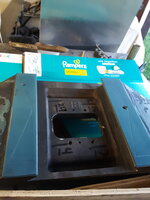
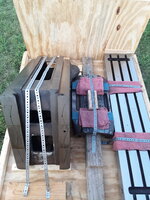
I had H&W machine regrind the knee, saddle, and table/regrind table top and sides. They applied turcite to the saddle and scraped the gibs. They supposedly have a known-good column standard to check the surfaces against. Total with freight both ways was 4,800 Spacebucks.

I haven't cleaned and assembled yet to measure anything yet. Stay tuned if anybody cares.View attachment 21720240827_195211.jpg3207[/ATTACH]
 

Attachments

  • 20240827_201807.jpg
    20240827_201807.jpg
    593.3 KB · Views: 32
  • 20240827_201819.jpg
    20240827_201819.jpg
    469.6 KB · Views: 32
  • 20240827_190334.jpg
    20240827_190334.jpg
    895.6 KB · Views: 30

AEAdam

Well-known member
Joined
May 27, 2023
Messages
2,886
Location
SE PA
Interesting that they ground the top of the knee. Didn’t even flake it? Did they offer to flake the top of the knee and you said no? Ground table looks amazing.

I think the picture you showed is Turcite on the bottom of the saddle. What about the top of the saddle? What did they do there?
 
OP
A

alfadan

Well-known member
Joined
Mar 9, 2007
Messages
2,141
Location
Augusta, ks
Interesting that they ground the top of the knee. Didn’t even flake it? Did they offer to flake the top of the knee and you said no? Ground table looks amazing.

I think the picture you showed is Turcite on the bottom of the saddle. What about the top of the saddle? What did they do there?


They did not offer to flake the knee. I am ok with that as long as the surfaces are fairly true. They were completely shot, with some deep scoring and wear. I should have taken before pictures. I will definitely oil the machine regularly, so the lack of flaking doesn't really bother me on this homeshop machine.

Table top is great as it someone must have used it for blacksmithing in the past. They used epoxy in the pock marks. There is turcite on the top and bottom of the saddle.
 

Firebrick43

Well-known member
Joined
May 12, 2015
Messages
14,407
Location
West central Indiana
They did not offer to flake the knee. I am ok with that as long as the surfaces are fairly true. They were completely shot, with some deep scoring and wear. I should have taken before pictures. I will definitely oil the machine regularly, so the lack of flaking doesn't really bother me on this homeshop machine.

Table top is great as it someone must have used it for blacksmithing in the past. They used epoxy in the pock marks. There is turcite on the top and bottom of the saddle.
Did they grind the turcite? Hard to tell by the pictures?
 

AEAdam

Well-known member
Joined
May 27, 2023
Messages
2,886
Location
SE PA
They did not offer to flake the knee. I am ok with that as long as the surfaces are fairly true. They were completely shot, with some deep scoring and wear. I should have taken before pictures. I will definitely oil the machine regularly, so the lack of flaking doesn't really bother me on this homeshop machine.

Table top is great as it someone must have used it for blacksmithing in the past. They used epoxy in the pock marks. There is turcite on the top and bottom of the saddle.
flaking helps with oil retention. I wonder if a different oil would make more sense for flat ways. What do the Hardinge HVL-H people use?
 
OP
A

alfadan

Well-known member
Joined
Mar 9, 2007
Messages
2,141
Location
Augusta, ks
Did they grind the turcite? Hard to tell by the pictures?
I don't really know as I'm not familiar with the process. I figured the surface would be ground flat, then the thin layer of turcite applied. How accurate in thickness is a piece of turcite?
 
OP
A

alfadan

Well-known member
Joined
Mar 9, 2007
Messages
2,141
Location
Augusta, ks
flaking helps with oil retention. I wonder if a different oil would make more sense for flat ways. What do the Hardinge HVL-H people use?
I use actual way oil so should be good I'd say. The ways of lathes, including mine are not flaked, but I'm probably talking out of my ****.
 

Firebrick43

Well-known member
Joined
May 12, 2015
Messages
14,407
Location
West central Indiana
I don't really know as I'm not familiar with the process. I figured the surface would be ground flat, then the thin layer of turcite applied. How accurate in thickness is a piece of turcite?
its not very accurate, due to the glue mainly. Their is another product called moglice where the parts are positioned correctly, a damn is built, and the moglice is pumped into the cavity.

It doesn't need hand scraped or ground but turcite and rulon which are sheet products do. I can tell without a doubt it wasn't scraped.

I have never seen turcite/rulon ground but according to the spec sheet it can be.
 
Last edited:

dutchgray

Well-known member
Joined
Sep 28, 2014
Messages
6,476
Location
Dorset. England.
I use actual way oil so should be good I'd say. The ways of lathes, including mine are not flaked, but I'm probably talking out of my ****.
On any quality lathe the underside of the saddle would have been scraped and flaked, plus one side of the other ways.

Generally speaking on a horizontal machine surface you should flake the underside of the top part rather than the top of the bottom part like Bridgeport does, but then it wouldn't be visible on the knee top.
 

AEAdam

Well-known member
Joined
May 27, 2023
Messages
2,886
Location
SE PA
I think I would ask Barry at H&W what he thinks. It could be what is good in theory doesn't make a hill of beans difference on a 20+ yr old bridgeport. He should know.

Failing that, I might choose an oil with tackifiers or even grease? If it was my mill, I'd give flaking a try. I think you can scrape Turcite just like iron. I think it would be difficult to screw up, even if it wasn't pretty, I would think anything would help.
 

Firebrick43

Well-known member
Joined
May 12, 2015
Messages
14,407
Location
West central Indiana
I think I would ask Barry at H&W what he thinks. It could be what is good in theory doesn't make a hill of beans difference on a 20+ yr old bridgeport. He should know.

Failing that, I might choose an oil with tackifiers or even grease? If it was my mill, I'd give flaking a try. I think you can scrape Turcite just like iron. I think it would be difficult to screw up, even if it wasn't pretty, I would think anything would help.
You can scrape turcite, we did all the time. It actually scrapes really easy. You need a sharper knife edge scraper with a radius and it takes very little pressure or effort. You can gouge it or take to heavy of cuts if you apply as much pressure as cast iron. We never did apply flaking to turcite or rulon because it holds oil just fine with regulars scraping. We just scraped it to properly flatten and in the case of tapered gibs bring out the correct geometry.
 

AEAdam

Well-known member
Joined
May 27, 2023
Messages
2,886
Location
SE PA
You can scrape turcite, we did all the time. It actually scrapes really easy. You need a sharper knife edge scraper with a radius and it takes very little pressure or effort. You can gouge it or take to heavy of cuts if you apply as much pressure as cast iron. We never did apply flaking to turcite or rulon because it holds oil just fine with regulars scraping. We just scraped it to properly flatten and in the case of tapered gibs bring out the correct geometry.
Would you even bother with a surface plate or just take a pass one way then the other, and call it quits? You could probably keep your lines spread apart to make a sort of checkerboard. You just need a few thou to trap oil and crud.
 

Firebrick43

Well-known member
Joined
May 12, 2015
Messages
14,407
Location
West central Indiana
Any 68 iso grade way oil from a reputable supplier is appropriate for most plain way machines. They all have tackifiers in them. Vactra 2 is the most common around here with vistac 68 a distant second but that is more from excellent Mobil dealers and saleman than anything.

We only had a few monster machines that used vactra 4

Turcite and rulon have some excellent properties as they dampen well and has decent life typically without wearing the other surface.

We had some large older CNC machines(G&L) that we swapped rulon tapered gibs every winter shut down. We had an extra set which gave us enough time to apply new rulon and scrape in that it was a 1 shift job to pull and replace the gibs and replace the wipers and chip shield/plows. The hardened steel box ways were 30 years old and never been reground.

The one big down side is that is soft and the way wipers must be kept up. If they are not, chips and grit can easily embed in the soft material and do serious damage as it cant escape with movement and additional lube.
 

Firebrick43

Well-known member
Joined
May 12, 2015
Messages
14,407
Location
West central Indiana
Would you even bother with a surface plate or just take a pass one way then the other, and call it quits? You could probably keep your lines spread apart to make a sort of checkerboard. You just need a few thou to trap oil and crud.
I assume and am going with the fact that we are talking about the turcite. I personally would check by bluing on a surface plate for flatness. If it isn't flat and it never was after being glued, we just scraped to a 2-3 spot per cm Rulon and turcite are actually ok to be ground flat due to the way the material itself traps oil. Problem is few grinders grind truly flat over a distance unless new/recently rebuilt and have a good operator.

Screenshot 2024-08-28 163751.png

Above is from the turcite sell/spec sheet.

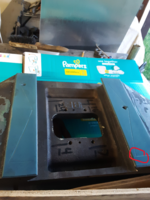
I do see an issue with the little area circled in red. The oil distribution grooves shouldn't ever come to daylight. Its hard to tell but its awful close.


0n5bica9.png
 
OP
A

alfadan

Well-known member
Joined
Mar 9, 2007
Messages
2,141
Location
Augusta, ks
I assume and am going with the fact that we are talking about the turcite. I personally would check by bluing on a surface plate for flatness. If it isn't flat and it never was after being glued, we just scraped to a 2-3 spot per cm Rulon and turcite are actually ok to be ground flat due to the way the material itself traps oil. Problem is few grinders grind truly flat over a distance unless new/recently rebuilt and have a good operator.

Screenshot 2024-08-28 163751.png

Above is from the turcite sell/spec sheet.

I do see an issue with the little area circled in red. The oil distribution grooves shouldn't ever come to daylight. Its hard to tell but its awful close.


0n5bica9.png
I went out to look at that spot. It does justttt peak through, though it is much shallower than the rest of the oil groove. I'm not sure I will lose much sleep over it. The whole surface does appear to be ground. Before assembly I will put it on my surface place and measure.

Wipers will definitely be maintained. They are cheap.
 
To avoid these ads, REGISTER NOW!
Top Bottom